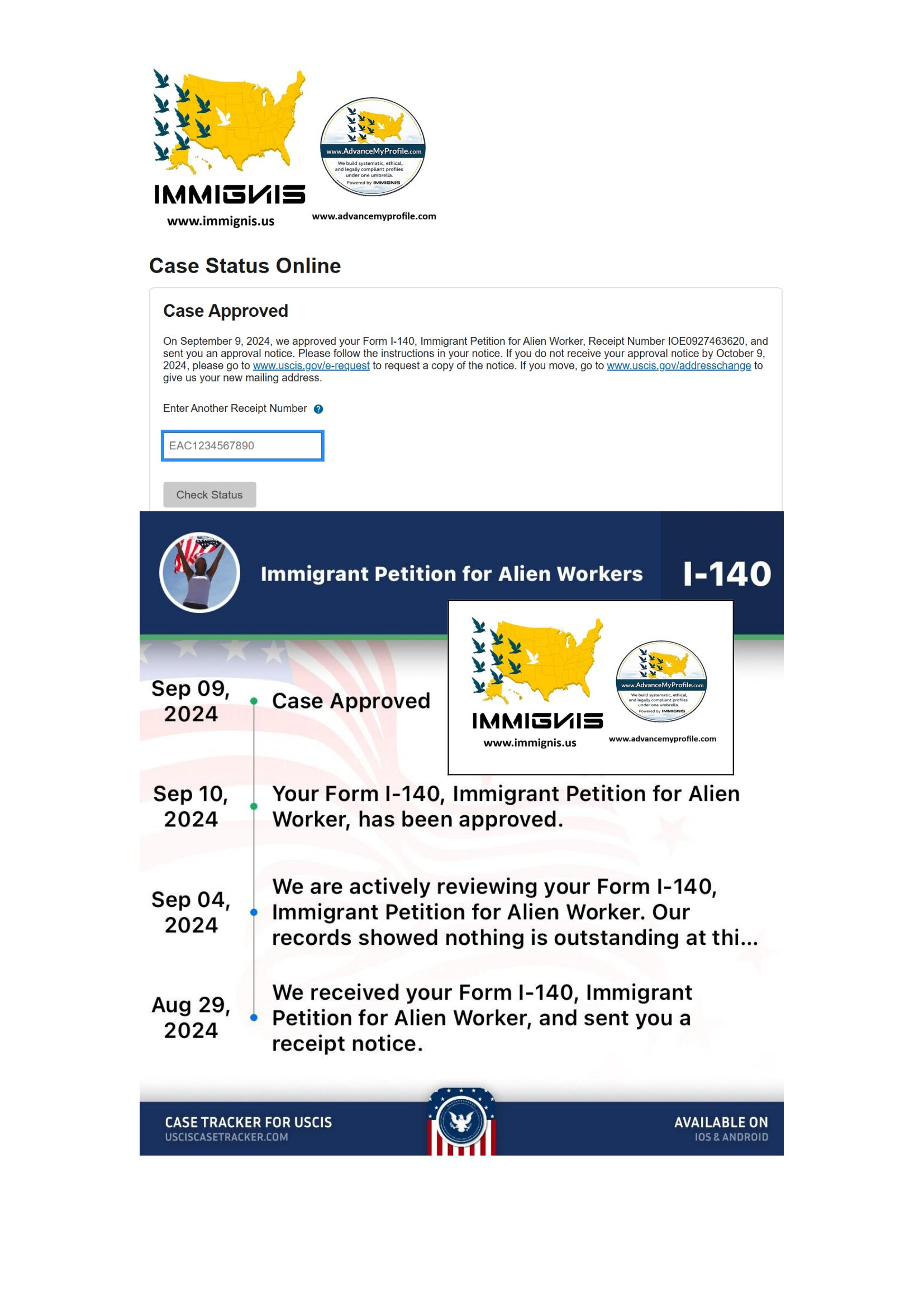
EB-1A for Master Distillers explains how an Irish master distiller secured approval by turning cask-development authorship, product-award attribution, person-focused spirits coverage, international competition judging, distilling-institute standing, and documented market response into a personal record of extraordinary ability.
Key facts at a glance
| Petition outcome | Form I-140 approved under EB-1A on September 09, 2024. |
| Professional profile | Irish master distiller whose maturation and cask-development work contributed to acclaimed whiskey releases during the category’s international revival. |
| Field niche | Whiskey maturation science and category innovation. |
| Starting weakness | The brands and bottles carried the public recognition, while the distiller’s technical authorship was reduced to a signature, a short biography, or no visible credit at all. |
| Profile-building focus | Producer-cleared attribution letters, maturation-method documentation, product-award records, person-focused spirits coverage, international competition judging, distilling-institute credentials, masterclasses, and commercial-performance evidence. |
| Principal EB-1A evidence areas developed | Original contributions, nationally or internationally recognized prizes or awards, judging the work of others, and published material about the petitioner, supported by documented product performance and industry reliance. |
| Central issue | Showing that the petitioner did more than represent successful whiskey brands: the petitioner personally shaped maturation decisions and cask programs that influenced recognized products and wider industry practice. |
| Approval lesson | In prestige industries built around brand names, EB-1A evidence becomes stronger when confidential technical authorship, independent recognition, peer judging, and market response are traced back to the individual without mischaracterizing product success as personal acclaim. |
The bottle carried the name. The maturation system did not.
A whiskey bottle tells a carefully controlled story. The label names the brand, the distillery, the age statement, the cask expression, and sometimes the master distiller. What it rarely shows is the chain of decisions behind the liquid: wood selection, previous cask use, cooperage specifications, toasting or charring choices, warehouse placement, sampling intervals, finishing strategy, blending thresholds, and the point at which a spirit is ready to release.
That gap shaped this case. The petitioner had helped develop cask and maturation approaches associated with highly regarded products, but the initial record looked like a collection of brand achievements. Awards belonged to bottles. Sales belonged to companies. Press coverage described a category revival. The person who made the technical choices appeared only briefly, or not at all.
USCIS approved the Form I-140 petition on September 09, 2024. Immignis and Advance My Profile built the case around attribution. The strategy did not claim that one distiller created an entire category or single-handedly produced every successful release. It identified the petitioner’s decisions, methods, responsibilities, peer recognition, and documented influence inside a collaborative commercial environment.
Why luxury and heritage industries can hide extraordinary ability
Whiskey is produced through teams and institutions. Distillers, blenders, coopers, warehouse managers, sensory panels, quality laboratories, production staff, brand teams, distributors, and commercial leaders all contribute. The finished product is marketed through a house identity, and that identity is designed to remain more visible than any one employee.
For an EB-1A petition, brand prestige and personal acclaim are not interchangeable. A famous bottle does not prove that every person connected to it worked at the top of the field. A master-distiller title does not, by itself, explain what the person originated. Strong sales do not identify the technical cause of success. The record had to separate the petitioner’s work from the company story while remaining accurate about collaboration.
The profile-building process therefore began with questions that ordinary marketing materials do not answer. Who designed the maturation trial? Who selected or rejected cask types? Who established the sensory and quality thresholds? Who authorized a finishing sequence? Who solved inconsistency, extraction, oxidation, sulfur, tannin, or balance problems? Who trained other professionals to apply the method? Those answers turned a brand narrative into a person-centered professional record.
The field was defined as whiskey maturation science and category innovation
The petition did not present the petitioner only as a chef-like craft professional or a general beverage executive. It defined the field as whiskey maturation science and category innovation. That description captured the technical and sensory work through which new-make spirit becomes a mature, stable, recognizable product.
The niche includes cask chemistry, wood-spirit interaction, extraction, oxidation, ester development, previous-fill effects, cooperage treatment, warehouse conditions, sampling, sensory evaluation, quality control, finishing, blending, product consistency, and the translation of experimental results into repeatable production decisions.
A precise field definition also helped USCIS understand how the profession recognizes distinction. In this niche, evidence may appear through attributed product innovation, awards linked to the person’s role, technical interviews, invitations to judge spirits, masterclasses, institute service, collector and trade response, and repeated reliance by respected producers. These are different from ordinary academic citation metrics, but they still require documentary proof and independent context.
Cask innovation had to be documented as authorship, not atmosphere
Cask language is common in whiskey marketing. Terms such as special finish, rare wood, limited release, and experimental maturation can sound impressive without identifying who created the approach or whether it changed practice. The petition therefore avoided treating promotional descriptions as proof of original contribution.
The record focused on method authorship. Cleared technical summaries, development timelines, trial records, tasting-panel documentation, release files, internal approvals, product briefs, and informed letters were used to show the petitioner’s role in designing, testing, refining, or scaling maturation approaches. Where precise formulas, suppliers, or commercial details remained confidential, the evidence explained the problem and the petitioner’s solution at a level that could be verified without exposing proprietary information.
This distinction mattered. The claim was not that using a particular cask was automatically original. The claim was that the petitioner made identifiable technical decisions that produced a repeatable result, solved a maturation problem, or created a product approach later relied upon by the producer or recognized by the field.
Producer-cleared attribution letters restored credit without breaching confidentiality
Attribution letters were central because much of the strongest work existed inside companies. The most useful letters did not simply call the petitioner talented or important. They identified the writer’s basis of knowledge, the product or program involved, the petitioner’s responsibility, the technical problem addressed, the decision made, and the significance of the result.
Company clearance also mattered. Whiskey producers protect supplier relationships, stock information, recipes, trial data, and release strategy. A letter that disclosed too much could create commercial risk; a letter that said too little would not help USCIS. The profile-building work aimed for a middle ground: enough detail to establish authorship and consequence, but no unsupported claim of sole ownership and no disclosure of restricted production information.
Independent letters from respected professionals then supplied field context. They explained why the maturation challenge was difficult, why the petitioner’s solution was not routine, and how the work compared with ordinary practice. Together, first-hand company evidence and independent expert analysis made the attribution more reliable.
Product awards were useful only after the personal role was proved
Spirits competitions create visible records of excellence, but most medals are awarded to products or producers rather than directly to the distiller. The petition did not assume that every medal won by a whiskey became the petitioner’s personal award.
Instead, the record separated two questions. First, did the petitioner personally receive a recognized prize or award for excellence? Second, where a product received the award, could the result still help corroborate the petitioner’s contribution? Award certificates, competition rules, judging panels, product descriptions, release timelines, company records, and attribution letters were reviewed together.
Where an award belonged to the bottle, it was used carefully as evidence that the product containing the petitioner’s documented work was independently recognized. Where the petitioner was personally named or honored, the petition analyzed whether the distinction met the regulatory awards criterion. This avoided a common error: converting every corporate accolade into a personal prize without evidence.
Commercial performance showed consequence, but it was not mislabeled as a separate criterion
Successful whiskey releases can produce meaningful evidence. Sales, allocation demand, repeat releases, export growth, auction or collector attention, distributor uptake, and continued use of a maturation concept may show that the work had commercial consequence. The case used such information when it could be tied to the petitioner’s documented contribution and placed in proper context.
The petition also maintained an important legal distinction. The EB-1A regulatory criterion for commercial success applies to the performing arts. A master distiller is not automatically a performing artist for that purpose. Product sales were therefore not presented as a standalone commercial-success criterion. They were used as corroborating evidence of adoption, impact, industry reliance, and final merits.
That treatment made the case more credible. Market evidence can be persuasive, but only after the record explains what the petitioner did, why the result was unusual, and how the commercial response relates to that work rather than to advertising spend, distribution power, brand heritage, scarcity, or broader market trends.
Spirits press had to focus on the distiller, not merely the release
Whiskey launches generate extensive publicity. Much of it is product copy, tasting notes, retailer material, or coverage of the brand. Published material for EB-1A requires a closer analysis. The strongest articles were independent pieces that discussed the petitioner, the petitioner’s work, and the professional role behind the product.
The profile-building strategy identified interviews, trade profiles, technical features, long-form release coverage, broadcast appearances, and specialist commentary that named the petitioner and explained the maturation decisions. It distinguished independent editorial material from sponsored content, press releases, rewritten brand copy, and brief mentions.
This person-focused coverage did two jobs. It supported the published-material criterion where the regulatory requirements were met, and it gave a non-specialist reader a clear account of why the petitioner’s work mattered. A technical career hidden inside warehouse records became understandable through credible public explanation.
Competition judging became formal peer evaluation
International spirits competitions supplied one of the cleanest forms of judging evidence. A competition that invites a professional to assess entries is asking that person to evaluate the work of other distillers, blenders, producers, and technical teams.
The record documented invitations, panel appointments, competition information, judging protocols, categories assessed, scoring duties, dates, and evidence that the petitioner completed the work. It also explained the professional level of the entries and why the organizers selected the petitioner.
Serving as a judge was not presented as a ceremonial hospitality role. The evidence showed actual evaluation of aroma, flavor, balance, maturity, defects, category compliance, and overall quality. That made the judging criterion natural to the field and easy to understand.
Institute credentials and masterclasses supported standing without being overclaimed
Distilling-institute credentials, technical memberships, masterclasses, and teaching appointments helped establish the petitioner’s professional environment. They showed sustained engagement with production science and the transfer of specialist knowledge to other professionals.
The petition did not assume that every paid membership or qualification satisfied the EB-1A membership criterion. Ordinary credentials generally show competence, not admission based on outstanding achievement judged by recognized experts. Where a selective fellowship, elected grade, committee appointment, or other distinction had qualifying standards, those standards were documented. Other credentials were used as supporting context.
Masterclasses were also evaluated for substance. Records showing that respected schools, institutes, festivals, or professional bodies invited the petitioner to teach advanced maturation topics helped demonstrate that the field sought the petitioner’s judgment, not merely the brand’s promotional presence.
Why this case worked
The petition succeeded because it solved an attribution problem before making an acclaim argument. It did not ask USCIS to infer extraordinary ability from an expensive bottle, a famous brand, or a category-wide revival. It built a chain from the petitioner’s technical decision to documented product use, independent recognition, peer judging, professional reliance, and market consequence.
The case also used different evidence for different purposes. Company records established the petitioner’s role. Independent experts explained field significance. Awards and press supplied external recognition. Judging showed peer trust. Commercial data corroborated impact. Institute and teaching records demonstrated sustained professional standing. No single item carried the entire case.
Most importantly, the presentation remained honest about teamwork. The petitioner was not described as the sole creator of Irish whiskey’s success. The evidence showed a specialist whose identifiable maturation work had become important within respected products and professional circles.
What other distillers and luxury-industry specialists can learn
Professionals in whiskey, wine, fragrance, watchmaking, fashion, culinary arts, product design, and other prestige industries often face the same problem: the house owns the public story. Their strongest achievements may appear under product names, brand campaigns, anonymous technical files, or team awards.
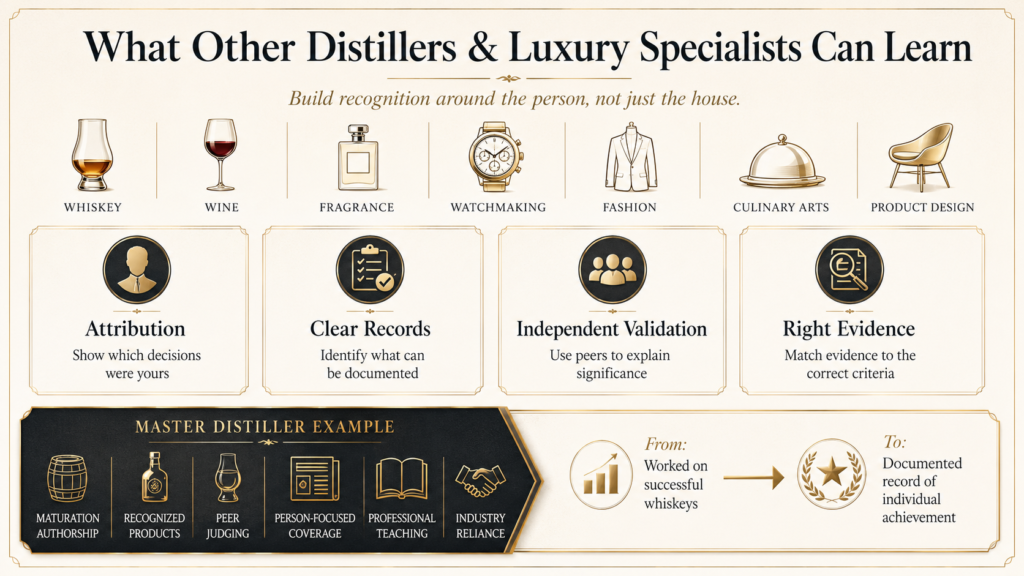
A useful profile-building strategy starts with attribution. It identifies which decisions belong to the person, which records can be cleared, which independent professionals can explain significance, and which public evidence is genuinely about the individual. It also distinguishes regulatory criteria from helpful supporting evidence instead of forcing every achievement into the wrong category.
For this master distiller, that meant moving from “worked on successful whiskeys” to a documented record of maturation authorship, recognized products, peer judging, person-focused coverage, professional teaching, and sustained industry reliance.
Frequently asked questions
Can a master distiller qualify for EB-1A?
Potentially. The person must satisfy the applicable evidentiary framework and, in the final assessment, show sustained national or international acclaim and standing among the small percentage at the top of the field. A title or famous employer alone is not enough.
Can whiskey product awards count as the distiller’s personal awards?
Sometimes, but not automatically. The evidence must show who received the award and how the competition recognized the petitioner. A product medal may corroborate the quality of work attributed to the distiller, but it should not be described as a personal prize without supporting documentation.
Can cask-development work support an original-contributions claim?
Yes, when the record establishes the petitioner’s authorship, explains what problem the method solved, and shows significance through adoption, repeated use, independent recognition, technical reliance, or other credible evidence.
How can confidential maturation work be documented?
Possible evidence includes authorized summaries, redacted records, development timelines, cleared technical descriptions, release files, internal role documents, and letters from people with direct knowledge. The petition should protect formulas, suppliers, inventory, and other restricted information.
Does strong product sales performance satisfy an EB-1A commercial-success criterion?
Not as a standalone criterion for this type of case. The regulatory commercial-success criterion is directed to the performing arts. For a master distiller, sales and market demand may still corroborate impact, adoption, and final merits when tied carefully to the petitioner’s work.
What counts as judging for a distiller?
Serving on a spirits-competition panel, evaluating technical submissions, assessing professional qualifications, or reviewing the work of other specialists may qualify when the evidence shows actual evaluation rather than attendance or sponsorship.
Can press coverage of a whiskey release support published material?
Only when the material is about the petitioner and the petitioner’s work, and the other regulatory requirements are met. Articles that mention only the brand or bottle are usually weaker for this criterion.
Do distilling-institute memberships satisfy the membership criterion?
Ordinary paid or credential-based membership generally does not. The relevant question is whether admission required outstanding achievements judged by recognized national or international experts. Credentials and professional service can still support other parts of the case.
Can masterclasses help an EB-1A petition?
They can help show that respected institutions seek the petitioner’s expertise, especially when the invitation, audience, subject, and selection basis are documented. A masterclass is supporting evidence and should be connected to the broader record.
How can a distiller prove personal influence inside a famous brand?
The case should connect the person to defined decisions and outcomes through development records, role documents, authorized letters, independent expert analysis, media coverage, awards context, judging records, and evidence that the method or product continued to be used or requested.
How does profile building help a master distiller?
Ethical profile building uncovers attribution hidden inside company records, develops authorized public explanations, organizes product and award evidence, documents judging and teaching, and presents technical maturation work in language a non-specialist adjudicator can evaluate.
Make the person visible without taking the brand’s story away
Master distillers, blenders, coopers, maturation specialists, sensory experts, beverage scientists, and other brand-embedded professionals may already possess persuasive evidence. The difficulty is often that the product became famous while the professional contribution remained private.
Start with a free EB-1A profile assessment to identify which achievements can be documented now, which product claims require stronger attribution, and which ethical profile-building steps can make the professional record visible without overstating confidential or collaborative work.