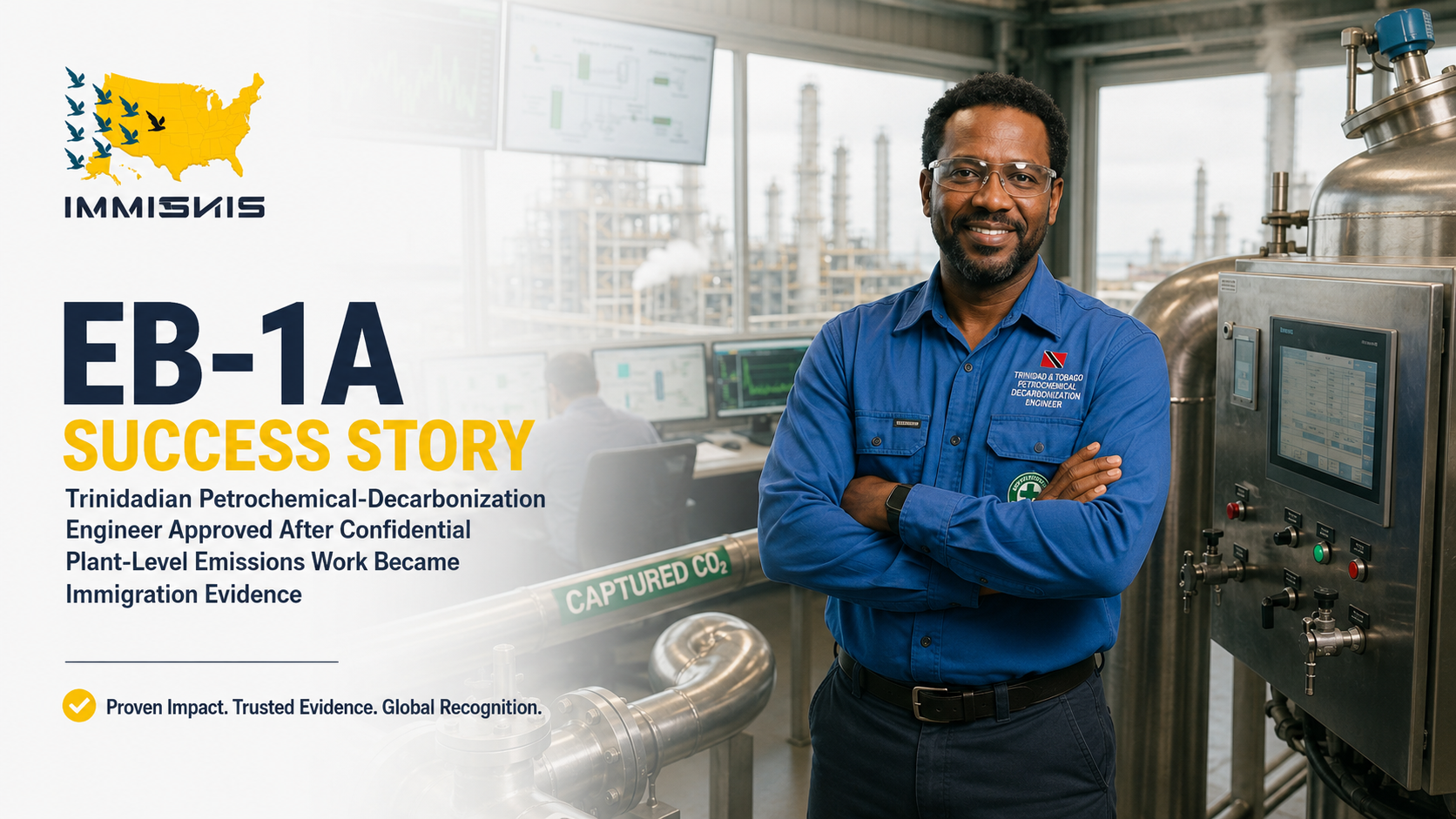
EB-1A for Petrochemical Engineers shows how a Trinidadian process engineer secured approval by turning petrochemical-cluster decarbonization work into a petition-ready immigration profile built on cleared performance documentation, decarbonization-conference presentations, trade publication, industry working-group roles, methodology papers, and ethical profile building.
Key facts at a glance
| Petition outcome | Form I-140 approved under EB-1A on September 10, 2024. |
| Professional profile | Trinidadian process engineer cutting emissions intensity across ammonia and methanol complexes. |
| Field niche | Petrochemical-cluster decarbonization engineering. |
| Starting weakness | The strongest achievements were plant-level improvements, but most performance data, process details, and business results were wrapped in commercial confidentiality. |
| Profile-building focus | Cleared performance documentation, decarbonization-conference presentations, trade publication, industry working-group roles, methodology papers, expert letters, and immigration-specific profile building. |
| EB-1A criteria supported | Original contributions, leading role, published material, scholarly articles, and membership. |
| Central issue | Showing that the petitioner did not merely operate industrial systems, but developed and disseminated decarbonization methods with significance across petrochemical operations. |
| Approval lesson | Confidential industrial achievements can support EB-1A when ethical profile building converts cleared performance data, technical methods, and industry recognition into USCIS-ready evidence. |
The approval
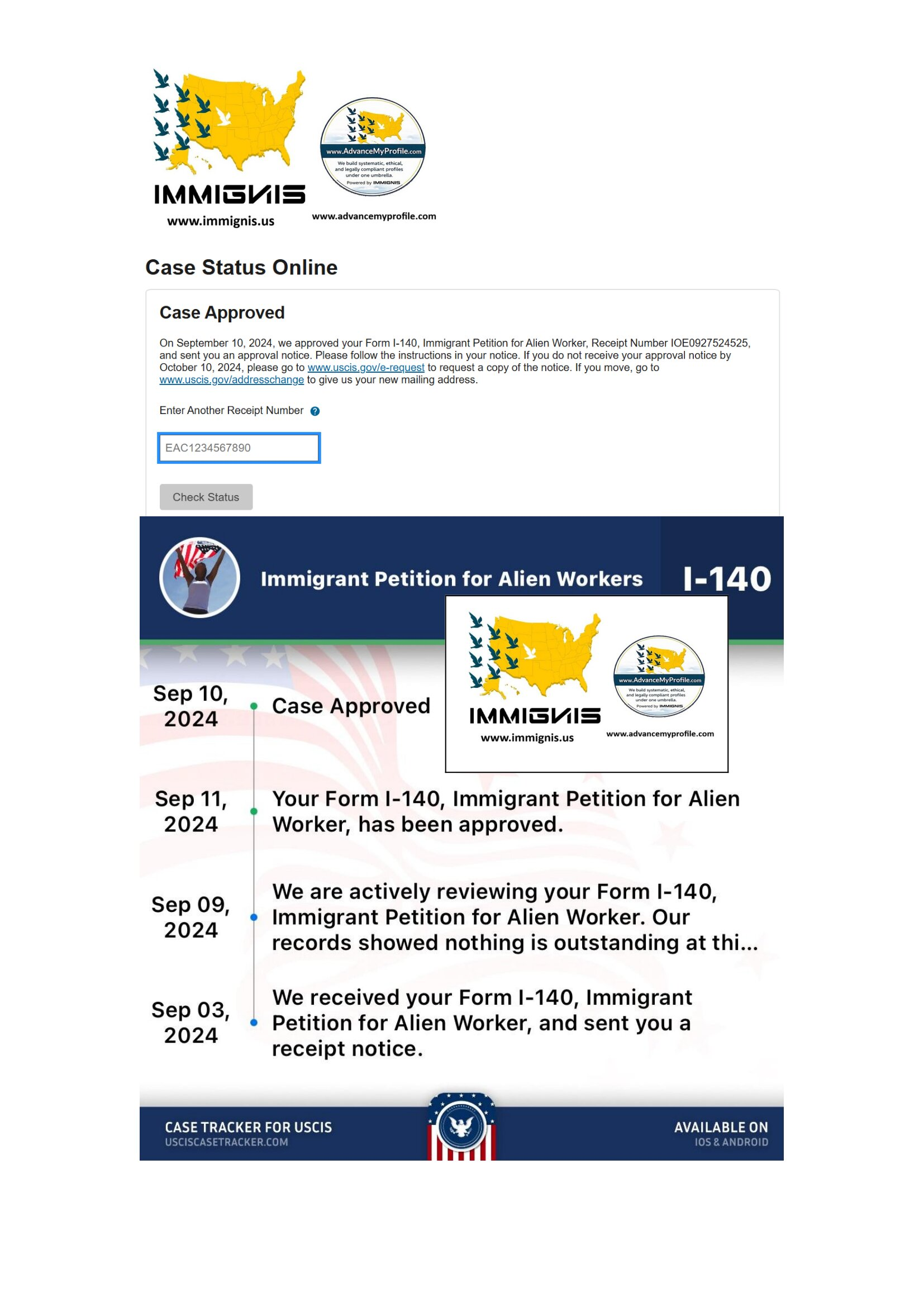
On September 10, 2024, USCIS approved the Form I-140 petition of a Trinidadian petrochemical-decarbonization engineer whose work focused on cutting emissions intensity across ammonia and methanol complexes.
The approval was important because the petitioner worked in a field where the strongest evidence is often locked inside plants, internal dashboards, process studies, operating logs, and commercially sensitive performance records. The real impact existed, but it could not simply be copied into a petition without careful review and clearance.
That made the case a strong example of EB-1A profile building, engineering profile building, climate-technology profile building, and immigration profile building. The petitioner already had valuable industrial decarbonization experience, but the record needed to be translated into evidence that USCIS could evaluate without exposing proprietary information.
Immignis and Advance My Profile helped convert the record into a petition-ready EB-1A profile. The strategy focused on cleared performance documentation, decarbonization-conference presentations, trade publication, industry working-group roles, methodology papers, expert letters, and profile improvement designed for immigration use.
The evidence problem in petrochemical-cluster decarbonization
Petrochemical-cluster decarbonization is a technically demanding field because it sits at the intersection of process engineering, energy efficiency, emissions accounting, industrial operations, and climate-transition strategy. In ammonia and methanol complexes, small changes in process design, heat integration, feedstock management, utilities, and operating discipline can carry large emissions and cost implications.
The difficulty was that the petitioner's strongest results were plant-level wins. They were measurable inside the company, but not naturally public. Commercial confidentiality limited what could be shared about production volumes, energy balances, process conditions, emissions factors, and operational savings.
That was the petitioner's starting weakness. The work mattered, but the public record was thin. Without immigration-specific profile building, the case could have looked like a confidential internal engineering role rather than top-level expertise in petrochemical decarbonization.
The petition therefore defined the field precisely as petrochemical-cluster decarbonization engineering. It did not present the petitioner as a general process engineer. It presented a specialist whose methods addressed emissions intensity in ammonia and methanol operations, a niche directly tied to industrial climate performance.
That field definition gave USCIS a clear measuring stick. It explained why cleared performance data, conference presentations, trade publications, working-group roles, and methodology papers were meaningful indicators of extraordinary ability in this field.
Why confidential plant-level wins needed cleared performance documentation
The strongest evidence in the case was also the hardest to use. Plant-level decarbonization results can show real technical impact, but the raw records may include proprietary operating data, confidential business metrics, or sensitive production information.
The petition used cleared performance documentation to solve that problem. Instead of exposing protected data, the evidence summarized the petitioner's role, the technical problem addressed, the type of performance improvement achieved, and the significance of those improvements in a way that could be verified without breaching confidentiality.
This was a critical profile-building step. USCIS needed evidence that the petitioner's work went beyond routine optimization and created meaningful improvement in emissions intensity, operational efficiency, or industrial decarbonization practice. Cleared documentation made those achievements visible and reviewable.
For professionals searching for profile building, EB-1A profile building, EB-2 NIW profile building, professional profile building, or immigration profile building, this case shows that confidential business results do not have to remain invisible. They must be documented ethically, carefully, and with enough context to show field significance.
Decarbonization-conference presentations created public technical visibility
Decarbonization-conference presentations helped move the petitioner's record from internal achievement to public professional recognition. In engineering fields, conference platforms can be powerful because they show that the field values the person's practical methods, case lessons, and technical judgment.
The petition organized conference records around the petitioner's expertise in emissions reduction, process optimization, industrial-energy transition, and petrochemical-cluster performance. These presentations helped show that the petitioner was not only executing confidential work, but also contributing to the broader technical conversation on industrial decarbonization.
This evidence supported published-material and leading-role arguments because it connected the petitioner to professional audiences outside one employer. It also helped the final merits analysis by showing that others in the field considered the petitioner's experience relevant enough to share publicly.
As part of engineering profile building and immigration-specific profile building, conference visibility was especially valuable because it created a lawful, public-facing record around work that otherwise remained inside plant walls.
Trade publication and methodology papers formalized the expertise
Trade publication and methodology papers gave the petitioner's practical work a written record. In petrochemical engineering, many important improvements begin as plant studies, internal notes, process changes, and operating procedures. For EB-1A, those achievements become stronger when they are translated into publishable technical knowledge.
The petition used publications to explain the petitioner's methods without disclosing proprietary details. Topics could be framed around non-confidential engineering principles, emissions-intensity reduction, process-efficiency frameworks, decarbonization roadmaps, measurement approaches, or lessons from industrial clusters.
This publication strategy supported scholarly articles, published material, and original contributions. It showed that the petitioner's work was not merely private know-how, but knowledge that could inform broader industry practice.
For publication profile building, professional profile building, and immigration profile building, this was a key step. It created a bridge between confidential plant performance and the public evidence USCIS expects in an extraordinary-ability petition.
Industry working-group roles showed field reliance
Industry working-group roles helped show that the petitioner's expertise was trusted beyond a single company or plant. In industrial decarbonization, working groups often shape technical guidance, benchmark practices, emissions-reduction frameworks, safety considerations, and sector-wide transition planning.
The petition used these roles to support membership and leading-role arguments. It showed that the petitioner participated in professional bodies or industry groups where technical judgment mattered and where other experts engaged with the same decarbonization challenges.
This evidence was important because plant-level improvements alone can sometimes look employer-specific. Working-group participation helped show that the petitioner's knowledge had field relevance. It placed the petitioner inside the broader petrochemical and energy-transition ecosystem.
For EB-1A profile improvement, working-group evidence is useful because it proves professional reliance. USCIS can see that the petitioner's expertise was not just used internally, but was recognized in settings where the field discusses standards, methods, and future direction.
Expert letters connected industrial decarbonization to extraordinary ability
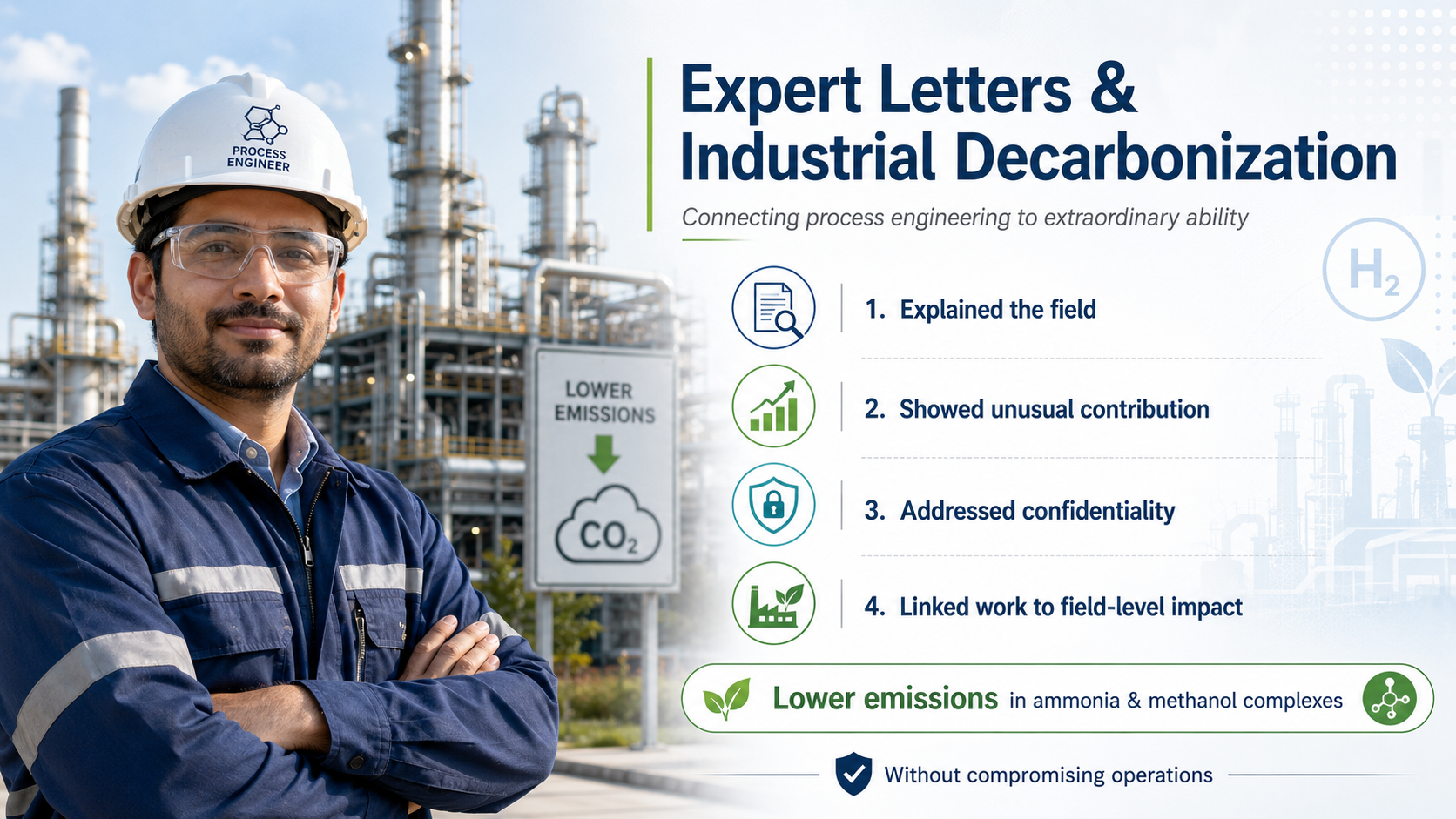
Expert letters were necessary because a USCIS officer may understand that decarbonization is important, but still need help understanding why a process engineer's specific work is unusual within petrochemical operations. The letters explained the field, the complexity of the work, and the petitioner's personal contribution.
The strongest letters did not simply praise the petitioner as hardworking or environmentally minded. They explained the technical challenge of reducing emissions intensity in ammonia and methanol complexes, the difficulty of doing so without compromising operations, and the significance of the petitioner's methods or leadership.
These letters also helped address confidentiality. Independent experts could explain why some details could not be fully disclosed and why cleared summaries, conference records, publications, and working-group roles were appropriate forms of evidence in this industry.
As part of ethical profile building, the letters gave the record professional context without exaggeration. They connected the petitioner's confidential industrial work to a recognizable field-level contribution.
How profile building changed the case
The case changed once the record was reorganized around the petitioner's actual contribution. Before profile building, the evidence could have looked like a strong process-engineering job with confidential achievements. After profile building, it became a coherent EB-1A record built around petrochemical-cluster decarbonization.
Immignis and Advance My Profile helped build that structure. The profile-building process connected cleared performance documentation, conference presentations, trade publication, industry working-group roles, methodology papers, and expert letters to the EB-1A criteria most relevant to the petitioner.
This was not artificial branding. It was profile improvement and immigration-specific profile building. The purpose was to make real engineering impact visible in the form USCIS expects while respecting commercial confidentiality and avoiding overstatement.
For engineers searching online for profile building, immigration profile building, EB-1A profile building, EB-2 NIW profile building, engineering profile building, climate-tech profile building, or professional profile improvement, this case shows how industrial decarbonization work can be converted into a stronger immigration profile.
Why this case worked
The case worked because it did not rely on a broad climate narrative alone. It did not simply say the petitioner worked in a green or important industry. It showed how the petitioner's technical work reduced emissions intensity, contributed methods, appeared in professional platforms, and gained recognition within the petrochemical decarbonization field.
Cleared performance documentation made the achievements measurable. Conference presentations created public technical visibility. Trade publication and methodology papers formalized the expertise. Working-group roles showed field reliance. Expert letters explained why the work mattered and why some evidence had to remain confidential.
Most importantly, the petition connected plant-level engineering to field-level significance. It showed that the petitioner's work was not merely routine process optimization, but part of a broader industrial decarbonization expertise that has value beyond one facility.
That is why the approval hook was strong: industrial decarbonization is a field the U.S. energy transition values, and the petition showed real chemistry, process engineering, and operational proof behind the claim.
Conclusion
The Trinidadian petrochemical-decarbonization engineer's EB-1A approval shows that confidential industrial engineering achievements can support an extraordinary-ability petition when the evidence is built with discipline.
The petition succeeded because it used ethical profile building to convert plant-level performance, conference visibility, trade publication, industry working-group participation, methodology papers, and expert validation into a clear immigration profile.
The broader lesson is clear: in confidential industrial fields, the challenge is not only proving that the work happened. It is proving the person's contribution, significance, and recognition without exposing protected information. When that connection is made, a quiet plant-level career can become a strong EB-1A record.
Frequently asked questions
Can a petrochemical engineer qualify for EB-1A?
Yes. A petrochemical engineer may qualify for EB-1A when the record shows extraordinary ability through original contributions, leading roles, publications, published material, membership, judging, and strong final-merits evidence.
Can confidential plant-level achievements be used in an EB-1A petition?
Yes. Confidential achievements can be used when they are documented through cleared summaries, authorized performance records, expert letters, non-proprietary publications, and other evidence that respects confidentiality while proving impact.
Can decarbonization work support an extraordinary-ability case?
Yes. Decarbonization work can support EB-1A when the petitioner shows specific technical contributions, measurable results, field recognition, publications, conference visibility, or leadership in relevant professional bodies.
Do trade publications and methodology papers help engineering EB-1A cases?
Yes. Trade publications and methodology papers can help formalize practical engineering expertise and show that the petitioner's work has value beyond one employer or internal project.
Do industry working-group roles support EB-1A criteria?
Yes. Industry working-group roles can support membership, leading role, original contributions, and final merits arguments when they show that the petitioner is trusted to contribute to the field's methods, guidance, or future direction.
Can Immignis and Advance My Profile help engineers build EB-1A or EB-2 NIW evidence?
Yes. Immignis and Advance My Profile help engineers, process experts, climate-tech professionals, and industrial decarbonization specialists build stronger immigration profiles through ethical profile building, evidence development, publication strategy, and USCIS-focused profile improvement.
Build an EB-1A record around industrial decarbonization, process engineering, and confidential performance evidence
Many engineers already have high-value technical achievements, but the evidence is often scattered across plant records, internal performance data, conference activity, technical papers, working groups, and confidential project files.
Start with a free EB-1A profile assessment and find out whether your process-engineering, petrochemical, energy-transition, industrial decarbonization, climate-tech, or chemical-engineering record can be developed into a stronger immigration profile through ethical profile building and USCIS evidence building.