
How a Hong Kong quantitative finance researcher secured EB-1A approval by turning high-remuneration evidence, cleared methodology papers, quant-conference talks, journal peer review, academic collaboration, and selective membership into a USCIS-readable extraordinary ability record.
Key facts at a glance
| Petition outcome | Form I-140 approved under EB-1A on May 1, 2026. |
| Professional profile | Hong Kong quantitative finance researcher whose models supported systematic strategies at a highly confidential fund. |
| Field niche | Systematic trading research for Asian markets. |
| Starting weakness | The work sat inside one of the most secretive industries; proprietary models, fund performance, and even job details could not be fully disclosed. |
| Profile-building focus | Compensation evidence, cleared methodology papers on non-proprietary topics, quant-conference talks, journal peer review, academic collaboration, and selective membership. |
| EB-1A criteria supported | High remuneration, scholarly articles, judging, original contributions, and membership. |
| Central issue | Proving extraordinary ability in quantitative finance without exposing proprietary trading systems or relying on vague claims about confidential fund work. |
| Approval lesson | In quant finance, remuneration can be a powerful lead criterion when it is benchmarked properly and supported by technical authorship, peer review, and independent recognition. |
The approval
On May 1, 2026, USCIS approved the Form I-140 petition of an EB-1A for Quantitative Finance Researchers whose models supported systematic trading strategies in Asian markets, but whose strongest work was protected by one of the most confidential industries in the world.
Inside the fund environment, his value was already understood. Portfolio teams relied on his research judgment, model design, and market-structure insight. Compensation reflected the premium placed on his expertise. Yet almost none of that work could be explained publicly in normal detail.
For EB-1A, that confidentiality created a serious evidentiary problem. The petitioner could not simply disclose proprietary signals, trading logic, portfolio data, or fund strategy. At the same time, USCIS needed evidence showing that his work rose above ordinary employment in finance.
That became the central challenge of the case: proving extraordinary ability in systematic trading research without exposing confidential trading methods or reducing the case to a vague finance résumé.
The evidence problem in quantitative finance cases
Quantitative finance is difficult to document because the strongest proof is often deliberately hidden. Successful models are not advertised. Internal research papers stay private. Trading signals, backtests, risk controls, and strategy-performance data are guarded because disclosure can destroy the value of the work.
The petitioner's starting weakness was not lack of achievement. The weakness was visibility. His field rewards secrecy, and even a strong job title may be vague or confidential. To an immigration officer, that can make an exceptional researcher look like an ordinary finance employee unless the evidence is translated carefully.
The case therefore needed a precise field definition. It was not framed as general investment analysis, financial services, or business strategy. It was framed as systematic trading research for Asian markets, with emphasis on quantitative modeling, market behavior, risk-aware strategy development, and research that professional funds value highly.
That field definition gave the petition a practical measuring stick. The question was not whether the petitioner could discuss proprietary fund performance. The question was whether disclosure-safe evidence could show that his quantitative research ability was recognized, valued, and trusted at a level beyond the ordinary.
Why confidentiality could not become an excuse for weak evidence
Many quantitative finance professionals assume that secrecy makes EB-1A impossible. That is not correct. Confidentiality changes the evidence strategy, but it does not remove the need for proof. USCIS still needs documents that identify the petitioner's role, explain the level of the work, and show recognition within the field.
The petition therefore avoided two extremes. It did not expose proprietary trading systems, and it did not hide behind generic descriptions such as “advanced models” or “important research.” Instead, it used cleared, non-confidential materials to explain the petitioner's expertise in a way that preserved fund secrecy.
That approach included compensation evidence, cleared methodology papers, conference participation, peer-review service, academic collaboration, and selective professional membership. Each category helped prove a different part of the same point: the petitioner had extraordinary ability in a field where the best proof is rarely public by default.
This made the case stronger. It showed USCIS that confidentiality had been handled responsibly, while still giving the officer enough evidence to evaluate the petitioner's individual standing.
High remuneration became the lead evidence category
In many fields, pay is supporting evidence. In quantitative finance, compensation can be especially meaningful when it is benchmarked correctly because elite funds often express market judgment through remuneration. The field may not publish rankings of researchers, but it does price scarce talent aggressively.
The petition used that reality carefully. It did not argue that salary alone proves extraordinary ability. Instead, it compared the petitioner's compensation against relevant market data and showed that his remuneration reflected unusual value for specialized quantitative research in systematic trading.
The strongest compensation evidence answered practical questions. What was the petitioner paid? How did that compare with comparable finance and quant roles? Why did the market pay that level for his skills? How did the compensation relate to the difficulty, confidentiality, and value of the work?
Those materials gave USCIS a concrete, disclosure-safe signal of field value. In a secretive industry, compensation became one of the clearest ways to show that sophisticated market participants treated the petitioner as highly valuable.
Cleared methodology papers made the research understandable
A quant petition cannot simply say that the petitioner built models. USCIS needs enough explanation to understand why the work required specialized expertise and why the petitioner's contribution mattered. At the same time, the petition cannot disclose proprietary methods that belong to an employer or fund.
The record solved this by using cleared methodology papers on non-proprietary topics. These materials described concepts, research approaches, market-structure problems, modeling challenges, and analytical methods without revealing protected trading logic or sensitive fund information.
This was important because it gave the petitioner an authorial and technical record outside confidential employment. The officer could see that the petitioner was not only a private employee using secret tools, but a professional capable of explaining sophisticated quantitative ideas in a public or semi-public form.
For secretive industries, this distinction is essential. Confidential work may prove employment importance, but cleared technical writing helps prove field-level expertise.
Original contribution in systematic trading research
Original contribution in quantitative finance is hard to present because the contribution may be valuable precisely because it is not public. A model, signal, or research framework can influence capital allocation and trading decisions without ever appearing in a press release or academic citation index.
For this petitioner, the original-contribution argument was built around disclosure-safe descriptions of his research work, the complexity of the Asian market problems addressed, the fund's reliance on his quantitative judgment, and expert explanations of why his approach showed uncommon skill.
That mattered because USCIS looks for contributions of significance, not routine job performance. The petition therefore connected his work to problems that matter in systematic trading: signal quality, market microstructure, execution sensitivity, risk management, data integrity, and research reliability.
The petition did not claim that he single-handedly changed global finance. It made a narrower and stronger point: within systematic trading research for Asian markets, his quantitative contribution was valuable, specialized, and recognized by sophisticated institutions that had strong reasons to evaluate talent carefully.
Quant-conference talks created public field visibility
The original profile had limited public documentation because fund research is usually private. Quant-conference talks helped address that gap by showing that the petitioner's knowledge was relevant beyond his own employer and useful to professional audiences in the field.
Those speaking platforms mattered because they placed the petitioner in front of peers who understood the technical language of systematic research, trading infrastructure, market data, and model evaluation. They helped show that his expertise was not limited to internal fund work.
The petition treated conference evidence as support for the broader record. The most useful presentations were tied to non-proprietary research themes, market-structure analysis, risk-aware modeling, data issues, or other topics that showed genuine technical authority without revealing trading secrets.
Journal peer review showed trusted technical judgment
Judging evidence can be powerful in a research-driven EB-1A case because it shows that others trusted the petitioner to evaluate the work of professionals in the field. In this case, journal peer review helped show that his quantitative judgment had value outside his employer.
The petition placed peer-review service in context. It explained the technical nature of the reviewed work, the standards involved, and why being selected as a reviewer reflected professional trust in his expertise.
That evidence was especially useful because it was independent of fund secrecy. Even when trading models cannot be disclosed, peer-review service can show that the petitioner is recognized as someone capable of assessing advanced quantitative research.
Academic collaboration strengthened the public research record
Academic collaboration helped bridge the gap between private fund work and public research recognition. It allowed the petitioner to show that his expertise could contribute to broader quantitative-finance, financial-econometrics, data-science, or market-microstructure conversations without exposing proprietary strategies.
The petition used academic collaboration as corroborating evidence. It showed that outside researchers valued his input, that his knowledge could be applied to non-proprietary research questions, and that his technical profile was not confined to one employer's internal trading desk.
That helped the final merits argument because it showed intellectual credibility beyond compensation alone. Market value was important, but it became stronger when paired with scholarly writing, review activity, and outside research collaboration.
Selective membership supported field recognition
Membership evidence can be weak when it reflects ordinary enrollment. In quantitative finance, however, selective professional associations, invitation-based research groups, or technical finance organizations can help show that the field recognizes a researcher's standing.
The petition therefore did not present membership as a shortcut. It used selective membership as part of a larger pattern: high remuneration, technical writing, conference participation, peer review, and academic collaboration all pointed toward the same conclusion.
That mattered because no single evidence category had to carry the entire case. Membership helped confirm that the petitioner was connected to serious professional circles where quantitative finance expertise is evaluated by knowledgeable peers.
Why the petition worked
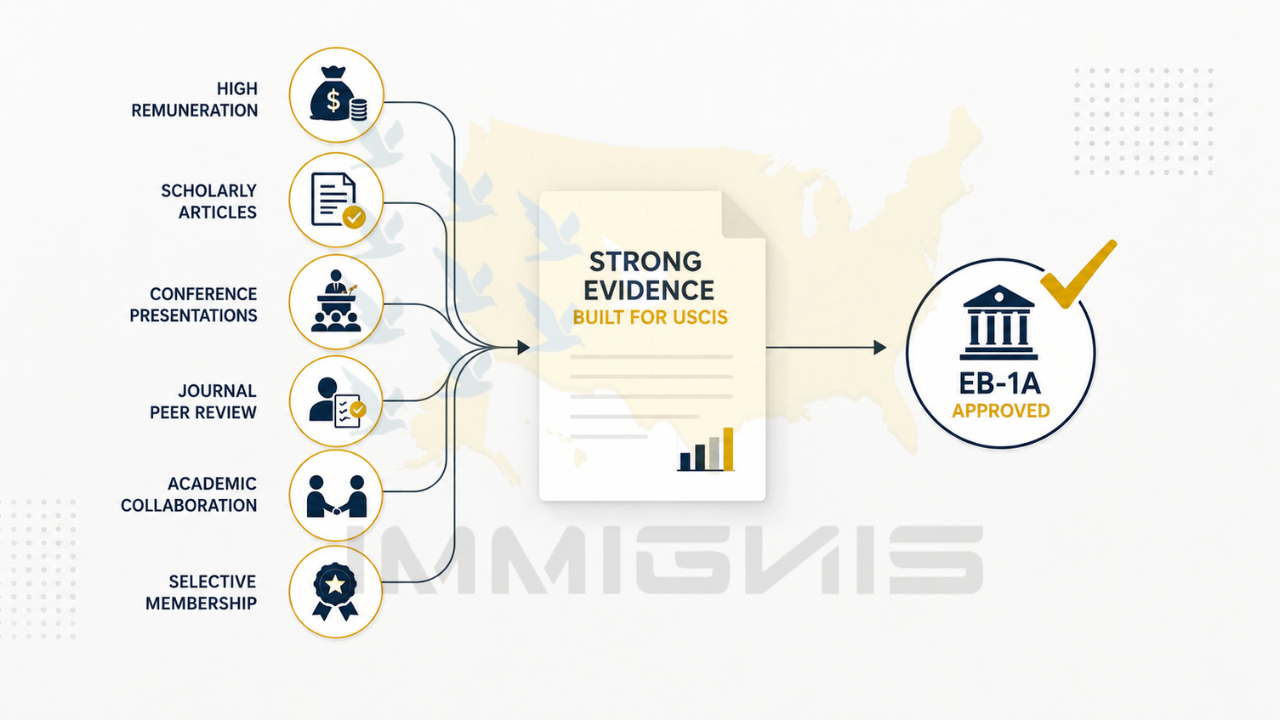
The success of the case came from disciplined framing. Instead of asking USCIS to accept a secret fund record on trust, the petition built a disclosure-safe proof architecture around the field's real signals of esteem.
It showed that the petitioner was not merely a confidential employee with a technical job title. He was a quantitative finance researcher whose expertise was valued through premium compensation, visible through cleared methodology work, and trusted through peer review, academic collaboration, and professional recognition.
That framing allowed the EB-1A criteria to work together. High remuneration showed market valuation. Scholarly articles and methodology papers showed technical authorship. Peer review showed judging. Original-contribution evidence showed research value. Membership and conference activity showed professional standing.
Why the approval mattered
The approval mattered because it showed how a quantitative finance professional can qualify for EB-1A even when the industry publishes very little and guards its strongest achievements. Secrecy does not eliminate the possibility of an extraordinary ability case, but it raises the standard for careful documentation.
For this Hong Kong quantitative finance researcher, the petition did not rely on vague claims about algorithmic success or secret fund performance. It used compensation, cleared writing, conference visibility, peer review, academic collaboration, and selective membership to make his standing legible.
Most importantly, the petition did not force the petitioner to breach confidentiality. It proved the case using evidence the industry could safely release, while still explaining why the underlying work mattered.
The approval confirmed the central lesson of the case: in quant finance, market valuation can be a powerful signal, but it works best when supported by technical authorship, independent professional trust, and a clear field niche.
The broader lesson for quantitative finance professionals
This case is useful for quantitative researchers, systematic trading specialists, financial engineers, data scientists in investment environments, market-microstructure researchers, and private-fund professionals whose strongest achievements are protected by confidentiality.
A strong EB-1A case in this space usually depends on showing that the petitioner's field uses different signals of acclaim than more public industries. A patent count, public product launch, or media profile may not be realistic. Compensation, peer review, selective membership, conference invitations, and cleared technical writing may be more accurate evidence of standing.
It also helps to avoid overclaiming. The petition should not imply that every internal trading result can be used or that pay alone guarantees approval. The strongest cases explain the field, protect confidential information, and then provide independent evidence that the petitioner is highly valued and trusted.
Lessons for quants, fund researchers, and confidential-industry professionals
This case is useful for professionals in quantitative finance, trading research, private funds, proprietary technology, confidential product development, and other sectors where major contributions are intentionally kept out of public view.
A strong record usually begins with the following questions:
- Can compensation be benchmarked against the correct labor market and shown as unusually high for the field?
- Can cleared methodology papers or non-proprietary publications explain the petitioner's technical expertise without disclosing protected trading strategy?
- Do conference talks, academic collaborations, or professional memberships show recognition beyond the employer?
- Can peer-review service or similar evaluation work show that others trusted the petitioner's technical judgment?
- Can expert letters explain the petitioner's contribution in a way that is specific, credible, and confidentiality-safe?
When those questions are answered with documents, even a highly secretive finance career becomes much easier for USCIS to evaluate. That is often the difference between an impressive private career and a successful EB-1A record.
Frequently asked questions
Can a quantitative finance researcher qualify for EB-1A?
Yes. A quantitative finance researcher may qualify for EB-1A if the evidence shows sustained acclaim and extraordinary ability in a defined field such as systematic trading research, financial engineering, market microstructure, or quantitative investment research.
Can confidential trading work be used in an EB-1A petition?
Yes, if it is documented safely. The petition can use cleared summaries, employer-authorized letters, non-proprietary methodology papers, compensation evidence, conference materials, peer review, and expert explanations without revealing protected strategy details.
Can high remuneration be the lead EB-1A criterion for a quant?
Yes. High remuneration can be a strong criterion when it is benchmarked against comparable roles and explained as evidence of premium market value. It should still be supported by other evidence such as technical authorship, peer review, conference visibility, or professional recognition.
Do cleared methodology papers help if they do not disclose proprietary models?
Yes. Cleared papers on non-proprietary topics can help show technical authorship, field knowledge, and research sophistication while preserving employer confidentiality.
Can journal peer review count as judging for EB-1A?
Yes. Journal peer review can support the judging criterion because it shows that the petitioner was trusted to evaluate the work of other professionals or researchers in the field.
Can Immignis and Advance My Profile help confidential finance professionals build EB-1A evidence?
Immignis and Advance My Profile help quantitative finance professionals, fund researchers, financial engineers, and confidential-industry specialists define a credible field niche, protect sensitive information, and build a petition-ready EB-1A evidence record.
Turn confidential quantitative finance work into petition-ready evidence
Many quantitative finance professionals create major value, but their strongest proof stays inside protected models, internal research systems, and confidential compensation structures.