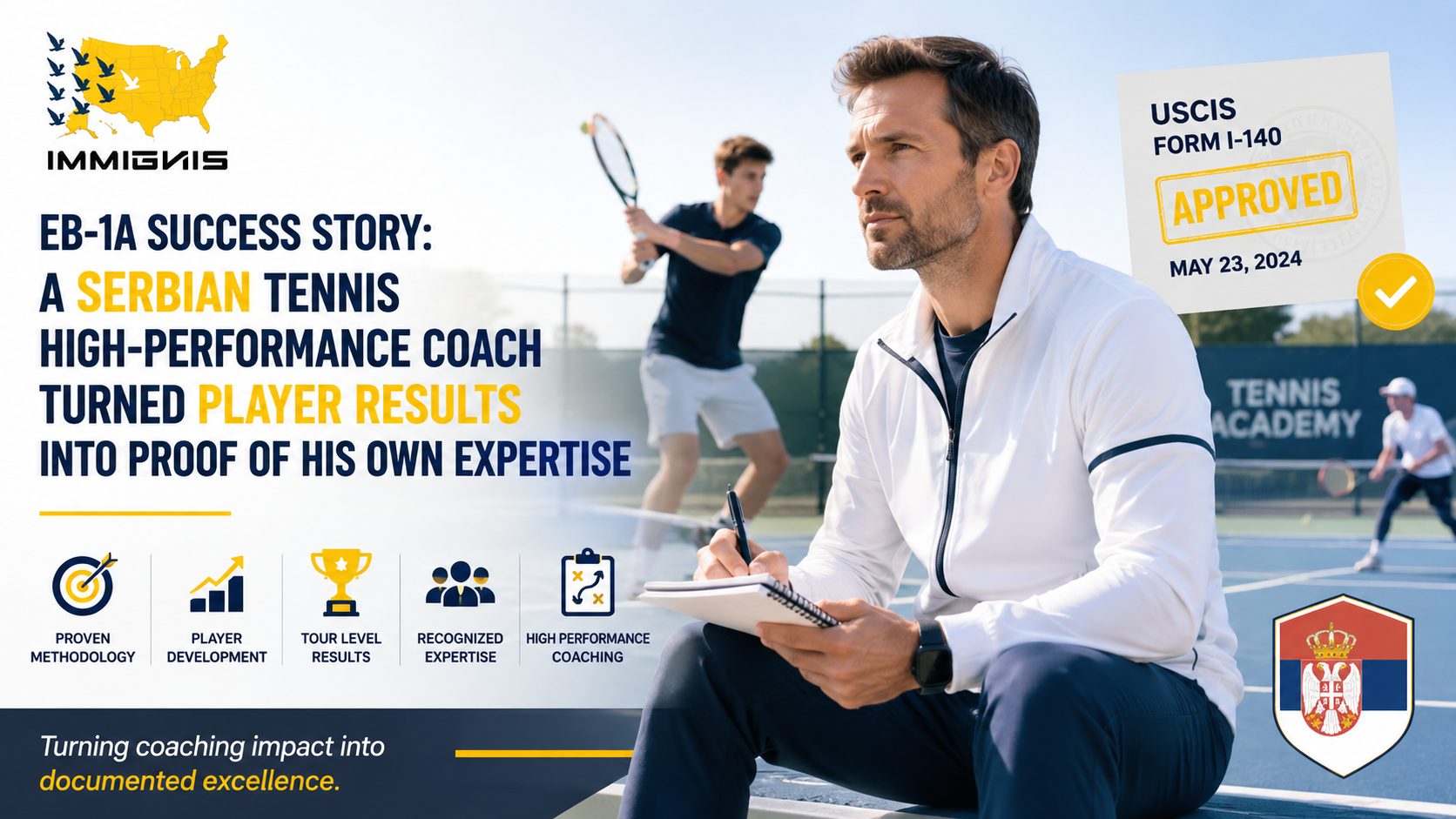
How Immignis and Advance My Profile helped convert locker-room reputation into evidence USCIS could evaluate
Key facts at a glance
| Outcome | EB-1A approval for a Serbian tennis high performance coach whose work focused on helping junior players transition into professional competition. |
| Approval date | USCIS approved the Form I-140 on May 23, 2024. |
| Field niche | Junior to professional tennis transition coaching, including the training, competition planning, and performance systems that prepare emerging players for tour level demands. |
| Starting problem | The players had ranking movement and public results, but the coach’s own role was mostly undocumented and tied to informal coaching relationships. |
| Profile-building path | Formal coaching contracts, player and federation attribution letters, coaching credentials, academy leadership documentation, tennis media interviews, coaching conference presentations, high remuneration evidence, and selection panel judging records. |
| EB-1A criteria supported | Original contributions, published material, leading or critical role, high remuneration, memberships or credentials where selective or achievement-based, and judging through athlete selection or evaluation panels where documented. |
The approval did not rest on calling him a respected coach. It rested on documenting what his coaching actually changed, who relied on it, and why the work mattered beyond one training court.
The approval came first. The harder question was attribution.
On May 23, 2024, USCIS approved the Form I-140 petition for an EB-1A for Tennis Coaches whose career had unfolded in the familiar shadows of elite sport. His players were the names that appeared in draws, rankings, match reports, federation pages, and tournament summaries. He was the person standing behind the training block, the match plan, the recovery cycle, and the difficult year when a promising junior had to learn how to survive the professional schedule.
That is normal in tennis. It is also a problem for EB-1A.
The EB-1A category is not designed to reward reputation that everyone in a small sporting circle understands but nobody has written down. USCIS needs evidence. For an athlete, the evidence may be obvious: ranking history, medals, prize money, televised matches, and published results. For a coach, the same public record often points away from the person whose methods helped create those results.
This case began with that imbalance. The coach had meaningful influence. Several players connected to his training environment had moved from junior promise toward professional competition. His name, however, appeared unevenly. Some arrangements were based on trust rather than contracts. Some player results were public, but attribution to the coach was private. Some federation and academy work existed, but the paper trail did not yet explain his role in a way an immigration officer could evaluate.
Advance My Profile, powered by Immignis, rebuilt the record around a simple question: what can be proved about the coach himself?
Why coaching cases are different from athlete cases
A strong coaching case cannot merely borrow the glory of the athlete. A coach may work with a future professional, a national champion, or an internationally ranked junior, but USCIS still needs to understand the coach’s own standing. Did he develop an identifiable method? Was his role leading or critical? Did athletes, academies, federations, or other professionals rely on his judgment? Was his compensation consistent with a higher level of achievement in the field? Was his work discussed in media or professional settings? Did he judge or help select other athletes based on recognized expertise?
Those questions matter because tennis success is usually collective. A player’s progress may involve parents, fitness trainers, hitting partners, physiotherapists, academies, sponsors, national federations, and tournament access. A petition that claims every ranking improvement as the coach’s achievement will sound exaggerated. A petition that ignores the ranking improvement entirely will miss the point.
The strategy in this case was not to overclaim. It was to isolate the part of the development process that belonged to him: junior-to-professional transition coaching.
That niche gave the case a measuring stick. It moved the story away from generic “tennis coach” language and toward a narrower field: preparing high potential juniors for the physical, tactical, scheduling, emotional, and competitive demands of professional tennis. In that setting, the record could explain why his work was not ordinary instruction. It was a performance development system used at a decisive stage in a player’s career.
What USCIS needed to see in a tennis coaching EB-1A case
The petition had to do more than list players and tournaments. It had to show that the coach had risen above routine employment or general sports instruction.
For original contributions, the record needed to identify the coaching method or player-development approach, not just the fact that he worked hard. The evidence had to explain how his training plans, match-preparation process, transition methodology, or academy role affected player development in a way other tennis professionals could recognize.
For published material, general coverage about a tournament or an athlete was not enough unless it discussed the coach, his methods, his role, or his expertise. Media had to connect back to him.
For leading or critical role, the petition needed documentation from academies, training groups, federations, or athlete teams showing that his responsibilities were central to a distinguished organization, project, or player-development structure. A job title alone would not answer the question.
For high remuneration, the comparison had to be fair. A private high-performance coach should not be compared with a casual weekend instructor. The record needed contracts, payments, or compensation evidence placed against a meaningful market comparison.
For judging, athlete selection panels, tournament evaluation roles, academy assessments, or federation panels could support the criterion only if the documentation showed that he evaluated the abilities of others in the field. Merely coaching students did not count as judging.
The final merits question was even broader: did the whole record show a coach with sustained acclaim and recognized standing in a specific area of tennis performance?
The first task was converting trust into documents
In elite coaching, important relationships often begin before any paperwork exists. A coach is introduced through a federation contact, a former player, an academy director, or a parent who has heard his name from someone inside the sport. A player trains for several weeks. The relationship continues. The work deepens. Years later, everyone knows what happened, but the formal record is thin.
That was one of the central evidence problems here. The coach’s reputation lived in conversations, practice courts, player memories, and academy routines. Immignis and Advance My Profile worked to bring that reputation into a professional record without turning informal history into unsupported claims.
Where current or former players could confirm his role, the file used attribution letters. Where academies or federations had records, the file used contracts, credentials, training schedules, program documents, or role confirmations. Where the coach had been paid above ordinary local coaching rates, the file used remuneration evidence. Where his methods had been discussed publicly or could be explained in professional settings, the team developed media and presentation opportunities tied to his actual expertise.
The goal was not to make the coach look more famous than he was. The goal was to make the evidence catch up with the reality of the work.
Player results were used carefully
Player results mattered, but they had to be handled with discipline. A junior player’s rise, a transition into professional events, a national ranking, or a tour level milestone can help explain why a coach’s work was important. It does not automatically prove that the coach caused the result.
The petition therefore connected player outcomes to documented coaching roles. If a player or federation letter described the coach’s involvement in the transition period, that letter was paired with the public result. If an academy record showed him leading a development program, the relevant athlete progress was described in that context. If a player’s improvement followed a training cycle, the petition explained the training role without pretending that tennis performance comes from one factor alone.
This made the record more credible. It showed that the petition understood the sport. Serious coaches do not claim ownership of every win; they explain the preparation that made performance possible.
The coaching methodology became the center of the case
The strongest part of the case was not a single trophy, contract, or letter. It was the coaching niche itself.
Junior-to-professional transition is a difficult stage in tennis. A player may dominate junior events but struggle once the match schedule becomes more demanding, opponents become physically stronger, travel increases, and small weaknesses get punished quickly. Development at that stage requires more than hitting drills. It requires competition planning, tactical maturity, physical durability, match review, surface adaptation, recovery management, and judgment about when to push and when to reset.
The petition described the coach as a specialist in that transition. His record was organized around the decisions that a high-performance coach makes: how to structure a season, how to prepare a player for different match environments, how to convert technical ability into match resilience, and how to help a junior athlete become responsible for professional routines.
That framing gave the letters and evidence a common language. Instead of praising him as “excellent,” the supporting evidence could explain what kind of excellence was being claimed.
Media and presentations gave the work a public record
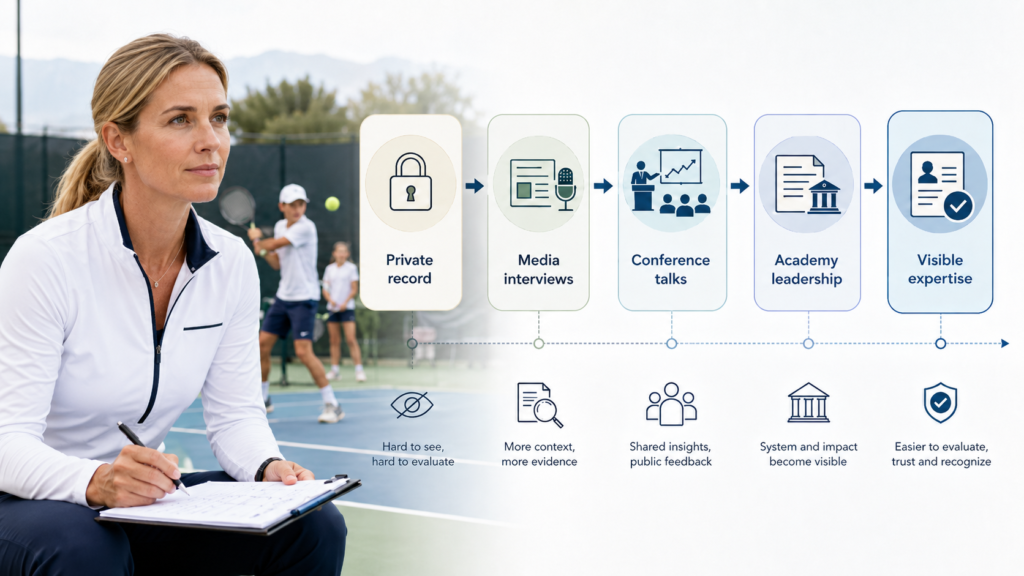
Before profile building, much of the coach’s record was private. That is common in sports. A coach may be known inside a club, academy, federation, or player circle while remaining almost invisible to the public.
The public-facing record was developed around his method, not around empty publicity. Tennis-media interviews discussed the challenges of moving from junior success to professional consistency. Coaching-conference presentations explained player-development topics that could be discussed without exposing private athlete information. Academy leadership documentation showed that his role was not limited to one student or one temporary assignment.
This helped the petition answer a recurring EB-1A problem: recognition must be visible enough for USCIS to evaluate. In this case, the new public record did not replace the coaching evidence. It helped translate the coaching evidence into a form that matched the regulatory framework.
High remuneration was documented with context
High remuneration can be a useful EB-1A criterion, but only when the comparison is meaningful. A private coach working with elite juniors or transition-level professionals may have compensation that looks unusual in one market and ordinary in another. The petition therefore avoided unsupported salary language and focused on what could be documented.
Contracts, payment records, and comparable coaching-market information were used to show that he was compensated at a level consistent with specialized high-performance work. The point was not that money alone proved extraordinary ability. The point was that athletes, families, academies, or organizations were willing to pay for his specific expertise in a competitive coaching market.
Judging evidence came from evaluation roles, not ordinary coaching
The case also addressed judging carefully. In sports, the word “judge” can be confusing because coaches evaluate athletes every day. That kind of evaluation, by itself, does not usually satisfy the EB-1A judging criterion.
The stronger evidence came from roles in which he evaluated other athletes or coaching related submissions outside the ordinary coach student relationship. Athlete selection panels, academy evaluations, federation assessment roles, or similar documented activities could show that others trusted his expertise to assess talent or performance. Where the evidence existed, it was separated from his routine coaching work and explained as independent evaluation.
Independent letters explained why the work mattered
The independent letters were especially important because they did not simply say that he was a good coach. The strongest letters explained the field. They described the difficulty of moving talented juniors into professional competition, the limited number of coaches trusted at that stage, and the practical significance of a method that helps players adapt to the demands of higher-level competition.
Letters from athletes can show attribution. Letters from academy directors, federation figures, or recognized tennis professionals can show reputation. Letters from independent experts can place the work within the wider field. The petition needed all three kinds of value, not merely praise from people who liked him personally.
How the EB-1A evidence worked together
The final petition did not depend on one dramatic fact. It worked because several forms of evidence pointed to the same professional identity.
- Original contributions: The petition identified his junior-to-professional transition methodology and supported it with athlete-development evidence, attribution letters, academy records, and expert explanation.
- Published material: Tennis media coverage and interviews discussed his role, method, or expertise instead of merely mentioning tournament results.
- Leading or critical role: Academy leadership, team responsibilities, federation related involvement, or documented coaching roles showed that his work was central to distinguished sporting environments or player development projects.
- High remuneration: Contracts and compensation records helped show that the market valued his specialized coaching services above ordinary instruction.
- Judging: Selection panel or evaluation records, where documented, showed that he was asked to assess other athletes or sports talent based on recognized expertise.
- Memberships and credentials: Federation or professional credentials supported the record when they involved recognized standards, achievement, or selective admission rather than simple enrollment.
At final merits, the evidence presented one coherent story: a Serbian high performance coach whose expertise helped players move through one of the hardest transitions in tennis and whose standing could finally be seen outside the private training environment.
The approval
USCIS approved his Form I-140 on May 23, 2024.
The approval showed why coaching cases should not be treated as weaker athlete cases. A coach can qualify for EB-1A when the petition proves the coach’s own recognized expertise, not merely the fame of the players. In this case, the work behind the finish line became visible: the contracts, the player development evidence, the media record, the remuneration, the evaluation roles, and the independent explanations all pointed to the same high performance specialist.
The lesson is simple but important. In sports, reputation often travels by word of mouth. EB-1A requires the reputation to be documented.
What other coaches can learn from this case
Coaches often assume that their athletes’ results will speak for them. Sometimes they do. More often, they speak for the athlete first.
A strong EB-1A coaching record should identify the coach’s role with precision. It should document contracts, official assignments, federation or academy recognition, player attribution, method based media, compensation, selection or judging activity, and independent letters from people who can explain the coach’s place in the field.
The strongest cases do not inflate the coach’s role. They make the role provable.
Frequently asked questions
Can a sports coach qualify for EB-1A?
Yes. A sports coach can qualify for EB-1A if the evidence shows recognized expertise, sustained acclaim, and a record that places the coach among a small percentage at the top of the field. The case must focus on the coach’s own achievements, not only the athletes’ achievements.
Can an athlete’s ranking or medal help a coach’s EB-1A case?
It can help when the record also proves the coach’s role in that athlete’s development.Public results are more useful when paired with contracts, attribution letters, training records, or independent statements explaining the coach’s contribution.
Does coaching a famous player automatically prove extraordinary ability?
No. USCIS needs evidence of the coach’s own acclaim and expertise. A famous player relationship may support the case, but it does not replace evidence of original contribution, leading role, published material, remuneration, judging, or other relevant criteria.
Can informal coaching relationships be used?
Yes, but they must be documented. Letters, payment records, schedules, training plans, federation confirmations, academy records, or player statements may help convert informal relationships into usable evidence.
What is the biggest risk in a coaching EB-1A case?
The biggest risk is attribution. If every public achievement belongs to the athlete and no evidence explains the coach’s role, the petition may look weak even when the coach is genuinely respected inside the sport.
Build an EB-1A record around the work behind the player results
If you are a coach, trainer, performance specialist, academy leader, or sports-development expert, your strongest evidence may not be obvious from public rankings alone. Immignis and Advance My Profile help identify the part of your work that belongs to you, organize it into EB-1A criteria, and build a record that USCIS can evaluate.