How an EB-1A Geothermal Reservoir Engineer from Kenya secured approval by turning confidential reservoir models, well-placement and reinjection decisions, sustainable steam-field management, technical publications, conference presentations, project-attribution records, expert validation, and remuneration evidence into a documented record of extraordinary ability.
Key facts at a glance
| Petition outcome | Form I-140 approved under EB-1A on December 6, 2023. |
| Professional profile | Kenyan geothermal reservoir engineer whose modeling and steam-field decisions improved reservoir understanding, supported well planning, reduced drilling uncertainty, and protected long-term field performance in East African geothermal projects. |
| Field niche | Geothermal reservoir modeling and sustainable steam-field management. |
| Starting weakness | The power plants, wells, and electricity output were visible, but the technical judgment behind well placement, production forecasts, reinjection strategy, pressure management, and reservoir protection remained inside operator systems and multidisciplinary project records. |
| Profile-building focus | Cleared reservoir-performance documentation, model and decision attribution, geothermal-engineering publications, international conference presentations, professional-society roles, independent expert letters, project records, and remuneration benchmarking. |
| Principal EB-1A evidence areas developed | Original contributions, authorship of scholarly articles, leading or critical role, published material about the petitioner, and high remuneration in relation to others in the field. |
| Central issue | Showing that the petitioner did not merely monitor an operating field, but produced reservoir intelligence that influenced expensive drilling decisions, sustainable production, reinjection design, and the dependable use of a strategic renewable-energy resource. |
| Approval lesson | Geothermal engineers can build persuasive EB-1A cases when confidential subsurface work is translated into cleared evidence of authorship, adoption, decision influence, technical publication, project reliance, professional recognition, and sustained standing in the field. |
The megawatts were public. The reservoir decisions were not.
A geothermal power station is easy to photograph. Turbines, cooling systems, transmission lines, drilling rigs, and steam rising above a field all create visible evidence of an energy project. The reservoir engineer works beneath that picture. The most important part of the job may exist as a pressure trend, a numerical model, a well-test interpretation, a forecast, or a recommendation that prevents the next well from being placed in the wrong part of the field.
That was the petitioner’s starting problem. His models and interpretations informed decisions with major technical and financial consequences, yet most of the record belonged to operators, project teams, drilling programs, and power facilities. A public observer could see that electricity was being generated. It was much harder to see who had assessed the reservoir, predicted its response, identified risk, or helped decide where production and reinjection should occur.
USCIS approved the Form I-140 petition on December 6, 2023. Immignis and Advance My Profile organized the case around one simple idea: the petition had to make the reservoir intelligence as visible as the plant that depended on it.
Why reservoir engineering determines whether geothermal power lasts
Geothermal electricity depends on more than finding heat underground. A commercial field must provide usable fluid or steam at sufficient temperature, pressure, flow, and reliability. The resource also has to be managed so that short-term production does not damage long-term performance.
Reservoir engineers combine geological, geophysical, geochemical, drilling, and production information to understand how fluids move through fractured rock. They review well tests, pressure and temperature behavior, production histories, injection response, tracer results, fluid chemistry, and other field data. Numerical models are then used to test competing explanations and forecast how the reservoir may respond to additional wells, changing production, or reinjection.
The work is consequential because drilling is expensive and uncertainty cannot be removed completely. A model does not merely create a technical report. It can influence whether a well is drilled, where it is targeted, how much production is expected, where separated water is returned underground, and whether signs of pressure decline or thermal breakthrough are addressed early enough.
For this case, those decisions formed the practical significance argument. The petitioner’s contribution was not defined by the number of spreadsheets or simulations he produced. It was defined by the decisions that relied on them and the field risks they helped manage.
The field was defined as geothermal reservoir modeling and sustainable steam-field management
The petition did not present the beneficiary as a general mechanical engineer, geologist, energy professional, or plant employee. It defined his field as geothermal reservoir modeling and sustainable steam-field management. That description matched the technical record and created a fair basis for evaluating his achievements.
Reservoir modeling addressed the scientific and computational work: integrating subsurface evidence, calibrating models against field behavior, evaluating uncertainty, and forecasting performance. Sustainable steam-field management addressed the operational purpose: balancing production, reinjection, pressure support, well use, resource protection, and the continued delivery of geothermal energy.
This definition also prevented the case from drifting into a broad claim about renewable energy. Geothermal power may have national and regional importance, but EB-1A still requires evidence about the individual. The petition therefore linked every larger energy benefit to a specific technical function performed by the petitioner.
Cleared reservoir-performance records made confidential engineering reviewable
The strongest evidence began inside operator records. Reservoir models, production histories, well recommendations, internal technical reviews, drilling plans, reinjection studies, and performance forecasts may contain commercially sensitive or security-sensitive information. Raw project files could not simply be attached without review.
The profile-building process separated the evidentiary value from the protected detail. Cleared summaries identified the technical problem, the petitioner’s role, the type of analysis performed, the recommendation made, the people or teams that relied on it, and the operational consequence. Sensitive well coordinates, proprietary model parameters, unreleased production data, and restricted commercial figures could remain protected.
This documentation helped answer the question that often weakens confidential engineering cases: what did the person personally do? Instead of describing a successful geothermal project and asking USCIS to infer individual distinction, the record mapped the petitioner to particular models, reviews, recommendations, and field-management decisions.
The evidence also explained authorship in a multidisciplinary environment. A reservoir model may depend on input from geologists, geophysicists, geochemists, drilling engineers, plant teams, and operations personnel. The petition did not erase those contributors. It showed the petitioner’s own analytical responsibility and the professional judgment he exercised when integrating their data into reservoir conclusions.
Well-placement work converted reduced uncertainty into original contribution
A new geothermal well is a high-stakes decision. Subsurface information is incomplete, productive fractures may be difficult to predict, and a location that looks promising in one dataset may be less persuasive when all evidence is considered together. Reservoir engineering reduces uncertainty by testing how the available evidence fits a coherent model of the field.
The case documented how the petitioner’s modeling and interpretation informed well targeting, drilling priorities, resource boundaries, or expected performance. The argument was not that he guaranteed every drilling result. No credible reservoir engineer can remove geological uncertainty. The argument was that his work gave decision-makers a better technical basis for allocating capital and choosing among competing drilling options.
This evidence was presented under the original-contributions criterion because the petitioner had produced methods, models, interpretations, or decision frameworks that others relied on beyond routine reporting. The record identified what was new or distinctive, how it was applied, and why experienced professionals considered it important.
Where measurable outcomes could be disclosed, they strengthened the explanation. Where figures remained confidential, authorized letters and cleared project summaries described the type and scale of the influence without inventing precision or exposing protected data.
Reinjection strategy showed that production was only half the job
Geothermal fields are not managed by extracting fluid indefinitely and treating reinjection as an afterthought. Reinjection can support pressure, dispose of produced fluids responsibly, and contribute to long-term resource management. Poorly located or poorly understood reinjection can also create risk, including unwanted cooling or other adverse reservoir effects.
The petitioner’s record included technical work connected to reinjection placement, response monitoring, reservoir connectivity, or production-injection balance. This made the sustainable-management part of the field definition concrete. His work addressed not only how much steam could be produced, but how the field might behave over time.
That distinction mattered in the final presentation. Routine operations evidence would have shown that the petitioner worked around producing wells. Stronger evidence showed that his analysis influenced how the resource was protected and how operational decisions were adjusted in response to reservoir behavior.
Technical publications moved operator knowledge into the professional record
Confidential project work alone can leave a strong engineer with a weak public profile. Technical publication created a lawful bridge between proprietary experience and knowledge that the wider field could evaluate. The publication strategy focused on topics that could be discussed without disclosing restricted operator information, such as modeling methodology, field-performance interpretation, uncertainty management, reinjection analysis, well testing, or lessons applicable to geothermal development.
The petition used qualifying articles to address scholarly authorship and to show a coherent technical identity. It did not list every paper as though publication volume alone proved extraordinary ability. Each article was connected to the defined niche and explained in terms of the technical question it addressed.
Authorship position, contribution statements, citations where meaningful, journal or proceedings quality, and the relationship between the written work and field practice helped make the publication record more informative. The goal was to show that the petitioner did not only consume established reservoir-engineering knowledge. He contributed knowledge that other professionals could read, test, discuss, and apply.
Conference presentations showed that the expertise traveled beyond one operator
International energy and geothermal conferences created another public record. Presenting technical work before specialist audiences showed that the petitioner’s experience was useful outside his employer and home project. It also allowed the case to document invitations, accepted papers, panel participation, technical sessions, and repeat engagement with the professional community.
The evidence was strongest when it explained the selectivity and purpose of the platform. A conference registration receipt says little. An accepted technical paper, invited presentation, program role, or expert panel carries more weight when supported by the event record and connected to the petitioner’s subject-matter expertise.
These activities also helped establish sustained recognition. The petition did not rely on one presentation occurring shortly before filing. It organized the petitioner’s public technical participation over time and showed how it developed alongside project responsibility and publication.
Project-attribution letters separated the engineer from the plant
Large energy projects can make everyone look interchangeable on paper. Job titles may be broad, organizational charts may not reveal technical authority, and final project reports may name a company or department rather than the individual who resolved a difficult subsurface question.
The expert and project letters in this case were written to close that gap. Strong letters identified the writer’s basis of knowledge, the technical issue, the petitioner’s specific contribution, the decision or result connected to it, and why the work was important in geothermal reservoir engineering. They avoided unsupported praise and did not claim that one engineer alone delivered an entire power project.
Internal attribution was reinforced with contemporaneous records where available: review comments, model ownership, presentation files, technical memoranda, meeting records, work-package assignments, or correspondence showing that the petitioner was consulted for reservoir decisions. Independent experts then placed the work in field context without merely repeating employer language.
Leading role required proof of technical authority, not a senior title
A leading or critical role argument cannot rest on a title alone. The petition documented the reputation of the relevant organizations or projects and then explained why the petitioner’s own function mattered to their work. Evidence included responsibility for model development or review, authority to advise major field decisions, coordination across technical disciplines, responsibility for forecasts, and reliance by management or project teams.
This approach was especially important because reservoir engineers may influence decisions without controlling every operational department. The case did not confuse executive authority with technical leadership. It showed that the petitioner occupied a role in which trusted subsurface judgment affected the direction and performance of distinguished geothermal activities.
High remuneration was benchmarked carefully
The high-remuneration criterion was treated as a comparative question, not as a statement that the petitioner earned a comfortable salary. The evidence had to show remuneration that was high in relation to others in the field, using reliable and relevant comparisons.
The analysis considered role level, geography, sector, experience, specialized responsibilities, and the components of compensation that could be documented. Where cross-border or employer-provided benefits were relevant, they were explained cautiously. The petition avoided comparisons that mixed unrelated occupations or used U.S. salary figures as the sole benchmark for an East African professional.
Remuneration was one part of the record. It reinforced market recognition of specialized expertise, but it did not replace proof of original contribution, authorship, professional influence, or sustained acclaim.
Published material had to be about the engineer, not only geothermal energy
General coverage of geothermal development, a power plant, or national energy policy does not automatically qualify as published material about a petitioner. The case distinguished articles that discussed the individual and his work from background reporting that mentioned only the project or sector.
Where professional or major media coverage focused substantially on the petitioner, it was organized with the publication details, author, date, circulation or audience context, and translated text where necessary. Trade interviews and technical profiles were useful when they contained genuine editorial treatment rather than copied promotional language.
This distinction improved both legal accuracy and credibility. The petition did not claim every newspaper article about a geothermal plant as personal acclaim. It used the coverage that actually attached technical recognition to the engineer.
The final merits case connected technical trust over time
Meeting at least three regulatory criteria is only the first stage of an EB-1A analysis. USCIS also evaluates the record as a whole to determine whether the petitioner has sustained national or international acclaim and belongs among the small percentage at the top of the field.
The final presentation therefore connected the evidence rather than counting documents. Confidential project records showed substantive work. Attribution evidence showed personal responsibility. Publications and presentations moved the knowledge into the field. Leading-role documentation showed institutional reliance. Published material and professional activity showed outside recognition. Remuneration evidence showed market value. Later invitations and continued technical responsibility helped demonstrate that the recognition was sustained.
The result was a clear professional identity: a geothermal reservoir engineer trusted to interpret uncertain subsurface systems and help convert that judgment into safer drilling choices, better field management, and more dependable renewable-energy production.
Why this case worked
The case worked because it did not ask USCIS to treat a visible power plant as proof of one person’s extraordinary ability. It traced the chain of technical dependence. A model informed an interpretation. The interpretation informed a recommendation. The recommendation influenced a well, reinjection plan, forecast, or field decision. Project records and qualified professionals identified the petitioner’s role in that chain.
The petition also respected the limits of the evidence. It did not disclose protected reservoir data, promise that modeling eliminated drilling risk, or claim sole ownership of team science. It presented cleared facts and explained their significance in the language of the field.
Most importantly, the record showed that the petitioner’s expertise was repeatedly sought, applied, communicated, and trusted. The electricity was public. The petition made the reservoir intelligence behind it personal and reviewable.
What other energy and subsurface professionals can learn
Professionals in geothermal energy, mining, oil and gas, carbon storage, groundwater, and other subsurface fields often face a similar evidence problem. Their most important work may be confidential, probabilistic, team-based, and expressed through decisions rather than public credit.
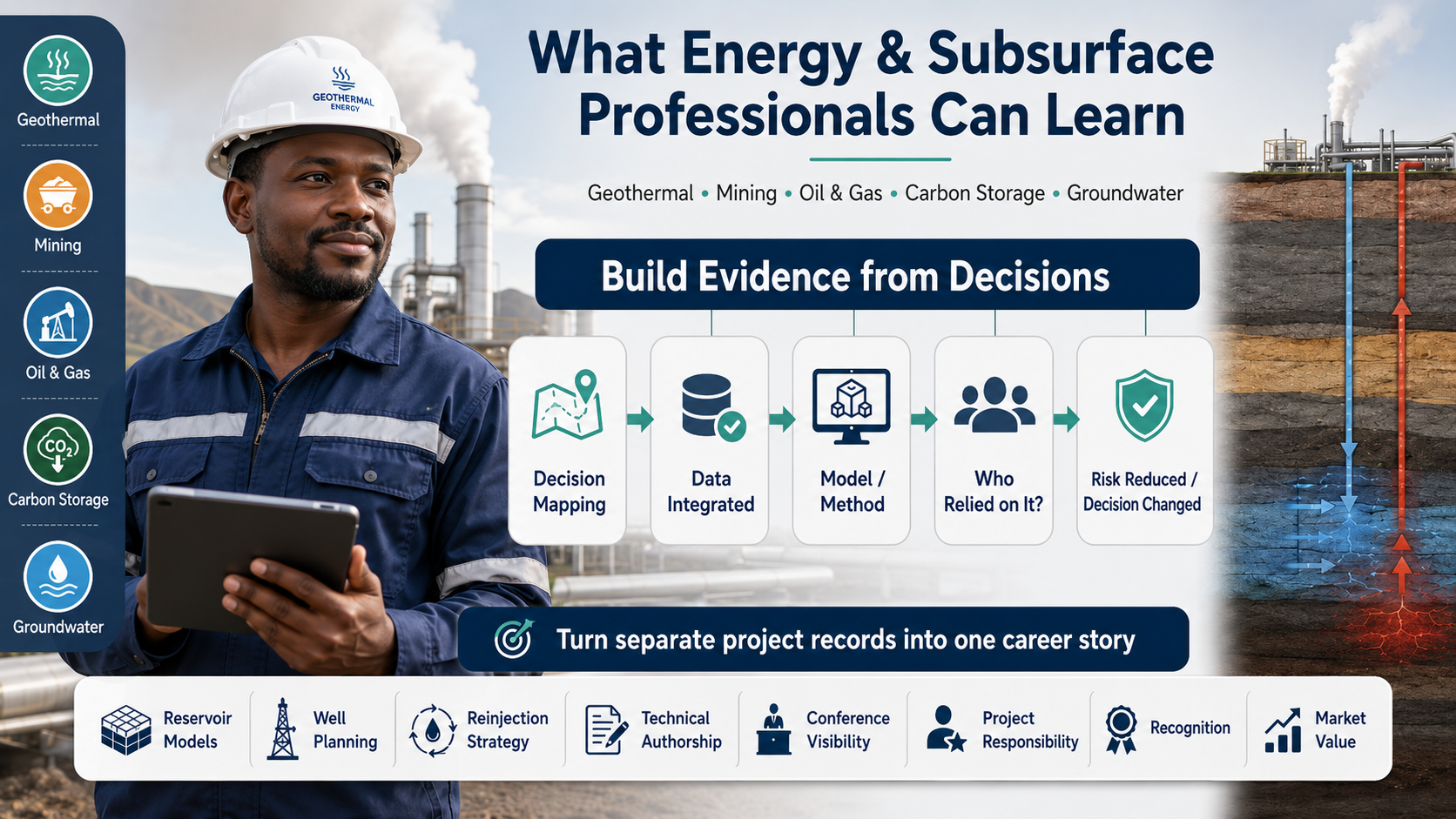
A useful evidence-building process starts with decision mapping. What question did the professional answer? What data did the person integrate? What model, method, or interpretation was personally developed? Who relied on it? What decision changed? What technical or financial risk did it address? Which records can be cleared, and who can independently explain the significance?
For this Kenyan engineer, the profile changed when reservoir models, well-planning influence, reinjection strategy, technical authorship, conference visibility, project responsibility, professional recognition, and market value were organized as one career rather than left in separate operator files.
Frequently asked questions
What is EB-1A?
EB-1A is an employment-based immigrant classification for a person of extraordinary ability in the sciences, arts, education, business, or athletics who satisfies the applicable evidentiary framework and demonstrates sustained national or international acclaim in the final assessment.
Can a geothermal reservoir engineer qualify for EB-1A?
Potentially. The case must be based on the person’s own record. Original technical contributions, scholarly authorship, leading roles, judging, selective membership, published material, high remuneration, awards, or comparable evidence may be relevant depending on the facts.
Can confidential reservoir models be used in an EB-1A petition?
They may be documented through authorized summaries, redacted records, cleared technical descriptions, model-ownership evidence, decision records, and letters from people with direct knowledge. The evidence should establish the contribution without exposing protected well data, commercial information, or proprietary methods.
How can reservoir modeling support the original-contributions criterion?
The record should identify what the petitioner developed or materially advanced and then show major significance through adoption, decision reliance, improved understanding, influence on drilling or field management, use by multiple projects, or independent expert validation. A model’s existence alone is not enough.
Does reducing drilling uncertainty prove extraordinary ability?
It can contribute to the analysis when the evidence explains the technical uncertainty, the petitioner’s method, how decision-makers relied on the work, and the importance of that reliance. The petition should not imply that uncertainty was eliminated or that every drilling outcome was guaranteed.
Can reinjection work be an original contribution?
Yes, when the person developed or advanced a significant method, model, strategy, or interpretation that influenced reservoir management. The evidence should show personal attribution and field significance rather than routine compliance with an existing reinjection plan.
What counts as scholarly authorship for a geothermal engineer?
Qualifying work may include peer-reviewed or appropriate professional articles and conference papers on reservoir modeling, well testing, field performance, reinjection, pressure management, uncertainty, or related technical subjects. The petitioner must be an author, and the publication must meet the applicable requirements.
Can conference presentations support an EB-1A case?
They can strengthen the record by showing public technical contribution, selection, invitations, or professional recognition. A conference appearance is not automatically a separate regulatory criterion, so the petition should explain how the evidence supports authorship, original contribution, leading role, judging, or the final merits analysis.
What proves a leading or critical role in a geothermal project?
The record should establish the reputation of the organization or project and document the petitioner’s actual authority, responsibilities, decision influence, model ownership, coordination role, or technical function on which the project relied.
What counts as published material about the petitioner?
The strongest evidence is professional or major media material substantially about the petitioner and his work. General articles about geothermal energy or a power project may be weaker when the individual is not discussed.
How is high remuneration evaluated?
USCIS considers whether the person commanded a high salary or other significantly high remuneration in relation to others in the field. Relevant comparisons should account for occupation, geography, seniority, sector, and compensation structure. A large number without a credible benchmark may carry little weight.
Does ordinary membership in an engineering society satisfy the membership criterion?
Usually not. The membership criterion requires evidence that admission demanded outstanding achievements judged by recognized experts. Professional-society service may still support the broader record even when ordinary membership does not satisfy the criterion.
Does EB-1A require a U.S. employer or labor certification?
EB-1A does not require a permanent job offer or labor certification, and an eligible person may self-petition. The petition must still show that the person intends to continue work in the area of extraordinary ability in the United States.
How does EB-1A differ from EB-2 NIW for an energy engineer?
EB-1A focuses on extraordinary ability and sustained acclaim under its own evidentiary framework. EB-2 NIW requires EB-2 qualification and a showing that waiving the job-offer and labor-certification requirements is in the national interest. The stronger category depends on the person’s evidence and proposed U.S. work.
How can a confidential engineering career show sustained acclaim?
The record can use repeated project reliance, progressive technical responsibility, publications, invited presentations, review service, professional roles, independent letters, remuneration, later consulting or advisory requests, and other evidence showing recognition over time.
How does ethical profile building help a geothermal engineer?
It identifies existing evidence, creates truthful attribution records, develops cleared technical publications and presentations, improves professional visibility, and organizes the record without inventing project results, exposing confidential data, purchasing false recognition, or overstating team contributions.
Make the reservoir intelligence visible
Subsurface professionals often have stronger records than their public profiles suggest. The evidence may be spread across model archives, well-test files, technical reviews, drilling recommendations, reinjection studies, meeting records, conference proceedings, and the knowledge of colleagues who relied on their judgment.