How blockchain traceability for cobalt and critical minerals became an EB-1A record of technical contribution, independent recognition, and field-level relevance
Key facts at a glance
| Category | Details |
| Outcome | EB-1A approval for a Congolese critical-minerals traceability specialist working with a Europe-based compliance platform. |
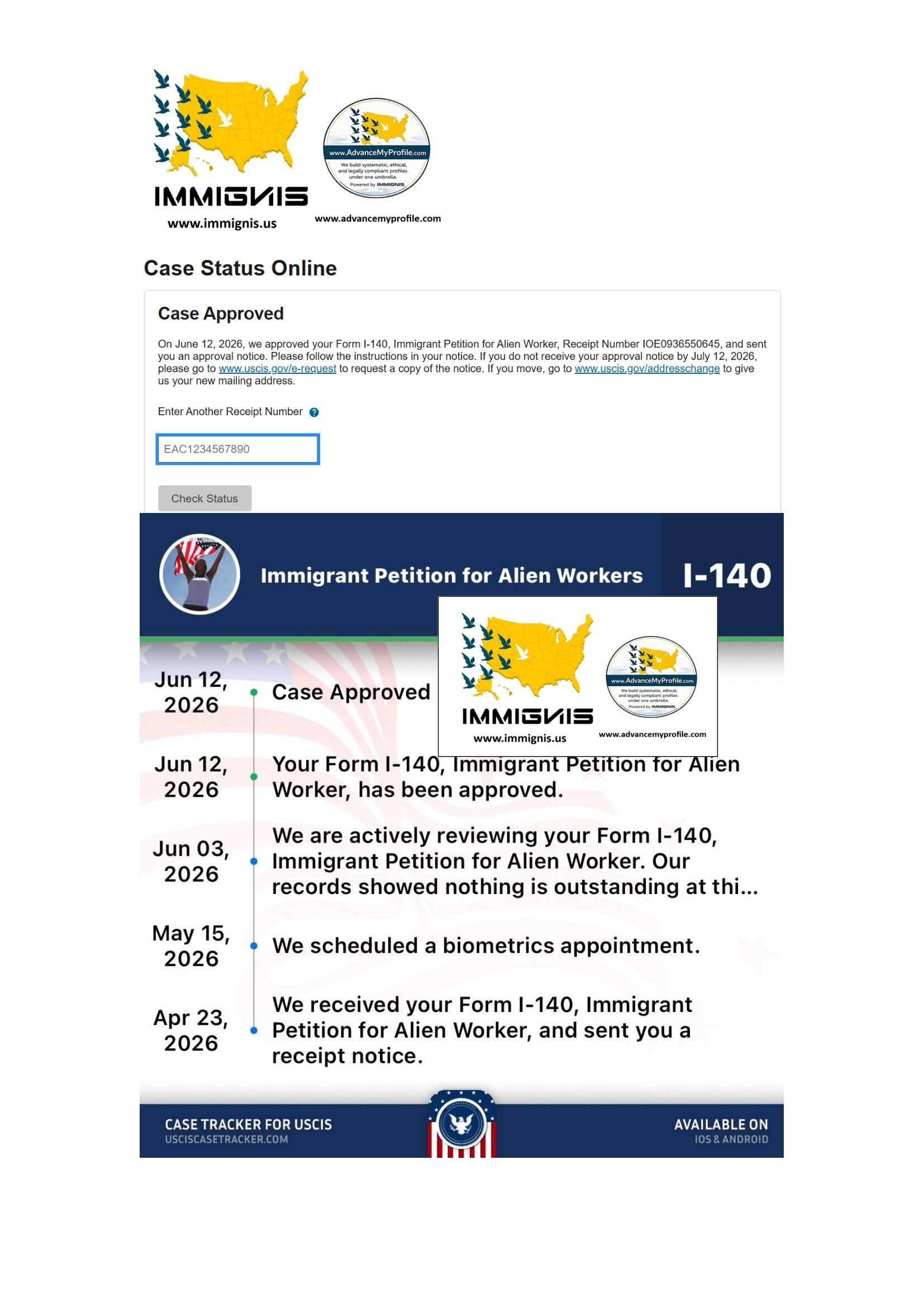
| Approval date | Approved on June 12, 2026. |
| Field niche | Blockchain traceability for cobalt and critical minerals, with a focus on chain-of-custody evidence, risk signals, responsible sourcing, and clean-energy supply-chain integrity. |
| Starting problem | The profile looked compliance-heavy. The work was important, but the early record did not clearly show technical originality or sustained recognition in a defined field. |
| Profile-building path | Traceability papers, platform adoption evidence, a white paper for standards and responsible-sourcing groups, expert commentary, judging, selective membership evidence, leading-role documentation, and independent letters from supply-chain and responsible-sourcing specialists. |
| EB-1A criteria supported in the petition | Original contributions, scholarly articles, published material, judging, memberships, and leading or critical role. |
| Core approval lesson | The petition showed that mineral traceability was not merely corporate compliance. It was a technical contribution to clean-energy supply-chain integrity. |
On June 12, 2026, USCIS approved the Form I-140 petition of a Congolese critical-minerals traceability specialist whose work focused on cobalt and other materials used in clean-energy supply chains, resulting in an EB-1A Green Card Approval.
The approval did not rest on calling him a blockchain expert. That would have been too broad, and it would have missed the real question. His case turned on whether the record could show a specific technical contribution: using traceability architecture to make mineral movement, supplier claims, risk signals, and supporting evidence more reliable across a complicated supply chain.
That distinction mattered. A supply-chain professional can spend years improving responsible-sourcing systems and still appear, on paper, to be a compliance employee. EB-1A requires more. The petition had to show individual expertise, recognized work, and contributions with significance beyond one employer or one platform.
The first problem was that the record sounded like compliance
His background included work with mineral traceability, supplier documentation, platform records, and responsible-sourcing processes. Those subjects are important, but they can sound administrative when they are not explained carefully.
The first version of the profile described audits, due diligence, reporting, and supply-chain compliance. It showed that he worked in a serious field. It did not yet show why his work should be evaluated as technical originality in critical-minerals traceability.
That was the central risk. If USCIS saw only a professional who helped companies document compliance, the case could look ordinary. The petition needed to show the engineering and data-architecture decisions behind the compliance layer.
Advance My Profile, powered by Immignis, reviewed the evidence with legal strategists and supply-chain domain support and narrowed the case to blockchain traceability for cobalt and critical minerals. The field was not framed as general ESG, general mining, or general software. It was framed around the integrity of mineral evidence as material moves from source to later-stage commercial use.
His niche began where a mineral record could lose trust
A cobalt shipment does not become trustworthy simply because a platform records it. A traceability system must answer harder questions: where did the material originate, what evidence supports that claim, who handled it, what transformation occurred, what risk flags appeared, and which documents followed the material through the chain?
Blockchain can help preserve records after they are created, but it cannot fix weak input data by itself. That is why the petition avoided technology hype. It focused on the method used to structure and evaluate chain-of-custody evidence.
The record showed work on supplier declarations, event records, lot or shipment references, supporting documentation, risk indicators, reconciliation across different data sources, and auditability. The specialty was not the word blockchain. The specialty was how traceability evidence could be organized so that responsible-sourcing claims were easier to test and harder to treat as unsupported paperwork.
This was especially important in clean-energy supply chains. Cobalt and other critical minerals can pass through multiple commercial, processing, logistics, and reporting steps before they are associated with batteries, electronics, or industrial systems. When evidence breaks down at one step, later users may still have documents, but not necessarily a reliable picture of origin, custody, or risk.
What USCIS needed to see in this critical-minerals EB-1A case
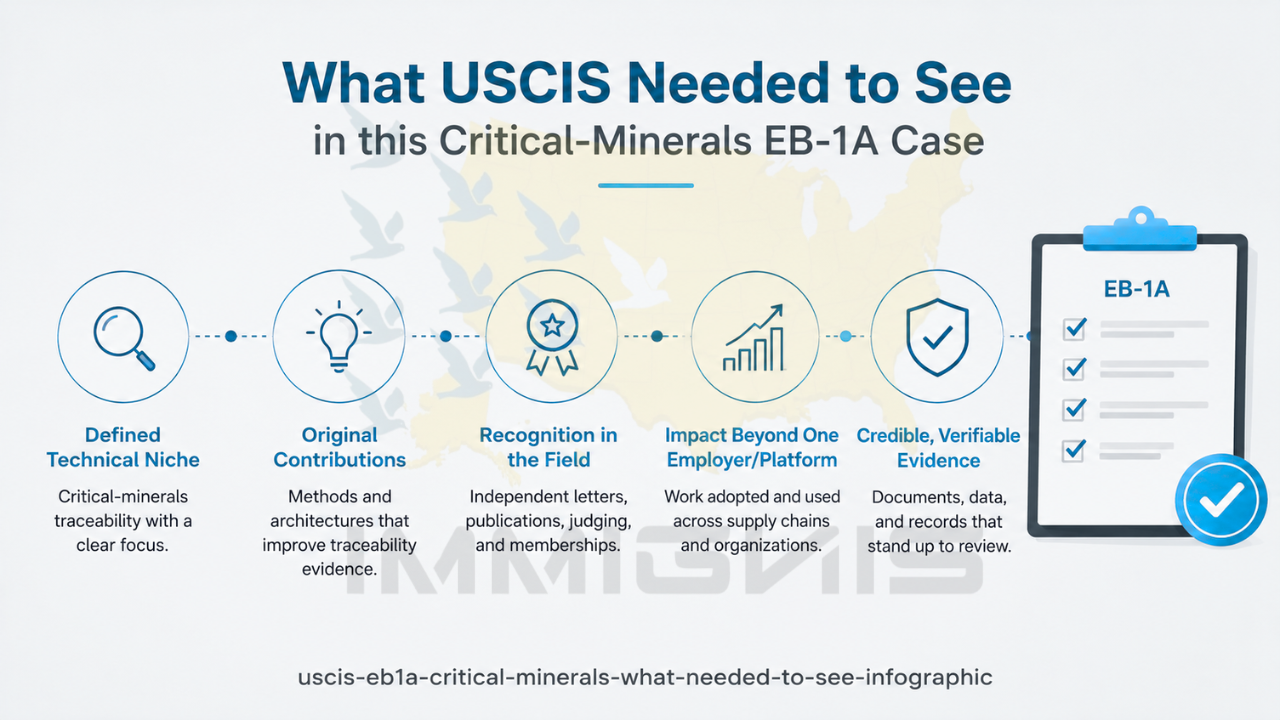
For EB-1A, the petition could not simply argue that critical minerals are important. USCIS needed evidence that this specialist had achieved recognized standing in a defined field and that his own work had significance within that field.
For original contributions, the file had to identify the traceability architecture, risk-evidence method, platform logic, or responsible-sourcing data framework linked to him. The record then needed independent support explaining why that work mattered beyond routine job performance.
Scholarly articles needed to address traceability, critical-minerals supply chains, responsible sourcing, digital evidence, blockchain architecture, or allied supply-chain analytics. Published material required independent coverage about him, his expertise, or his work in critical-minerals traceability.
Judging evidence required real evaluation of other professionals work, not attendance at events or informal opinions. Membership evidence required selective admission or elevation standards tied to achievement. For leading or critical role, the petition had to show why the platform or projects relied on his technical judgment, not merely that he had a job title in a recognized organization.
At final merits, the evidence still had to work together. A few articles, a platform role, and a general supply-chain narrative would not be enough unless the full record described the same expert: a specialist whose work helped make critical-minerals traceability more reliable and usable across responsible-sourcing systems.
The evidence was rebuilt around technical decisions, not reporting labels
The case team reorganized the record by the decisions the traceability system needed to support. What event should be recorded when custody changes? What evidence should be attached to a supplier claim? How should a platform treat missing data, inconsistent records, or a risk signal that appears after material has already moved?
This changed the story. Instead of presenting compliance work as a list of responsibilities, the petition showed a sequence of technical choices: define the material event, connect it to documentation, flag risk, preserve the record, reconcile conflicting information, and make the evidence available for review by downstream users or auditors.
Confidential supplier names, commercial terms, customer data, and sensitive platform details were kept out of the public record. The non-confidential version focused on method, attribution, use, and significance.
That approach also avoided overclaiming. The petition did not say that blockchain alone proves responsible sourcing. It showed how a traceability system can strengthen the evidence chain when it is supported by sound data design, review logic, and adoption by users who need to evaluate mineral origin and risk.
The papers moved the profile from ESG language to supply-chain technology
With domain support, the client developed focused papers on blockchain traceability, responsible-sourcing data, critical-minerals custody records, and the use of digital evidence in cobalt and clean-energy supply chains.
One paper examined why traceability systems fail when they preserve transaction records but do not sufficiently test the evidence behind those records. Another looked at how risk signals can be attached to material movement without turning every missing document into the same level of concern.
The publications gave the petition two advantages. First, they placed his work in a technical literature rather than a corporate ESG narrative. Second, they created public authorship around the same subject that independent experts later discussed in their letters.
Adoption evidence showed that the method was used, not just described
The record included non-confidential platform adoption and use evidence where available. It showed that traceability methods connected to real workflows, responsible-sourcing review, and mineral documentation processes.
Adoption evidence was handled carefully. The petition did not invent user counts, mineral volumes, or compliance outcomes that the records could not support. Where metrics existed, they were tied to the process they measured and the role the client played in building or improving that process.
This was important for original contributions. An internal idea may be useful, but EB-1A requires evidence of significance. The adoption materials helped show that the method did not remain a private concept. It entered practical supply-chain use and gave experts a concrete basis to evaluate its value.
The white paper spoke to standards and responsible-sourcing stakeholders
The white paper was written for readers who work with responsible sourcing, critical-minerals due diligence, standards alignment, and clean-energy supply-chain risk. It explained the traceability problem without pretending that one technology can solve every sourcing challenge.
Its central point was practical: responsible-sourcing systems need evidence that follows the material, not just records that follow the company. A mineral traceability platform must document events, connect them to supporting records, and make inconsistencies visible before later users rely on unsupported claims.
The white paper also explained why critical-minerals traceability matters to clean-energy supply-chain integrity. Batteries, electrification, and advanced manufacturing depend on materials whose sourcing, custody, and risk history may be examined by customers, regulators, investors, and industry partners. The paper connected his technical niche to that wider problem without turning the article into a policy argument.
Published material helped make a technical subject understandable
Independent commentary and media coverage helped move the profile beyond internal platform documents. The strongest public explanations did not praise blockchain in abstract terms. They explained why mineral traceability can fail when companies rely on disconnected declarations, delayed documents, or records that cannot be compared across the chain.
He discussed the difference between visibility and verification. A dashboard can show where a shipment is reported to be. A stronger evidence system asks what supports that report, whether the record has changed, whether risk signals appeared, and whether later users can review the basis for the claim.
That kind of explanation mattered because EB-1A published material is not simply publicity. It helps show that others are discussing the professional and the expertise in a way that supports field recognition.
Judging and membership evidence added independent professional recognition
The petition documented judging activity where he evaluated work by other professionals in supply-chain technology, responsible sourcing, traceability, sustainability innovation, or allied fields. The evidence focused on completed evaluation activity, selection basis, and the nature of the work reviewed.
Selective membership evidence was treated with the same discipline. Open enrollment was not presented as an EB-1A membership criterion. The file identified the association, admission or elevation standard, and whether the process required professional achievement or expert review.
Together, judging and membership evidence helped address a weakness that many corporate specialists face. Their work may be valuable inside a platform, but EB-1A asks whether the field recognizes the person’s expertise. Peer evaluation and selective professional recognition helped answer that question.
Leading-role evidence showed why the platform depended on his judgment
The leading or critical role evidence did not rely only on title. It traced the parts of the platform or project that depended on his technical decisions. The record connected him to traceability architecture, risk-evidence logic, supply-chain data interpretation, or responsible-sourcing functionality used by the organization.
Letters and internal role evidence described why the work mattered to the organization and why his contribution was not replaceable clerical reporting. The most useful evidence identified the technical problem, his role in solving it, and the consequence for the platform or users.
That framing helped separate technical leadership from ordinary compliance participation. It showed a professional whose judgment shaped how critical-minerals traceability evidence was created, preserved, interpreted, and used.
Independent letters explained significance without exaggeration
Independent expert letters were important because the case involved technical work that could easily be misunderstood. Supply-chain documents can look like administrative files until an expert explains the architecture behind them.
The strongest letters came from professionals who understood mineral sourcing, supply-chain data, responsible-sourcing standards, clean-energy materials, or traceability technology. They explained why chain-of-custody design, data reconciliation, and risk evidence matter when critical minerals move through complex commercial networks.
The letters did not need to claim that one platform solved the global cobalt supply problem. The more credible argument was narrower: his work contributed to methods that make mineral evidence more reliable, reviewable, and useful for responsible-sourcing decisions.
How the EB-1A evidence came together
The case worked because the evidence pointed in the same direction. The articles, platform evidence, published material, judging, membership records, leading-role documentation, and expert letters all described a professional working in critical-minerals traceability.
Scholarly articles showed public authorship in the field. Original-contribution evidence identified the traceability method and its use. Published material showed outside discussion of his expertise. Judging showed that other organizations trusted him to evaluate professional work. Memberships added selective recognition where supported. Leading-role evidence connected the technical contribution to significant platform activity.
The final-merits argument did not depend on one dramatic exhibit. It depended on the way the full record changed the picture. A compliance-heavy profile became a defined authority record in blockchain traceability for cobalt and critical minerals.
The approval
USCIS approved the Form I-140 on June 12, 2026.
For the client, the approval recognized a record that had been easy to underestimate. His strongest work was not only in helping organizations meet compliance expectations. It was in building and explaining the technical evidence systems that make responsible-sourcing claims more reliable.
For other professionals in critical minerals, ESG technology, responsible sourcing, and supply-chain analytics, the lesson is direct: do not let the language of compliance hide the technical method. EB-1A cases often become stronger when the record identifies the problem, the method, the use of the method, and the recognition that followed.
What this case teaches critical-minerals and supply-chain technology professionals
Many professionals in responsible sourcing, mining compliance, ESG platforms, and supply-chain technology assume that their work is too corporate for EB-1A. Sometimes the problem is not the work. The problem is the way the work is documented.
A strong EB-1A record must show more than employment in an important industry. It should identify a precise professional niche, explain the person’s own contribution, document adoption or use where possible, build public authorship, obtain credible independent recognition, and present the evidence under the correct EB-1A criteria.
For critical-minerals traceability specialists, the strongest story may sit inside the evidence chain: how material data is recorded, verified, reconciled, risk-flagged, and used by people who depend on supply-chain integrity.
Advance My Profile and Immignis help professionals identify that kind of defensible authority niche, develop evidence that can be verified, and prepare an EB-1A record around real professional work rather than generic titles or broad industry claims.
Frequently asked questions
Can compliance or ESG work support an EB-1A case?
Yes, but the petition should not rely on broad compliance language alone. It should identify the technical, analytical, policy, or professional contribution linked to the applicant and show why that contribution has significance in the field.
Is blockchain traceability automatically an original contribution?
No. Using blockchain technology does not automatically establish EB-1A significance. The petition must explain the applicant’s own method, how it was used, why it mattered, and how independent evidence supports that claim.
Can platform adoption help prove original contributions?
Platform adoption can help when it is documented and tied to the applicant’s specific contribution. Adoption evidence is stronger when it shows use of the method, the problem it addressed, and the applicant’s role in developing or improving it.
Does EB-1A require a PhD for supply-chain technology professionals?
No. EB-1A does not require a PhD. A strong record may be built through original contributions, professional recognition, published material, judging, scholarly or technical authorship, selective memberships, leading or critical roles, and other qualifying evidence.
What is the biggest mistake in EB-1A cases for corporate traceability professionals?
The biggest mistake is allowing the record to sound like ordinary job performance. The petition should show what the applicant created, improved, influenced, or was recognized for, and why that work matters beyond the employer.
Build an EB-1A record around the technical work behind responsible sourcing
If you work in critical minerals, clean-energy supply chains, responsible sourcing, blockchain traceability, ESG data systems, mining technology, or supply-chain integrity, your strongest EB-1A evidence may already exist in your work. It may simply be hidden inside platform records, technical architecture, adoption evidence, white papers, professional recognition, or expert explanations.