Key facts at a glance
| Outcome | EB-1A approval for a Spanish renewable grid engineer working as a U.S. based utility consultant. |
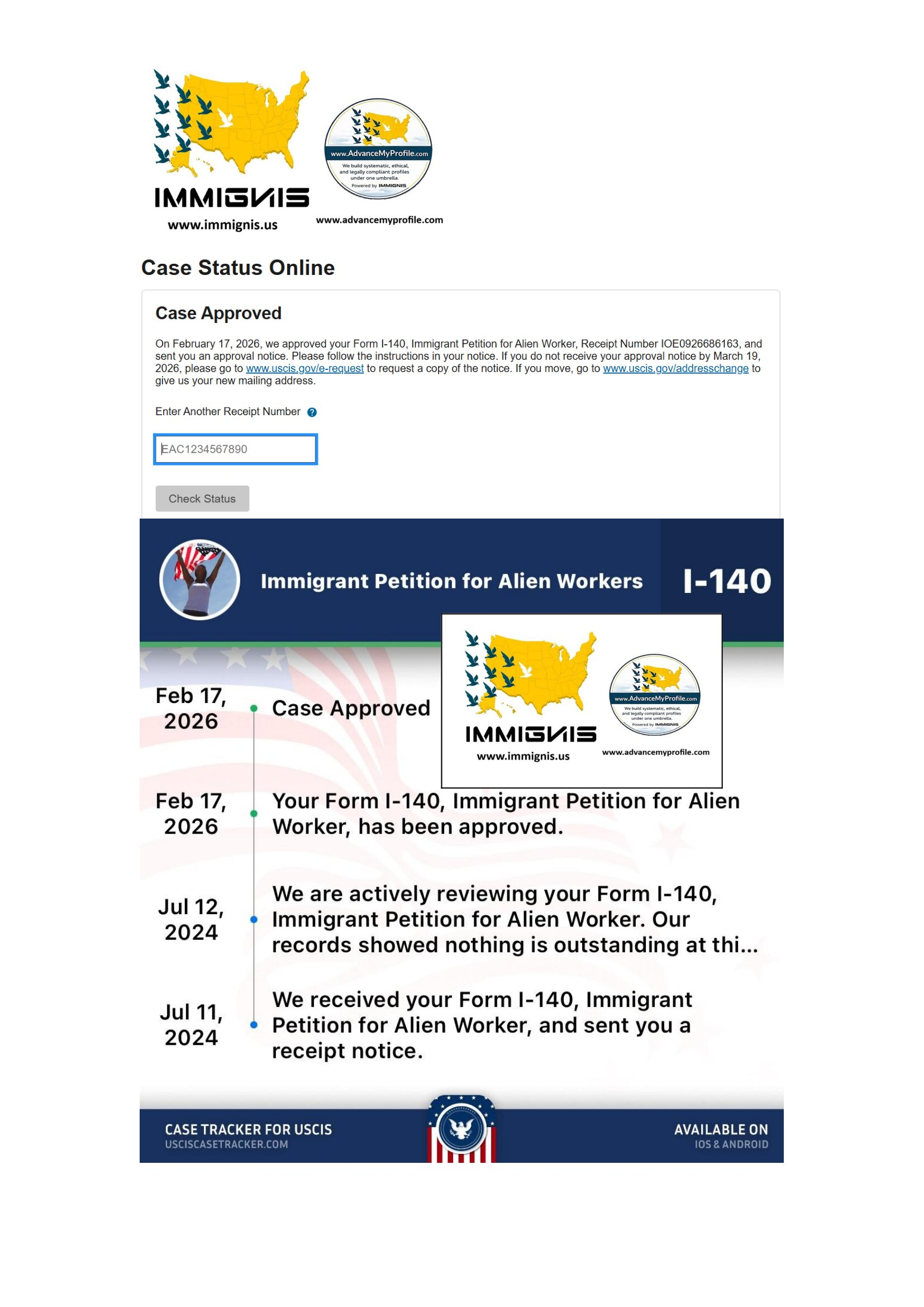
| Approval date | Approved on February 17, 2026. |
| Field niche | Grid-forming inverter integration for renewable reliability and power system stability. |
| Starting problem | Strong implementation experience, but limited public recognition and little evidence separating his individual technical influence from client projects. |
| Path used | Ethical EB-1A profile building through technical papers, a utility facing white paper, conference workshop, standards-group participation, media coverage and quotes, peer review, selective membership, and independent letters from grid researchers and utility executives. |
| USCIS EB-1A criteria activated | Original contributions, scholarly articles, published material, judging, memberships, and leading or critical role. |
The EB-1A grid engineer approval appeared on February 17, 2026. For an engineer who had spent years studying what happens when renewable power meets a grid that was designed for rotating machines, the case-status screen carried an unusual kind of simplicity: Case Approved.
His technical work had never been simple. He worked with grid-forming inverter integration, one of the hard engineering questions behind renewable reliability. He understood control behavior, system strength, interactions between inverter based resources, and the practical gap between a promising model and a utility system that must remain stable when conditions change. Yet when he first considered an EB-1A green card, the professional record visible outside his projects did not match the engineer utilities relied on. The work was there. The recognition was not.
Why did a strong renewable-grid career still look weak on paper?
The problem was not experience. The problem was attribution and field recognition.
Utility consulting creates a peculiar evidence challenge. Important technical decisions may sit inside client reports, simulation reviews, integration studies, commissioning discussions, and confidential project files. A consultant may influence how a system is assessed or how inverter behavior is understood, yet the public record shows only an employer name and a job title.
That was his starting point. His implementation background was strong, but USCIS would not automatically know which grid-integration insights were his, whether those insights mattered beyond one client engagement, or whether experts outside his employer recognized him as a specialist in grid-forming inverter reliability.
The EB-1A green card is a self-petition immigrant category for people who can show extraordinary ability through sustained national or international acclaim and a record placing them among the small percentage at the top of their field.
His concern was immediate. He did not have the kind of public profile people usually imagine when they hear the words sustained acclaim.
He had utility problems, technical judgment, and implementation experience. What he lacked was a record that made those things visible.
What did Immignis see in the original profile?
Immignis saw an engineer with a real niche hidden inside a broad renewable energy résumé. The original profile could easily have been described as power systems, renewable integration, inverter consulting, grid studies, and utility support. All of those descriptions were true. Together, they were too wide.
Advance My Profile, powered by Immignis, narrowed the authority story to grid-forming inverter integration for renewable reliability.
That decision changed the build. Grid forming inverters are not simply another renewable energy topic. The case had to show why his work concerned the behavior of inverter based resources when power systems face lower synchronous generation, changing system strength, frequency and voltage challenges, and the need for stable control interactions.
Now the evidence had a technical center.
The question was no longer, ‘Is he a good renewable energy engineer?’ The question became, ‘Has his work on grid forming inverter integration earned independent recognition because it contributes to the reliability of renewable-heavy power systems?’ That was a much stronger EB-1A question.
What did USCIS need to see in this grid-forming inverter case?
USCIS needed to see the difference between routine grid consulting and recognized technical influence in a defined engineering field.
For original contributions, the petition had to identify the engineer’s own methods, technical analysis, or integration approaches and explain why they mattered to grid forming inverter reliability. General statements about ‘supporting renewable projects’ would not have been enough.
For leading or critical role evidence, the file needed to show why his technical responsibilities mattered inside important utility-facing work. A senior title alone would not explain whether decision-makers relied on his judgment in stability assessment, inverter integration, or system performance questions.
For the final merits review, the officer also needed a pattern of independent recognition. Were other researchers and utility professionals engaging with his ideas? Was he invited to explain the work? Was he trusted to review technical scholarship? Did selective professional bodies recognize his standing? Did independent experts understand his contribution without simply repeating his résumé?
The case therefore had to connect implementation evidence with field recognition. A paper without utility relevance would be incomplete. A utility project without individual attribution would be incomplete. A standards group without selective or substantive participation would be incomplete.
The petition needed the pieces to point in the same direction. That direction was grid-forming inverter reliability.
How did Advance My Profile turn implementation work into an authority record?
The build did not begin with awards or media. It began with technical focus. Legal strategists and power systems domain experts reviewed his work and identified the problems he could discuss credibly without exposing client confidential material. The roadmap separated what could be documented publicly from what had to remain inside protected project files.
Then the publication work began. With domain support, he developed focused technical papers around inverter reliability, control interactions, and the integration questions that arise when inverter based resources play a larger role in power-system behavior. The topics were chosen to deepen one niche rather than scatter his name across unrelated energy themes.
The papers gave his expertise a scholarly record. They also created something his original profile lacked: a public technical vocabulary attached to his name.
A utility facing white paper followed. This was deliberately different from an academic article. It translated grid forming inverter questions into the concerns of utility and grid management audiences: reliability, integration risk, system behavior, operational confidence, and the need to understand how control strategies interact with real networks.
The white paper was shared with relevant industry and utility audiences. Its purpose was not to create a document for the petition file and forget it. The purpose was to put his analysis in front of the people who work with the problem.
Conference visibility came next. A workshop format allowed him to explain technical issues, compare integration concerns, and engage with engineers who understood the difference between a generic renewable presentation and a serious discussion of inverter-driven system behavior.
Standards-group participation strengthened the field narrative. Immignis did not present participation itself as an automatic EB-1A criterion. Instead, the evidence showed that his technical focus placed him in professional discussions where grid reliability and inverter integration were being evaluated by specialists.
Media work was also kept close to the niche. Energy and power-system coverage sought his comments on renewable reliability, inverter behavior, and the engineering limits of simply adding more inverter-based generation without understanding system interactions.
The public record began to change. He was no longer visible only as a consultant attached to client projects. He was increasingly visible as a technical voice on a specific reliability problem.
Why were peer review, selective membership, and independent letters important?
Because EB-1A is not built only from what a professional says about himself. Peer-review service showed that technical publications trusted him to evaluate the work of other researchers. In a field where control models, simulation assumptions, and stability conclusions can be highly specialized, that evaluating role mattered.
Selective professional membership was approached carefully. The team looked for membership levels or professional recognition that depended on achievement, experience, or expert assessment rather than ordinary payment of dues.
Independent letters then gave the petition an outside technical voice.
Grid researchers explained why grid-forming inverter integration has become an important power-systems problem. Utility executives explained why technical judgment in this area matters in implementation settings. The letters were drafted around specific aspects of his work, not generic praise.
The distinction was important. A letter saying an engineer is ‘excellent’ adds little. A letter explaining how his analysis addressed control interaction, renewable reliability, or grid-integration risk gives the adjudicator something to evaluate.
Advance My Profile helped organize the referee strategy and prepared evidence-based drafts that the experts could review, revise, and sign only where accurate. Everything stayed tied to the same technical identity.
Why did ethical profile building matter in a power-systems case?
Power engineering has a long memory. Technical papers can be read years later. Conference presentations can be challenged by other engineers. Utility professionals can ask how a claimed method actually works. Standards communities notice when someone overstates a role.
That makes fake profile building especially dangerous. A weak journal, invented award, paid citation scheme, or exaggerated project claim may be created for one immigration filing, but the digital record can follow the professional long after the case is decided.
Immignis took the opposite approach. The papers had to reflect his true technical competence. The white paper had to address a real utility problem. Media commentary had to stay within his field. Peer review had to be genuine. Membership evidence had to be selective where claimed. Independent experts had to understand the contribution they were discussing.
This is the difference between profile decoration and profile building. Profile decoration tries to create the appearance of extraordinary ability for one filing.
Profile building develops a professional record the engineer can continue to use in research, industry discussions, conference work, utility engagement, and future leadership.
The visa result matters. The professional identity should last longer.
Could your own EB-1A profile be stronger than your public record suggests?
If your strongest engineering work lives inside utility studies, proprietary models, client reports, or implementation projects, the absence of a large public profile does not automatically mean the career lacks value.
It may mean the contribution has not been documented correctly.
Immignis offers a free profile assessment to identify the applicant’s true technical niche, the evidence already available, the criteria that may be developed honestly, and the gaps that cannot be solved by petition writing alone.
A lawyer or petition writer can organize evidence. No one can argue convincingly from evidence that was never built.
Which USCIS EB-1A criteria did the final Form I-140 petition activate?
Original contributions: The petition connected his grid-forming inverter integration work to renewable reliability and explained his individual technical influence through implementation evidence, focused publications, the utility white paper, and independent expert analysis.
Scholarly articles: Technical papers created a coherent authorship record in grid-forming inverter behavior, inverter-based resource integration, and power-system stability.
Published material: Energy and power sector coverage discussed his work and expertise, while field-specific media sought his comments on renewable-grid reliability and inverter integration.
Judging the work of others: Peer-review assignments showed that technical publication venues trusted him to assess research by other power systems professionals.
Memberships: Selective professional membership evidence was tied to achievement-based or expert evaluated standing rather than ordinary open enrollment.
Leading or critical role: Project and organizational evidence showed that his technical judgment was important to distinguished utility-facing work involving inverter integration and renewable reliability.
The final merits narrative brought the criteria together. It did not argue that every paper, workshop, standards discussion, media feature, review assignment, and expert letter independently proved extraordinary ability.
It showed a pattern. His implementation experience created the technical foundation. Focused authorship made the work public. Utility facing writing translated it for industry. Conference and standards activity placed him in professional discussion. Peer review showed evaluative trust. Selective membership and independent letters added outside recognition.
Taken together, the record described a specialist whose work and recognition converged on one field.
Grid-forming inverter integration for renewable reliability.
What did the February 2026 EB-1A approval mean?
The Form I-140 approval came on February 17, 2026. The case had been received in July 2024. By the time of approval, the professional record presented to USCIS looked very different from the broad implementation profile that had started the process.
He had focused technical authorship. A utility facing white paper. Conference visibility. Standards-group participation. Media recognition. Peer-review work. Selective professional membership. Independent validation from grid researchers and utility executives.
The approval gave him an EB-1A self-petition path without employer sponsorship or a labor certification requirement. But the case also produced something harder to measure.
His name now had a technical center. When another engineer, researcher, utility executive, or industry journalist encountered his work, the field association was clearer: grid-forming inverter integration and renewable reliability.
The EB-1A approval was the immigration result. The authority record was the career asset.
If this sounds like your engineering career
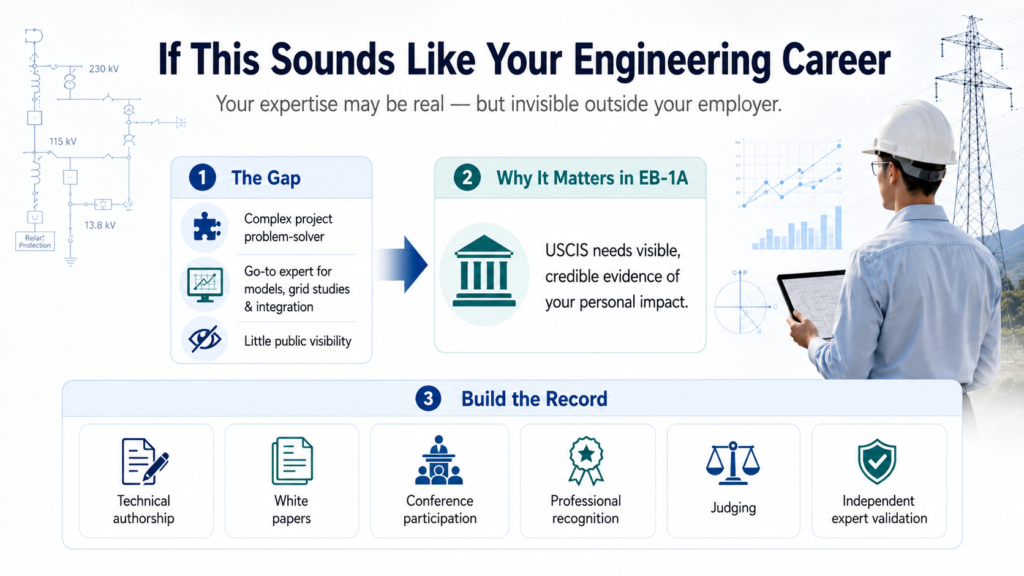
You may have spent years solving problems that exist only inside complex projects.
You may be the person colleagues call when a model behaves strangely, a grid study raises questions, or an integration assumption does not match operating reality.
Yet your name may barely exist outside your employer. That gap matters in EB-1A.
The answer is not to invent a public record. The answer is to build one from the expertise you already own: focused technical authorship, field-relevant white papers, conference participation, legitimate professional recognition, judging, independent expert validation, and evidence that clearly identifies your personal contribution.
Build something you can explain to USCIS. Build something you can also explain to the next utility engineer who asks how your method works.
FAQs
Can grid-forming inverter work support an EB-1A original-contribution claim?
Yes, when the evidence shows more than routine project participation. The petition should identify the applicant’s individual technical contribution, explain why it mattered to inverter integration or grid reliability, and support the significance with implementation evidence, technical publications, adoption or use evidence, and independent expert analysis.
How can a utility consultant prove personal influence when client projects are confidential?
The case should separate protected client information from evidence that can be documented safely. Technical summaries, role evidence, non-confidential methodologies, focused papers, white papers, and independent letters can help show what the engineer personally contributed without disclosing grid data, customer information, or proprietary models.
Does standards-group participation automatically satisfy the EB-1A membership criterion?
No. Ordinary participation in a standards or working group is not the same as membership in an association that requires outstanding achievements judged by recognized experts. Standards activity can still strengthen the final merits story by showing field engagement, while a membership claim needs evidence about the organization’s actual admission requirements.
Why was a utility-facing white paper useful in this case?
The white paper translated grid-forming inverter research into utility reliability questions. It helped show that the engineer’s expertise was not confined to academic theory and created a public, field facing document that industry stakeholders could review, share, and discuss.
Can peer review help a power systems engineer even without a university job?
Yes. The judging criterion focuses on evaluating the work of others, not on holding a faculty title. Genuine journal peer review or comparable technical evaluation work can show that a professional has been trusted to assess other experts’ work in power systems or a closely related specialty.
Do I need a PhD, a patent, or a large citation count for an EB-1A grid engineering case?
No single one of those is automatically required. A PhD can support expertise, a patent can support an original contribution story, and citations can help show recognition, but the decisive question is the total evidence of sustained acclaim and top-level standing in the defined field. For an implementation focused engineer, strong attribution, independent recognition, judging, authorship, selective professional standing, and critical role evidence may be more important than copying an academic profile.
Build an EB-1A success story around the engineering work you already own
If you work in power systems, renewable integration, grid-forming inverters, utility analytics, energy storage, or another advanced engineering field, your strongest achievements may already exist inside projects that the public cannot see.
Immignis and Advance My Profile help professionals identify a defensible niche, build credible field recognition, document individual impact, and assemble an EB-1A record around evidence that is real and verifiable.