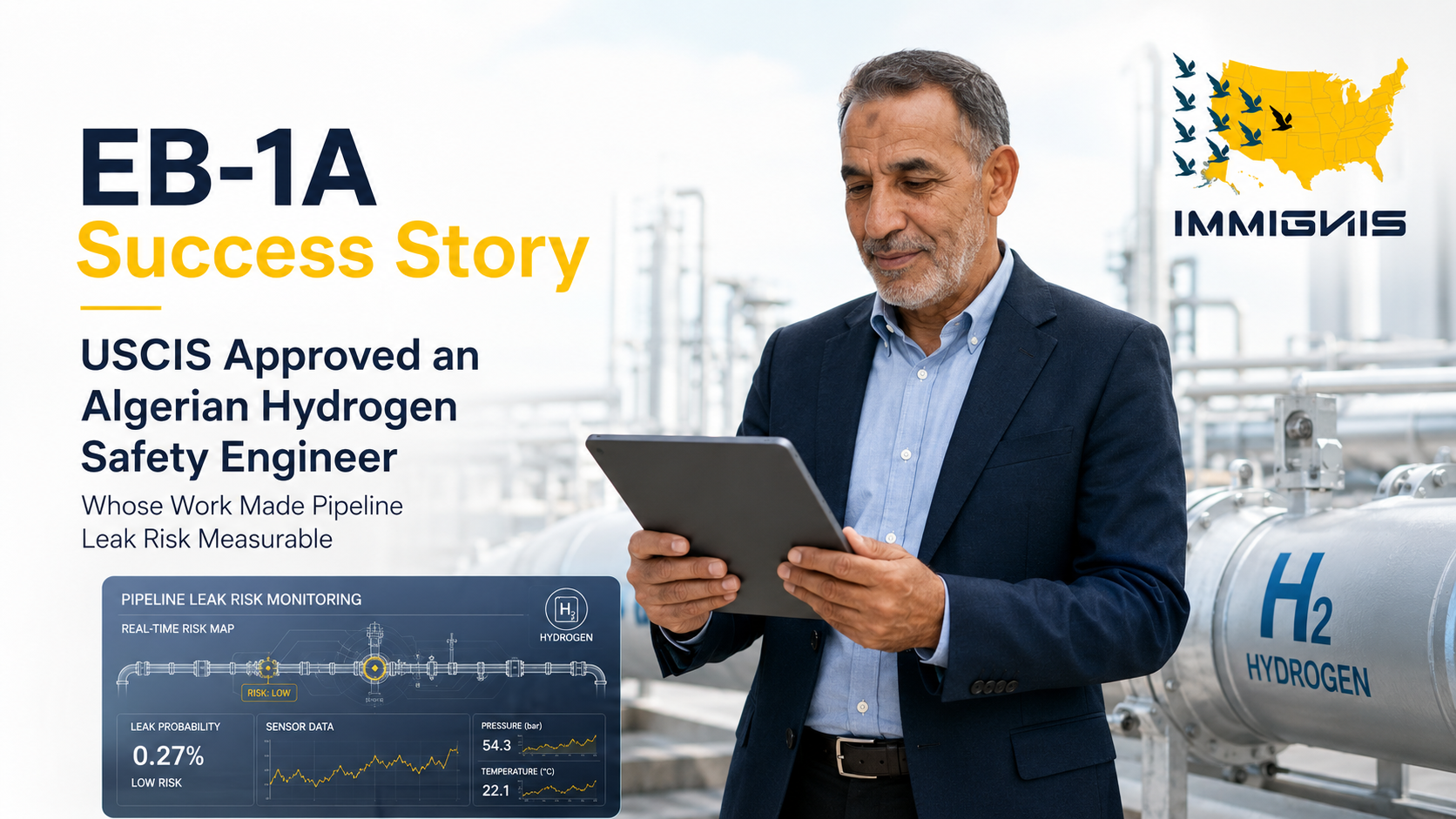
How a Germany-based energy engineer built an EB-1A record around hydrogen pipeline safety, leak-risk modeling, and the reliability of emerging energy infrastructure
Key facts at a glance
| Outcome | EB-1A approval for an Algerian hydrogen safety engineer working at a Germany-based energy firm. |
| Approval date | Approved on May 15, 2026. |
| Field niche | Hydrogen pipeline safety and leak-risk modeling, with a focus on material compatibility, leakage pathways, monitoring logic, and risk models for emerging hydrogen infrastructure. |
| Starting problem | His hydrogen expertise was real, but the public record did not yet show a sustained reputation outside employer-based energy work. |
| Profile-building path | Focused hydrogen-safety papers, a risk-model white paper for energy stakeholders, standards participation, media commentary, invited speaking, peer review, patent-disclosure evidence, and independent letters from hydrogen and pipeline-safety experts. |
| Evidence presented under EB-1A criteria | Scholarly articles, original contributions, published material, judging, memberships, and supporting patent-disclosure evidence tied to original contributions. |
USCIS approved his Form I-140 on May 15, 2026.
The approval did not rest on the broad statement that hydrogen is important. It rested on a narrower and more difficult claim: this EB-1A Hydrogen Safety Engineer had developed recognizable expertise in hydrogen pipeline safety and leak-risk modeling, and the evidence showed that the work mattered beyond one employer.
That distinction mattered because emerging energy fields can create a false sense of security for EB-1A applicants. Hydrogen appears constantly in policy discussions, investment plans, and infrastructure roadmaps. But a national conversation about hydrogen is not the same as proof that one engineer has sustained acclaim in the field.
Before the petition was built, his strongest work was inside energy projects. The work involved safety analysis, modeling, technical review, and infrastructure decisions, but much of it read like internal engineering responsibility. Advance My Profile, powered by Immignis, helped convert that under-documented record into a focused EB-1A profile without exposing confidential project information.
The real story was not hydrogen. It was safety under uncertainty.
Hydrogen infrastructure raises different safety questions from ordinary pipeline work. Hydrogen molecules are small, leakage behavior can be difficult to monitor, and teams must consider material compatibility, pressure cycling, connections, valves, sensors, dispersion, inspection intervals, and the way a system behaves as operating conditions change.
The engineer had worked at the point where those questions become practical. A pipeline segment, storage connection, compressor interface, or monitoring system may look acceptable under one assumption and become more difficult under another. The safety question is not only whether hydrogen can move through the system. It is whether the risk has been identified, modeled, monitored, and reduced in a way that operators and engineers can use.
His initial professional record did not make that clear enough. It showed participation in energy projects, safety reviews, and technical decisions. It did not yet tell a reader why his work should be understood as a distinct contribution to hydrogen pipeline safety.
Why the case needed a sharper field definition
A broad field such as clean energy would have weakened the case. So would a generic description such as hydrogen engineering. EB-1A analysis benefits from a field that is neither artificially narrow nor too vague to evaluate.
The petition defined his specialty as hydrogen pipeline safety and leak-risk modeling. That field allowed the evidence to focus on a specific professional problem: how to identify, model, and monitor leak risk in hydrogen infrastructure before it becomes a reliability or safety failure.
Once the field was defined that way, scattered evidence began to connect. Technical papers, patent-disclosure evidence, standards participation, invited talks, media commentary, peer review, and independent letters could all answer the same question: had this engineer become recognized for work that helped the energy field understand hydrogen pipeline safety?
What USCIS needed to see in this EB-1A case
USCIS did not need a lesson in why hydrogen energy exists. It needed evidence that the petitioner had risen above routine engineering work in a defined area of expertise.
For original contributions, the petition identified his leak-risk modeling approach, safety-analysis methods, monitoring logic, and technical concepts that could be attributed to him. The record then explained why those contributions had significance in the context of hydrogen infrastructure.
For scholarly articles, the publications had to do more than add paper titles to the file. They needed to show a coherent subject: hydrogen pipeline leakage, safety modeling, material and monitoring considerations, and risk analysis for energy infrastructure.
For published material, the coverage had to discuss him or his expertise, not merely mention hydrogen as a trend. For judging, the record needed evidence that he evaluated the work of other specialists through peer review or comparable technical review activity. For memberships, the petition had to document selectivity, advancement standards, or achievement-based admission where applicable.
Patent-disclosure evidence helped trace technical ideas to him, but it was not treated as a separate EB-1A regulatory criterion. It supported the original-contribution argument only where the record could explain the problem addressed and his role in the technical concept.
The confidential engineering record had to become public without becoming careless
One challenge was confidentiality. Energy companies often protect pipeline designs, operating conditions, sensor architecture, facility names, performance assumptions, and safety-review records. A petition cannot simply publish employer data to make an immigration case stronger.
The solution was to separate the method from protected project details. The public record described the type of engineering problem, the categories of risk considered, and the logic of modeling and monitoring without disclosing proprietary operating data.
The evidence was organized around practical safety questions: where could leakage occur, what factors could change risk, which materials or interfaces required review, what monitoring evidence would be meaningful, and when should a model prompt closer inspection or engineering action?
That structure gave independent experts something to evaluate. They did not need confidential pipeline maps to understand why better leak-risk modeling could matter in hydrogen infrastructure.
The publications gave the case a consistent technical record
With domain support, the engineer developed focused papers on hydrogen leak-risk modeling, pipeline safety, detection strategies, material compatibility, and risk analysis for emerging hydrogen infrastructure.
The best papers did not try to make hydrogen sound futuristic. They stayed with engineering problems that safety professionals recognize: how leak pathways form, how monitoring assumptions can fail, how models should account for operating conditions, and why material or interface choices can change the risk picture.
This was important for EB-1A because publications are more persuasive when they reinforce a defined authority niche. A collection of unrelated energy papers can look productive but unfocused. Here, the publications helped show that his professional identity was increasingly tied to hydrogen pipeline safety.
The white paper explained risk modeling to the right audience
The hydrogen-safety white paper was written for energy firms, infrastructure planners, safety managers, and technical groups evaluating hydrogen pipeline deployment.
Its value was not promotional. It explained how leak-risk modeling can help teams think before deployment and during operation: identify vulnerable interfaces, consider material and pressure behavior, evaluate sensor placement, define inspection logic, and connect model output to safety decisions.
The paper also avoided exaggerated claims. A risk model does not eliminate hydrogen leakage. A monitoring system does not replace engineering judgment. The record presented the work as a disciplined contribution to decision-making, not as a guarantee of perfect safety.
Standards participation helped show professional engagement beyond one employer
Standards-related activity can be useful in an EB-1A case when it is documented accurately. The petition identified the relevant group or technical process, his role, and the hydrogen-safety subject matter involved.
The evidence did not treat standards participation as a stand-alone shortcut to approval. Instead, it showed that his technical judgment was entering broader discussions about how hydrogen infrastructure should be evaluated and managed.
That mattered because one of the starting weaknesses was that his work appeared employer-based. Standards participation helped place his expertise in a wider professional setting.
Media commentary made an emerging safety issue understandable
Trade and technical media helped translate a specialized engineering field for readers who were following hydrogen development but did not necessarily understand pipeline safety.
The engineer explained why hydrogen safety involves more than adding sensors to an existing system. He discussed leakage pathways, operating assumptions, monitoring limits, and the need to connect detection data to engineering response. He also addressed why safety planning must evolve as hydrogen projects move from pilot activity to larger infrastructure use.
For the published-material criterion, the petition focused on coverage that discussed him or his expertise. General articles about hydrogen infrastructure were not enough unless they connected to his work in a qualifying way.
Peer review and invited speaking strengthened the recognition record
Peer review became part of the judging evidence because he evaluated work produced by other researchers and engineers. The file documented review activity in hydrogen safety, energy infrastructure, risk analysis, or related engineering areas where available.
His invited talk addressed the point at which hydrogen safety analysis becomes operational: how teams decide what needs monitoring, which risk assumptions should be tested, and when model results should lead to inspection, redesign, or closer review.
The speaking evidence was not presented as performance or visibility alone. It was used to show that others were asking him to explain a specialized safety problem to professionals in the field.
Independent expert letters connected the engineering work to field significance
Independent letters were important because the original record could have been mistaken for strong internal employment. The letters helped explain why hydrogen leak-risk modeling is not ordinary maintenance work and why the petitioner’s contribution had relevance beyond one company.
The strongest letters did three things. They identified the technical problem, explained the method or contribution attributed to him, and described why that contribution mattered in hydrogen pipeline safety or emerging energy infrastructure.
They avoided unsupported praise. A letter that simply calls someone brilliant is less useful than a letter that explains how a risk model, monitoring approach, or safety framework changes the way engineers evaluate hydrogen infrastructure.
How the EB-1A evidence worked together
The petition did not depend on one impressive document. It worked because the evidence pointed in the same direction.
- Scholarly articles showed a focused body of work in hydrogen pipeline safety and leak-risk modeling.
- Original-contribution evidence identified methods and technical concepts linked to the engineer, supported by patent-disclosure materials and expert analysis.
- Published material showed that his expertise was discussed outside the employer environment.
- Judging evidence documented peer review and technical evaluation of work by other specialists.
- Membership and standards-related evidence helped show professional recognition and field engagement where supported by actual requirements.
- Independent letters connected the technical record to the practical significance of safer hydrogen infrastructure.
At final merits, the point was not that hydrogen is a promising sector. The point was that this engineer had a coherent record of specialized work, recognition, and professional judgment in a safety-critical part of that sector.
The approval
USCIS approved the Form I-140 on May 15, 2026.
For the client, the approval confirmed that a highly technical energy-safety career could be presented as an EB-1A case when the evidence was organized around a real field contribution. His petition did not need to reveal protected project data or claim ownership of an entire hydrogen economy. It needed to show his own role in a defined area of pipeline safety and leak-risk modeling.
That is the lesson many energy engineers miss. A strong employer, a respected project, and a hot sector can help create context, but they do not replace evidence of individual acclaim. EB-1A requires a record that shows what the person contributed, how others recognized it, and why the contribution matters in the field.
What hydrogen and clean-energy engineers can learn from this case
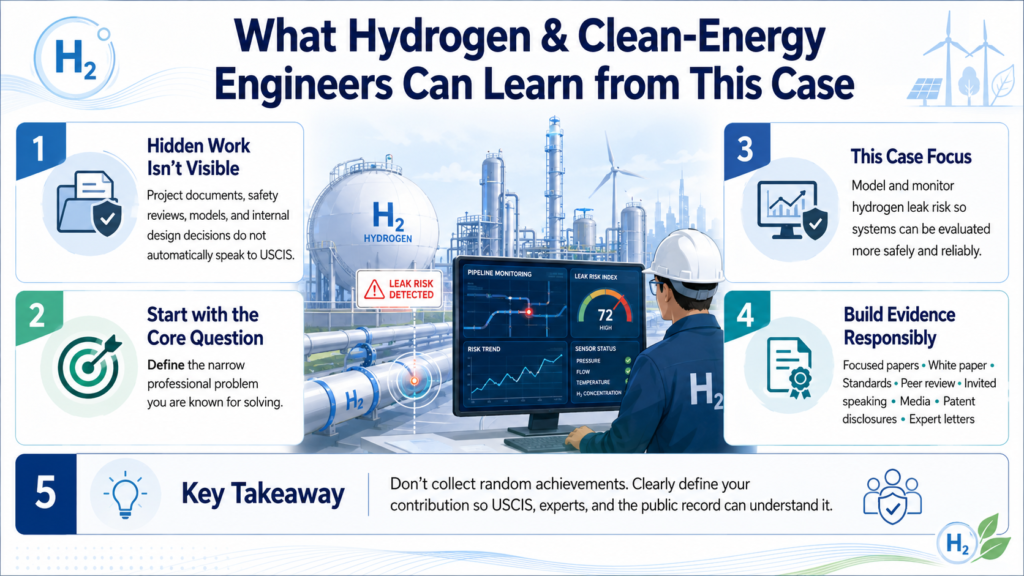
Engineers in emerging energy fields often have serious work hidden inside project documents, safety reviews, modeling files, and internal design decisions. That work may be valuable, but it is not automatically visible to USCIS.
A stronger EB-1A strategy begins by identifying the narrow professional question the engineer is known for answering. For this client, the question was not simply how to build hydrogen infrastructure. It was how to model and monitor leak risk so that hydrogen systems could be evaluated more safely and reliably.
Once that question was clear, the evidence could be built responsibly: focused papers, a technical white paper, standards engagement, peer review, invited speaking, media explanation, patent-disclosure evidence, and independent expert letters. Each item had a role. None was treated as a shortcut.
If your strongest work is buried inside hydrogen, renewable energy, infrastructure safety, pipeline engineering, or technical risk modeling, the first step is not to collect random achievements. The first step is to define the professional contribution clearly enough that USCIS, independent experts, and the public record can understand it.
FAQ
Can hydrogen pipeline work support an EB-1A petition?
Yes, but the petition must show more than employment in a growing energy sector. It should identify the engineer’s own methods, contributions, recognition, and field-level significance. Hydrogen infrastructure may provide important context, but EB-1A approval depends on the individual record.
Are patents enough for EB-1A?
No. Patent filings or disclosures can help trace technical concepts and inventorship, but they do not automatically prove major significance. They are strongest when supported by technical evidence, expert letters, adoption, publications, or other proof that the contribution matters in the field.
Can confidential energy-project work be used in an EB-1A case?
Yes, if it is documented carefully. The petition can describe non-confidential methods, roles, technical questions, and impact without exposing protected operating data, customer information, project designs, or proprietary parameters.
Does standards participation help an EB-1A case?
It can help when the record documents the actual role, technical subject matter, and professional significance of the participation. It should not be presented as a separate criterion unless it fits a recognized EB-1A category, such as qualifying membership or evidence supporting original contributions or acclaim.
What is the main EB-1A lesson for clean-energy engineers?
The field’s importance is not enough. The petition must show the engineer’s own recognized contribution. A strong case connects technical work, public evidence, independent recognition, and final-merits credibility in one focused professional niche.
Build an EB-1A record around the energy-safety work you can prove
Advance My Profile, powered by Immignis, helps engineers, researchers, founders, and technical leaders identify a defensible authority niche, develop credible public evidence, and organize EB-1A records around facts that can be verified and explained professionally.