EB-1A Impact Investment Fund Manager: How a Brazilian emerging-market impact-investment leader turned portfolio-outcome documentation, financial-press visibility, investment-conference panels, startup-selection judging, industry-body membership, and compensation benchmarking into a USCIS-approved EB-1A case.
Key facts at a glance
| Petition outcome | Form I-140 approved under EB-1A on September 3, 2024. |
| Professional profile | Zambian copper hydrometallurgist whose leaching and recovery work helped extract copper from low-grade and oxide ores that conventional processing routes could leave uneconomic or underused. |
| Field niche | Low-grade and oxide copper hydrometallurgy. |
| Starting weakness | The most persuasive achievements existed inside mine-site operating data, metallurgical testwork, process changes, patent files, and confidential operator records rather than in a broad public profile. |
| Profile-building focus | Cleared process documentation, technical authorship, international extractive-metallurgy conference presentations, professional-institute roles, patent records, published material, expert letters, and comparative remuneration evidence. |
| Principal EB-1A evidence areas developed | Original contributions, authorship of scholarly or technical articles, published material about the petitioner, membership based on professional distinction, and high remuneration. |
| Central issue | Showing that improved copper recovery was not ordinary plant optimization, but attributable metallurgical innovation with significance beyond one shift, one ore campaign, or one mine. |
| Approval lesson | Confidential mine-site innovation can support EB-1A when technical records establish authorship, measurable performance, wider relevance, independent recognition, and the specialist value of the person behind the process. |
The approval
On September 3, 2024, USCIS approved the Form I-140 petition of a Zambian copper hydrometallurgist whose work focused on recovering copper from low-grade and oxide ores.
At the mine, the value of the work could be seen in the circuit: ore that had previously produced weak returns became more recoverable after changes to leach chemistry, residence time, solution management, reagent control, or downstream recovery. On paper, however, the same work looked much less impressive. The numbers belonged to the operator, the process data was confidential, and the improvement appeared under a plant name rather than the metallurgist’s name.
The petition was therefore built around a distinction that matters in industrial EB-1A cases. Running a process well is valuable, but it is not the same as creating a method that changes what the process can recover. Immignis and Advance My Profile organized the record to show where routine operations ended and original metallurgical contribution began.
The ore was called low grade; the problem was not low value
Low-grade ore does not mean useless ore. It means that the concentration, mineralogy, impurities, or processing behavior can make recovery difficult or commercially unattractive under an existing flowsheet. Oxide ores create their own challenges because they do not always respond to the concentration and smelting routes used for sulfide material.
Hydrometallurgy offers another route. Copper-bearing material can be leached into solution and then recovered through processes such as solvent extraction and electrowinning. The technical question is whether the ore will dissolve selectively and consistently enough to justify the reagents, time, energy, water, and operating control required.
The petitioner worked in this difficult middle ground. The ore contained copper, but the mine needed a better way to release and recover it. His contribution was not a general belief that leaching could work. It was the practical design and refinement of conditions under which it worked more effectively on challenging material.
Why mine-site success can disappear inside company records
Industrial metallurgy produces a large amount of evidence, but much of it is not written for immigration. Metallurgical accounting reports, bottle-roll tests, column tests, assay results, reagent-consumption records, recovery curves, operating dashboards, mass balances, and internal technical memoranda are created to run the plant and protect the business.
These records can show exactly what changed, yet they may contain proprietary ore characteristics, production targets, costs, recovery percentages, or process settings. A petition cannot simply copy sensitive operating files into an exhibit and hope that the significance is obvious.
The case required a cleared evidence layer. Approved summaries explained the technical problem, the petitioner’s role, the nature of the method, and the resulting improvement without exposing protected details. Supporting letters identified the source records and confirmed that the summaries accurately reflected the underlying work.
Cleared process documentation separated invention from optimization
The most important evidence did not merely say that recovery improved. It explained why the improvement could be attributed to the petitioner. The documentation traced his role in test design, interpretation, parameter selection, scale-up, troubleshooting, and implementation.
This distinction mattered because every operating plant makes adjustments. A routine change to respond to feed variation is different from a method that resolves a persistent recovery barrier, becomes part of the accepted flowsheet, or is repeated on comparable ore. The petition described the technical baseline, the intervention, and the reason the result was unusual within the operating environment.
Where exact figures could be disclosed, they helped quantify the effect. Where they could not, the evidence used verified ranges, relative improvements, implementation scope, production continuity, or adoption history. The aim was accuracy, not dramatic but unsupported percentages.
Process significance had to travel beyond one successful campaign
A mine can have a strong month for many reasons. Better feed, fewer shutdowns, equipment availability, weather, or changes elsewhere in the circuit may affect the result. For EB-1A, the petition needed more than a temporary performance spike.
The record therefore looked for repeatability and reliance. Was the method used across multiple campaigns? Did other teams follow the approach? Did the procedure enter technical guidance, training, design decisions, or future test programs? Did independent metallurgists view the contribution as technically meaningful?
Evidence of continued use helped show that the work had become part of professional practice rather than remaining a one-off trial. This made the original-contribution argument more credible and reduced the risk that ordinary production improvement would be mistaken for field-level innovation.
Patent records gave confidential innovation a public boundary
Patent evidence became another important part of the profile. A patent does not automatically prove major significance, and the petition did not treat it as a trophy. Its value was that it identified an inventor, defined a technical problem, and described a protected solution in a public record.
The patent materials helped show that the petitioner’s work involved more than carrying out instructions. They provided an authorship signal for leaching, reagent use, solution control, recovery sequencing, residue treatment, or another part of the hydrometallurgical process addressed by the protected method.
The stronger argument came from connecting the patent to use. Implementation records, operator letters, technical references, licensing activity, or incorporation into later process work helped establish why the invention mattered. Patent ownership and field significance were treated as related but separate questions.
Technical publication made the metallurgical reasoning visible
The petitioner’s early profile was heavy on plant work and light on public authorship. That imbalance is common in mining. A metallurgist may solve difficult problems for years while publishing little because the operator owns the data and the priority is production.
The publication strategy focused on what could be shared lawfully: leach behavior, low-grade-ore recovery, oxide mineralogy, impurity management, kinetic interpretation, scale-up lessons, or non-confidential process methodology. The writing did not reveal the mine’s protected operating recipe. It explained the science and engineering logic behind the contribution.
This strengthened the authorship evidence and gave the field a way to evaluate the petitioner’s technical judgment. It also created consistency across the petition. The same specialized identity appeared in papers, presentations, letters, patents, and the final merits discussion.
Conference presentations moved the work outside the plant fence
International extractive-metallurgy conferences were useful because they placed the petitioner before professionals who understood the difficulty of treating low-grade and oxide copper resources. The petition documented accepted papers, technical talks, panel roles, session responsibilities, and invitations where available.
A presentation was most persuasive when the record showed substance: what problem was discussed, how the contribution related to the defined field, and why the organizer selected the work. Attendance alone was not treated as recognition.
Conference activity also helped establish that the petitioner could explain plant-derived knowledge without breaching confidentiality. The public record became broader while the mine’s proprietary information remained protected.
Professional-institute roles required more than paying dues
The petition reviewed the petitioner’s professional-institute record carefully. Ordinary membership open to anyone in the occupation would have limited value under the EB-1A membership criterion. The stronger evidence involved grades, fellowships, committee appointments, technical panels, or other roles that depended on achievement, experience, nomination, or peer assessment.
Admission standards, nomination procedures, selection records, appointment letters, and governing rules helped explain why a particular role reflected distinction. Where the role involved reviewing technical work, standards, conference submissions, or professional qualifications, it could also support judging or final-merits arguments.
The focus remained on the actual basis of selection. A prestigious organization name could not replace proof that the petitioner personally met a selective professional threshold.
Published material had to be about the metallurgist, not only copper
Mining and business publications frequently discuss production, investment, commodity prices, or a company’s technical program. Such coverage may be useful context, but it does not automatically become published material about an EB-1A petitioner.
The profile-building strategy therefore sought articles, interviews, technical profiles, and trade coverage that named the petitioner and described his leaching work, patents, plant contribution, conference role, or professional expertise. General stories about Zambia’s copper sector were not presented as personal recognition.
This distinction kept the evidence honest. The case used industry context to explain why the field mattered, while reserving the published-material argument for coverage that genuinely concerned the applicant and his work.
High remuneration was presented through the right comparison group
Compensation evidence can be misleading when salaries from different countries, currencies, industries, and job levels are compared without context. The petition did not rely on a simple conversion of the petitioner’s pay into U.S. dollars.
Instead, it examined the relevant labor market and professional group. Base salary, site allowances, performance compensation, housing, transport, retention benefits, and other elements of mining remuneration were considered where documented. The comparison focused on metallurgists and comparable technical professionals working in the same or a closely related market.
Employer records, compensation surveys, recruitment data, tax documents, and expert analysis helped show whether the total remuneration was high relative to others in the field. The argument was comparative and evidence-based, not merely that mining work paid well.
Copper gave the case a strategic context without replacing personal evidence
Copper is used throughout electrical systems, including wiring, motors, transformers, power networks, renewable-energy equipment, and electric transportation. As electrification expands, recovering more metal from lower-grade and previously unattractive resources becomes an increasingly important technical problem.
That context helped a non-metallurgist understand why hydrometallurgical recovery matters. A method that makes difficult copper resources more usable can affect supply, mine life, resource efficiency, and the economics of existing deposits.
The petition did not argue that copper’s importance automatically made every copper professional extraordinary. Strategic context explained the stakes. The EB-1A evidence still had to show what this petitioner created, how others relied on it, and why his record placed him above ordinary practice in the defined field.
Independent letters explained what the confidential documents could not
Expert letters were used to interpret the technical record, not to replace it. The strongest writers identified the specific metallurgical problem, explained what the petitioner changed, and described why that change was difficult or useful in professional terms.
Independent experts were particularly valuable because they could compare the contribution with accepted hydrometallurgical practice. Mine-site colleagues established firsthand facts, while outside specialists helped explain broader significance. The petition kept those functions separate.
Vague praise was avoided. A letter saying that the petitioner was brilliant carried less weight than one explaining why a particular leach strategy, patent, or scale-up decision solved a known recovery limitation.
How Immignis and Advance My Profile changed the record
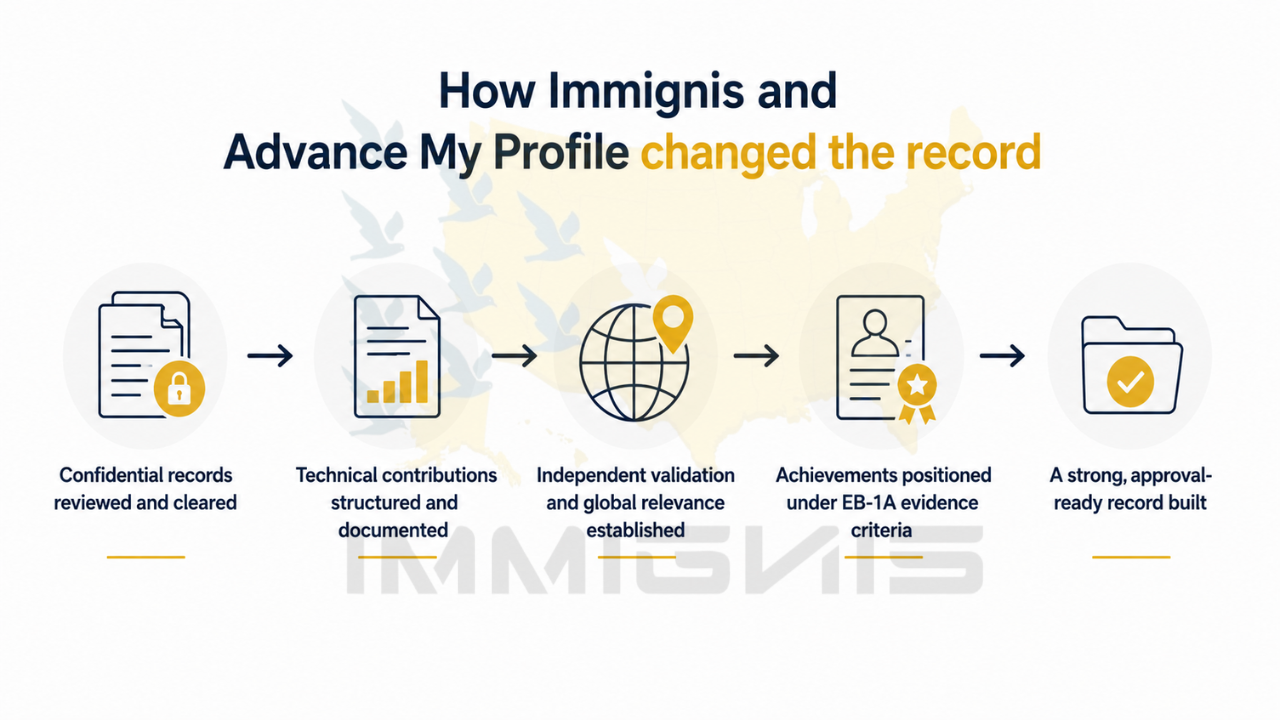
Before profile building, the career could have been reduced to a familiar mining title and a set of confidential achievements. The petitioner had done technically difficult work, but the public record did not clearly identify which methods were his, where they were used, or why they mattered outside the operator’s internal performance system.
Immignis and Advance My Profile rebuilt the record around attribution. Cleared process summaries established the work. Patent and publication records gave it identifiable authorship. Conference activity and institute roles showed recognition beyond the employer. Published material created personal visibility, remuneration evidence addressed market value, and expert letters translated the metallurgy for USCIS.
The process did not turn plant operations into a publicity exercise. It created an accurate professional record around work that had previously remained behind the mine gate.
Why the case held together
The evidence was strongest because each part answered a different question. Process documentation showed what happened. Patent and authorship records showed who created the relevant method. Repeat use and implementation established practical significance. Conferences and professional roles demonstrated peer recognition. Published material made the applicant visible, and remuneration evidence showed how the market valued his specialized expertise.
The field definition also prevented the petition from becoming too broad. The petitioner was not presented as an expert in every part of mining or copper production. The case stayed centered on low-grade and oxide copper hydrometallurgy, where his evidence was most coherent.
The approval hook remained practical: he helped recover copper from material others were prepared to leave behind, and the petition finally documented the person responsible for that technical value.
What mining and industrial professionals can learn from this case
Confidentiality is a documentation problem, not necessarily an evidence dead end. Industrial professionals should begin by identifying what can be cleared, summarized, independently confirmed, or placed into a public technical record without disclosing protected business information.
They should also distinguish personal contribution from team performance. A plant result becomes more useful when the evidence identifies the baseline problem, the applicant’s decision or method, implementation history, repeatability, and the reason other professionals considered the work significant.
No patent, salary figure, conference talk, or recommendation letter guarantees EB-1A approval. USCIS evaluates the regulatory evidence and then considers the record as a whole. The value of profile building is that it allows the adjudicator to see a real professional contribution that the company’s internal files were never designed to explain.
Conclusion
The Zambian copper hydrometallurgist’s approval was built around a problem familiar to many industrial experts: the employer could measure the achievement, but the outside world could not see the person behind it.
Once the petition connected confidential process improvement to authorship, repeat use, patents, technical communication, professional recognition, and market value, the case no longer looked like ordinary plant support. It showed a specialist who had changed what difficult copper resources could yield.
The client’s name and identifying details are omitted to protect privacy. The professional field, approval date, and evidence strategy reflect the underlying case record.
Frequently asked questions
Can a mine-site metallurgist qualify for EB-1A?
Yes. An industrial career can support EB-1A when the evidence addresses the regulatory criteria and the complete record demonstrates the required level of professional recognition. Public fame is not the only way to document extraordinary ability.
Can confidential process improvements be used in an EB-1A petition?
They can be used when the employer permits appropriate disclosure and the evidence is presented through cleared summaries, verified records, technical letters, patents, or other documentation that protects proprietary information while still explaining the applicant’s contribution.
Does improving copper recovery automatically prove an original contribution of major significance?
No. The record should identify what the applicant created, distinguish it from routine optimization, and document significance through implementation, repeat use, measurable results, adoption, patents, independent expert analysis, or influence beyond a single short-term production event.
Can patents alone establish extraordinary ability?
No. Patents can show inventorship and technical novelty, but they become more persuasive when connected to implementation, industry reliance, licensing, citations, commercial use, or other evidence of significance.
How can a metallurgist satisfy the scholarly-authorship criterion if company data is confidential?
The professional may publish non-confidential technical articles, conference papers, methodology discussions, or research that explains the science without revealing restricted operating parameters. The publication must still qualify under the applicable evidentiary standard.
What kind of professional membership can help an EB-1A case?
The most useful membership evidence shows that admission, grade, fellowship, or appointment requires outstanding achievement, peer evaluation, nomination, or another selective professional standard. Ordinary paid membership generally carries less weight.
How should high remuneration be documented for a mining professional?
The comparison should use an appropriate market and peer group. Evidence may include salary records, site and expatriate allowances, bonuses, tax documents, industry compensation surveys, recruitment data, and expert analysis comparing the applicant with similar metallurgical professionals.
Why does copper’s role in electrification matter to the case?
It provides context for why recovering copper from difficult resources has broader economic and technical relevance. That context does not replace personal evidence; the petition must still prove the applicant’s own contribution and recognition.
Turn confidential industrial achievement into attributable immigration evidence
Mining, manufacturing, energy, and process-industry professionals often have strong achievements that remain hidden inside plant data, patents, technical teams, and confidential company systems.