Key facts at a glance
| Category | Details |
| Outcome | EB-1A approval for an Indian oncology bioinformatics scientist working at a U.S.-based cancer center. |
| Field niche | Multi-omics biomarkers for precision oncology, with a focus on using genomic, transcriptomic, proteomic, and related cancer data to support patient stratification and research-informed clinical decision pathways. |
| Starting problem | The publication record was strong, but the case still needed a clearer story of sustained acclaim, independent recognition, and practical significance beyond ordinary scholarly productivity. |
| Profile-building path | Advance My Profile built a precision-oncology authority record through focused papers, citation-growth positioning, peer review, invited talks, patient-stratification adoption evidence, media explanations, selective membership evidence, leading-role documentation, and independent letters. |
| Evidence presented under the EB-1A criteria | Scholarly articles, original contributions, published material, judging, memberships, and leading role. |
| Approval hook | USCIS approved the case after the petition showed that his oncology bioinformatics work affected cancer research and clinical decision pathways, not merely that he had published papers. |
USCIS approved the petition, but the story was never just publication count
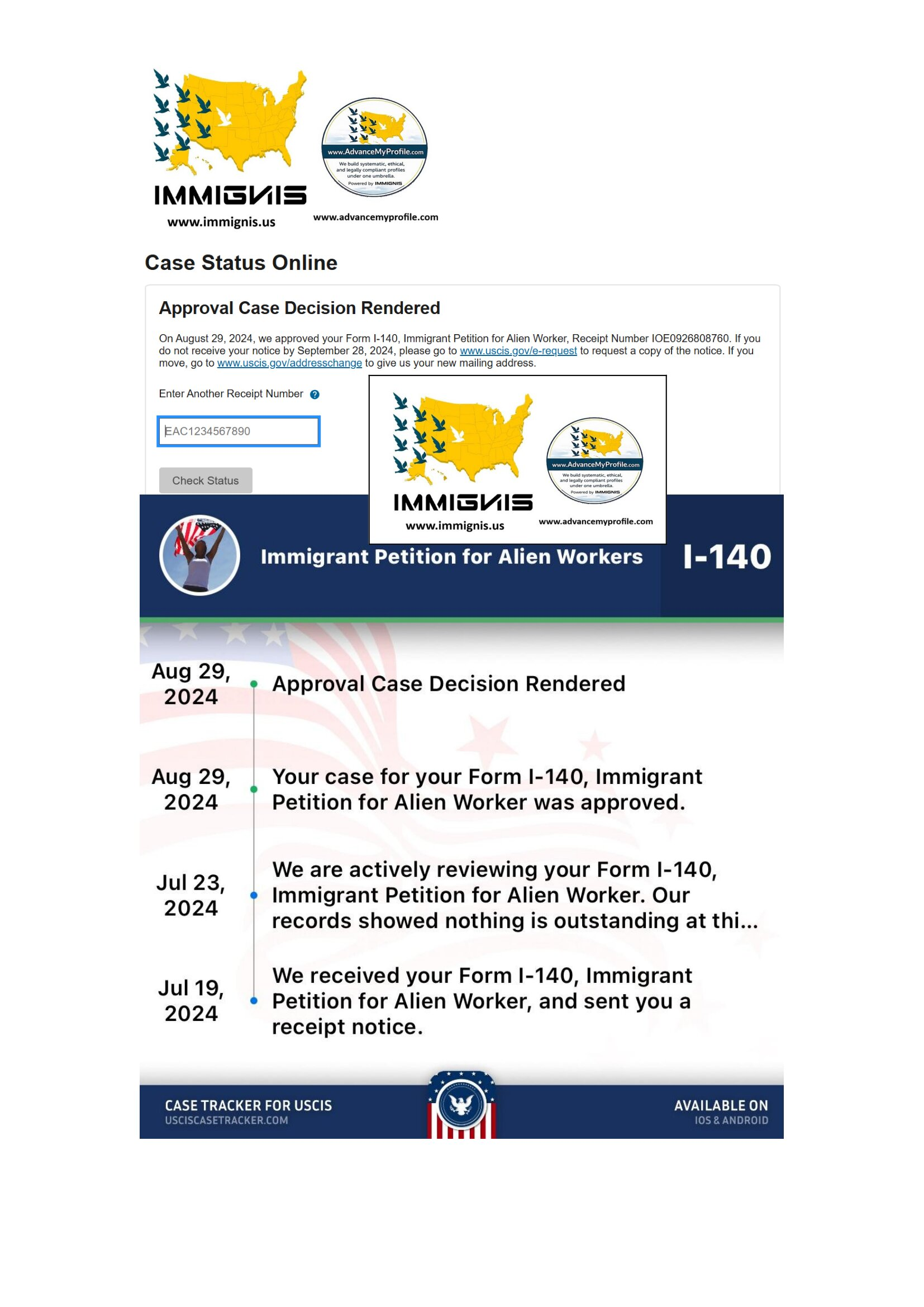
USCIS approved the Form I-140 petition of an EB-1A Indian Oncology Bioinformatics scientist working at a U.S.-based cancer center.
At first glance, this looked like a researcher’s case. He had strong publications and years of work in cancer bioinformatics. That was helpful, but it was not enough by itself. A long bibliography can show productivity. EB-1A asks a different question: has the person developed a record of extraordinary ability, sustained recognition, and contributions that the field can identify as his own?
That distinction shaped the entire case. The record did not need to prove that cancer bioinformatics is important. It needed to prove why this scientist’s work in multi-omics biomarkers had become recognizable, useful, and relied upon in precision-oncology research and related clinical decision pathways.
The approval came after the petition moved beyond a list of publications and built a coherent authority record around one professional theme: using multi-omics data to identify biomarker patterns that help stratify cancer patients and support more precise oncology decisions.
The publication record was strong. The authority story was not yet visible
Many oncology researchers assume that a strong publication list speaks for itself. In an EB-1A case, it rarely does. USCIS does not simply count papers and approve a scientist because the subject is cancer research. The petition must connect the individual to a defined area of expertise, show how the work has been received by others, and explain why the contributions matter in the field.
This scientist’s early record had the common strengths of a serious researcher. He had authorship, technical depth, and a role inside a respected cancer environment. But the record still had gaps. The publications were spread across projects, collaborations, data sets, and disease contexts. A reader could see an active bioinformatics scientist, but the professional identity was not yet sharp enough.
The strongest recurring question was not “What papers did he publish?” It was “What scientific problem kept appearing in his work, and how did other researchers or clinical teams use the answer?”
Advance My Profile, powered by Immignis, reviewed the record with legal strategists and oncology-bioinformatics specialists. The profile was narrowed to multi-omics biomarkers for precision oncology, with particular attention to patient stratification, biological interpretation, and the movement of research findings into cancer-research and clinical decision pathways.
His niche sat at the point where cancer data becomes a stratification decision
Cancer bioinformatics can sound abstract to a non-specialist. The work often involves data, algorithms, pipelines, signatures, cohorts, and molecular measurements. The petition had to translate that technical work without oversimplifying it.
In this case, the scientist’s work focused on multi-omics biomarkers. Multi-omics analysis brings together different layers of cancer information, such as genomic alterations, gene-expression patterns, protein activity, epigenetic signals, and other molecular features. The goal is not to make the data look more complex. The goal is to identify patterns that may help researchers understand tumor behavior, classify patient groups, evaluate risk, or support treatment-related research decisions.
The case did not claim that one bioinformatics model cured cancer or replaced physician judgment. It made a more precise and defensible argument: his work helped turn high-volume cancer data into biomarker evidence that could inform patient stratification and support precision-oncology pathways when used with appropriate scientific and clinical review.
That narrower explanation mattered. It allowed USCIS to see the scientist as more than a coauthor on cancer papers. He became a defined professional figure in a specific field: multi-omics biomarker discovery and interpretation for precision oncology.
What did USCIS need to see in this oncology bioinformatics EB-1A case?
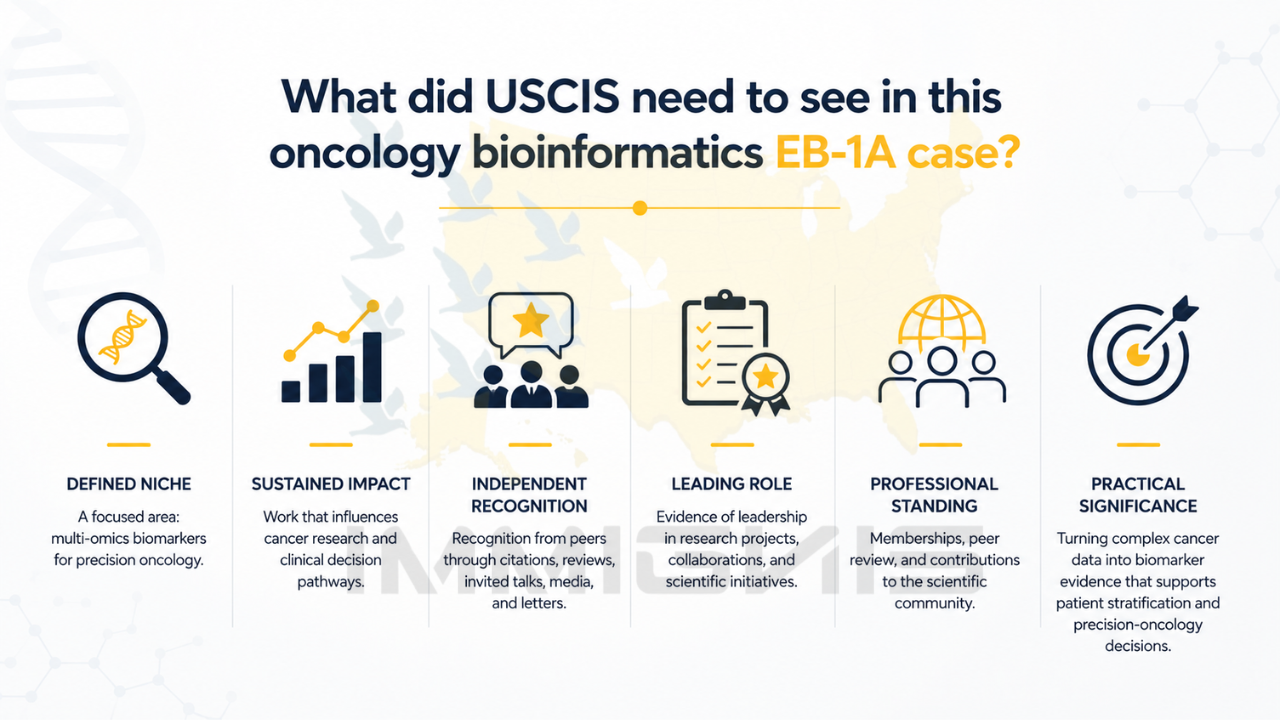
For this type of case, the petition had to solve several evidence problems at the same time.
First, the record had to identify his original contributions. In a cancer center, many projects are collaborative. A publication may have several authors, and a clinical research pathway may involve physicians, statisticians, pathologists, data engineers, and laboratory scientists. The petition therefore had to show which methods, analyses, biomarker interpretations, or patient-stratification frameworks were attributable to him.
Second, the petition had to show significance. A method may be technically sophisticated and still remain internal, preliminary, or limited to one study. The case needed independent evidence that his work mattered beyond routine participation in research projects.
Third, the publication record had to be organized around a focused theme. The question was not whether he had published. The question was whether the publications showed a sustained body of work in a recognizable area of oncology bioinformatics.
Fourth, the record needed proof that other specialists trusted his judgment. Peer review, invited talks, selective membership evidence, and independent expert letters helped show that he was not only producing work, but also being asked to evaluate and explain work in the field.
Finally, the leading-role evidence had to show more than employment at a respected cancer center. USCIS needed documentation of why the cancer center or research program relied on his bioinformatics expertise and how his work entered research and clinical decision processes.
The case was rebuilt around one scientific question
The profile-building work reorganized the record around a practical scientific question: how can multi-omics data help identify patient groups or biomarker patterns that matter for precision oncology?
Project summaries, authorship evidence, citation records, peer-review invitations, presentation materials, media discussions, patient-stratification adoption evidence, and expert letters were grouped around that question. This gave the petition a center of gravity.
Instead of presenting scattered oncology projects, the petition traced a sequence. The scientist helped process or interpret complex molecular data. That work identified biomarker patterns or patient subgroups. Those patterns informed cancer research questions or clinical decision pathways. Other experts then recognized the relevance of the work through citations, review invitations, talks, adoption evidence, and independent letters.
The record also stayed within the evidence. It did not invent patient outcomes, survival improvements, treatment response rates, or hospital-wide changes that the documents could not prove. Where adoption evidence existed, it was described by what it actually showed: use of patient-stratification methods or biomarker logic in research and clinical decision settings.
Focused papers turned a publication list into a body of work
The strongest publication strategy did not add unrelated papers for volume. It made the existing and developing record easier to understand.
With domain support, the scientist developed focused work on multi-omics biomarker discovery, patient stratification, cancer subtype analysis, translational bioinformatics, and the interpretation of molecular signatures in precision oncology. The papers were selected and framed around the niche rather than treated as isolated academic products.
One line of work examined how integrating multiple data layers can help distinguish patient subgroups that may not be visible through a single molecular measurement. Another addressed the challenge of translating complex biomarker patterns into evidence that research teams and clinical collaborators can evaluate.
This did not mean that every paper had the same disease site, same data type, or same method. It meant the record had a recognizable professional throughline: using bioinformatics to make oncology biomarkers more informative for stratification and decision support.
Citation growth mattered because it was tied to the right work
Citation evidence can be persuasive, but only when it is used carefully. The petition did not treat citation growth as a simple scoreboard. It examined what was being cited, who was citing it, and how the cited work connected to the scientist’s authority niche.
For this case, citation growth helped show that other researchers were engaging with his multi-omics and biomarker work. The stronger argument was not “he has citations.” The stronger argument was that citations were connected to the same scientific questions the petition identified: biomarker interpretation, patient stratification, cancer-data integration, and precision-oncology research.
That connection helped prevent the publication record from looking like a general academic file. It showed movement from output to reception. Other researchers were not merely seeing his name in journals; they were using or building upon work tied to the field niche presented in the petition.
Peer review showed that other scientists trusted his judgment
Peer review became one of the clearest forms of independent recognition. Journals and research venues invited him to assess work by other specialists in oncology bioinformatics, cancer genomics, biomarker discovery, and related computational methods.
The judging evidence was documented as actual evaluation work. The petition identified the review activity, the nature of the venues, and the type of judgment required. He reviewed study design, data interpretation, biomarker claims, statistical or computational reasoning, and whether conclusions followed from the evidence presented.
That mattered because peer review is not the same as attending a conference or being listed in a professional directory. It showed that the field trusted him to evaluate the scientific work of others.
Invited talks made the authority public
Invited talks helped move the record beyond written publications. They gave the scientist a public role in explaining how multi-omics biomarkers can be used responsibly in precision oncology.
The talks focused on the practical bridge between data and interpretation. He discussed how different molecular layers can support patient stratification, why biomarker models need careful validation, and where bioinformatics evidence can help cancer teams ask better research or clinical questions.
The strongest talks avoided exaggerated claims. They did not suggest that bioinformatics alone makes treatment decisions. They explained how molecular evidence can support stratification and help organize oncology research and decision pathways when combined with clinical context and expert review.
Adoption evidence connected research with decision pathways
For original-contribution evidence, adoption was especially important. Publications and citations helped show scientific reception. Patient-stratification adoption evidence helped show practical significance.
The petition documented where his biomarker logic, analysis methods, or patient-stratification framework entered research workflows or clinical decision pathways at the cancer center or through documented collaborations. The evidence was described without exposing protected patient information, confidential institutional protocols, or unpublished clinical data.
This part of the record answered a question USCIS could reasonably ask: did the work remain a paper, or did it shape how cancer information was organized and used?
The adoption evidence showed that his work helped inform the classification of patient groups, the interpretation of multi-omics results, or the movement of biomarker evidence into research and clinical decision processes. That gave independent experts a practical record to evaluate.
Media explanations made a technical field understandable without diluting it
Published material about a scientist can be difficult to develop in a research-heavy field. The coverage must be independent, accurate, and related to the person or expertise. It cannot simply be a recycled biography or a paid profile with no substance.
In this case, media explanations helped translate the scientist’s work for a wider professional and educated public audience. The articles discussed why precision oncology increasingly depends on the ability to interpret several layers of cancer data and why biomarker evidence must be handled carefully before it can influence research or care pathways.
The strongest coverage did not call him a miracle worker or present bioinformatics as a replacement for oncologists. It explained his specialty in clear language and connected his expertise to a real problem in cancer research: how to move from large molecular data sets to patient groups and decisions that clinicians and researchers can review.
Selective membership evidence was handled by the admission standard
The memberships criterion was developed carefully. Ordinary memberships that anyone can purchase do not carry the same evidentiary value as memberships or elevations that require achievement, review, recommendation, or expert assessment.
The petition documented the relevant association, the admission or advancement standard, and the basis on which the scientist qualified. The goal was not to inflate membership as a stand-alone achievement. The goal was to show that professional bodies recognized him at a level consistent with the authority record built across publications, peer review, talks, and contributions.
Leading role evidence tied his cancer-center work to responsibility, not job title
A position at a U.S.-based cancer center can help establish context, but EB-1A requires more than an impressive employer. The petition had to show why his role mattered within the organization or program.
The leading-role evidence focused on documented responsibility for bioinformatics work tied to precision oncology. It showed how research teams relied on his expertise in multi-omics analysis, biomarker interpretation, patient stratification, and the integration of data into research or clinical decision pathways.
The record distinguished between being employed in an important setting and performing a role that was significant to the setting. That distinction made the evidence stronger and more credible.
Independent letters explained why the work mattered beyond one workplace
Independent expert letters were essential because they connected the technical record to field significance. The strongest letters did not simply praise the scientist or repeat his resume. They explained the problem, identified his contribution, and described why the work was meaningful in oncology bioinformatics or precision medicine.
The letters addressed his multi-omics biomarker work, patient-stratification methods, citation reception, peer-review activity, and documented use of the work. They also helped explain why the contribution mattered outside the boundaries of one laboratory or one employer.
That independent framing was especially important because bioinformatics work is often collaborative and difficult for a non-specialist to evaluate. Expert letters helped USCIS understand what was ordinary participation and what reflected individual scientific authority.
How the EB-1A evidence worked together
The petition did not rely on one document to carry the case. The evidence worked because several categories pointed to the same professional identity.
- Scholarly articles showed sustained authorship in oncology bioinformatics, multi-omics analysis, biomarkers, and precision-oncology research.
- Original contributions were supported by biomarker methods, patient-stratification adoption evidence, documented research use, citation reception, and independent expert analysis.
- Published material explained his expertise in precision oncology and made the significance of multi-omics biomarker work accessible to a broader audience.
- Judging evidence came from peer review and other documented evaluation of scientific work by specialists in related fields.
- Membership evidence was tied to selective standards, not open enrollment or routine dues.
- Leading-role evidence showed that a distinguished cancer environment relied on his bioinformatics judgment for research and decision-pathway work.
Together, those evidence streams gave USCIS a coherent record. The scientist was not presented as a general cancer researcher with many publications. He was presented as an oncology bioinformatics authority whose work in multi-omics biomarkers had received independent recognition and practical use.
Why this approval matters for cancer researchers
This approval is instructive because many scientists in oncology, genomics, computational biology, and translational medicine make the same mistake. They assume the publication list will do all the work.
A publication list can start the EB-1A conversation. It does not finish it. A successful extraordinary-ability case must explain the field, the person’s particular contribution, the evidence of recognition, and the way the work has influenced scientific or practical activity.
For this scientist, the case became stronger when the record stopped treating publications as separate achievements and started treating them as part of a larger authority story. Focused authorship, citation growth, peer review, invited talks, media explanations, adoption evidence, selective membership, leading-role documentation, and independent letters all pointed toward the same conclusion: his work had moved from scientific output to recognized precision-oncology expertise.
Lessons for oncology bioinformatics professionals considering EB-1A
A strong EB-1A record in oncology bioinformatics usually requires more than technical skill and a respected institutional address. It needs a defined niche, clear attribution, evidence that others recognize the work, and proof that the contribution matters beyond normal job duties.
For researchers working with cancer genomics, multi-omics integration, biomarkers, clinical data science, molecular diagnostics, computational oncology, or patient stratification, the most useful first step is often not adding more disconnected achievements. It is identifying the scientific question that already links the strongest work.
Once that question is clear, the evidence can be developed around it: publications with a consistent theme, peer-review invitations, talks that place the work before the field, media that accurately explains the expertise, membership evidence that reflects achievement, and adoption records showing how the work entered research or clinical pathways.
That is what made this case work. It did not turn an ordinary profile into an artificial one. It documented real expertise, expanded independent recognition, and presented the scientist’s oncology bioinformatics work in a way USCIS could evaluate.
Frequently asked questions
Can an oncology researcher qualify for EB-1A with publications alone?
Publications can support EB-1A, but publications alone are rarely the full answer. USCIS needs evidence showing sustained acclaim, recognized achievements, and the significance of the person’s own contributions. Citation evidence, peer review, adoption, talks, media coverage, memberships, and independent expert analysis can help show how the field received the work.
Does bioinformatics adoption evidence need to prove direct patient outcomes?
Not necessarily. Adoption evidence should be described accurately. In a bioinformatics case, the evidence may show that a method, biomarker framework, or patient-stratification approach was used in research workflows or clinical decision pathways. The petition should not claim improved survival, treatment success, or patient outcomes unless the record actually proves those claims.
Can peer review count as judging in an EB-1A case?
Peer review can support the judging criterion when it shows that the scientist actually evaluated work produced by other researchers or specialists. The record should document the review invitations, completed reviews where available, the nature of the venue, and the expertise required to evaluate the work.
Why are independent letters important in a collaborative cancer-research case?
Cancer research is often collaborative, and USCIS may need help understanding what part of the work belonged to the petitioner and why it mattered. Independent letters are most useful when they explain the technical problem, identify the petitioner’s specific contribution, and describe the contribution’s significance in the field.
What should a cancer scientist do before starting an EB-1A petition?
The best starting point is to identify the narrow authority niche. A researcher should ask: what scientific problem links my strongest papers, citations, reviews, talks, adoption records, and expert recognition? Once that niche is clear, the EB-1A evidence can be organized into a record that is much easier to evaluate.
Build an EB-1A record around the scientific authority your cancer work already shows
If you work in oncology bioinformatics, cancer genomics, biomarker discovery, molecular diagnostics, multi-omics research, or precision medicine, your strongest evidence may already exist across publications, citations, peer review, presentations, institutional work, and adoption records. The challenge is making that evidence speak with one professional voice.
Advance My Profile and Immignis help researchers identify a defensible authority niche, document individual contributions, develop credible recognition, and prepare an EB-1A record around evidence that can be verified and professionally defended.