
Key facts at a glance
| Outcome | EB-1A approval for a German industrial AI reliability engineer working within a U.S.-based manufacturing group. |
| Approval date | Approved on October 3, 2023. |
| Field niche | Predictive maintenance and industrial AI reliability for critical manufacturing lines. |
| Starting problem | His record looked like senior plant operations and maintenance leadership, not a field-recognized extraordinary ability profile. |
| Path used | Ethical EB-1A profile building through non-confidential implementation case evidence, focused technical publications, a manufacturing association white paper, a plant leadership webinar, trade media visibility, peer review, professional award recognition, and detailed salary and critical role documentation. |
| USCIS EB-1A criteria activated | Original contributions, published material, recognized prizes or awards, judging, leading or critical role, and high remuneration. |
Four days after USCIS logged the premium processing request for this EB-1A industrial AI engineer approval, the status changed to Case Was Approved.
October 3, 2023. The speed of the final decision was easy to see on the case tracker. The harder story was everything that had to happen before filing.
Inside manufacturing plants, he was already the person people trusted when a critical line became unpredictable. Bearings degraded. Vibration patterns shifted. A motor behaved normally until it did not. A maintenance team had data, alarms, and experience, but the cost of learning too late could be an unplanned shutdown.
He had spent years turning those signals into better maintenance decisions. On paper, however, he looked like a senior operations engineer. That was the problem.
Why did a senior manufacturing engineer not yet look like an EB-1A candidate?
Because operational excellence is often visible to a company and almost invisible to a field.
His work lived inside plants, reliability programs, maintenance reviews, equipment histories, implementation meetings, and confidential production systems. Leaders knew which lines had become more predictable. Maintenance teams understood why certain failure signals were taken more seriously. Internal stakeholders could see the value of predictive maintenance when it changed the timing of intervention.
USCIS could not see any of that unless the evidence was separated from routine job duties and explained clearly.
The EB-1A green card is a self-petition immigrant category for people who can show extraordinary ability through sustained national or international acclaim and a record placing them among the small percentage at the top of their field.
Immignis did not try to make him a generic AI expert
A broad story about artificial intelligence would have weakened the case. So would a broad story about manufacturing leadership. Advance My Profile, powered by Immignis, identified the intersection where his strongest evidence already existed: predictive maintenance for critical manufacturing lines.
That distinction mattered. He was not presented as someone who merely used a machine-learning tool. The case focused on how he connected equipment behavior, reliability engineering, maintenance workflows, and predictive models in environments where a wrong signal can waste maintenance resources and a missed signal can interrupt production.
His work was about making predictive maintenance technically useful in real manufacturing operations.
What did USCIS need to see in an industrial AI reliability case?
USCIS needed to see why his work went beyond competent plant engineering. For original contributions of major significance, the petition had to identify his individual reliability methods, implementation approaches, or decision frameworks. It was not enough to say that a factory used predictive maintenance or that the company invested in AI. The evidence had to show what he personally developed, refined, or led, and why those contributions mattered to the reliability of critical lines.
The implementation evidence also needed context. A model can produce a risk score. In a plant, the harder question is what happens next. Which signal should trigger inspection? How should maintenance teams combine model output with engineering judgment? How can false alarms be controlled? How can a method be repeated across equipment or production environments?
For leading or critical role, USCIS needed more than a senior title. The petition had to show why distinguished manufacturing operations relied on his judgment and how his responsibilities affected important reliability functions.
For high remuneration, the analysis had to compare his compensation with appropriate occupational and market evidence. A large salary in isolation says little. The record needed to show that his remuneration was high relative to others in the field or a comparable position.
The final merits question was equally important: did the total record show a recognized industrial AI reliability specialist, or only a successful employee inside one manufacturing group?
The evidence build started inside the factory, but it could not stay there
Immignis and the technical team reviewed what could be documented without exposing proprietary production data. The evidence focused on methodology, decision logic, role attribution, implementation responsibility, and the operational significance of the reliability work. Confidential customer information, sensitive line data, and protected algorithms remained protected.
With domain support, he developed focused technical publications on predictive maintenance, industrial AI reliability, model adoption in manufacturing, and the engineering gap between anomaly detection and maintenance action. The topics were chosen from problems he had already worked with, not from whatever AI subject was popular that month.
A manufacturing-association white paper followed. It was written for plant leaders and reliability professionals rather than only data scientists. The paper examined how manufacturers can evaluate predictive-maintenance systems, align alerts with maintenance workflows, document engineering judgment, and avoid treating AI output as an automatic maintenance order.
A webinar changed who could hear the work
The session focused on questions plant leadership understands immediately: when predictive alerts deserve trust, why maintenance teams resist some AI tools, how model performance can drift from operational reality, and why reliability programs fail when analytics are disconnected from maintenance ownership.
Trade-media visibility developed in parallel. Manufacturing and industrial-technology coverage sought his perspective on predictive maintenance, factory AI, and the difference between an attractive analytics dashboard and a reliability system that changes engineering decisions.
Where the published material criterion was used, the petition documented qualifying coverage about him and his work. Expert quotations and commentary also supported the broader final-merits narrative by showing that outside audiences increasingly associated him with industrial AI reliability.
Why did peer review and professional recognition matter?
Peer-review assignments placed him in the role of evaluating other specialists’ work on industrial analytics, predictive maintenance, and reliability-related research. Genuine review activity supported the judging criterion because technical venues trusted him to assess professional or scholarly work in the field.
A field-relevant professional award added a different form of recognition. Advance My Profile documented the award, its selection standards, the competitive or evaluative process, and the connection between the recognition and his industrial reliability work.
This is also where ethical profile building becomes visible. A professional can buy a certificate from a weak organization. That does not create real acclaim. The stronger approach is slower: identify credible recognition, confirm eligibility, prepare the evidence properly, and let a genuine evaluating body decide.
The salary and critical-role evidence told USCIS something the publications could not
Critical-role evidence identified the manufacturing functions, reliability responsibilities, and decision making areas in which his technical judgment mattered. Organizational records, role descriptions, project evidence, and supporting letters explained why his work was important to critical manufacturing operations.
A global manufacturing group can be distinguished. That does not automatically make every employee extraordinary. The petition had to show why this engineer, in this role, was relied upon for industrial AI reliability and predictive-maintenance decisions that mattered to the organization.
High-remuneration evidence was built with the same discipline. Compensation records were compared with relevant salary data and occupational context. The argument did not say that a high number alone proved extraordinary ability. It showed that the market and employer compensated him at a level consistent with unusually valuable expertise.
Why fake profile building would have been especially dangerous here
A person can say a model prevented downtime. A reliability engineer will ask how failure was defined, what the baseline was, whether the alert changed maintenance action, and how false positives were handled.
That is why weak journals, purchased awards, invented adoption claims, and fake citation activity would have damaged this story rather than strengthened it.
Do not build a record that must be hidden after the immigration process.
Build publications you can cite in a future presentation. Build a white paper a manufacturing association can share. Accept review work you are qualified to perform. Pursue awards whose selection process you are comfortable explaining. Document salary and role evidence honestly.
Could an operations-heavy career be stronger than it looks?
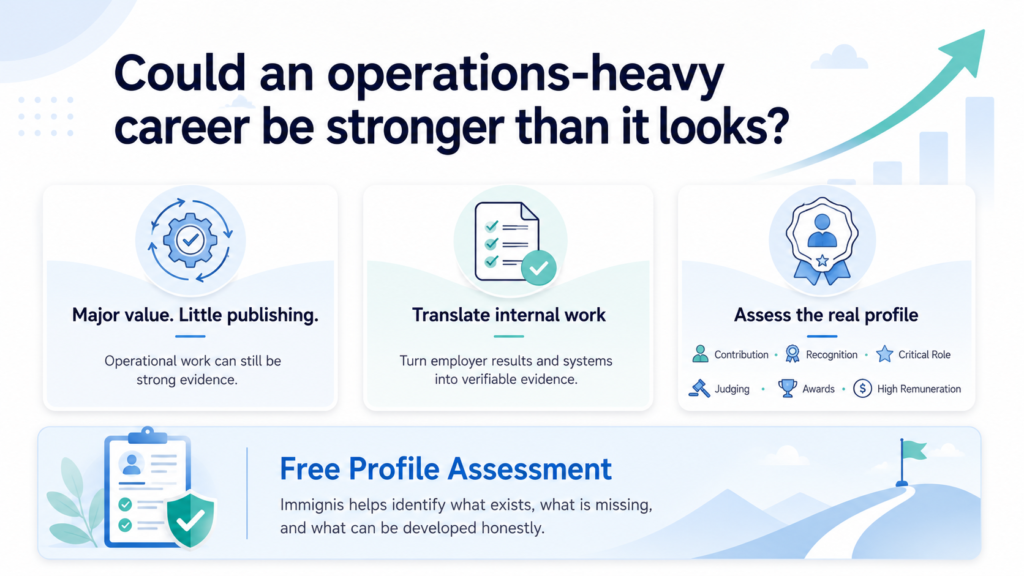
Some professionals create major value without spending years in academic publishing. Their problem is often that employer results, internal systems, and operational decisions have never been translated into independent, verifiable evidence.
It means the profile should be assessed for individual contribution, field significance, independent recognition, judging, awards, critical role, high remuneration, and other evidence that may fit the USCIS criteria.
Immignis offers a free profile assessment to identify what already exists, what is missing, and which gaps can be developed honestly through profile building.
Which USCIS EB-1A criteria did the final Form I-140 petition activate?
Original contributions: Non-confidential implementation evidence, technical publications, the manufacturing white paper, role attribution, and independent context showed how his predictive maintenance approaches contributed to industrial AI reliability beyond routine operations work.
Published material: Qualifying manufacturing and industrial-technology coverage discussed him and his work, while expert commentary strengthened the public record around predictive maintenance and factory AI reliability.
Recognized prizes or awards: Professional recognition was supported with evidence of the award, its criteria, and the evaluative process connecting the honor to his industrial reliability work.
Judging the work of others: Peer-review assignments showed that relevant technical venues trusted him to evaluate work by other specialists in industrial analytics and reliability-related fields.
Leading or critical role: Organizational and project evidence explained why distinguished manufacturing operations relied on his technical judgment in important predictive maintenance and reliability functions.
High remuneration: Compensation evidence and relevant comparison data showed that his remuneration was high relative to others in comparable professional contexts.
His implementation work created the expertise. Case evidence identified his contribution. Focused publications gave that expertise a public technical form. The white paper and leadership webinar carried it to manufacturing audiences. Media coverage created independent visibility. Peer review showed evaluative trust. The professional award added external recognition. Critical-role and remuneration evidence documented how his value was reflected inside a distinguished manufacturing environment.
It described an industrial AI reliability specialist whose work, recognition, and professional standing converged on predictive maintenance for critical manufacturing lines.
What did the October 2023 EB-1A approval mean?
USCIS approved the Form I-140 on October 3, 2023. The visible case history showed the petition received in September 2023, a premium-processing request received on September 29, and approval on October 3. The displayed timeline did not show a Request for Evidence before approval.
The approval gave him an EB-1A self-petition path without employer sponsorship or labor certification. Before profile building, people inside the manufacturing organization knew what he could do. After the build, his expertise existed in technical publications, industry-facing writing, a leadership webinar, media coverage, peer review, professional recognition, and documented evidence of critical responsibility.
If this sounds like your career
You may have spent years improving systems that your company will never publish in full. Your best evidence may sit inside maintenance programs, operations dashboards, implementation reviews, internal methods, or results your employer considers proprietary.
The solution is not to invent public achievements. The solution is to document what can be documented, identify the real technical niche, build legitimate authorship and field visibility, seek genuine judging and recognition opportunities, and prove why your individual role mattered.
FAQ
Can a predictive-maintenance engineer qualify for EB-1A without being a university researcher?
Yes. EB-1A is not limited to academics. An implementation focused engineer may build evidence through original industrial contributions, qualifying published material, judging, recognized awards, critical roles, high remuneration, and other applicable criteria. The key is proving field-level recognition and significance, not simply showing a senior job title.
How can I prove an industrial AI contribution when my employer owns the system and the data?
The case can use non-confidential methodology summaries, role attribution, implementation evidence, technical publications, white papers, and independent letters that explain the applicant’s contribution without revealing protected production data or source code. The evidence should identify what the professional personally developed, refined, or led.
What is the difference between a factory AI dashboard and EB-1A evidence?
A dashboard may show internal performance, but USCIS needs evidence that can be attributed to the applicant and evaluated in context. Stronger evidence explains the reliability problem, the applicant’s technical role, how the method affected maintenance decisions, and why experts or industry audiences recognized the work.
Can peer review in industrial engineering satisfy the judging criterion?
Genuine peer review can support the criterion for judging the work of others when the applicant is asked to evaluate professional or scholarly work in the same or an allied field. The petition should document the invitations, completed reviews, venue, and relationship between the reviewed subject matter and the applicant’s expertise.
How is high salary evaluated in an EB-1A engineering case?
USCIS looks for evidence that remuneration is high relative to others in the field. Compensation documents should be paired with appropriate comparison evidence, such as occupational, geographic, industry, or comparable-position data. A salary figure without context is much less persuasive.
Build an EB-1A success story from the work your industry already trusts
If you work in industrial AI, predictive maintenance, manufacturing reliability, process engineering, smart factories, or another implementation heavy field, your strongest achievements may be hidden inside operations.
Immignis and Advance My Profile help professionals identify a defensible niche, document individual influence, build credible field recognition, and prepare an EB-1A record around evidence that is real and verifiable.
Start with a free EB-1A profile assessment and find out whether your operational expertise can be developed into a stronger authority record.