EB-1A Infectious Disease Physician: How a Myanmar infectious-disease physician secured EB-1A approval by transforming politically complicated malaria-containment work into a petition-ready immigration profile built on contribution-attribution from international consortia, first-author publication push, WHO-network documentation, conference platforms, journal peer review, expert letters, and ethical profile building.
Key facts at a glance
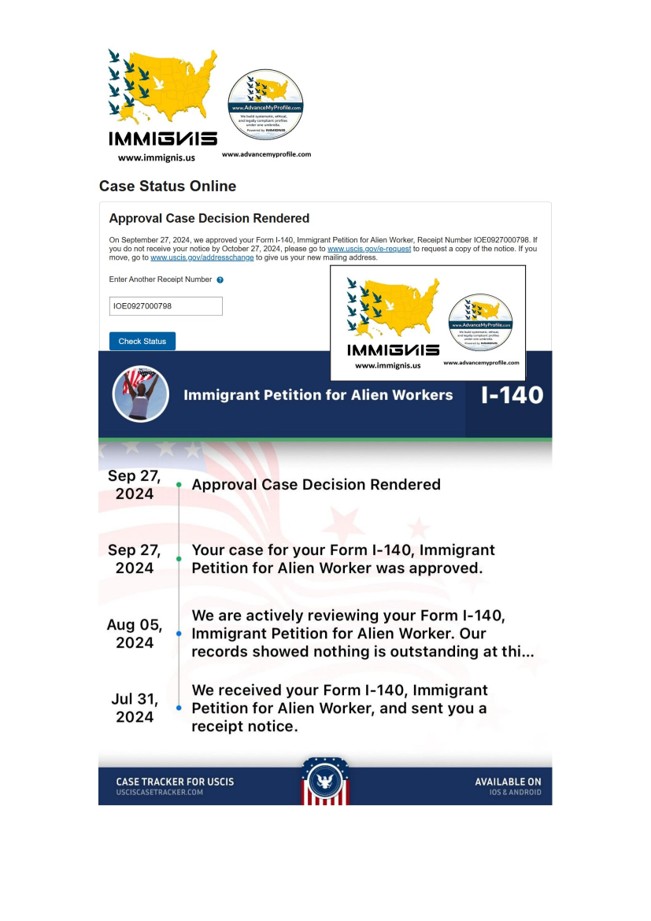
| Petition outcome | Form I-140 approved under EB-1A on September 27, 2024. |
| Professional profile | Myanmar infectious-disease physician leading drug-resistant malaria containment work in the region where resistance often emerges first. |
| Field niche | Antimalarial-resistance clinical surveillance and containment. |
| Starting weakness | Politically complicated geography, informal collaborations, and important publications or consortium work appearing under other names made the individual role difficult to prove. |
| Profile-building focus | Contribution-attribution from international consortia, first-author publication development, WHO-network documentation, conference platforms, journal peer review, expert letters, and immigration-specific profile building. |
| EB-1A criteria supported | Scholarly articles, original contributions, judging, leading role, and membership. |
| Central issue | Showing that the petitioner was not just a physician working in a difficult location, but a field-central clinician whose surveillance and containment work mattered to global antimalarial-resistance control. |
| Approval lesson | Small or politically complex fields can support EB-1A when profile building explains why the geography, expertise concentration, and independent attribution make the professional top-of-field. |
The approval
On September 27, 2024, USCIS approved the Form I-140 petition of a Myanmar infectious-disease physician whose work focused on antimalarial-resistance clinical surveillance and containment.
The approval was important because the petitioner did not have a simple, polished evidence record. His strongest work happened in one of the world’s most complicated infectious-disease settings, where drug-resistant malaria surveillance depends on field access, clinical judgment, regional collaboration, and trust across organizations that do not always create clean public documentation.
That made the case a strong example of EB-1A profile building, immigration profile building, and professional profile building for physicians whose real impact is buried inside consortium projects, informal field collaborations, and technical public-health networks.
Immignis and Advance My Profile helped convert the record into a petition-ready EB-1A profile. The strategy focused on contribution-attribution from international consortia, first-author publication development, WHO-network documentation, conference platforms, journal peer review, membership evidence, expert letters, and ethical profile building that made the petitioner’s individual role visible without overstating the record.
The evidence problem in antimalarial-resistance clinical surveillance
Antimalarial-resistance clinical surveillance is a narrow but globally important field. It involves detecting treatment failure, tracking resistance patterns, coordinating field data, connecting clinical signals with laboratory and epidemiological findings, and helping public-health actors respond before resistant strains spread more widely.
The petitioner’s starting weakness was not a lack of field significance. It was that the field itself is small, politically complicated, and heavily collaborative. Much of the work happens through surveillance programs, cross-border initiatives, research consortia, ministries, and international networks. Public documents often name institutions or senior consortium leaders, while the field physicians who make surveillance possible remain less visible.
The petition therefore defined the field precisely as antimalarial-resistance clinical surveillance and containment. It did not present the case as ordinary infectious-disease practice or general tropical medicine. It presented a specialized area where location, clinical access, surveillance judgment, and containment experience can place a physician at the center of a global health problem.
This field definition was essential for immigration-specific profile building. It helped USCIS understand why work in Myanmar carried unusual weight. In malaria resistance, the frontline location is not incidental background. It is part of the field’s scientific and public-health significance.
Why location itself became part of the evidence strategy
The approval hook in this case was that the frontline of global resistance became part of the argument. The petition did not treat geography as a hardship story. It treated geography as field centrality. The petitioner was working where resistance surveillance has direct relevance to regional and global malaria-control decisions.
That distinction mattered. A petition that only emphasizes difficult conditions can sound sympathetic but legally weak. EB-1A requires extraordinary ability, not only hardship. The record therefore had to show that the petitioner’s location placed him in a professional position where his expertise, data, observations, collaborations, and clinical decisions had importance beyond local care.
This was a profile-building challenge. The petition had to explain why a physician in a politically complicated region could hold expertise that is rare even among infectious-disease professionals. It also had to show that the petitioner’s work mattered to organizations and experts tracking antimalarial resistance at a wider level.
By framing location as scientific relevance rather than emotional background, the case became stronger and more credible. USCIS could see why the petitioner’s experience was not replaceable by a general infectious-disease physician in a lower-burden setting.
Contribution-attribution from international consortia made the individual visible
Contribution-attribution from international consortia became one of the strongest pillars of the petition. In resistance surveillance, consortium work is common. The challenge is that consortium outputs may not always show who designed field methods, collected clinical data, interpreted surveillance signals, or coordinated implementation in difficult regions.
The petition therefore gathered attribution evidence from international collaborators and consortium participants. These materials explained what the petitioner personally contributed, why his field access and clinical expertise mattered, and how his work supported surveillance or containment goals.
This evidence supported original contributions and leading role arguments because it showed that the petitioner was not simply attached to international projects. He was providing specialized input that others needed in order to understand and respond to resistance patterns in a field-critical geography.
As part of USCIS evidence building and immigration profile building, these attribution materials converted collaborative work into person-centered proof. They answered the key EB-1A question: what did this professional do that the field relied upon?
A first-author publication push strengthened the scholarly record
A first-author publication push helped solve another weakness. The petitioner had contributed to important work, but some publications or research outputs appeared under other names or within group authorship structures. That made it harder for USCIS to see the petitioner’s direct intellectual role.
The profile-building strategy therefore emphasized the need to develop and highlight first-author or clearly attributable scholarly work where appropriate. This did not mean inventing publications. It meant identifying real clinical surveillance knowledge, data interpretation, treatment-response insight, or containment experience that could responsibly be organized into publication-quality output.
This strengthened the scholarly-articles criterion and supported original contributions. A first-author record made the petitioner easier to recognize as a producer of knowledge rather than only a field implementer inside larger projects.
For physicians searching for EB-1A profile building, EB-2 NIW profile building, medical profile building, or publication profile improvement, this case shows why authorship clarity matters. In technical medicine, the work may already exist, but it must be converted into evidence that clearly identifies the person behind the knowledge.
WHO-network documentation connected local work to global health infrastructure
WHO-network documentation helped show that the petitioner’s work was part of a recognized global-health infrastructure. In antimalarial resistance, regional networks, technical initiatives, surveillance collaborations, and WHO-linked activities can carry substantial evidentiary value because they show that the issue is not isolated or purely local.
The petition used WHO-network documentation to connect the petitioner’s clinical surveillance and containment work to the broader professional system tracking resistance. This helped USCIS understand that his contributions mattered within an organized field response, not just within one hospital or one local program.
This evidence supported leading role, membership, and original-contribution arguments. It showed that the petitioner had credible engagement with the institutions and professional networks that define the field’s standards and priorities.
As part of professional profile building for immigration, WHO-network evidence was useful because it translated a complicated public-health record into a recognizable indicator of field relevance.
Conference platforms and journal peer review supported visibility and judging
Conference platforms helped move the petitioner from a hidden field physician to a visible professional voice. In narrow infectious-disease fields, speaking invitations, technical sessions, poster leadership, panel participation, or invited updates can show that the field values the petitioner’s experience.
The petition connected conference activity directly to antimalarial-resistance surveillance. It did not treat these appearances as generic speaking engagements. It explained how they reflected recognition of the petitioner’s specialized role in a region central to resistance monitoring.
Journal peer review also supported the judging criterion. Peer review is strong EB-1A evidence because it shows that the petitioner was trusted to evaluate the scholarly work of other professionals. In infectious disease and tropical medicine, journal review can be especially meaningful when the reviewer has rare frontline expertise that editors need.
Together, conference platforms and journal peer review improved the petitioner’s professional visibility, strengthened the judging record, and showed that his expertise had value beyond his own clinical program.
Expert letters mapped a small field without making it look small
Expert letters were critical because antimalarial-resistance clinical surveillance is a small field. A USCIS officer may not immediately know why there are fewer journals, fewer peers, fewer awards, and fewer public-facing reference points than in larger medical specialties.
The strongest letters explained the field itself. They described the global stakes of drug-resistant malaria, the importance of early clinical surveillance, the role of Myanmar and neighboring regions, the scarcity of qualified frontline experts, and the petitioner’s specific contributions inside that ecosystem.
This helped prevent a common mistake in niche EB-1A cases. A small field should not be framed as a small achievement. The petition showed that being at the top of a narrow, high-stakes field can still reflect extraordinary ability when the record proves expertise concentration, external reliance, and meaningful professional contribution.
For immigration-specific profile building, expert letters were the interpretive bridge between the technical field and the legal standard. They helped USCIS understand why the petitioner’s work carried significance even when the public record was not large.
How profile building changed the case

This case shows how profile building can change the way a difficult medical record is understood. Before evidence development, the petitioner looked like a strong physician working in a complex region with some collaborative publications and technical public-health involvement. After profile building, the record showed a specialist positioned at the frontline of a global resistance problem.
Immignis and Advance My Profile helped organize the record around the EB-1A criteria that mattered most: scholarly articles, original contributions, judging, leading role, and membership. Contribution-attribution letters made the individual role visible. First-author publication development strengthened authorship. WHO-network documentation connected the work to global health. Conference platforms and journal peer review showed visibility and evaluative authority.
The profile improvement process also strengthened the petitioner’s broader professional presence. It supported EB-1A profile building, immigration profile building, professional profile building, publication profile improvement, evidence reconstruction, and USCIS evidence development without turning the case into an exaggerated publicity exercise.
For professionals searching online for profile building, immigration-specific profile building, EB-1A profile building, EB-2 NIW profile building, or profile building services for doctors and researchers, this case shows how real but under-attributed medical work can be made legally readable.
Why this case worked
The case worked because it did not rely on one kind of evidence. It built a layered record. Consortium attribution showed personal contribution. Publications showed scholarship. WHO-network evidence showed field connection. Conference platforms showed recognition. Journal peer review supported judging. Expert letters explained the importance of a narrow field and a difficult geography.
The petition also avoided overclaiming. It did not say the petitioner single-handedly solved antimalarial resistance. It showed that he played a meaningful, recognized, and difficult-to-replace role in clinical surveillance and containment work inside one of the field’s most important regions.
Most importantly, the case reframed the petitioner’s geography as field centrality. In this niche, being located at the frontline of resistance was not incidental. It was part of why his experience, contributions, and judgment mattered.
That is why the case became a strong example of ethical EB-1A profile building for infectious-disease physicians, tropical-medicine specialists, malaria researchers, public-health clinicians, and medical professionals whose achievements are important but not always easily visible.
Conclusion
The Myanmar infectious-disease physician’s EB-1A approval shows that narrow, politically complex, and technically specialized medical fields can support extraordinary ability when the evidence is built with precision.
The petition succeeded by turning antimalarial-resistance surveillance, consortium contributions, first-author publication development, WHO-network documentation, conference activity, journal peer review, and expert explanation into a coherent immigration profile.
The broader lesson is clear: a small field is not a weak field. When the work sits at the frontline of a global health threat, ethical profile building can show USCIS why the professional’s contribution is central, valuable, and extraordinary.
Frequently asked questions
Can an infectious-disease physician qualify for EB-1A?
Yes. An infectious-disease physician may qualify for EB-1A when the record shows extraordinary ability through scholarly articles, original contributions, judging, leading roles, memberships, and strong final-merits evidence.
Can antimalarial-resistance surveillance support an EB-1A case?
Yes. Antimalarial-resistance surveillance can support EB-1A when the petition shows that the petitioner’s work has recognized significance in malaria containment, treatment-response monitoring, clinical surveillance, or global health networks.
Do consortium attribution letters help EB-1A?
Yes. In collaborative medical fields, consortium attribution letters are very helpful because they explain the petitioner’s personal role when public documents name only organizations, senior authors, or group projects.
Can journal peer review count as judging for EB-1A?
Yes. Journal peer review can support the judging criterion because it shows that the petitioner evaluated the scholarly work of other professionals in the field.
Does a small medical field weaken an EB-1A petition?
No. A small field does not automatically weaken a case. The petition should explain the field’s size, importance, expert concentration, and professional hierarchy so USCIS understands why the petitioner’s achievement is significant.
Can Immignis and Advance My Profile help infectious-disease physicians build EB-1A evidence?
Yes. Immignis and Advance My Profile help physicians, researchers, global-health professionals, and infectious-disease specialists define a precise niche, document achievements, improve visibility, and build petition-ready EB-1A or EB-2 NIW profiles through ethical profile building and immigration-specific evidence development.
Build an EB-1A record around infectious-disease leadership, malaria surveillance, and global-health impact
Many infectious-disease physicians and public-health clinicians already have important impact, but the evidence is often scattered across consortium records, ministry work, publications, surveillance programs, conference activity, peer review, and international network documents.