How Immignis and Advance My Profile helped a Persian calligrapher and type designer convert cultural influence, licensing records, exhibitions, design press, judging, and publisher evidence into a USCIS-approved EB-1A petition.
Key facts at a glance
| Outcome | EB-1A approval for an Iranian calligrapher and Farsi type designer whose work connected classical Persian calligraphy with digital type design. |
| Approval date | Approved on December 12, 2025. |
| Field niche | Bridging classical Persian calligraphy and digital Farsi type design. |
| Starting problem | His typefaces and calligraphic language appeared widely in publishing and design use, but his name was often absent from the public-facing record. |
| Profile-building path | Licensing and usage documentation, design-press features, exhibition records, type-design competition judging, letters from publishers and foundries, and evidence of commercial use. |
| EB-1A criteria supported | Original artistic contributions, commercial success in the arts, display at artistic exhibitions, published material, and judging the work of others. |
On December 12, 2025, USCIS approved the Form I-140 petition of an EB-1A Iranian Calligrapher and type designer whose career sat between two worlds: the disciplined tradition of Persian calligraphy and the practical demands of modern Farsi publishing.
At first glance, his problem looked unusual. His work was not hidden because nobody used it. It was hidden because too many people used it without a public record that clearly pointed back to him.
Book covers, publishing layouts, cultural posters, editorial design, and digital type environments may carry the visual language of a designer without placing that designer’s name in front of the reader. For EB-1A, that created a direct evidentiary problem: influence had to become attribution.
This success story is about that conversion. The petition did not ask USCIS to admire calligraphy in the abstract. It showed how a specific artist built a recognizable bridge between classical Persian letterform discipline and digital Farsi type design, and how that work could be documented through usage, licensing, exhibitions, press, judging, and independent letters.
The case was not about beautiful writing alone
Persian calligraphy can be appreciated as visual art, but this petition needed to do more than present finished images. It had to explain the professional field in which the petitioner worked and why his contribution mattered inside that field.
His niche was defined as the bridge between classical Persian calligraphy and digital type design. That framing was important. A calligrapher creates letterforms by hand. A type designer must also think about repeatability, legibility, spacing, digital rendering, publishing use, and the behavior of letters across many words, sizes, and formats.
The petition therefore treated his work as both artistic and functional. His contribution was not only that he made refined calligraphic compositions. It was that he helped carry a classical visual tradition into type systems that publishers, designers, and cultural organizations could actually use.
That distinction kept the story focused. It avoided a broad claim that he was important to all Persian art. Instead, it presented a narrow professional identity: a calligrapher-type designer whose work gave Farsi publishers and designers a usable digital language rooted in classical form.
Why a visible design career can still look weak on paper
Before the profile was rebuilt, the record had a familiar weakness for artists and designers. The work appeared in the world, but the evidence did not consistently connect the work to the person.
A typeface may be licensed by a publisher. It may be used across a catalog. It may appear in books, covers, journals, event materials, or cultural communications. Yet the reader normally sees the author, the publisher, the institution, or the campaign. The designer of the type system may remain invisible.
For USCIS, that invisibility matters. EB-1A does not approve an aesthetic style because it is attractive or widespread. The petition must show that the individual beneficiary has sustained acclaim and recognized achievements. In this case, the record needed to answer several questions at once:
- Which typefaces or calligraphic systems were actually his?
- Where were they used?
- Who licensed or adopted them?
- Did qualified design, publishing, or cultural professionals recognize the work?
- Was the work displayed, reviewed, judged, commissioned, or commercially used in a way USCIS could evaluate?
The answer was not a louder biography. It was a better evidence structure.
Attribution became the center of the EB-1A strategy
Immignis and Advance My Profile reviewed the record and treated attribution as the central problem. The case could not rely on general statements that the petitioner’s typefaces were popular or widely used. It had to document where the work appeared and why knowledgeable people connected the work to him.
Licensing records, usage examples, publisher confirmations, foundry documentation, and design materials were organized around the same question: how did the field encounter his work, and how could USCIS verify that connection?
This approach also protected the credibility of the petition. It did not claim that every similar Farsi design belonged to him. It did not treat cultural familiarity as proof of authorship. It separated documented use from general influence and kept the case grounded in evidence that could be traced.
That discipline mattered because the strongest artistic cases often fail when they turn into praise without proof. Here, the evidence was built around identifiable works, specific uses, and third-party recognition.
What USCIS needed to see in a calligraphy and type-design EB-1A case
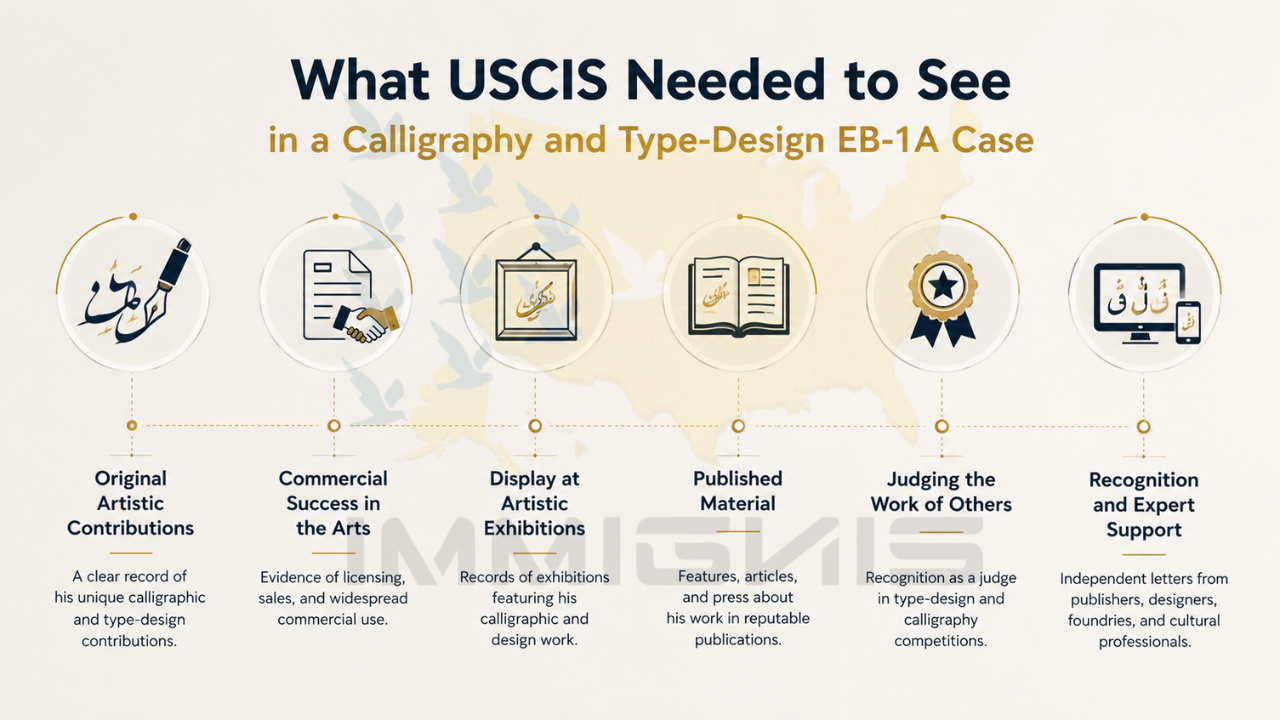
This case did not fit the common researcher model of papers, citations, and peer review. It belonged to the arts and design world, where the EB-1A evidence had to be translated through exhibitions, published material, commercial use, judging, and original artistic contribution.
For original artistic contributions, the petition identified the petitioner’s calligraphic and type-design methods and explained how they connected classical Persian forms to modern digital use. Independent letters from publishers, type foundries, curators, and design professionals helped explain why the contribution was meaningful in the field.
For commercial success, the record focused on licensing, publisher use, adoption by design clients, and other forms of market evidence where available. The argument was not that commercial use alone made the work extraordinary. It was that documented adoption helped show that the work had moved beyond a personal studio practice.
For exhibitions, the record showed where his calligraphy or type-related work was displayed, curated, or presented to an arts or design audience. The exhibition evidence gave USCIS a way to see his work as part of a public artistic record, not only as a private design service.
For published material, the case used design-press features and critical coverage that discussed him, his work, or his expertise. Ordinary promotional blurbs were kept separate from qualifying media evidence.
For judging, the record documented his service evaluating type-design competitions, emerging designers, or related artistic submissions. USCIS needed to see that he was judging the work of others, not merely attending a design event.
Licensing and usage records turned ubiquity into evidence
The strongest practical evidence came from the places where his typefaces entered real publishing use. A typeface can shape the appearance of books, cultural materials, and institutional communications without producing a conventional byline. The petition solved that problem by building a record behind the visible design.
Licensing files helped show permissioned use. Publisher and foundry confirmations helped establish attribution. Visual usage examples showed how the work appeared in real design settings. Where the evidence allowed, the petition connected a typeface or calligraphic system to a particular publishing or cultural context.
That combination was more persuasive than a claim that his work was everywhere. USCIS could see the chain: the design was created, licensed or adopted, used by others, and recognized by professionals who understood its artistic and technical value.
The case also avoided overstating what usage evidence could prove. Use by a publisher may support commercial success or significance, but it does not automatically prove extraordinary ability. It becomes stronger when combined with press, exhibitions, judging, expert letters, and a coherent account of the designer’s field.
The exhibitions showed the artistic side of a technical design practice
Type design can sometimes look too commercial for an arts petition if the record only shows client use. The exhibition evidence helped correct that imbalance.
The petition documented displays of calligraphic and type-related work in artistic or design contexts. These exhibitions showed that the petitioner’s work was not limited to production fonts or publishing tools. It also had a visual and cultural life within the broader field of Persian calligraphy and contemporary design.
That mattered for final merits. USCIS could evaluate him as an artist and designer whose work had been placed before the public, reviewed by curators or organizers, and connected to a recognized artistic tradition.
Design press helped explain why the work mattered
A non-specialist can look at a Farsi typeface and miss the underlying design problem. Persian script has visual rhythm, joining behavior, proportion, contrast, and cultural expectations that do not translate neatly into a simple digital font file.
Design-press coverage helped make that problem visible. Articles and features explained his work in a language that connected artistic tradition with digital use. They also provided independent public recognition, which was necessary because internal publisher use alone could have looked like ordinary client work.
The most useful press did not merely announce that he had released a typeface. It discussed the nature of the work, the design choices, the relationship to calligraphy, or his standing as a designer. That kind of coverage helped USCIS understand why his record belonged in an extraordinary ability petition.
Judging evidence showed that other designers trusted his eye
Judging was important because it showed that the field was not only using his work. It was also asking him to evaluate the work of others.
The record documented type-design competition judging and related evaluation roles. Those assignments supported the EB-1A judging criterion because they showed that organizers trusted his professional judgment in assessing artistic or design quality.
In an arts case, this kind of evidence can be especially useful. It shows that recognition is not limited to fans, clients, students, or buyers. It shows that other professionals view the petitioner as someone capable of setting standards, identifying quality, and evaluating emerging work.
Letters from publishers and foundries filled the gap between use and recognition
Independent letters were important, but they were used carefully. A letter that says an artist is talented rarely carries a case. A stronger letter explains what the person created, where the work was used, why it was difficult, and how it affected practice in the field.
Letters from publishers, type foundries, curators, and design professionals helped explain the petitioner’s role in bringing Persian calligraphic traditions into modern digital type environments. They also helped show that his work was not interchangeable with ordinary graphic production.
The best letters did not rely on adjectives. They explained the design problem: how classical form, readability, digital behavior, publishing needs, and cultural aesthetics had to be balanced. That gave USCIS a technical and artistic basis for understanding the contribution.
How the EB-1A evidence came together
The final record did not depend on one dramatic fact. It worked because the evidence pointed in the same direction from several sources.
- Original artistic contributions: The petition identified his calligraphic and type-design systems and explained how they contributed to modern Farsi visual communication.
- Commercial success in the arts: Licensing, usage, publisher adoption, and related documentation showed market use of his work where the records supported it.
- Display at artistic exhibitions: Exhibition records placed his calligraphy and type-related work before arts and design audiences.
- Published material: Design-press features and critical coverage provided independent public recognition.
- Judging: Type-design competition judging and related evaluation roles showed that others relied on his professional assessment.
At final merits, the case presented a consistent professional identity: a Persian calligrapher and type designer whose work was used, displayed, discussed, evaluated, and independently attributed.
The approval
USCIS approved the Form I-140 petition on December 12, 2025.
The approval did not come from claiming that calligraphy is culturally important in general. It came from showing that this petitioner had built a documented record within a narrow field: bridging classical Persian calligraphy and digital Farsi type design.
The case turned a common weakness into the main evidentiary theme. His typefaces were visible, but the author was not. The petition made the authorship visible.
What artists and designers can learn from this case
Many artists, type designers, illustrators, choreographers, cinematographers, and other creative professionals face the same problem. Their work may be seen by large audiences, used by respected institutions, or embedded in public culture, but the proof may not point back to them clearly enough for EB-1A.
For USCIS, visibility must become evidence. A designer should be able to show not only that the work exists, but that the work is attributable, recognized, used, reviewed, displayed, or relied upon in ways that satisfy the EB-1A framework.
This is especially important for creative professionals whose contributions are often behind the scenes. A typeface, a visual system, a choreography, a cinematography style, or a performance method may influence the final product while remaining absent from public credit. EB-1A preparation must correct that gap with documentation, not exaggeration.
The most valuable profile building is not cosmetic. It identifies the field, documents the actual contribution, creates public recognition where appropriate, and gathers independent evidence that can be verified.
Frequently asked questions
Can a calligrapher or type designer qualify for EB-1A?
Yes, an artist or designer may qualify for EB-1A if the record satisfies the regulatory criteria and shows sustained acclaim and extraordinary ability in the field. The petition must document recognition, original contributions, exhibitions or displays, media coverage, judging, commercial success, or other qualifying evidence where applicable.
Is widespread use of a typeface enough for EB-1A?
Not by itself. Widespread use becomes useful only when the record can show attribution, adoption, licensing, commercial or artistic significance, and independent recognition. USCIS must be able to connect the visible work to the individual petitioner.
Do artists need academic publications for EB-1A?
No. Artists are not required to present academic publications if other EB-1A criteria fit the field. For creative professionals, exhibition records, press coverage, judging roles, awards, commercial success, original artistic contributions, and leading roles may be more relevant.
What is the most common weakness in an arts EB-1A case?
A common weakness is relying on reputation without documentation. USCIS does not approve a case because colleagues say the artist is respected. The record should show verifiable evidence such as programs, exhibition materials, reviews, contracts, licenses, media features, jury invitations, awards, or institutional letters.
Why did this case focus so much on attribution?
Because the petitioner’s work was visible in publishing and design use, but his name was not always visible to the public. The petition had to prove that the work belonged to him and that professionals in the field recognized its value.
Build an EB-1A record around the artistic work people actually use
If you are a calligrapher, type designer, visual artist, illustrator, filmmaker, dancer, musician, or other creative professional, your strongest evidence may not be sitting in one obvious place. It may be spread across exhibitions, client records, reviews, licenses, festival programs, usage examples, and letters from people who understand your field.
Immignis and Advance My Profile help creative professionals identify a defensible field niche, document attribution, build credible public recognition, and prepare an EB-1A record around evidence that can be verified and professionally explained.