USCIS approved the Form I-140 after the petition showed that his seismic retrofit work was more than routine structural consulting.
Key facts at a glance
| Outcome | EB-1A approval for an Iranian earthquake structural engineer working at a U.S. based engineering consultancy. |
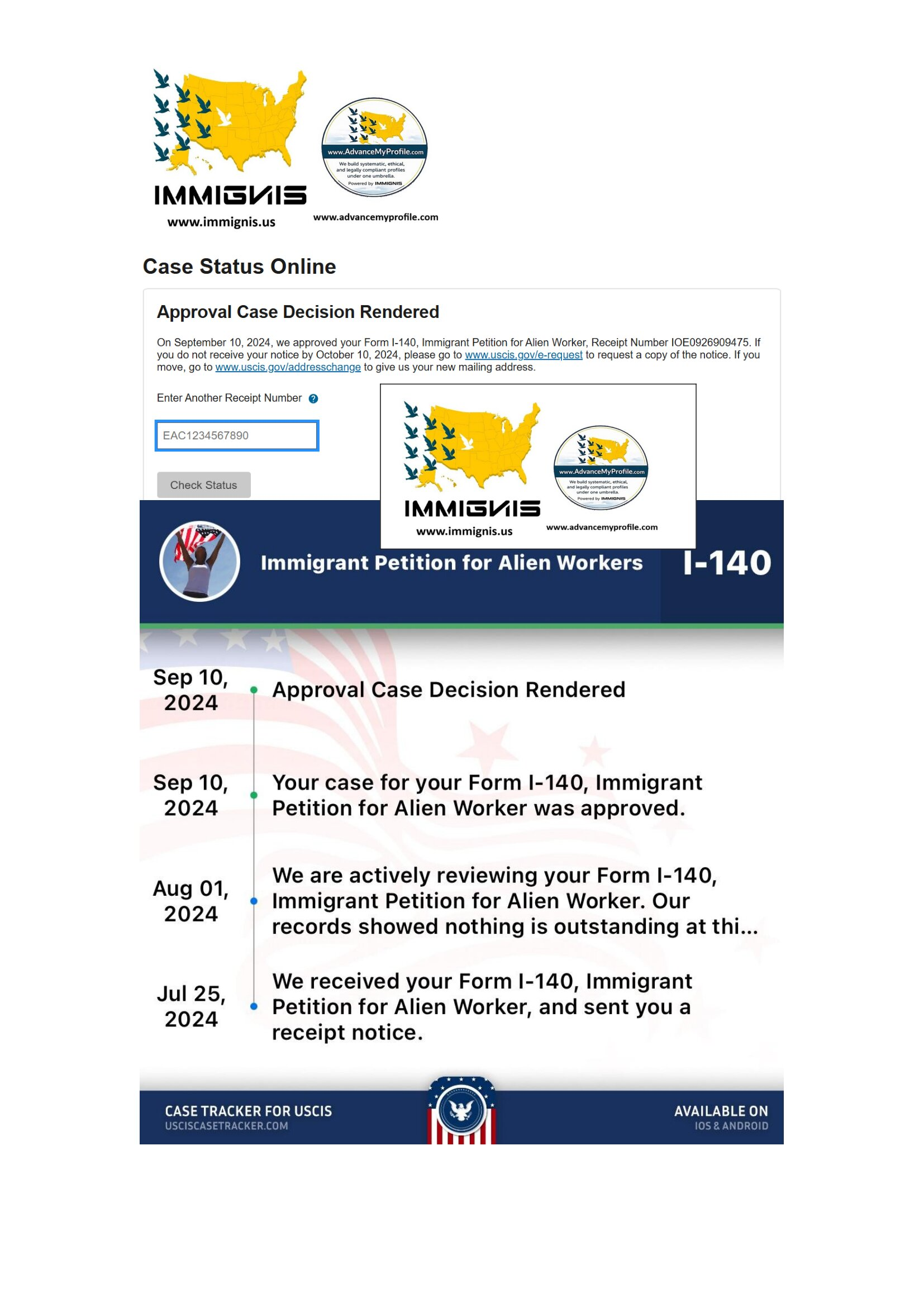
| Approval date | Approved on September 10, 2024. |
| Field niche | Seismic retrofit methods for older concrete buildings, with a focus on evaluating vulnerability, selecting appropriate interventions, and documenting public-safety relevance. |
| Starting problem | The engineering work was serious, but the record looked like ordinary structural consulting. USCIS needed to see a recognized seismic-retrofit specialist, not only a capable project engineer. |
| Profile-building path | Focused seismic-retrofit papers, a retrofit guide, municipal-facing white paper, expert commentary after earthquakes, invited trainings, peer review, professional awards, leading-role evidence, and independent letters. |
| EB-1A criteria supported | Original contributions, scholarly articles, published material, awards, judging, and leading or critical role. |
USCIS approved his Form I-140 of an EB-1A Iranian Earthquake Engineer on September 10, 2024.
The petition was not built around the idea that he had simply worked on buildings in seismic regions. It was built around a harder point: older concrete buildings can carry hidden structural weaknesses, and retrofit decisions made before the next earthquake can affect whether a building remains usable, repairable, or dangerous after strong shaking.
He was an Iranian structural engineer working at a U.S.-based engineering consultancy. His focused area was seismic retrofit methods for older concrete buildings. Before profile building, his record contained serious engineering work, but it still looked like a collection of client projects, calculations, reports, and consulting responsibilities. That is common in structural engineering. It is also risky in an EB-1A case.
The EB-1A green card is a self-petition immigrant classification for individuals who can demonstrate extraordinary ability through sustained national or international acclaim and recognized achievements in their field. For an engineer, a strong employment history is not enough by itself. The petition must show why the person is recognized for work that is important in the field, not just valued by an employer or client.
Advance My Profile, powered by Immignis, reviewed his technical record with legal strategists and structural engineering specialists. The case was narrowed to a specific authority niche: seismic retrofit methods for older concrete buildings. That focus made the difference between a general engineering resume and a coherent EB-1A record.
Why a serious consulting record can still look ordinary to USCIS
Structural engineers often do some of their most important work inside project files that are not public. They evaluate existing buildings, review drawings, study field conditions, compare retrofit options, prepare calculations, advise clients, and help teams decide which intervention is technically appropriate. Much of that work is confidential, tied to a property owner, or described only in internal project language.
That created the central weakness in this case. The record showed useful work, but it did not immediately show a field-recognized seismic retrofit specialist. The professional story was scattered across building assessments, retrofit discussions, project documentation, and technical responsibility inside a consulting practice.
The legal issue was not whether seismic retrofit work matters. It does. The issue was attribution and recognition. Which methods belonged to him? Which problems did he repeatedly solve? Who outside his employer recognized his judgment? How did his work connect to broader public-safety concerns rather than only to individual consulting assignments?
Those questions shaped the entire profile-building strategy.
His niche was the retrofit decision after vulnerability is found
The case did not present him as a general earthquake engineer who could work on any seismic problem. It focused on older concrete buildings, especially the engineering decisions that follow once vulnerability has been identified.
Older concrete structures may involve original design assumptions, detailing practices, material conditions, gravity-load constraints, occupancy requirements, and retrofit limitations that make the analysis more difficult than simply applying a modern design checklist. A retrofit recommendation must consider the likely failure mode, the performance objective, the building’s use, constructability, cost, disruption, and the limits of available information.
His work was organized around that decision process. What condition was being evaluated? Which structural behavior created concern? Which retrofit option addressed the problem without creating another one? What evidence supported the recommendation? How should an owner, consultant, or local decision-maker understand the risk before the next seismic event?
That became the professional through-line of the petition: not just designing retrofits, but making older concrete building risk more understandable, documentable, and defensible.
What USCIS needed to see in this earthquake engineering EB-1A case
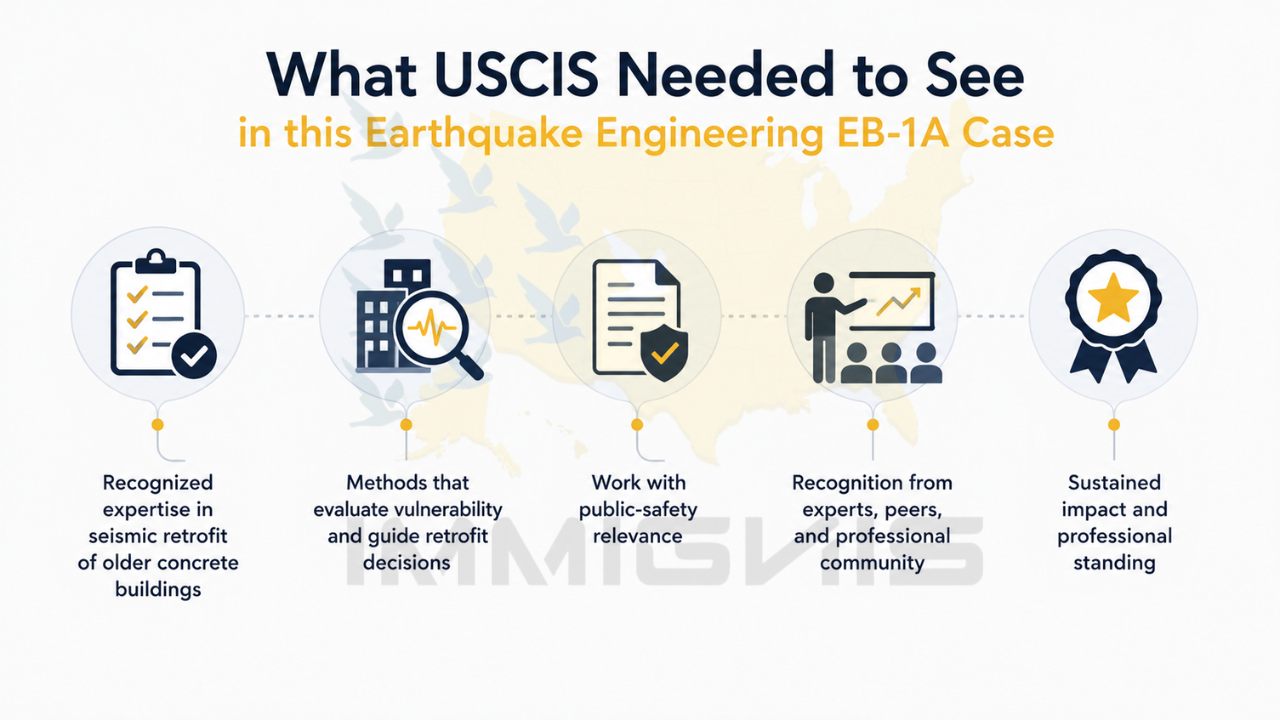
USCIS needed a record that did more than describe a capable engineer. The petition had to show recognized expertise in a defined area of seismic resilience and prove that the evidence fit both the regulatory criteria and the final-merits standard.
For original contributions, the record identified his retrofit methods, evaluation frameworks, guide materials, and documented engineering work. Independent structural engineering experts explained why those contributions mattered for assessing and improving older concrete buildings.
Scholarly articles needed to be more than general publications about earthquakes. They had to connect his authorship to the same field niche: seismic vulnerability, retrofit selection, performance concerns, and practical methods for existing concrete structures.
Published material required independent coverage about him or his expertise. Commentary after earthquakes helped translate the technical problem for a broader audience, but it still had to be tied to his recognized professional judgment.
Awards evidence had to document the recognition, the basis for selection, and the professional significance of the honor. Peer review supported judging when he evaluated the work of other specialists. Leading or critical role evidence required more than a job title; it needed records showing that significant engineering work relied on his seismic retrofit judgment.
At final merits, USCIS could still ask whether the whole record described a professional with sustained acclaim and top-level expertise in the field. The petition therefore had to make every part of the evidence point toward the same engineer, the same problem, and the same area of recognized skill.
The consulting evidence was rebuilt around engineering decisions
The strongest internal material was reorganized by engineering question rather than by client name or project title.
One group of evidence addressed building vulnerability. Another addressed retrofit selection. Another traced how technical recommendations moved into project planning or public-safety discussions. This structure helped the petition avoid a common mistake: treating a list of projects as if the list itself proves extraordinary ability.
The evidence instead asked: What was the structural problem? What method did he use or develop? What changed because of that analysis? Which records connected the work to him? Which independent expert could evaluate the significance without needing confidential project drawings?
Protected property details, client identities, proprietary calculations, and sensitive project records were kept outside the public story. The petition used non-confidential descriptions, role evidence, public-facing technical work, and independent explanations to show the engineering value without exposing protected information.
The method papers gave his retrofit work a public technical language
With domain support, he developed focused papers on seismic retrofit strategy for older concrete buildings. The papers addressed the kinds of questions that practicing engineers and public-safety stakeholders face before a damaging earthquake occurs.
One paper examined why a building that appears serviceable in daily use may still require careful seismic evaluation. Another discussed how retrofit decisions should account for likely failure modes, constructability, and the intended performance objective rather than treating all deficiencies as if they call for the same intervention.
The publications were important because they moved the record away from private consulting files and into public authorship. They did not reveal client data. They gave USCIS and independent experts a way to see the professional method behind the consulting work.
The retrofit guide made the contribution practical
The retrofit guide was written for professionals who needed a clearer sequence for evaluating older concrete building risk and considering intervention options.
It organized the process around screening, review of existing information, identification of vulnerable components or structural behaviors, selection of retrofit objectives, comparison of possible interventions, documentation of assumptions, and communication of residual risk.
The guide did not promise that one method can make every building earthquake-proof. That would have weakened the credibility of the case. Instead, it showed disciplined engineering judgment: identify the risk, explain the basis for concern, connect the retrofit option to the building behavior being addressed, and document the limitations of the recommendation.
For EB-1A purposes, the guide helped present a concrete professional contribution. It also gave independent experts something specific to assess when explaining the significance of his work.
A municipal-facing white paper connected engineering work to public safety
The municipal-facing white paper helped frame the work for people who are not structural engineers but may still make decisions about building risk, budgets, priorities, and public safety.
The paper explained why older concrete buildings can be difficult to manage before an earthquake. Some buildings require detailed engineering review. Some require staged intervention. Some require owners and local officials to understand that a building’s age, apparent condition, and occupancy do not answer every seismic-risk question.
The white paper did not turn the case into a policy petition. It remained an EB-1A case about a structural engineer. Its value was that it showed the broader relevance of his technical expertise: seismic retrofit work can affect how communities think about risk reduction before damage occurs.
Media commentary after earthquakes showed public trust in his judgment
Earthquakes often create public questions that are more complicated than the immediate news cycle can handle. Why did one building suffer heavy damage while another nearby building remained standing? Does visible cracking mean failure is likely? Can an older concrete building be considered safe because it has survived previous earthquakes?
His media commentary addressed these questions in careful terms. He explained damage patterns, retrofit concepts, and the limits of quick visual assumptions. The commentary avoided assigning blame for specific incidents he had not investigated and avoided claiming certainty where proper engineering evaluation would be required.
This mattered because published material in an EB-1A case should not merely be publicity. It should help show that others looked to the person for expertise. In this case, public-facing commentary helped connect his name to seismic retrofit and structural-safety questions outside normal consulting channels.
Invited trainings moved the work in front of practicing professionals
The invited trainings gave the record another form of recognition. Engineers, building professionals, and related stakeholders could engage with the retrofit logic directly.
The sessions focused on practical questions: how to read early signs of vulnerability, how to choose between investigation and intervention, how to avoid overclaiming from limited records, and how to communicate seismic risk in a way that is accurate but useful for decision-makers.
Training evidence was not treated as a substitute for original contributions. It supported the broader record by showing that his expertise was being shared with professionals beyond one employer and one client file.
Peer review and awards strengthened the recognition record
Peer review helped show that technical venues trusted him to evaluate the work of other specialists. The petition documented review assignments in structural engineering, earthquake engineering, retrofit methods, and related resilience subjects where available.
This evidence supported the judging criterion because it involved actual evaluation of other professionals’ work. The petition avoided treating attendance at conferences or participation in ordinary professional activity as judging.
Professional awards were handled with the same discipline. The record described what was awarded, who granted the recognition, the basis for selection, and why the honor mattered within the engineering context. Awards are strongest when USCIS can see that they recognize professional achievement, not merely participation or payment.
Together, peer review and awards helped answer a question that consulting records often cannot answer alone: did others in the field recognize his judgment?
Independent letters explained why the retrofit work mattered
The independent letters were not written as general praise letters. Their purpose was to explain the engineering significance of the work in terms USCIS could evaluate.
Experts discussed older concrete building risk, retrofit decision-making, public-safety relevance, and the importance of documenting methods before an earthquake exposes the weakness. They connected his papers, guide, consulting evidence, trainings, media commentary, and professional recognition into one coherent record.
The strongest letters did not simply say he was talented. They explained what he contributed, how the contribution fit the field, and why the work had significance beyond routine structural consulting. That distinction was essential.
How the EB-1A evidence worked together
The final petition did not rely on one impressive item. It presented a connected record.
Original contributions were supported by retrofit methods, guide materials, documented engineering work, and independent expert analysis. Scholarly articles gave those methods a public technical foundation. Published material showed that his seismic expertise was visible outside employer-controlled records. Peer review showed that technical venues used his judgment to evaluate other work. Awards and leading-role evidence helped show professional recognition and responsibility in meaningful engineering activity.
This type of record is stronger than a checklist. It tells the same story from different directions: a structural engineer with a defined specialty in seismic retrofit methods for older concrete buildings, recognized through authorship, expert commentary, professional evaluation, awards, and independent assessments of his contribution. That is the difference between evidence that merely fills categories and evidence that supports final merits.
USCIS approved the petition
On September 10, 2024, USCIS approved his Form I-140.
The approval did not mean that every structural engineer with retrofit projects can qualify for EB-1A. It meant that this petition presented a focused and documented record of recognized expertise. The case showed how serious consulting work can be reframed around a defensible professional contribution when the evidence is accurate, specific, and supported by independent recognition.
For this engineer, the petition moved the record away from ordinary project descriptions and toward a clearer public-safety contribution: helping professionals evaluate and improve older concrete buildings before seismic risk becomes visible through damage.
What structural engineers can learn from this case
Many structural engineers underestimate their own evidence because their best work is hidden inside project files. Others overestimate their evidence because they assume difficult consulting work automatically proves extraordinary ability. EB-1A usually requires a more precise approach.
A strong case begins by identifying the actual professional contribution. For a seismic engineer, that may be a retrofit method, a vulnerability-assessment framework, a performance-based design contribution, a hazard-mitigation approach, or a documented method for translating technical findings into decisions that owners and public agencies can act on.
The next step is proving that the contribution belongs to the engineer and matters beyond one assignment. Publications, peer review, invited trainings, awards, published commentary, adoption evidence, and independent letters can all help, but only when they point to the same professional authority.
The lesson is simple: do not present every project. Present the professional method that links the projects.
Frequently asked questions
Can a structural engineer qualify for EB-1A?
Yes. A structural engineer may qualify if the evidence shows extraordinary ability through sustained acclaim and recognized achievements. Routine project work is usually not enough by itself. The petition must identify the engineer’s own contribution, field recognition, and significance.
Can consulting projects support an EB-1A case?
Yes, but they must be documented carefully. Consulting projects can help when they show the engineer’s specific method, responsibility, and contribution. Confidential records should be handled through safe summaries, role evidence, non-confidential technical descriptions, and independent expert analysis.
Do seismic retrofit methods count as original contributions?
They can, if the petition shows that the methods are attributable to the engineer and have significance in the field. The evidence may include technical papers, guides, documented use, expert letters, trainings, or other records showing that the work mattered beyond ordinary job duties.
Does public-safety importance automatically prove EB-1A?
No. Public-safety relevance can help explain the importance of the field, but EB-1A still requires evidence of the individual’s extraordinary ability, sustained acclaim, and recognized achievements. The petition must connect public-safety significance to the engineer’s own work.
Can awards and peer review strengthen an engineering EB-1A petition?
Yes. Awards can help when they reflect professional achievement and have a documented selection basis. Peer review can support judging when the engineer actually evaluated the work of other specialists. Both types of evidence should be tied to the overall professional narrative.
What if most of my engineering work is confidential?
A confidential record can still be developed, but it requires care. The petition should avoid exposing protected drawings, client names, proprietary calculations, and sensitive project data. Instead, it can use non-confidential summaries, public technical work, expert letters, and evidence of the applicant’s role and contribution.
Build an EB-1A record around the engineering method your projects already show
If you work in structural engineering, seismic retrofit, earthquake resilience, forensic engineering, building safety, or infrastructure risk reduction, your strongest EB-1A evidence may not be your project list. It may be the method that appears across your projects again and again.
Immignis and Advance My Profile help professionals identify a defensible authority niche, document original contributions, develop credible public recognition, and prepare an EB-1A record around evidence that can be verified and defended professionally.