EB-1A Lithium Extraction Chemist: How a Bolivian chemist working on direct lithium extraction for high-altitude salt-flat brines secured EB-1A approval by transforming strategic-resource work into a petition-ready immigration profile built on cleared methodology publication, battery-supply-chain press commentary, international conference talks, patent documentation, peer review, expert letters from battery-materials leaders, and ethical profile building.
Key facts at a glance
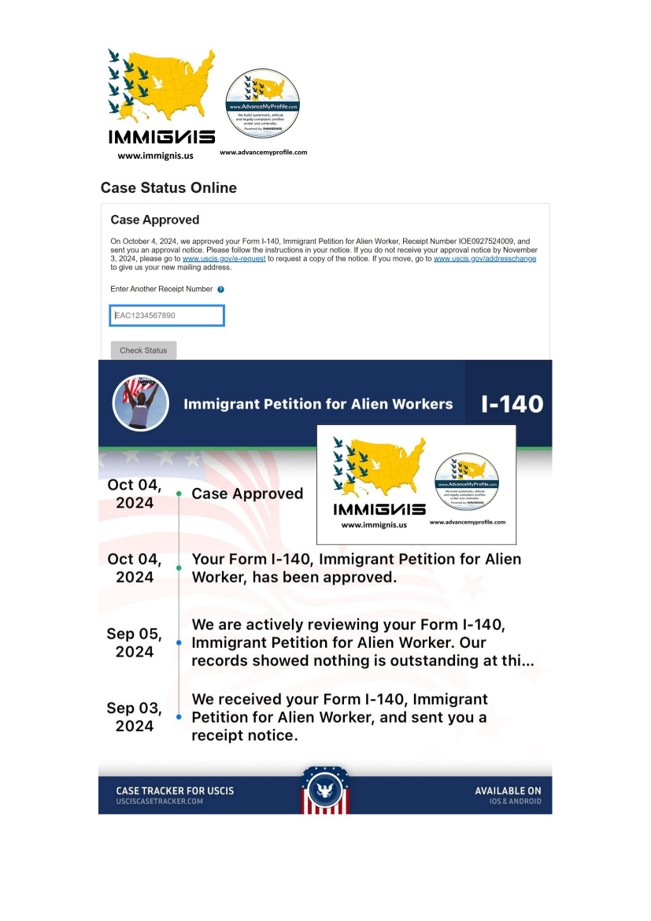
| Petition outcome | Form I-140 approved under EB-1A on October 4, 2024. |
| Professional profile | Bolivian lithium-brine chemist advancing direct-lithium-extraction methods for high-altitude salt-flat brines. |
| Field niche | Direct lithium extraction chemistry for South American brines. |
| Starting weakness | The work involved strategic-resource secrecy and state-company confidentiality, so the strongest technical achievements could not be freely disclosed in a normal public profile. |
| Profile-building focus | Cleared methodology publication, battery-supply-chain press commentary, international conference talks, patent documentation, peer review, expert letters from battery-materials leaders, and immigration-specific profile building. |
| EB-1A criteria supported | Original contributions, scholarly articles, published material, judging, and leading role. |
| Central issue | Showing that the petitioner had made real chemistry contributions to a globally important green-transition field while respecting confidentiality around strategic lithium resources. |
| Approval lesson | A confidential technical record can become a strong EB-1A profile when cleared evidence, expert validation, publication, patents, and field-specific positioning turn private scientific work into USCIS-readable proof. |
The approval
On October 4, 2024, USCIS approved the Form I-140 petition of a Bolivian lithium-brine chemist whose work focused on direct lithium extraction chemistry for South American brines.
The approval was significant because the petitioner was working in a field where technical achievement is often protected by strategic-resource secrecy, state-company confidentiality, private pilot data, and non-public process information. The chemistry mattered, but much of the strongest proof could not simply be copied into an immigration petition without careful review.
This made the case a strong example of EB-1A profile building, immigration profile building, and professional profile building for scientists whose work is real, valuable, and technically advanced, but partially hidden behind commercial, governmental, or resource-security restrictions.
Immignis and Advance My Profile helped convert the petitioner’s technical record into a petition-ready EB-1A profile. The strategy focused on cleared methodology publication, patent documentation, battery-supply-chain press commentary, international conference talks, peer review, expert letters from battery-materials leaders, and ethical profile building that made the petitioner’s work visible without violating confidentiality.
The evidence problem in direct lithium extraction chemistry
Direct lithium extraction is one of the most closely watched areas in the clean-energy supply chain. Lithium is central to battery production, electric vehicles, grid storage, and the wider energy transition. But the chemical methods used to extract lithium from brines can be sensitive, proprietary, and strategically important, especially when they relate to high-altitude salt flats in South America.
The petitioner’s starting weakness was not a lack of technical achievement. The weakness was that the best evidence lived inside confidential process work, pilot-scale results, state-company records, internal technical discussions, and strategic-resource projects. USCIS needed proof, but the petitioner could not simply disclose every formula, test result, or process detail.
The petition therefore defined the field carefully as direct lithium extraction chemistry for South American brines. It did not present the case as general chemistry, mining support, or routine laboratory work. It presented a precise niche involving brine chemistry, sorbent or separation approaches, process adaptation, impurity management, high-altitude salt-flat constraints, and battery-materials supply-chain relevance.
This field definition was essential for immigration-specific profile building. It helped USCIS understand why even a narrow technical contribution could carry broad significance when it related to lithium supply, battery materials, clean energy, and regional resource development.
Why strategic-resource secrecy had to be handled carefully
A major challenge in this case was strategic-resource secrecy. In lithium-brine chemistry, the most valuable evidence may also be the most sensitive. Process details, recovery rates, impurity-removal methods, pilot performance, brine-characterization data, and government-linked resource strategy may be protected by confidentiality rules or practical national-interest concerns.
The petition could not rely on vague claims, but it also could not expose confidential technical assets. That is where ethical profile building mattered. The goal was to show what the petitioner contributed, why it mattered, and how independent experts viewed the work, without disclosing restricted information or overstating what could be publicly proven.
This required a cleared evidence plan. Each technical item had to be reviewed for whether it could be shared, summarized, redacted, or supported through independent letters instead of raw data. The petition prioritized evidence that was specific enough to prove significance but safe enough to use in an immigration record.
For scientists searching for profile building, immigration profile building, EB-1A profile building, EB-2 NIW profile building, research profile improvement, or USCIS evidence building, this case shows why confidential work requires strategy rather than guesswork. The issue is not only whether the work is strong. The issue is how to prove it safely.
Cleared methodology publication created a public scientific record
Cleared methodology publication became one of the strongest components of the case. When confidential technical work cannot be fully disclosed, a carefully cleared publication can help show the professional logic, scientific contribution, and methodological value of the petitioner’s work without revealing protected details.
The petition used publication evidence to show that the petitioner’s knowledge was not only internal to one project. It had been converted into professional scientific material that could be read, evaluated, and used by others in the lithium, battery-materials, and extraction-chemistry communities.
This supported the scholarly-articles criterion and also strengthened the original-contributions argument. The publication record helped USCIS understand that the petitioner was contributing technical knowledge in a recognized area of clean-energy chemistry, not merely performing assigned laboratory tasks.
As part of scientific profile building and immigration-specific profile building, the cleared publication served a dual function. It protected sensitive information while giving the petitioner a public professional record that a non-specialist adjudicator could evaluate.
Patent documentation turned technical secrecy into traceable evidence
Patent documentation added another important layer. In technical EB-1A cases, patents can help show originality, technical authorship, and recognized problem-solving, especially when proprietary information prevents full disclosure of the underlying work.
The petition used patent evidence to connect the petitioner to specific innovations in lithium-brine processing and direct extraction chemistry. The point was not simply that a patent existed. The point was that the patent documentation provided an official, traceable record of inventive contribution in a field with strategic importance.
This evidence supported original contributions because it showed that the petitioner’s work moved beyond routine implementation. It addressed real technical barriers in lithium recovery from complex brine environments and helped make the petitioner’s contribution identifiable despite confidentiality around broader projects.
For professional profile building, patents can be especially powerful when they are paired with expert letters, publications, and industry context. A patent alone may not prove extraordinary ability, but in this case it formed part of a larger evidence architecture showing innovation, field relevance, and technical credibility.
Battery-supply-chain press commentary made the field legible
Battery-supply-chain press commentary helped make the field legible for USCIS. Direct lithium extraction is scientifically technical, but its importance is also economic and geopolitical. Press commentary gave the petition a public-facing explanation of why lithium-brine chemistry matters to electric vehicles, battery manufacturing, supply-chain resilience, and the global green transition.
The petition did not rely on media as decoration. It used published commentary to show that the petitioner could explain a specialized technical area to a wider industry audience and that the subject itself was important beyond one laboratory or one national project.
This supported published material and final-merits arguments because it connected the petitioner’s niche to a field of recognized global importance. It also helped translate chemistry into adjudicator-readable significance.
For immigration profile building, this is a useful tactic in technical cases. When the science is complex, industry-facing publication and commentary can help show both expertise and public relevance without weakening the scientific record.
International conference talks and peer review showed professional trust
International conference talks helped demonstrate that the petitioner’s expertise was visible beyond Bolivia and beyond internal project teams. In scientific and technical fields, invited talks and conference presentations are important because they show that professional audiences want to hear from the person, not just from the institution.
The petition used conference evidence to show that the petitioner was part of the international discussion on lithium extraction, battery materials, and resource chemistry. This helped support leading role, published material, and broader recognition in the field.
Peer review added direct support for the judging criterion. When a chemist is trusted to review technical work by other professionals, it shows that the field recognizes that person as capable of evaluating scholarly or scientific quality. In EB-1A terms, that is especially useful because judging is one of the clearest criteria when documented properly.
Together, conference talks and peer review showed that the petitioner was not operating in isolation. The record demonstrated participation in the professional systems through which lithium-chemistry knowledge is shared, assessed, and improved.
Expert letters from battery-materials leaders explained the chemistry and the stakes
Expert letters from battery-materials leaders were essential because they explained both the technical contribution and the broader importance of the work. USCIS officers are not expected to be experts in brine chemistry, sorbent design, impurity control, or lithium recovery. The letters helped translate those subjects into a credible immigration narrative.
The strongest letters did not merely say the petitioner was talented. They explained why high-altitude South American brines present distinctive technical challenges, how direct lithium extraction differs from conventional evaporation pathways, and why the petitioner’s work mattered within battery-materials development and the clean-energy supply chain.
These letters also helped address the confidentiality issue. When raw data could not be fully disclosed, independent experts could still explain the nature and significance of the petitioner’s contribution at an appropriate level of detail.
As part of profile improvement and professional profile building for immigration, the expert letters gave the petition context, credibility, and technical authority. They helped USCIS understand that the green-transition resource story was not just a marketing theme. It was supported by real chemistry.
The approval hook: green-transition relevance with real chemistry behind it
The approval hook was that the green-transition resource story was already easy for officers to understand, but the petition did not stop there. It gave USCIS the chemistry behind the story. Lithium matters because batteries matter, but this petitioner’s case succeeded because the record showed specific expertise in extracting lithium from difficult brine environments.
The petition connected global relevance to individual contribution. It showed that the petitioner was not simply working in a trendy field. He was contributing to a technical niche where better chemistry can affect extraction efficiency, resource development, environmental performance, and the supply chain for battery materials.
That distinction was important. Many applicants work near important industries. EB-1A requires showing why the applicant personally stands out. The evidence in this case did that through publications, patents, conference activity, peer review, expert letters, and a precise field definition.
This is what ethical EB-1A profile building does well. It turns a broad public story into a specific, evidence-supported professional profile.
How profile building changed the case
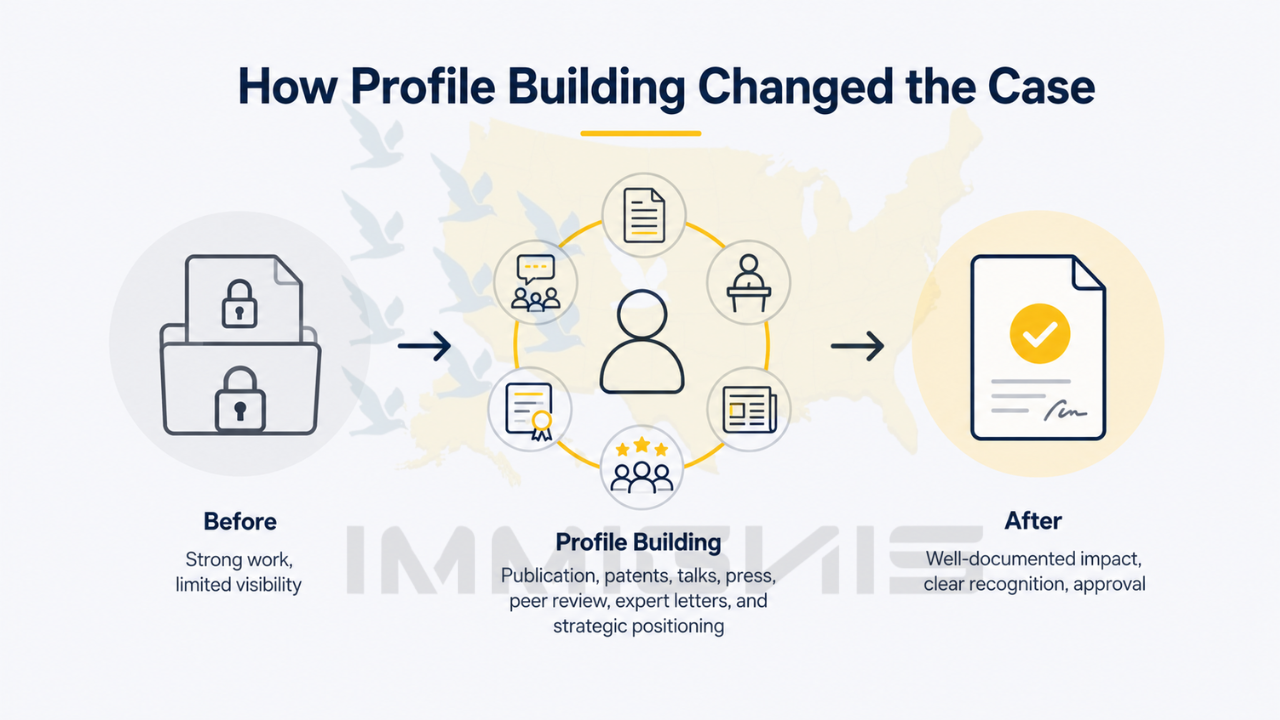
Before profile building, the petitioner’s record could have looked too confidential, too technical, and too dependent on state or company projects. The work was important, but the evidence was not naturally arranged for immigration adjudication.
Immignis and Advance My Profile helped organize the record around a clear EB-1A theory: original contribution in direct lithium extraction chemistry, supported by scholarly articles, published material, judging through peer review, and leading role evidence in a strategically important technical area.
The profile-building process turned cleared methodology publication into public scientific proof, patent documentation into traceable innovation, press commentary into field visibility, international talks into recognition, peer review into judging evidence, and expert letters into technical explanation.
For professionals searching online for profile building, immigration-specific profile building, professional profile improvement, EB-1A profile building, EB-2 NIW profile building, scientist profile building, research profile building, or USCIS evidence development, this case shows how confidential technical work can be transformed into a strong petition record without inventing achievements or exposing restricted information.
Why this case worked
The case worked because every evidence category solved a real problem. Cleared publication solved the public-record problem. Patent documentation solved the traceability problem. Press commentary solved the field-legibility problem. Conference talks solved the visibility problem. Peer review solved the judging problem. Expert letters solved the technical-explanation and confidentiality problems.
The petition also defined the field with discipline. It did not argue that the petitioner was extraordinary simply because lithium is important. It showed that the petitioner had made meaningful contributions in a difficult and specialized area of lithium-brine chemistry tied to the green-transition supply chain.
Most importantly, the evidence was structured honestly. It respected confidentiality while still making the petitioner’s individual role visible. That balance gave the petition credibility.
That is why this case became a strong example of ethical profile building for chemists, battery-materials researchers, mining-technology specialists, clean-energy scientists, and professionals whose most important work sits inside confidential technical environments.
Conclusion
The Bolivian lithium-brine chemist’s EB-1A approval shows that strategic-resource work can support extraordinary ability when the evidence is built with care.
The petition succeeded by turning direct-lithium-extraction research, cleared methodology publication, patent evidence, supply-chain commentary, conference presentations, peer review, and expert validation into a clear immigration profile.
The broader lesson is clear: confidential clean-energy work does not have to remain invisible. With ethical profile building and immigration-specific evidence development, real scientific contribution can be made petition-ready while protecting sensitive information.
Frequently asked questions
Can a chemist working in lithium extraction qualify for EB-1A?
Yes. A chemist working in lithium extraction may qualify for EB-1A when the record shows extraordinary ability through original contributions, scholarly articles, published material, judging, leading roles, patents, expert validation, and strong final-merits evidence.
Can confidential scientific work support an EB-1A petition?
Yes. Confidential work can support EB-1A when the petition uses cleared publications, redacted summaries, patent documentation, expert letters, and other safe evidence to prove the person’s contribution without exposing protected information.
Do patents help in a technical EB-1A case?
Yes. Patents can help show inventive contribution and technical originality, especially when combined with publications, expert letters, field impact, and evidence that the work matters beyond routine employment.
Can peer review count as judging for EB-1A?
Yes. Journal or conference peer review can support the judging criterion when it shows that the petitioner was trusted to evaluate the work of other professionals in the field.
Why is field definition important in clean-energy EB-1A cases?
Field definition is important because USCIS needs to evaluate the person inside the correct professional niche. In this case, direct lithium extraction chemistry for South American brines was more persuasive than a broad label like chemistry or mining.
Can Immignis and Advance My Profile help scientists build EB-1A evidence?
Yes. Immignis and Advance My Profile help scientists, researchers, engineers, chemists, and clean-energy professionals define a niche, document achievements, improve visibility, and build petition-ready EB-1A or EB-2 NIW profiles through ethical profile building and immigration-specific evidence development.
Build an EB-1A record around clean-energy chemistry, patents, publication, and technical impact
Many scientists and technical professionals already have meaningful field impact, but the evidence is often scattered across confidential projects, patents, publications, internal results, conference activity, expert relationships, and peer-review service.
Start with a free EB-1A profile assessment and find out whether your chemistry, clean-energy, battery-materials, mining-technology, lithium extraction, patent, publication, or research record can be developed into a stronger immigration profile through ethical profile building, profile improvement, and USCIS evidence building.