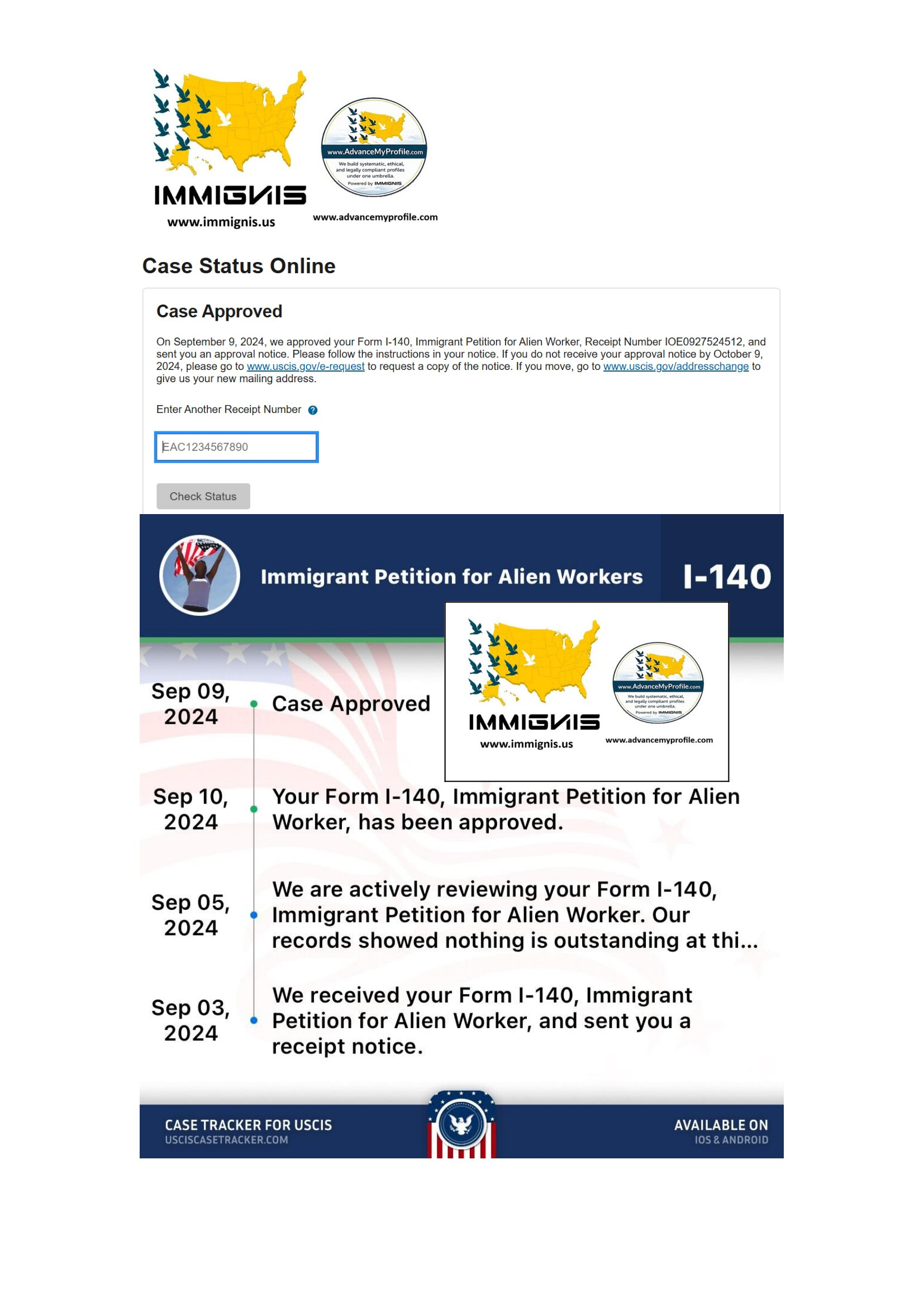
How an EB-1A Livestock Genomics Scientist from Uruguay secured approval by transforming industry-wide adoption into a petition-ready immigration profile built on adoption documentation from breeder associations, a genomics publication record, international livestock-genetics committee roles, industry-press coverage, evaluation-system authorship, expert letters, and ethical profile building.
Key facts at a glance
| Petition outcome | Form I-140 approved under EB-1A on September 9, 2024. |
| Professional profile | Uruguayan geneticist whose selection models helped shape a national beef-export industry. |
| Field niche | Bovine genomic selection for pasture systems. |
| Starting weakness | Industry adoption was widespread, but the scientist had limited name recognition because the models were absorbed into breeder systems, evaluation reports, and national livestock infrastructure. |
| Profile-building focus | Adoption documentation from breeder associations, genomics publication record, international livestock-genetics committee roles, industry-press coverage, evaluation-system authorship, expert letters, and immigration-specific profile building. |
| EB-1A criteria supported | Original contributions, scholarly articles, judging, leading role, and published material. |
| Central issue | Showing that the petitioner was not merely a researcher inside a national cattle-improvement ecosystem, but a named scientist whose genomic-selection models influenced breeding decisions, pasture-system performance, and beef-export competitiveness. |
| Approval lesson | When industry adoption is everywhere but personal recognition is nowhere, EB-1A profile building must trace use, authorship, and measurable value back to the individual scientist. |
The approval
On September 9, 2024, USCIS approved the Form I-140 petition of a Uruguayan livestock-genomics scientist whose work focused on bovine genomic selection for pasture systems.
The approval was important because the petitioner’s strongest achievements were not centered on personal publicity. His selection models were influencing breeder decisions, herd-improvement programs, and a national beef-export industry, but the public-facing record often credited associations, programs, evaluation systems, or the industry itself.
That created the core evidence problem. Industry adoption was visible everywhere, but name recognition was almost nowhere. Without immigration-specific profile building, USCIS could have seen a strong agricultural scientist with useful research rather than a top-of-field expert whose models helped shape a national production system.
Immignis and Advance My Profile helped convert that record into a petition-ready EB-1A profile. The profile-building strategy focused on breeder-association adoption documentation, genomics publications, committee roles, industry-press coverage, evaluation-system authorship, and expert letters that connected national-scale genetics work back to the petitioner personally.
The evidence problem in bovine genomic selection for pasture systems
Bovine genomic selection is a specialized field where the best evidence is often buried inside technical evaluations, breeding values, selection indices, herd databases, and association-led improvement programs. The science may influence thousands of animals and major export outcomes, yet the scientist behind the model may remain almost invisible to the public.
The petitioner’s field niche was defined as bovine genomic selection for pasture systems. This was important because Uruguay’s cattle industry relies heavily on pasture-based production, so selection models must account for performance in grazing environments rather than simply importing models designed for different production systems.
The starting weakness was therefore not a lack of impact. It was attribution. Breeders used the outputs. Associations relied on the evaluation systems. Industry outcomes benefited from better selection. But the petition needed to show that the petitioner personally contributed to the underlying methods and not merely worked around a successful national program.
This field definition was central to EB-1A profile building. It gave USCIS a clear lens for understanding why genomic-selection models, evaluation-system authorship, breeder adoption, and livestock-genetics committee roles could support extraordinary ability in an agricultural-science case.
Why national-industry adoption needed person-centered proof
National industry adoption can be persuasive, but only when the evidence connects adoption to the individual. USCIS does not approve a beef-export sector, a breeder association, or a national livestock system. It evaluates the person named in the petition.
For that reason, the petition had to avoid a broad and vague claim that the scientist’s country had a strong cattle industry. Instead, it needed to explain what models he developed or shaped, where those models were used, how the outputs influenced breeding decisions, and why other professionals treated his work as important.
This is a common issue in agricultural science, genomics, livestock improvement, and applied research. The more useful a model becomes, the more it may disappear into ordinary industry infrastructure. The petition therefore had to reverse that invisibility and make the authorship visible again.
For professionals searching for profile building, immigration profile building, EB-1A profile building, EB-2 NIW profile building, or profile improvement for scientists, this case shows why person-centered proof matters. Adoption is powerful only when the record traces the adoption back to the applicant’s specific contribution.
Adoption documentation from breeder associations made industry use visible
Adoption documentation from breeder associations became one of the strongest parts of the case. In livestock genomics, breeder associations often control the records that matter most: which evaluation systems are used, how animals are ranked, which traits are prioritized, and how selection decisions move through the industry.
The petition organized evidence showing how the petitioner’s genomic-selection work was used or relied upon by breeder groups, genetic-evaluation structures, and pasture-based cattle-improvement systems. This turned a broad industry story into a documented record of practical field use.
This evidence supported the original-contributions argument because it showed real-world adoption, not only academic promise. A model that influences breeder decisions, selection indices, or evaluation systems can represent a contribution of major significance when the petition explains its reach and technical value clearly.
As part of professional profile building for immigration, the adoption evidence also helped solve the name-recognition problem. It showed that even if the public did not know the scientist’s name, the industry was using the scientist’s work.
A genomics publication record gave the case scientific foundation
The genomics publication record gave the petition a formal scientific foundation. Publications helped show that the petitioner’s work was not only operationally useful but also technically grounded, peer-evaluated, and capable of contributing to the broader livestock-genetics field.
The petition used scholarly publications to support the scholarly-articles criterion and to reinforce the original-contributions theory. The record showed that the petitioner had contributed to the methods, data interpretation, and applied genetic knowledge needed to improve selection in pasture-based cattle systems.
Publication evidence was especially important because agricultural genomics can be hard for a non-specialist adjudicator to understand. Written scientific work gave USCIS a clearer basis for understanding the technical nature of the contribution and why the petitioner’s models mattered.
This is a key point in science and research profile building. Strong applied impact becomes much more persuasive when it is supported by a publication record that explains the science behind the industry adoption.
International livestock-genetics committee roles showed field trust
International livestock-genetics committee roles helped show that the petitioner’s expertise was recognized beyond one local program. Committee participation can be valuable in EB-1A cases when it reflects selection for expertise, responsibility for evaluating professional work, or influence on standards in the field.
The petition used committee evidence to support judging, leading role, and final-merits arguments. In a field like livestock genomics, peer review and committee participation can show that other experts trusted the petitioner to assess methods, guide technical discussion, or contribute to decision-making beyond his own institution.
This evidence also helped address the small-field issue. Livestock genomic selection for pasture systems is specialized, so recognition may not appear through mass-media fame. It may appear through committees, technical bodies, evaluation panels, and expert networks where the most relevant professionals actually operate.
For EB-1A profile building, that kind of field-native recognition is often more persuasive than generic publicity because it shows standing inside the expert community that understands the work.
Industry-press coverage and evaluation-system authorship built visibility
Industry-press coverage helped translate the petitioner’s technical work into public-facing recognition. In agricultural science, trade and industry publications can be important because they are read by breeders, exporters, agribusiness leaders, and technical professionals who use the work in practice.
The petition treated industry press carefully. It was not presented as celebrity media. It was used to show that the petitioner’s expertise had relevance to the livestock sector and that his work was visible in the channels where the field actually communicates.
Evaluation-system authorship was equally important. Authorship of selection systems, genetic-evaluation frameworks, or technical models helped connect the petitioner’s name to the machinery through which the industry made breeding decisions.
Together, industry press and evaluation-system authorship strengthened the published-material, original-contribution, and final-merits arguments. They made the scientist visible inside a record that had previously looked industry-wide but personally anonymous.
Leading role and original contributions in a national beef-export ecosystem
The leading-role argument focused on the petitioner’s responsibility inside a national livestock-improvement ecosystem. In agricultural science, leading role does not always look like a corporate title. It can be shown through authorship of evaluation systems, technical responsibility for models, advisory roles, and influence over tools that other stakeholders rely on.
The original-contributions argument focused on the importance of the petitioner’s selection models and their adoption in pasture-based beef production. The petition explained how the work helped improve decision-making in a national beef-export context and why that influence mattered beyond one laboratory or employer.
This framing was necessary because USCIS needed to see the connection between the scientist’s technical work and the broader industry outcome. The petition did not claim that one person alone created a national beef-export industry. Instead, it showed that one scientist’s models played a significant and attributable role inside that system.
That balanced approach made the case credible. It respected the collaborative nature of national agriculture while still proving the petitioner’s individual distinction.
How profile building changed the case
Before profile building, the petitioner’s record could have looked too quiet, too technical, and too absorbed by the industry. The work had impact, but the evidence was scattered across breeder documentation, publications, committee roles, technical systems, and sector-specific coverage.
Immignis and Advance My Profile helped organize the evidence around a focused EB-1A theory: the petitioner was a livestock-genomics scientist whose selection models helped shape bovine genetic improvement for pasture systems and supported the competitiveness of a national beef-export sector.
The profile-building process turned adoption documentation into impact evidence, publications into scientific proof, committee roles into judging and recognition evidence, and industry press into visibility. It also connected evaluation-system authorship directly to the petitioner’s name.
For agricultural scientists, geneticists, livestock experts, food-security professionals, and applied researchers searching for immigration profile building or EB-1A profile building services, this case shows how technical adoption can be converted into a clear extraordinary-ability record.
Why this case worked
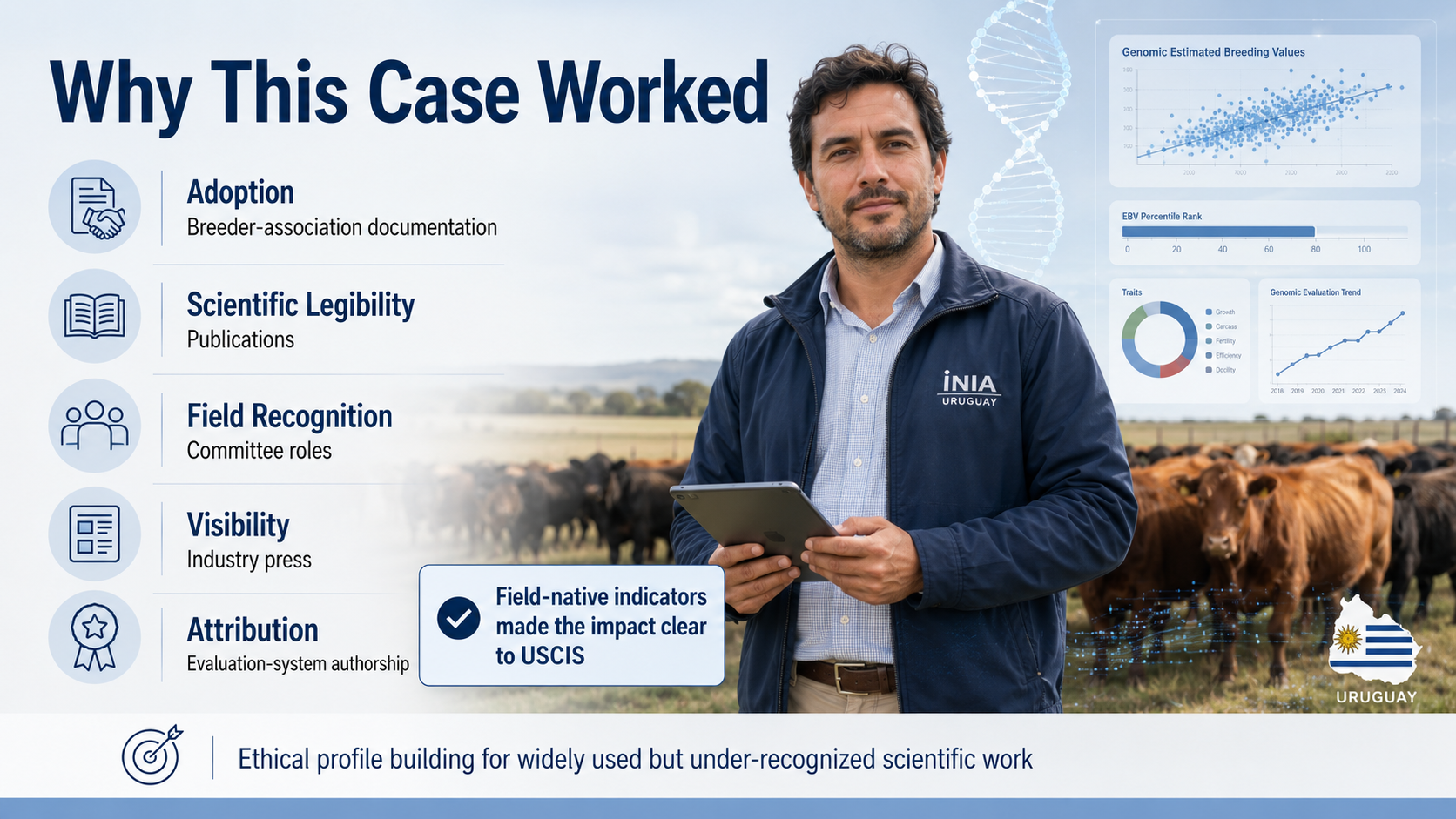
The case worked because each evidence category solved a specific problem. Breeder-association documentation solved the adoption problem. Publications solved the scientific-legibility problem. Committee roles solved the field-recognition problem. Industry press solved the visibility problem. Evaluation-system authorship solved the attribution problem.
The petition also used the field’s own logic. In livestock genomics, a scientist’s impact may be measured by adoption into evaluation systems, breeder reliance, trait-selection frameworks, and industry decision-making. The petition made those field-native indicators understandable to USCIS.
Most importantly, the case did not overstate the record. It did not argue vague national importance without proof. It traced the national industry’s genetics back to one scientist’s models through documents, expert validation, publications, and adoption evidence.
That is why the case became a strong example of ethical profile building for scientists whose work is widely used but not publicly recognized.
Conclusion
The Uruguayan livestock-genomics scientist’s EB-1A approval shows that applied agricultural science can support an extraordinary-ability case when industry adoption is documented and tied back to the individual.
The petition succeeded by turning bovine genomic selection work, breeder-association adoption, genomics publications, committee roles, industry-press coverage, and evaluation-system authorship into a clear immigration profile.
The broader lesson is clear: name recognition is not the only way to prove extraordinary ability. With ethical profile building and disciplined evidence development, a scientist whose models shape an industry can be presented as a top professional in a precise field niche.
Frequently asked questions
Can a livestock-genomics scientist qualify for EB-1A?
Yes. A livestock-genomics scientist may qualify for EB-1A when the record shows original contributions, scholarly articles, judging, leading role, published material, and strong final-merits evidence in a defined field niche.
Can industry adoption support an EB-1A petition?
Yes. Industry adoption can be strong evidence when the petition documents who adopted the work, how it was used, why it mattered, and how the adoption connects to the petitioner personally.
Do breeder-association letters help agricultural-science EB-1A cases?
Yes. Letters or documentation from breeder associations can be persuasive because they help prove practical adoption, field reliance, and the specific role of the scientist in the livestock-improvement system.
Can a publication record help if the main impact is applied industry work?
Yes. Publications help explain the technical foundation of applied work and can support scholarly-articles and original-contributions arguments.
Can committee roles count as judging or recognition?
Yes. Committee roles can support judging, leading role, membership, or professional recognition when they show that the petitioner was selected for expertise and trusted to evaluate or guide work in the field.
Can Immignis and Advance My Profile help agricultural scientists build EB-1A evidence?
Yes. Immignis and Advance My Profile help scientists, agricultural experts, researchers, geneticists, and technical professionals define a niche, document achievements, improve visibility, and build petition-ready EB-1A or EB-2 NIW profiles through ethical profile building and immigration-specific evidence development.
Build an EB-1A record around scientific adoption, authorship, and industry impact
Many scientists already have meaningful field impact, but the evidence is often scattered across association records, technical systems, publications, committee roles, industry reports, and expert letters.