Key facts at a glance
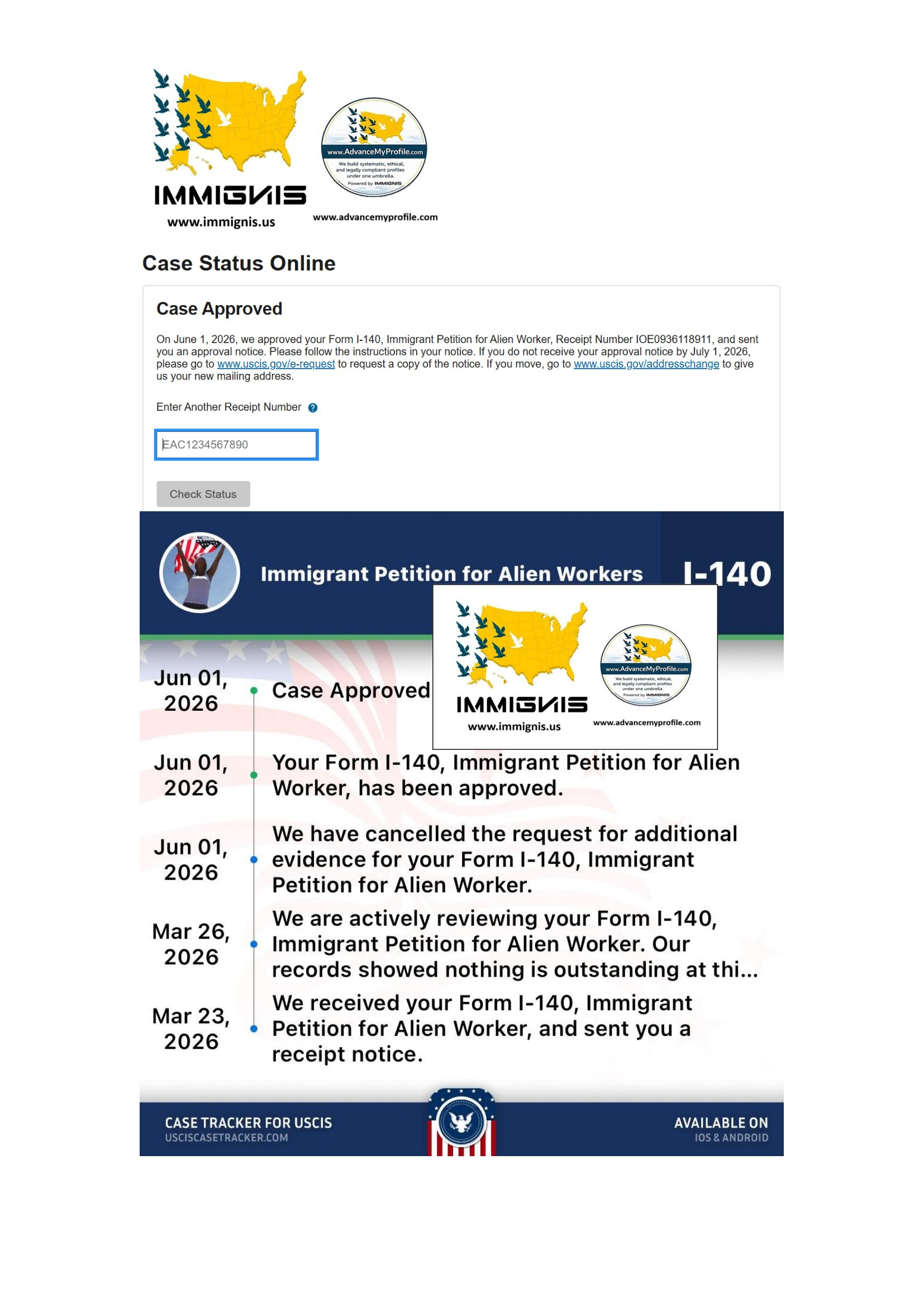
| Outcome | EB-1A approval for a Ugandan malaria diagnostics innovator working with a United Kingdom-based medtech laboratory. |
| Approval date | Approved on June 1, 2026. |
| Field niche | Low-cost AI microscopy for malaria detection, with a focus on diagnostic validation, frontline usability, image-based review, and access to reliable screening in resource-limited settings. |
| Starting problem | The invention was promising, but the record needed stronger independent corroboration. USCIS could not be asked to approve the case on potential alone. |
| Evidence developed | Diagnostic validation papers, patent filing evidence, a public-health white paper, media coverage, invited demonstrations, professional awards evidence, peer review, and independent letters from diagnostics and public-health experts. |
| EB-1A criteria supported in the petition | Original contributions, scholarly articles, published material, awards, and judging. Patent evidence supported attribution and original-contribution arguments rather than being treated as a separate EB-1A regulatory criterion. |
| Approval theme | USCIS approved the petition after the record connected low-cost AI microscopy to malaria diagnostic access and showed independent recognition of the innovator’s technical contribution. |
The EB-1A Malaria Diagnostics Innovator received USCIS approval of his Form I-140 on June 1, 2026.
The approval did not turn on the simple fact that he had built a malaria diagnostic tool. Many capable inventors build useful prototypes. EB-1A asks a different question: has the person become recognized for work that places him among the small percentage who have risen to the top of the field?
That distinction shaped this case. The client was a Ugandan diagnostics innovator working with a United Kingdom-based medtech laboratory. His work focused on low-cost AI microscopy for malaria detection. The promise was clear. In many settings, malaria diagnosis still depends on trained personnel, reliable microscopy, quality slides, time, and access to laboratories or point-of-care tools. A system that helps identify parasites in microscopy images can matter if it is reliable, affordable, and usable where diagnostic access is limited.
But promise is not the same as proof. The early record showed an invention and a serious public-health problem. It did not yet show enough independent corroboration, validation, recognition, and expert explanation to make the EB-1A case safe. Advance My Profile, powered by Immignis, helped rebuild the record around a narrower and more defensible authority profile: low-cost AI microscopy for malaria detection.
The problem was not invention. It was corroboration
Medtech innovators often assume that a good invention will speak for itself. In immigration filings, that assumption is risky. A diagnostic device, algorithm, mobile tool, or image-analysis workflow may be interesting, but USCIS still needs evidence of the individual’s contribution, the quality of the work, and recognition beyond the team that built it.
This case had that problem. The invention addressed a real diagnostic need, but the original profile did not yet provide enough public evidence to answer practical adjudication questions. Was the work technically attributable to him? Had the diagnostic method been tested or validated in a credible way? Did others in diagnostics, malaria research, or public health recognize its significance? Could experts explain the contribution without relying on confidential lab records or promotional claims?
The strategy was therefore not to make the invention sound larger than it was. It was to document the parts of the work that could be verified: validation logic, image-analysis methods, patent evidence, demonstrations, expert review, professional recognition, and public explanation of the diagnostic problem.
His field niche sat between microscopy, machine learning, and public-health access
A malaria microscopy system is not useful merely because it contains artificial intelligence. It becomes useful only if it helps with a real diagnostic task. The tool must deal with image quality, parasite visibility, slide preparation, staining, magnification, labeling, model performance, false positives, false negatives, and the workflow of the person who reviews the result.
The EB-1A record was narrowed around that practical space. His contribution was not described as generic AI in health care. It was low-cost AI microscopy for malaria detection, with attention to diagnostic validation and use in settings where laboratory resources may be limited.
That framing made the case more credible. It allowed the petition to discuss technical performance without claiming that an AI tool replaces trained clinicians or laboratory standards. The work was presented as a diagnostic-support contribution, not as a cure for malaria or a guaranteed replacement for established testing.
What did USCIS need to see in a malaria diagnostics EB-1A case?
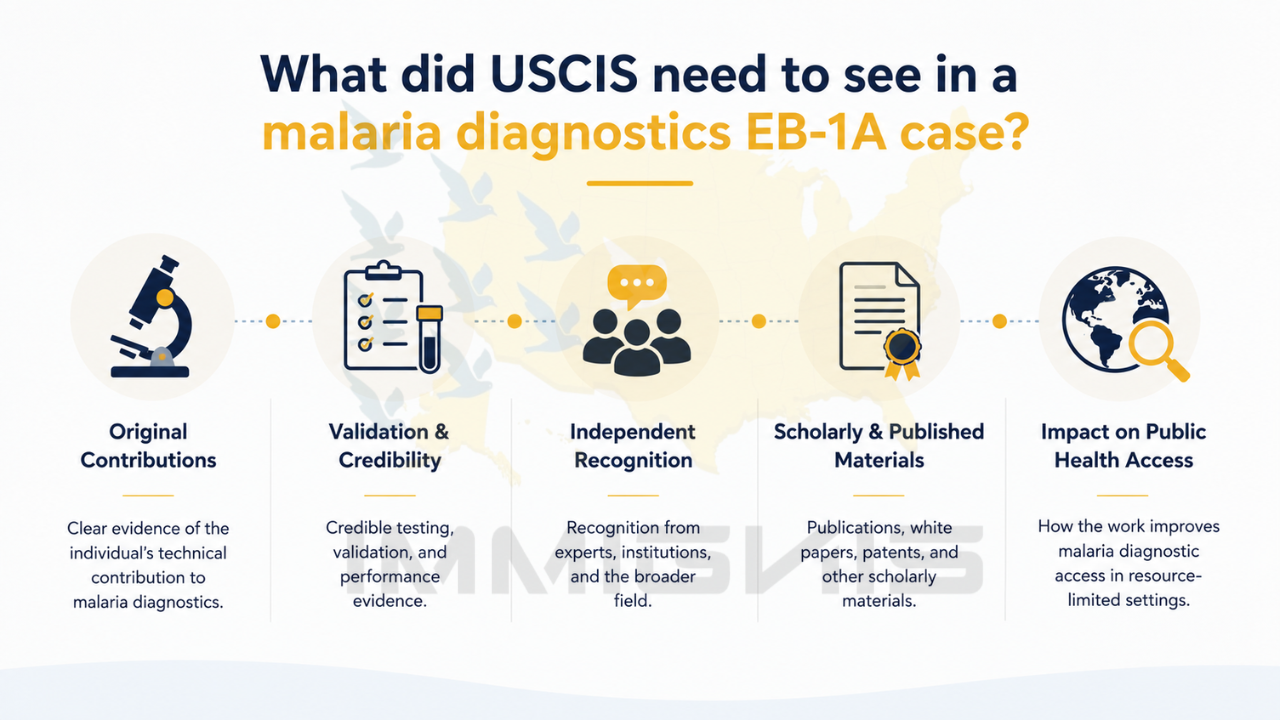
The petition needed to prove more than humanitarian value. Malaria is a serious disease, but EB-1A does not approve a case because the problem is important. It approves a person when the evidence shows extraordinary ability, sustained acclaim, and recognized achievements in a defined field.
For original contributions, the record had to identify the client’s own diagnostic method, image-analysis work, validation approach, or implementation contribution and explain why that contribution had major significance. A broad statement that malaria diagnostics are important would not be enough.
For scholarly articles, the papers needed to connect his authorship to AI microscopy, diagnostic validation, malaria screening, or related public-health technology. For published material, independent coverage had to discuss him or his work, not merely mention malaria or medtech in general. For judging, the evidence had to show actual evaluation of other specialists’ work, such as peer review or judging in diagnostic, medtech, public-health, or innovation settings.
Award evidence needed the same discipline. The petition documented the scope, selection basis, and relevance of any professional awards or recognitions. Where an item was only a nomination, application, or showcase opportunity, it was not inflated into an award win.
Validation papers gave the invention a scientific record
The first major step was developing a public technical record through diagnostic validation papers. These papers addressed the questions that matter in AI-assisted microscopy: how images were evaluated, how labels were handled, how performance was measured, how false results were considered, and why low-resource settings create different constraints from well-equipped laboratories.
The papers did not need to disclose confidential data from the medtech laboratory. They could discuss the diagnostic problem, the validation approach, the types of errors that matter, and the conditions under which AI microscopy may help expand access to screening or triage.
That public authorship mattered because an EB-1A case should not ask USCIS to accept a private invention at face value. A scientific record lets outside experts, reviewers, and readers understand what was built and why the work belongs to the individual.
Patent evidence helped connect the technical concept to the innovator
Patent filing evidence was used carefully. Where the filing materials identified him as an inventor or connected him to the diagnostic concept, the petition used that evidence to support attribution. It helped show that the AI microscopy method was not merely something he encountered at work. It was connected to his own technical contribution.
The filing itself was not treated as automatic proof of major significance. A patent application can show inventorship and a technical idea. It does not, by itself, prove that the field has recognized the contribution as important. The significance argument came from the wider record: validation work, public explanation, expert letters, awards evidence, demonstrations, and recognition by other professionals.
The public-health white paper explained why low-cost diagnosis matters
The public-health white paper helped shift the audience from a narrow product discussion to a diagnostic-access discussion. It explained why low-cost malaria detection tools are relevant where microscopy expertise, laboratory capacity, or rapid screening access may be uneven.
The paper stayed within defensible limits. It did not claim that AI microscopy alone solves malaria control. It explained a more precise point: diagnostic support tools may help make screening more accessible if they are validated, affordable, integrated into local workflows, and reviewed with appropriate clinical or laboratory judgment.
That framing helped the EB-1A narrative. The work was not presented as a startup pitch. It was presented as a contribution to the diagnostic infrastructure needed for earlier and more reliable malaria detection.
Media coverage and demonstrations made the work visible outside the laboratory
Independent media coverage was useful because it made the technical work visible to audiences beyond the laboratory and immediate development team. Strong coverage did not simply praise innovation. It explained the diagnostic problem, the need for accessible tools, and the role AI microscopy might play when used responsibly.
Invited demonstrations served a different purpose. They allowed technical, public-health, and medtech audiences to see how the system approached image review and where its limits remained. In this kind of case, demonstrations are strongest when they invite questions rather than avoid them: What happens with poor slide quality? How are uncertain images handled? Who reviews the output? What evidence supports the performance claim?
Those moments helped turn a private medtech project into a public authority record. They also showed that other professionals considered the work worth examining.
Awards and peer review supported recognition from outside the development team
Professional awards evidence helped show recognition, provided the evidence was real and properly documented. The petition identified the award or recognition, the selection process, the scope of the competition or organization, and the connection to diagnostic innovation or public-health technology.
Peer review also played an important role. When journals or technical venues asked him to review work by other researchers, that activity supported the judging criterion. The value was not the title of reviewer alone. It was the fact that other professionals relied on his judgment to evaluate methods, validation claims, diagnostic reasoning, or health-technology evidence submitted by others.
Together, awards and peer review helped address the starting weakness. The record no longer depended only on what the development team believed about the invention. It showed outside recognition and professional reliance on his expertise.
Independent letters explained the difference between a useful idea and a significant contribution
Independent letters were especially important because diagnostic innovation can be difficult for a general adjudicator to evaluate. The most useful letters did not simply call the work impressive. They explained the malaria diagnostic problem, the technical contribution, the validation evidence, and the reason low-cost AI microscopy may matter in settings where access to reliable diagnosis is limited.
The letters also helped avoid exaggeration. Good expert letters can explain significance while acknowledging limits. They can say why a method is promising, where it has been tested, what it contributes to diagnostic access, and what responsible implementation still requires. That balance made the record more credible.
How the EB-1A evidence came together
The final petition did not ask USCIS to approve him because malaria is a serious disease or because artificial intelligence is popular. It presented a focused record showing that he had become recognized for a specific contribution in low-cost AI microscopy for malaria detection.
- Original contributions: Diagnostic method evidence, validation work, patent filing materials, demonstrations, and independent expert letters connected the innovation to the client and explained its significance.
- Scholarly articles: Focused papers gave the work a public scientific record in AI microscopy, malaria detection, diagnostic validation, and public-health technology.
- Published material: Independent media coverage explained the work and its relevance to diagnostic access rather than merely describing a product.
- Awards: Professional recognition was documented according to the actual selection basis and relevance to diagnostics, medtech, or public-health innovation.
- Judging: Peer review and related evaluation activity showed that other professionals trusted his judgment to assess technical or scientific work.
- Patent evidence: The patent filing helped prove attribution and technical inventorship, while the broader evidence carried the significance argument.
The strength of the case came from the combination. A patent without validation would have been thin. Validation without independent recognition would have looked unfinished. Media without technical evidence would have looked promotional. The petition worked because those pieces pointed to the same professional identity: a malaria diagnostics innovator whose AI microscopy work had moved from invention to recognized expertise.
The approval showed why independent corroboration matters
USCIS approved the Form I-140 on June 1, 2026. The approval is useful for medtech founders, diagnostic researchers, public-health innovators, and AI health professionals who have strong work but limited public recognition.
The central lesson is simple. EB-1A does not reward an idea just because the idea sounds important. It requires a record. For diagnostic innovators, that record should show the technical method, validation evidence, public authorship, independent recognition, professional review, and expert explanation of significance.
In this case, the client had a meaningful invention. The work became EB-1A-ready when the record showed why other professionals should recognize him as an authority in low-cost AI microscopy for malaria detection.
What similar medtech professionals can learn from this case
A strong EB-1A profile for diagnostics or health technology should usually answer five questions.
- What specific diagnostic problem does the professional solve?
- Which technical method, validation approach, or invention can be attributed to the individual?
- What evidence shows the work has been tested, reviewed, demonstrated, or adopted?
- Who outside the immediate company or laboratory recognizes the person’s expertise?
- How does the work matter beyond one product, pilot, or internal development program?
When those answers are missing, even a promising invention can look like early-stage product development. When they are documented clearly, the same work can become a coherent EB-1A record.
FAQ
Can a diagnostic invention support an EB-1A petition?
Yes, but the petition must show more than invention. It should document the individual’s technical contribution, validation evidence, recognition, and significance in a defined field. A device or algorithm alone is usually not enough.
Is a patent enough for EB-1A?
No. Patent evidence can help prove inventorship and attribution, but EB-1A still requires evidence that the contribution has major significance and that the person has sustained acclaim in the field. Expert letters, validation evidence, publications, media, awards, or adoption evidence may be needed.
Can AI health technology qualify if it is still being developed?
It depends on the evidence. Early-stage technology can be part of an EB-1A record if there is credible proof of the person’s contribution, validation, recognition, judging, awards, or influence. Unsupported claims about future impact are weak.
Does public-health value help an EB-1A case?
Public-health relevance can help explain significance, but it does not replace EB-1A evidence. The petition must still show the person’s own achievements, recognition, and field-level contribution.
What made this malaria diagnostics case stronger?
The record combined diagnostic validation papers, patent filing evidence, public-health explanation, media coverage, demonstrations, professional recognition, peer review, and independent expert letters. The evidence worked together instead of relying on one claim.
Build an EB-1A record around the diagnostic contribution others can verify
If you work in AI diagnostics, medtech, laboratory innovation, public-health technology, microscopy, infectious disease screening, or point-of-care tools, your strongest evidence may still be scattered across validation files, product records, pilot data, conference materials, and expert relationships.
Immignis and Advance My Profile help professionals identify a defensible authority niche, document original contributions, build credible recognition, and prepare an EB-1A record around evidence that can be verified and explained professionally.