How a marathon athlete moving into endurance-training leadership turned race results, prize and appearance-fee records, athletics press, pacing and mentoring roles, and coaching credentials into a USCIS-approved EB-1A record.
Key facts at a glance
| Petition outcome | Form I-140 approved under EB-1A on June 3, 2026. |
| Professional profile | Ethiopian marathon athlete moving from competition into endurance-training leadership and coaching. |
| Field niche | Marathon competition and endurance-training leadership. |
| Starting weakness | The case had to answer whether sustained acclaim could continue after the athlete moved beyond peak competition years. |
| Profile-building focus | Race-result consolidation, prize and appearance-fee remuneration records, athletics-press archive, documented pacing and mentoring roles, and coaching credential pathway. |
| EB-1A criteria supported | Awards, high remuneration, published material, original contributions, and memberships. |
| Central issue | Proving that the petitioner would continue working in the same field rather than presenting only a finished athletic career. |
| Approval lesson | For athletes transitioning into coaching, the future pathway must be documented as carefully as the past acclaim. |
The approval
On June 3, 2026, USCIS approved the Form I-140 petition of an EB-1A Marathon Coach whose case raised a question that appears often in sports immigration work: what happens when the athlete is no longer at the beginning of a competitive career?
The petitioner had meaningful race results and recognition in marathon competition. He had also begun moving toward pacing, mentoring, and coaching work in endurance training. Inside athletics, that progression made sense. Elite runners often continue in the field by guiding younger athletes, leading training groups, pacing major efforts, and translating competition experience into coaching judgment.
For EB-1A, however, the transition needed to be documented carefully. USCIS had to see that his acclaim was not trapped in the past and that his future work still belonged to the same area of extraordinary ability.
That became the heart of the case: avoiding the retirement trap by proving that his athletic record, public recognition, compensation history, and developing coaching pathway all pointed toward continued work in marathon competition and endurance-training leadership.
The evidence problem in athlete-to-coach cases
Many athletes build their strongest records while competing. Their best evidence may come from race results, prize money, rankings, media coverage, invitations, and federation or club records. But when an athlete begins to age out of peak competition, an EB-1A case can become more complicated.
The issue is not whether the athlete was accomplished. The issue is whether the record still shows sustained acclaim and a clear plan to continue working in the field. If the petition looks like a tribute to a finished career, USCIS may question whether the person will continue in the same area of expertise after approval.
This case therefore needed a narrower and more practical field definition. It was not framed as general fitness, broad sports coaching, or a vague athletic career. It was built around marathon competition and endurance-training leadership.
That field definition allowed the evidence to connect naturally. Race results showed competitive standing. Prize and appearance-fee records showed market recognition. Athletics press showed public visibility. Pacing and mentoring roles showed continuity. Coaching credentials helped prove the next stage was real, not an afterthought.
Why race results were only the beginning
Race results were important, but they could not do the entire job. Major-race top finishes can support awards and recognition, but USCIS still needs to understand the level of the events, the size and quality of the field, and why the results matter inside marathon competition.
The record therefore consolidated race outcomes rather than leaving them scattered across event websites, federation pages, timing platforms, and old media references. This was necessary because athletic records often live in many places. A result that looks obvious to a runner may be difficult for an officer to verify if it is not organized clearly.
The petition treated race results as proof of competitive standing, then connected them to the broader story of sustained professional recognition. The goal was not simply to say he finished near the front. The goal was to show that he had competed at a level where results carried real field value.
That shift made the evidence stronger. The race record became part of a professional profile rather than a loose collection of performances.
Race-result consolidation made the athletic record readable
One of the most important profile-building steps was turning scattered results into a clean, chronological, officer-friendly record. Marathon careers are often messy on paper. A runner may have results under different spelling variations, national federation formats, event archives, sponsor pages, timing systems, and press reports.
The petition organized those results into a consistent record that showed the level of competition, the year, the placement, and the significance of each race. Where possible, the evidence also explained whether the race was nationally recognized, internationally competitive, or connected to prize money, professional invitations, or elite fields.
This mattered because USCIS does not award EB-1A based on a runner simply saying he was elite. The petition had to show the officer what the athletic community already understood: which races mattered, why those finishes were meaningful, and how the petitioner stood within the marathon field.
Once the results were organized properly, the case could present the petitioner as an athlete with a coherent competitive history rather than as someone relying on disconnected race memories.
Prize and appearance-fee records supported high remuneration
High remuneration can be useful in sports cases, but it has to be handled with context. Marathon athletes may receive prize money, appearance fees, sponsorship support, pacing payments, training stipends, coaching income, and other forms of compensation. If those records are not explained, they can look irregular or incomplete.
The petition therefore treated remuneration evidence as part of the professional sports economy. Prize records showed that his race performance had financial value. Appearance-fee and related payment records helped show that organizers or sponsors valued his participation, not merely his personal interest in running.
The comparison also had to be reasonable. The point was not to compare his income against unrelated occupations or the highest-paid athletes in global sport. The stronger comparison was against relevant marathon, road-racing, pacing, coaching, and endurance-training roles.
When placed beside race results and public recognition, the compensation evidence helped show that his ability had been valued in the market. It supported the broader conclusion that he was recognized above the ordinary level in his field.
Original contribution after competition
Original contribution can be difficult in athlete cases when the record is built only around personal performance. A fast time or a strong finish is impressive, but it does not always explain what the athlete contributes to others in the field.
For this petitioner, the original-contribution evidence was developed around pacing, mentoring, and endurance-training leadership. The petition showed that he was not simply leaving the sport. He was beginning to transfer elite marathon knowledge into training support for other runners.
That included documented pacing roles, mentoring responsibilities, and involvement in helping athletes prepare for competition. These records helped show that his experience had practical value beyond his own race day performance.
The petition did not overclaim. It did not argue that he invented marathon training. It made a narrower and more credible point: his elite competition experience, when applied through pacing, mentoring, and coaching development, had become a meaningful contribution within endurance training.
Published material and athletics press
Published material helped show that the petitioner was not merely a private runner with a good record. Athletics press, race coverage, interviews, event previews, and post-race reporting helped document public recognition around his competitive identity.
This type of evidence also helped preserve continuity. Press coverage from earlier competitive years showed the foundation of acclaim. More recent coverage or references connected that record to his continuing place in endurance running, including pacing, mentoring, and coaching-related roles.
The petition used media coverage as supporting evidence, not as decoration. The most useful pieces named the petitioner, described his race performance, discussed his role in the running community, or helped explain why his achievements mattered within marathon competition.
Membership and coaching credentials created the future pathway
The membership and credential evidence was especially important because the case involved a career transition. If an athlete plans to continue in the field through coaching, training leadership, or athlete development, the record should show that the pathway is already underway.
The petition therefore documented coaching credential steps, athletics affiliations, and participation in recognized endurance-running structures. These materials helped show that the petitioner was not changing fields. He was continuing in the same athletic domain from a different professional role.
That distinction mattered. An EB-1A case becomes weaker when the future plan feels detached from the prior acclaim. Here, the evidence showed continuity: marathon competition had led naturally into endurance-training leadership.
The continued-work issue had to be answered directly
The most delicate part of this case was the continued-work issue. Athletes face a particular challenge because competitive performance has a natural timeline. An officer may wonder whether the person is still active, whether the acclaim is current enough, and whether future work remains in the same field.
The petition addressed that question directly rather than hoping USCIS would overlook it. The record showed that the petitioner’s future work would remain tied to marathon and endurance performance through coaching, pacing, mentoring, and athlete-development activity.
That direct explanation helped avoid a common mistake. The case did not pretend he would compete forever. It showed that he would continue contributing in the same field in a credible way.
How the EB-1A criteria worked together
The petition did not depend on one perfect document. It worked because several forms of evidence supported the same story:
- Awards: Major-race results and top finishes were organized to show competitive recognition within serious marathon fields.
- High remuneration: Prize money, appearance fees, and related compensation records showed that his athletic value was recognized financially.
- Published material: Athletics press documented public recognition and helped explain the significance of his performances.
- Original contributions: Pacing, mentoring, and endurance-training leadership showed that his expertise was being applied beyond his own competition results.
- Membership: Coaching credentials and athletics affiliations helped document a credible pathway for continued work in the field.
The strongest part of the record was coherence. The petition did not treat competition and coaching as two unrelated careers. It showed them as one professional arc inside marathon and endurance training.
The final-merits argument
At the final-merits stage, the petition had to show that the evidence, taken together, established sustained acclaim and extraordinary ability. This was especially important because the petitioner was no longer presenting the case as a runner at the earliest stage of his competitive life.
The argument focused on continuity. His race results showed the foundation of acclaim. His remuneration records showed professional value. His press archive showed public recognition. His pacing and mentoring roles showed that his knowledge was already being used by others. His coaching credential pathway showed a credible future in the same field.
Together, those pieces answered the question USCIS could have asked: is this still an active field of extraordinary ability, or just a past athletic record? The petition showed that it was active, ongoing, and logically connected to future work.
That is why the case was stronger than a list of race results. It told USCIS not only what the athlete had achieved, but how those achievements would continue to matter in endurance training.
Why the approval mattered
The approval mattered because it showed that an athlete does not have to be frozen at the peak of competition to present a strong EB-1A case. Sports careers evolve. A marathoner can move into coaching, pacing, mentoring, and training leadership without leaving the field that made him extraordinary.
For this Ethiopian athlete, the petition did not avoid the transition issue. It built the case around it. That made the record more honest and more persuasive.
The approval confirmed the central lesson of the case: for athletes nearing the next stage of their careers, the future plan must be documented as carefully as the past acclaim.
Lessons for endurance athletes and sports professionals
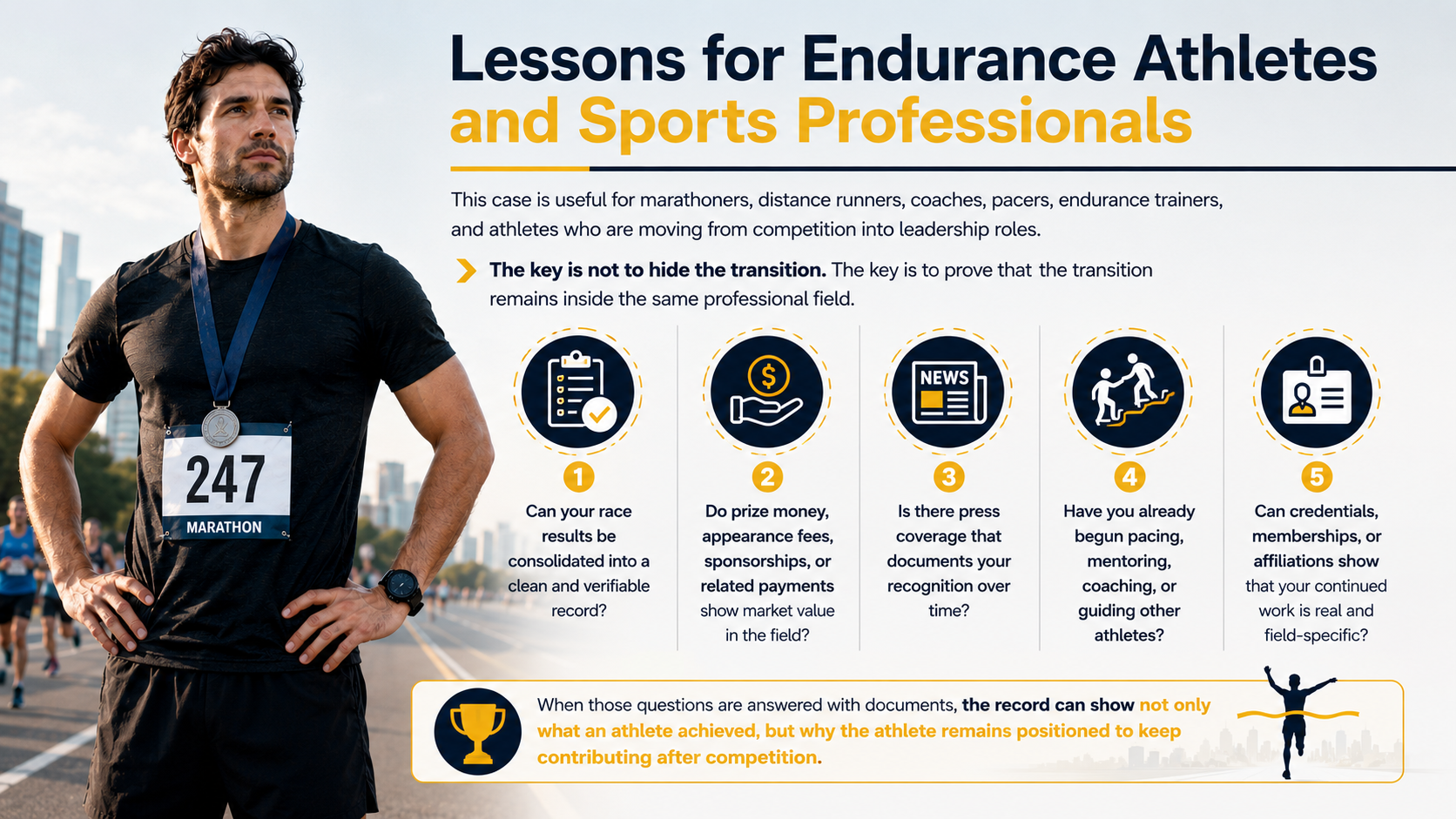
This case is useful for marathoners, distance runners, coaches, pacers, endurance trainers, and athletes who are moving from competition into leadership roles. The key is not to hide the transition. The key is to prove that the transition remains inside the same professional field.
A strong record usually begins with the following questions:
- Can your race results be consolidated into a clean and verifiable record?
- Do prize money, appearance fees, sponsorships, or related payments show market value in the field?
- Is there press coverage that documents your recognition over time?
- Have you already begun pacing, mentoring, coaching, or guiding other athletes?
- Can credentials, memberships, or affiliations show that your continued work is real and field-specific?
When those questions are answered with documents, the record can show not only what an athlete achieved, but why the athlete remains positioned to keep contributing after competition.
Frequently asked questions
Can a marathon athlete qualify for EB-1A?
Yes. A marathon athlete may qualify for EB-1A if the evidence shows sustained acclaim and extraordinary ability in marathon competition or a closely connected endurance-running field. The petition should document race results, recognition, compensation, press, memberships, and continued work in the field.
Can an athlete still qualify for EB-1A when transitioning to coaching?
Yes, but the transition must be documented carefully. The petition should show that coaching, pacing, mentoring, or athlete development is a continuation of the same area of extraordinary ability rather than a move into an unrelated field.
Do race results count as awards for EB-1A?
They can support the awards criterion when the results are properly documented and explained. The petition should identify the level of the race, the competitiveness of the field, the placement, and why that achievement carries recognized value in the sport.
Can prize money and appearance fees support high remuneration?
They may support high remuneration when the payments are documented and compared to an appropriate peer group. For a marathon athlete, the comparison should focus on relevant running, racing, pacing, coaching, and endurance-performance roles.
Why is the future coaching plan important?
EB-1A requires more than past acclaim. The petitioner must show an intention to continue working in the area of extraordinary ability. For athletes, a documented coaching or endurance-training pathway can help prove that continued work clearly remains within the field.
Can Immignis and Advance My Profile help athletes build EB-1A evidence?
Immignis and Advance My Profile help athletes, coaches, and sports professionals define a focused field niche, consolidate competition records, document remuneration and recognition, and build a professional record that can be presented clearly in an EB-1A petition.
Build an EB-1A record that continues beyond the finish line
Many athletes have strong results but weak documentation, especially when they begin moving from competition into coaching or leadership. Race records, prize payments, media archives, pacing roles, mentorship activity, and coaching credentials can support an EB-1A case when they are organized around a clear field niche.