How a South African mining ESG executive secured EB-1A approval by turning community agreements, permit outcomes, incident-reduction records, industry-body leadership, ESG-press commentary, investor-conference panels, framework authorship, and remuneration evidence into a petition-ready record.
Key facts at a glance
| Petition outcome | Form I-140 approved under EB-1A on November 26, 2024. |
| Professional profile | South African executive who rebuilt community relations and environmental performance for major mining operations. |
| Field niche | Extractive-industry ESG transformation. |
| Starting weakness | The strongest evidence involved prevented conflict, improved trust, and reduced environmental or community risk, which can be hard to document as affirmative achievement. |
| Profile-building focus | Outcome metrics, permit and community-agreement records, incident-reduction documentation, industry-body leadership, ESG-press commentary, investor-conference panels, framework authorship, and remuneration benchmarking. |
| EB-1A criteria supported | Leading role, original contributions, published material, membership, and high remuneration. |
| Central issue | Proving that the petitioner personally created measurable ESG value in mining, rather than presenting routine compliance or corporate sustainability work. |
| Approval lesson | Prevented harm can support a strong EB-1A case when the petition documents the risk, intervention, outcome, and field-level validation. |
The approval
On November 26, 2024, USCIS approved the Form I-140 petition of an EB-1A Mining ESG Executive whose work helped rebuild community relations and environmental performance around major mining operations.
Inside the extractive sector, his work was highly consequential. Projects moved forward because community risk was reduced. Environmental systems improved because governance became more disciplined. Stakeholders trusted him because he could turn operational tension into workable agreements and measurable safeguards.
For EB-1A, however, this kind of achievement can be difficult to prove. Much of the value of ESG work appears in problems that do not happen: permits that are not lost, protests that do not escalate, incidents that decline, community relationships that stabilize, and investor concerns that are answered before they become crises.
That became the central challenge of the case: documenting prevented harm in a way USCIS could evaluate as extraordinary ability in extractive-industry ESG transformation.
The evidence problem in mining ESG cases
Mining ESG work often involves confidential operations, sensitive community negotiations, regulator-facing materials, environmental compliance records, and internal incident reports. These records may show serious impact, but they are not always public and cannot always be disclosed in full.
The petitioner's starting weakness was not lack of achievement. The weakness was visibility. His strongest work was measured through operational stability, improved stakeholder trust, better environmental performance, and fewer disputes. Those outcomes mattered deeply to mining companies and communities, but they did not automatically look like awards, publications, or public acclaim.
The case therefore needed a precise field definition. It was not framed as general corporate social responsibility, routine compliance, or ordinary mining administration. It was framed as extractive-industry ESG transformation, with emphasis on community relations, environmental governance, social-license strategy, and risk-reduction frameworks for mining operations.
That field definition gave the petition a practical measuring stick. The question was not whether the petitioner had worked in mining. The question was whether his ESG leadership had produced recognized, high-level value in a specialized and difficult field.
Why absence of conflict had to become affirmative evidence
One of the hardest parts of an ESG case is that success often looks quiet. A mine continues operating. A permit remains intact. A community agreement holds. Environmental incidents decline. Investor confidence improves. From the outside, nothing dramatic may appear to have happened.
For immigration purposes, that quiet success must be converted into documents. The petition could not simply say the petitioner prevented conflict or improved trust. It had to show the before-and-after record, explain the risks that existed, and connect stabilized outcomes to the petitioner's leadership.
This required counterfactual framing. The case explained what could reasonably have happened without effective ESG intervention and then used evidence to show how the petitioner's frameworks, negotiations, and governance work reduced that risk.
That approach made the case stronger. Instead of relying on vague claims that he was good at stakeholder relations, the petition gave USCIS concrete evidence of permits protected, agreements reached, incidents reduced, processes improved, and field actors who trusted his expertise.
Outcome metrics became the backbone of the case
In mining ESG, outcome metrics can be more persuasive than adjectives. The record focused on documents that showed measurable change: community agreements, permit progress, environmental-performance indicators, incident records, compliance improvements, grievance-resolution patterns, stakeholder-engagement records, and project-continuity evidence.
The petition used those metrics carefully. It did not disclose confidential operational details beyond what could be safely cleared. Instead, it presented performance evidence in a disclosure-safe way that showed scale, responsibility, and significance without exposing sensitive commercial or community information.
The best evidence answered practical questions. What problem existed before his involvement? What framework or intervention did he lead? Which stakeholders were affected? What changed after the work was implemented? Why did those changes matter in the mining sector?
Those materials helped convert invisible risk reduction into officer-readable proof. They also showed that the petitioner's work was not ordinary compliance paperwork, but strategic ESG leadership affecting the viability and reputation of significant mining operations.
Leading-role evidence had to show authority across difficult stakeholder environments
A senior ESG title alone does not prove extraordinary ability. The petition had to show that the petitioner held real responsibility in complex environments where companies, communities, regulators, investors, contractors, and environmental stakeholders all had competing interests.
The record documented his authority over ESG strategy, community-relations systems, environmental-performance improvement, permit-risk management, stakeholder negotiations, and social-license planning. It showed that he was trusted to handle matters that could affect whether major operations remained stable and legitimate.
That evidence helped establish a leading or critical role within distinguished mining operations. It also showed why his work mattered in a sector where ESG failure can stop projects, damage communities, trigger regulatory action, and destroy investor confidence.
For ESG professionals, this distinction is essential. A company may have a sustainability department. EB-1A requires proof that the petitioner's own role was central, high-level, and recognized as important within the field.
Original contribution in extractive-industry ESG transformation
Original contribution in ESG does not always look like a patent or academic discovery. In mining, originality may appear through a repeatable stakeholder-engagement framework, a community-agreement model, an environmental-performance system, a grievance mechanism, or a practical method for reducing social and operational risk.
For this petitioner, the original-contribution argument was built around applied ESG frameworks that improved the relationship between mining operations and affected communities while strengthening environmental discipline. The case showed that his work created practical systems others could rely on, not merely one-time crisis management.
That mattered because USCIS looks for contributions of significance, not routine job performance. The petition therefore avoided general language about sustainability and focused on documented changes, credible stakeholder recognition, and evidence that his methods were valued beyond ordinary internal compliance.
The petition did not claim that he solved every ESG challenge in mining. It made a narrower and stronger point: within extractive-industry ESG transformation, his frameworks and leadership materially improved community relations, environmental performance, and project stability in contexts where failure would have carried serious consequences.
ESG press and investor-facing visibility made the record public
The original profile had limited public documentation because many mining ESG achievements are handled privately. Companies may announce production targets, new permits, or investment plans, while the ESG professionals who made social-license and environmental stability possible remain unnamed.
ESG-press commentary, investor-conference panels, and public-facing thought leadership helped correct that weakness. They connected the petitioner's name to extractive-industry ESG issues and showed that his expertise was visible beyond internal company files.
The petition treated public visibility as support for the broader record. The most useful materials showed that he was not merely employed in ESG, but recognized as someone who could explain, shape, and influence serious conversations about mining, community relations, environmental risk, and responsible operations.
Industry-body leadership helped prove peer recognition
Membership evidence can be weak when it reflects ordinary participation. In this case, industry-body leadership mattered because it showed that the field trusted the petitioner in a professional capacity beyond his own employer.
The petition used those roles to show peer recognition. Leadership in ESG, mining, sustainability, or extractive-industry bodies helped demonstrate that other professionals considered his judgment valuable in shaping standards, discussions, or initiatives within the field.
That evidence also supported the final-merits argument. It showed that the petitioner's standing did not depend only on internal corporate responsibility. His expertise had value to the wider mining and ESG community.
Framework authorship turned experience into a named contribution
Framework authorship was important because it transformed practical ESG experience into a documented professional output. In fields like mining ESG, a framework can serve the same narrative function that a publication, model, or methodology serves in other fields: it explains what the professional actually contributed.
The petition showed how the petitioner authored or led frameworks for community engagement, environmental performance, stakeholder communication, or risk governance. These materials helped USCIS understand his work as a structured contribution rather than informal problem-solving.
This evidence also strengthened the original-contribution claim because it showed a repeatable approach. The petitioner was not only reacting to crises. He was building systems that could prevent crises and guide responsible operations over time.
How the EB-1A criteria worked together
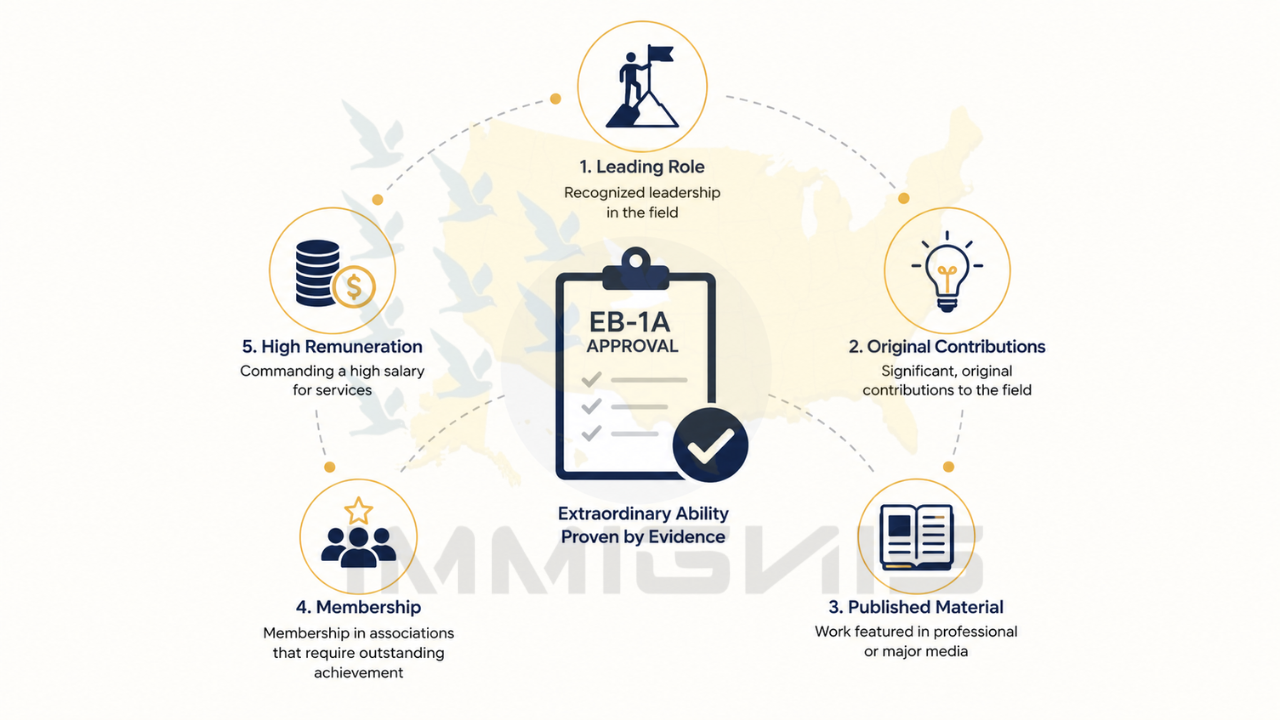
The petition did not depend on one perfect exhibit. It worked because several types of evidence supported the same theory of the case:
- Leading role: Records and letters showed that the petitioner held central ESG responsibility in high-stakes mining operations.
- Original contributions: Outcome metrics and framework evidence showed that his methods improved community relations, environmental performance, and operational stability.
- Published material: ESG commentary, investor-facing visibility, and industry coverage helped show recognition beyond confidential company records.
- Membership: Industry-body leadership supported peer recognition and field-level credibility.
- High remuneration: Compensation benchmarking helped show that the market valued his specialized expertise above ordinary ESG or compliance roles.
The strongest part of the case was coherence. Every piece of evidence pointed to the same proposition: the petitioner was not a routine compliance officer, but a recognized ESG transformation leader in a high-risk extractive-industry environment.
The final-merits argument
At the final-merits stage, the petition had to show that the evidence, viewed as a whole, established sustained acclaim and extraordinary ability in the petitioner's defined field.
The argument focused on field-level impact rather than public fame. The petitioner did not need to be a household name. He needed to be shown as a professional whose ESG leadership was trusted, independently validated, and important to major mining operations and the wider responsible-mining field.
The final record showed that through outcome metrics, community-agreement documentation, environmental-performance records, industry-body leadership, ESG commentary, investor-conference participation, framework authorship, and compensation evidence.
That is why the petition became stronger than a standard business case. It did not simply say the petitioner helped a company avoid problems. It documented how his work prevented harm, reduced risk, and created value in a sector where ESG failure can have severe social, environmental, and financial consequences.
Why the approval mattered
The approval mattered because it showed how an ESG executive can qualify for EB-1A even when the best proof is not a dramatic public event, but a documented pattern of avoided crisis, improved governance, and stakeholder trust.
For this South African mining ESG executive, the petition did not try to manufacture celebrity. It identified the real evidence that already existed and organized it into a record USCIS could evaluate.
The approval confirmed the central lesson of the case: in ESG transformation, prevented harm can be powerful evidence when the petition explains the risk, documents the intervention, and shows the measurable outcome.
Lessons for ESG executives, mining leaders, and sustainability professionals
This case is useful for ESG executives, mining sustainability leaders, community-relations heads, environmental-performance directors, social-license specialists, and responsible-investment professionals whose work is important but often confidential or indirectly visible.
A strong record usually begins with the following questions:
- Can outcome metrics show improvements in permits, community agreements, incident reduction, grievance resolution, environmental performance, or operational stability?
- Can company or stakeholder letters explain the petitioner's specific role in preventing conflict, reducing risk, or improving ESG outcomes?
- Do industry-body roles, investor panels, or ESG forums show that the petitioner's expertise is recognized beyond one employer?
- Can framework authorship or policy writing show a structured contribution to responsible mining practice?
- Can remuneration evidence show that the market values the petitioner's specialized ESG expertise at an unusually high level?
When those questions are answered with documents, a quiet ESG career becomes much easier for USCIS to understand. That is often the difference between a compliance narrative and an extraordinary-ability record.
Frequently asked questions
Can a mining ESG executive qualify for EB-1A?
Yes. A mining ESG executive may qualify for EB-1A if the evidence shows sustained acclaim and extraordinary ability in a defined field such as extractive-industry ESG transformation, community-relations strategy, environmental governance, or social-license leadership.
How can prevented harm support an EB-1A petition?
Prevented harm can support EB-1A when the petition documents the risk, the petitioner's intervention, and the measurable outcome. Useful evidence may include incident records, permit stability, community agreements, grievance-resolution data, investor materials, and stakeholder letters.
Can confidential mining work be used in an EB-1A case?
Yes, when it is documented in a disclosure-safe way. Cleared summaries, redacted records, public metrics, letters, and non-confidential framework descriptions can show impact without exposing sensitive operational or community information.
Do ESG press commentary and investor panels help prove extraordinary ability?
Yes. ESG commentary, investor-conference panels, and industry speaking can help show that the petitioner is recognized beyond internal company work and trusted to contribute to field-level conversations.
Can industry-body leadership support EB-1A for ESG professionals?
Yes. Leadership roles in mining, ESG, sustainability, or responsible-investment bodies can support EB-1A when they show peer trust, recognized expertise, or influence within the field.
Can Immignis and Advance My Profile help ESG professionals build EB-1A evidence?
Immignis and Advance My Profile help ESG executives, mining professionals, sustainability leaders, and community-relations specialists define a credible field niche, document impact, improve visibility, and build a petition-ready EB-1A evidence record.
Turn ESG transformation into petition-ready evidence
Many ESG professionals create value by preventing crises before they happen. EB-1A success depends on documenting that quiet impact through metrics, frameworks, recognition, and independent validation.