Key facts at a glance
| Outcome | EB-1A approval for a Lithuanian neuroeducation technology researcher working with an EU-based university and U.S. edtech partners. |
| Approval date | Approved on March 4, 2026. |
| Field niche | Cognitive learning tools for neurodiverse students, with a focus on adaptive learning support, attention and working memory scaffolds, individualized practice data, and classroom usability. |
| Starting problem | The initial profile was too broad across education, psychology, and technology. Useful work existed, but it needed to be organized around a narrow authority niche and supported by publications, pilots, public recognition, judging, awards, and independent expert explanation. |
| Profile-building path | Advance My Profile, powered by Immignis, helped develop a focused neuroeducation technology record through research studies, school pilot data, an authored practitioner guide, a policy paper for special-education networks, media commentary, peer review, invited talks, awards evidence, and independent letters. |
| EB-1A criteria supported in the petition | Scholarly articles, original contributions, published material, awards, judging, and leading or critical role. |
Approval came after a broad education profile became a specific neuroeducation technology record
USCIS approved the Form I-140 petition on March 4, 2026. The beneficiary was a Lithuanian EB-1A Neuroeducation Technology Researcher whose work connected cognitive learning science, digital tools, and classroom support for neurodiverse students.
The case did not begin with a weak professional record. It began with a record that was too wide. Education research appeared in one place, psychology informed learning design in another, classroom technology in another, and U.S. edtech collaboration somewhere else. A reader could see activity, but not yet a single professional question that explained why this researcher had risen to the level required for EB-1A.
That was the central problem. EB-1A is not awarded for being generally useful across education and technology. The petition needed to show a defined field, identifiable original contributions, and evidence that other professionals recognized the researcher within that field.
Advance My Profile, powered by Immignis, helped narrow the record to one authority niche: cognitive-learning tools for neurodiverse students. That focus allowed the petition to explain the work as more than general edtech. It became a case about making learning support measurable, adaptable, and usable for students whose attention, processing, executive-function, or communication needs may not fit a standard classroom model.
The case was not about replacing teachers with software
Neuroeducation technology is easy to misunderstand. A weak petition might describe it as an app, a platform, or a broad digital-learning product. That would miss the point. The strongest part of this researcher’s work was not the mere use of technology in classrooms. It was the design of learning tools that helped educators understand where a student needed support and how that support could be adjusted over time.
The petition therefore avoided exaggerated claims. It did not say that software could diagnose a student, cure a learning difference, or replace individualized professional judgment. It showed a more defensible contribution: cognitive learning tools can help structure practice, record learning patterns, support attention and working memory, and make classroom interventions easier to observe and refine.
That distinction helped the story become credible. The evidence presented technology as a support system for educators and students, not as a miracle solution. For EB-1A, that made the contribution easier to evaluate because the petition could identify what the researcher actually built, studied, tested, published, and taught.
Why the initial profile created EB-1A risk
The researcher’s original profile touched education, psychology, cognitive learning, digital platforms, special education, teacher training, and student support. Those subjects were related, but they were not yet organized into a legally persuasive EB-1A record.
That created several risks. First, the petition could have looked like a collection of educational interests rather than a sustained record in one field. Second, school pilot work could have been dismissed as local implementation unless the evidence showed what method was being tested and why it mattered beyond one classroom or one partner organization. Third, media or policy work could have sounded general unless it connected directly to the researcher’s own technical and educational contribution.
The case also needed care because neurodiversity is a sensitive and practice heavy area. Claims about student outcomes must be grounded. A petition that overstates improvement, uses unsupported diagnostic language, or treats complex learning needs as a simple product problem can lose credibility quickly.
The solution was not to make the profile louder. It was to make it clearer.
The authority niche became cognitive learning tools for neurodiverse students
A strong EB-1A field definition must be narrow enough to show expertise but broad enough to matter. In this case, the field was framed around cognitive learning tools for neurodiverse students.
That niche captured the researcher’s repeated professional question: how can learning technology help educators provide more individualized support when students process information, sustain attention, organize tasks, or demonstrate learning in different ways?
The evidence was reorganized around that question. Research studies addressed cognitive scaffolding, adaptive practice, learning-pattern data, and classroom support. Pilot evidence showed how tools were tested in school settings. The practitioner guide explained how educators could use the method. The policy paper placed the work within special education and inclusive-learning systems. Media commentary and invited talks made the subject understandable to wider audiences.
This structure made the record more coherent. It allowed USCIS to see the same professional identity across publications, pilots, public commentary, peer review, awards, and letters: a neuroeducation technology researcher focused on measurable learning support for neurodiverse students.
What USCIS needed to see in this neuroeducation technology EB-1A case
For original contributions, the petition had to identify the researcher’s own methods, tools, studies, learning support frameworks, or classroom implementation work and explain why they had significance in the field. General statements that technology helps students would not have been enough.
Scholarly articles needed to show focused authorship in neuroeducation, cognitive learning tools, inclusive digital learning, special-education technology, or related subjects. A broad education publication record would have been less useful if it did not point back to the same authority niche.
Published material required qualifying coverage about the researcher, the work, or the expertise being recognized. Media visibility had to do more than mention a product. It needed to help show public recognition of the researcher’s professional contribution.
Judging evidence required actual evaluation of work by other professionals. Peer review, academic review, competition judging, or expert evaluation could support the criterion when the record documented what was reviewed and why the activity required professional judgment.
Awards evidence needed documented selection standards, scope, and relevance. A nomination, participation certificate, or open promotional listing could not be treated as a qualifying award. Leading or critical role evidence had to show that projects or partner programs depended on the researcher’s educational technology methods, not merely that the researcher held a title.
Studies turned the learning-support method into public evidence
The publication strategy was built around the actual educational problem. Neurodiverse students may need supports that help with attention, task sequencing, memory load, reading pace, communication, feedback, or structured practice. A useful tool must do more than deliver content. It must help educators understand how a student is engaging with that content.
The studies therefore examined learning support methods, adaptive practice design, cognitive scaffolds, and the use of learning data in classroom support. The strongest papers did not treat students as one uniform group. They considered how a tool could make learning patterns visible while still leaving interpretation to educators and specialists.
This public authorship mattered because the petitioner’s work could not remain only inside pilot programs or partner schools. The articles gave the field a written record that other educators, researchers, and technology specialists could examine.
The articles also helped discipline the legal argument. Instead of claiming broad success across all educational outcomes, the petition could point to specific questions: what kind of support was designed, how it was tested, what data was collected, and how educators could use the information.
School pilot data showed use, but the petition avoided overstating outcomes
Pilot data can be valuable in an education technology case because it shows that a method was tested beyond theory. At the same time, school data can be easy to overstate. Student progress depends on many variables, including instruction, family support, classroom environment, prior learning, disability related needs, and the quality of implementation.
The petition treated pilot data as evidence of method use and educational relevance. It showed where the tool was used, what support functions were tested, what information was captured, and how the implementation connected to the researcher’s work.
Where the record supported measurable findings, they were described carefully. The petition did not claim that one digital tool alone transformed student outcomes. It explained how structured learning data, adaptive practice, and educator-facing feedback could improve the way support was delivered and reviewed.
That restraint strengthened the case. For USCIS, credible evidence is often more persuasive than aggressive language. A disciplined record can show major significance without pretending that education is simple.
The practitioner guide helped move the work from research to classroom use
A practitioner guide became an important bridge between research and implementation. It explained the learning support method for educators, specialists, school leaders, and technology partners who needed practical guidance rather than academic theory alone.
The guide organized the work around classroom questions: which learning barrier is the tool trying to support, what data should the educator review, when should a learning task be adjusted, and how should technology fit within a broader student support plan?
That kind of document helped the EB-1A petition because it showed field facing contribution. The researcher was not only studying cognitive learning tools. The record showed an effort to help professionals use those tools responsibly in educational settings.
The guide also kept the work aligned with ethical practice. It treated neurodiverse students as learners with individual needs, not as data points or product users. That mattered for credibility with educators and with independent experts reviewing the case.
The policy paper gave the work a wider education systems frame
The policy paper for special education and inclusive learning networks helped place the work in a broader system. Schools often face a practical challenge: how to personalize support while working within limited staffing, varied classroom conditions, and inconsistent access to specialized tools.
The paper addressed where cognitive learning technology could help. It discussed early support signals, structured practice, educator-facing dashboards, data protection, accessibility, and the need to keep technology accountable to students and teachers.
This did not turn the case into a policy petition. It helped explain why the researcher’s field mattered. Neuroeducation technology can affect how schools identify learning barriers, support classroom decisions, and design more inclusive digital tools. The petition used that context to show practical significance without losing the narrow technical and educational focus.
Media commentary and invited talks made the expertise visible
Public recognition was one of the weaknesses in the starting profile. To address it, the record included media commentary and invited presentations that explained the field in accessible language.
The researcher discussed why neurodiverse students may need learning tools that adapt to cognitive load, attention patterns, task sequencing, or feedback needs. He also explained why education technology should support teachers rather than hide decisions inside a black box system.
Invited talks allowed educators, researchers, and edtech professionals to examine the method. These sessions were especially important because they showed that the researcher was not merely publishing papers. He was being asked to explain the work to professional audiences.
The media and speaking evidence supported the recognition record. It also made the article topic useful for readers: an EB-1A profile often becomes stronger when a specialist can explain a difficult field clearly outside the original institution.
Peer review, awards, and leadership evidence added independent recognition
Peer review helped show that other professionals trusted the researcher’s judgment. The record documented review activity in education technology, neuroeducation, special education research, digital learning, or related fields. That supported the judging criterion when the activity involved evaluating the work of others.
Awards evidence was handled with the same care. The petition presented awards or award related recognition where the record showed selection standards, relevance, and professional meaning. It did not inflate participation or nomination into a final award unless the documentation supported that claim.
Leading or critical role evidence connected the researcher to university work and U.S. edtech partner activity. The petition showed where programs relied on his research direction, learning tool design, pilot interpretation, or practitioner facing methodology.
Together, these evidence streams helped solve the original problem. They showed that the researcher was not simply involved in useful education projects. He had become a recognized contributor in a defined neuroeducation technology niche.
Independent letters connected the technical and educational record
Independent letters were essential because the case crossed several disciplines. A USCIS officer may not immediately know how cognitive science, learning technology, special education, and classroom implementation fit together.
The strongest letters explained the field first. They described why neurodiverse students often need more individualized forms of support, why conventional digital learning tools may miss important learning barriers, and why educator facing measurement can matter.
They then connected that field explanation to the petitioner’s work: research studies, school pilot evidence, the practitioner guide, policy work, invited presentations, and public commentary. Rather than offering general praise, the letters identified the researcher’s specific contribution and explained why it mattered beyond one classroom or project.
How the EB-1A evidence worked together
The approved petition did not rely on one impressive document. It worked because the evidence described the same professional identity from several angles.
Scholarly articles connected the researcher’s authorship to cognitive learning tools, neuroeducation technology, adaptive support, and inclusive classroom practice.
Original contribution evidence identified the learning support methods, pilot implementation, practitioner guide, classroom usability framework, and expert explanation tied to his work.
Published material and media commentary helped show public recognition of the researcher’s expertise and made the field understandable to wider audiences.
Judging evidence came from peer review and professional evaluation of work by others. Awards evidence added recognition where the documentation supported selection and relevance. Leading or critical role evidence showed that education and edtech projects depended on his specialized knowledge.
At final merits, these pieces had to show more than technical participation. They had to show sustained recognition and a level of expertise consistent with EB-1A extraordinary ability. USCIS approved the petition on March 4, 2026.
What other education technology researchers can learn from this case
This success story is useful because many education, psychology, and edtech professionals face the same problem. Their work helps real learners, but the immigration record is scattered across publications, school projects, training materials, pilots, product features, and internal partner documents.
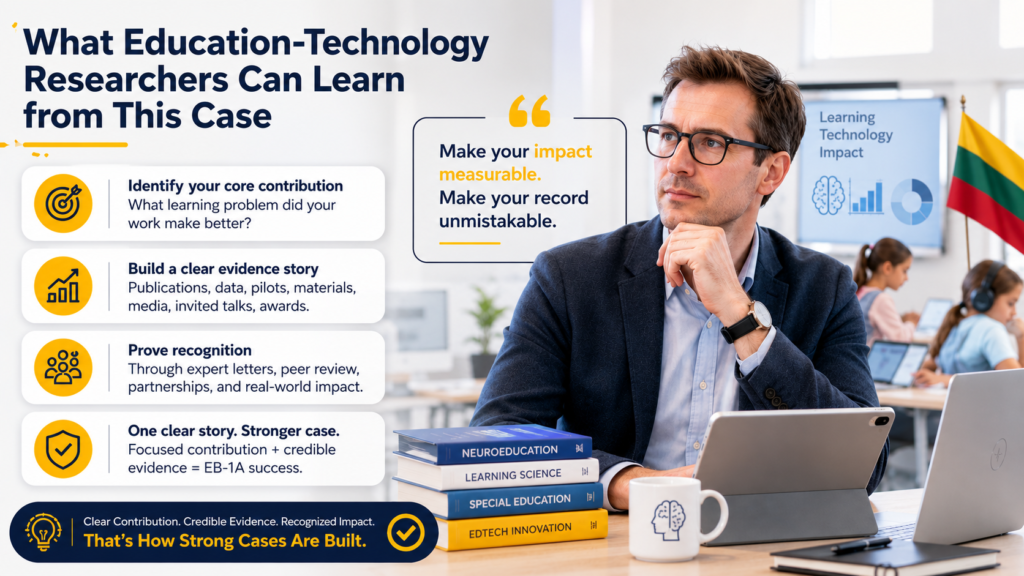
The lesson is not that every education technology project can become an EB-1A case. The lesson is that a strong case must identify the professional contribution and then prove recognition with credible evidence.
For neuroeducation and special education technology professionals, the strongest question is often this: what learning problem did your work make more measurable, more usable, or more responsive for students and educators?
When the answer is clear, the evidence can be built around it. Publications, pilot data, practitioner materials, media, invited talks, peer review, awards, and expert letters begin to support one story instead of competing for attention.
Frequently asked questions
Can education technology work qualify for EB-1A?
Yes, it can, but the petition must show more than employment in edtech or participation in school projects. The record should identify the applicant’s own contribution, show why it matters in the field, and document recognition through evidence such as publications, adoption, judging, awards, media coverage, invited talks, or independent expert letters.
Are school pilot results enough for EB-1A?
Usually not by themselves. Pilot results may support an original-contribution argument when they are documented, attributable to the applicant, and explained by qualified experts. They should be presented carefully, especially where student outcomes depend on multiple factors.
Can a practitioner guide support an EB-1A case?
A practitioner guide can help when it shows that the applicant’s method has been organized for use by other professionals. It is strongest when tied to publications, pilot evidence, invited presentations, or independent recognition.
Does neurodiversity-focused work need medical evidence?
Not necessarily. A neuroeducation technology case can focus on learning support, cognitive scaffolding, accessibility, and classroom usability. The petition should avoid unsupported diagnostic or medical claims unless the evidence and professional qualifications support them.
What made this case stronger than a general edtech profile?
The record was narrowed to cognitive-learning tools for neurodiverse students. That focus allowed the petition to connect studies, pilot data, practitioner guidance, policy work, public commentary, judging, awards, and expert letters to one defined field.
Build an EB-1A record around the learning problem your work actually solves
If you work in education technology, neuroeducation, special education, cognitive learning, assistive learning tools, or classroom data systems, your strongest EB-1A evidence may not be obvious from your job title. It may be hidden inside studies, pilots, guides, training materials, partner programs, and implementation records.
Immignis and Advance My Profile help professionals identify a defensible authority niche, organize credible evidence, build independent recognition, and prepare EB-1A records around work that can be verified and explained professionally.