How reliability, grid integration, and independent recognition turned marine-energy engineering into an EB-1A record
Key facts at a glance
| Outcome | EB-1A approval for a Portuguese ocean-energy engineer working at a Portugal-based marine energy company. |
| Approval date | Approved on November 13, 2025. |
| Field niche | Wave-energy converter reliability and grid integration, with a focus on converter availability, survivability, power-takeoff behavior, maintenance planning, and grid interface decisions. |
| Starting problem | His pilot work was strong, but the record lacked the recognition signals and field-level narrative needed for EB-1A. The original evidence risked reading as product development inside one marine-energy company. |
| Profile-building path | Focused technical papers, supported pilot metrics, an industry white paper, a conference presentation, clean-energy award judging, selective professional membership, media coverage, leading-role evidence, and independent expert letters. |
| EB-1A criteria supported | Original contributions, scholarly articles, published material, judging the work of others, memberships, and leading or critical role. |
USCIS approved his Form I-140 on November 13, 202 , in this EB-1A Ocean Energy Engineer case.
The approval was not built around a general claim that wave power is promising. It was built around a more specific engineering record: how a Portuguese ocean-energy engineer helped make wave-energy converters more reliable, more measurable, and more practical for grid-connected clean-power systems.
That distinction mattered. Many renewable-energy professionals can point to pilot projects, prototypes, and company milestones. EB-1A asks a different question. It asks whether the person has shown sustained national or international acclaim and whether the record demonstrates expertise at the level required for extraordinary ability.
For this engineer, the first version of the story was too close to the product. The final record had to make the engineer visible.
The case was not about wave energy in general
Wave energy can sound simple from a distance. Waves move, a device captures motion, and electricity reaches the grid. The engineering reality is much less simple.
A wave-energy converter must survive a harsh marine environment. It must operate through changing sea states, resist corrosion and fatigue, manage mechanical loads, protect power-takeoff components, and produce electricity in a form that can be measured, controlled, and connected. A device may work in a demonstration and still face reliability questions before it can support a serious grid-integration argument.
The petition therefore did not define him as a broad renewable-energy engineer. Advance My Profile, powered by Immignis, narrowed the record to wave-energy converter reliability and grid integration. The narrower field made the evidence stronger because it tied the client to a concrete engineering problem: what must happen between a promising marine-energy prototype and a converter that can be evaluated as part of a real power system.
Why strong pilot work was not enough by itself
His company had pilot results, technical involvement, and marine-energy experience. That was useful, but it created a familiar EB-1A risk. A strong project can still look like ordinary participation when the record does not separate the person from the company, the device, or the broader team.
USCIS does not approve a petition because an employer works in a valuable sector. The evidence had to identify his individual technical judgment, show why that work mattered, and demonstrate recognition beyond the company.
The original materials contained engineering activity, but the acclaim signals were thin. There were limited public explanations of his niche, limited evidence that other professionals had relied on his judgment, and limited documentation showing how his reliability work connected to wider clean-energy and grid-integration concerns.
The profile-building work focused on that gap. It did not try to turn company progress into personal acclaim without support. It reorganized the record around the engineering decisions that could be traced to him and then built independent recognition around those decisions.
The professional niche: reliability before scale
The core of the case was reliability. A wave-energy converter can have a useful design concept and still face practical barriers if components fail too often, maintenance windows are unpredictable, or output cannot be managed in a grid-relevant way.
His work addressed the questions that come after proof of concept. How does the converter behave across changing sea states? Which components carry the highest risk? How should pilot data be interpreted? What does availability mean in a marine setting? How can output behavior, maintenance planning, and grid interface requirements be discussed together instead of as separate problems?
That field definition made the petition more credible. It avoided a broad claim that he was an expert in all ocean energy. It showed a specialist whose work sat at the point where mechanical performance, operating data, and grid-readiness meet.
What USCIS needed to see in this ocean-energy EB-1A case
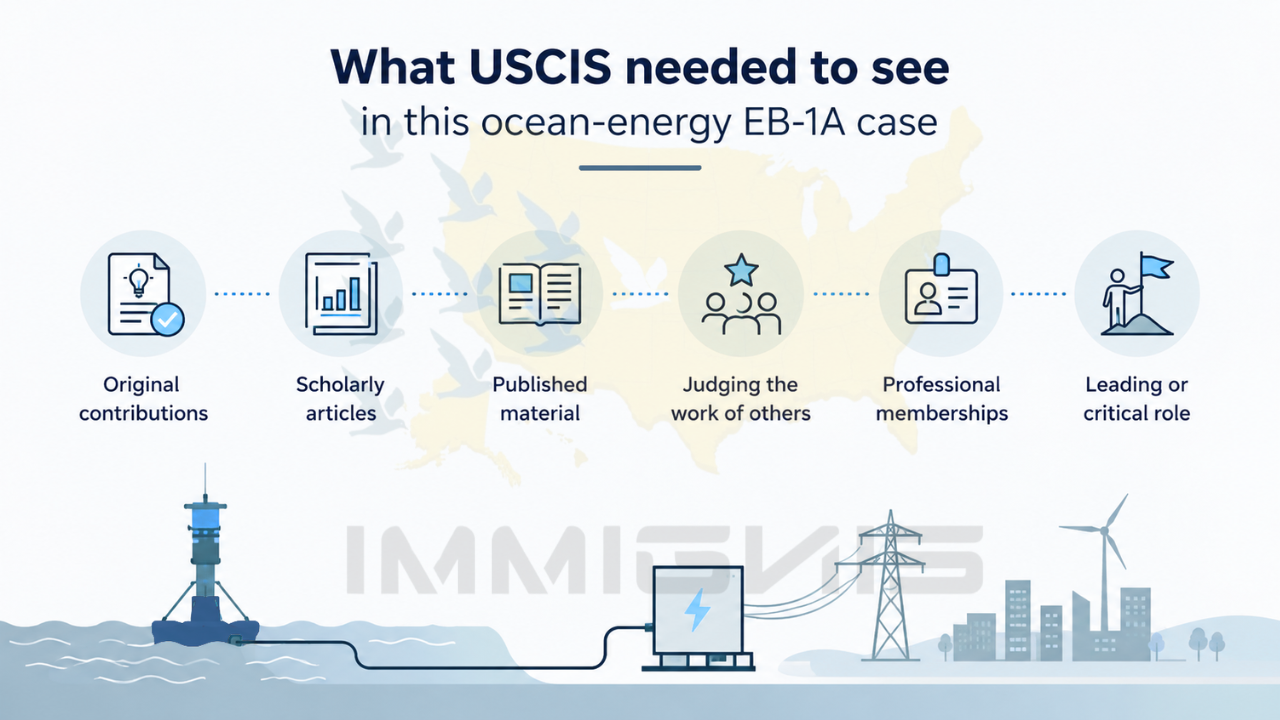
For original contributions, the petition needed more than a statement that he worked on a promising technology. It had to identify his reliability methods, pilot-analysis work, grid-interface contribution, or technical decisions and explain why those contributions mattered beyond routine employment.
For scholarly articles, the work needed to address the same professional niche. General renewable-energy writing would have been weaker. Focused papers on wave-energy converter reliability, availability, power-takeoff behavior, marine operating conditions, or grid integration helped build a coherent authorship record.
Published material required independent coverage about him or his expertise, not only articles about the company or the technology. Judging required evidence that he evaluated the work of other professionals, such as clean-energy award submissions or technical projects. Membership evidence required selective admission or advancement based on achievement or expert assessment. Leading or critical role evidence had to show why important work at the marine-energy company depended on his technical judgment.
At final merits, the evidence also had to describe the same person from different angles. The papers, pilot metrics, conference presentation, media coverage, judging, membership, company evidence, and expert letters could not look like unrelated attempts to satisfy separate criteria. They had to show one recognizable authority in wave-energy reliability and grid integration.
How the pilot metrics were used carefully
Pilot metrics can help an EB-1A case, but only when they are used with discipline. A petition should not turn limited data into sweeping claims. It should not claim broad commercial success, cost reduction, or grid transformation unless the records support those claims.
In this case, the pilot evidence was organized around the questions it could actually answer. The record documented supported information about converter operation, availability, performance review, maintenance-related observations, output behavior, and reliability issues addressed during development. It also identified where his technical role entered the analysis.
The petition avoided pretending that a pilot project was equivalent to full market adoption. Instead, the pilot data helped show that his work was applied to real engineering decisions. Independent experts could then evaluate why those decisions were meaningful in the ocean-energy field.
The technical papers made reliability visible
One of the strongest improvements to the record was the authorship strategy. His technical papers did not merely repeat that wave energy is renewable or that the ocean has energy potential. They focused on the harder middle ground: reliability, survivability, power behavior, and grid-readiness.
One paper examined why converter availability matters when a device operates in a marine environment where maintenance access can be limited. Another addressed the relationship between wave variability, power-takeoff behavior, and the interpretation of pilot data. A third discussed the grid-integration questions that arise when marine-energy output must be controlled, conditioned, and evaluated as part of a broader power system.
These papers helped move the record from company engineering to public technical authorship. They gave USCIS a way to see his expertise without relying on confidential design files or internal product documents.
The white paper connected engineering reliability to clean-energy deployment
The industry white paper was written for marine-energy companies, grid planners, clean-energy stakeholders, and professionals evaluating emerging ocean-power technologies. Its role was not to oversell wave energy. Its role was to explain what reliability evidence should look like when a converter moves from pilot testing toward grid-connected use.
The paper organized the discussion around converter availability, component stress, maintenance planning, power conversion, data interpretation, and the difference between an encouraging demonstration and a repeatable engineering record. It also explained why grid integration is not an afterthought. A device must not only generate electricity; it must do so in a way that can be managed, measured, and connected responsibly.
That public document helped place his work in a broader professional conversation. It showed that his expertise was not limited to operating inside one company. He could explain the reliability questions that other engineers and energy stakeholders also needed to consider.
A conference presentation let other specialists test the thinking
The conference presentation gave the record a live professional setting. He discussed what reliability means for wave-energy converters, how pilot data can be misunderstood, and why grid-readiness depends on more than peak output.
Audience questions focused on maintenance assumptions, component durability, output variability, measurement periods, and the degree to which pilot results can predict future deployment conditions. Those questions mattered because they were the same questions a serious marine-energy record must answer.
The presentation was not treated as a substitute for original contributions or scholarly work. It supported the wider recognition picture by showing that his technical judgment was being placed before other professionals in the field.
Published coverage helped explain a specialized field
Media coverage can be weak evidence when it merely repeats a company announcement. The stronger coverage in this case was tied to his expertise. It explained why wave-energy reliability is a practical barrier to wider deployment and why pilot metrics must be read carefully.
His commentary helped non-specialist readers understand that ocean-energy engineering is not only about capturing wave motion. It is also about whether a converter can operate, survive, be maintained, and deliver power in a useful form. That explanation connected the field to clean-power innovation without making unsupported claims about the scale of adoption.
The published material supported the petition because it identified him as a specialist, not simply as an employee of a marine-energy company.
Judging and membership showed recognition outside the employer
The judging evidence came from clean-energy award or innovation-review activity where he evaluated work submitted by others. That distinction was important. Reviewing a colleague’s internal report is not the same as judging the work of others in the EB-1A sense. The file documented the venue, the nature of the submissions, his role, and the evaluation activity.
Selective membership evidence was handled with similar care. Open enrollment or paid membership would not be enough. The petition documented the organization, the admission or advancement standard, and how the standard related to achievement, professional standing, or expert review.
Together, the judging and membership evidence helped answer a central problem in the case: did other professionals recognize his technical judgment outside the company?
Leading-role evidence made the company record useful without letting it dominate the case
The company record still mattered. It showed where his work entered serious marine-energy development. The petition used role descriptions, project records, non-confidential technical summaries, and leadership documentation to show that he was not peripheral to the reliability work.
The leading-role evidence focused on responsibility and reliance. Which reliability questions did he lead? Which technical decisions required his judgment? How did his analysis influence pilot review, converter improvement, maintenance planning, or grid-interface discussions?
This was more persuasive than a job title alone. A title can show employment seniority. EB-1A evidence must show why the role was important and why the person’s contribution was significant within that role.
Independent letters gave the technical record context
Independent expert letters were used to explain the field, not to replace evidence. The strongest letters came from professionals who could discuss wave-energy reliability, marine-energy deployment, grid integration, or renewable-power engineering with enough detail to evaluate the significance of his work.
The letters did not simply say he was talented. They explained why converter reliability is a difficult problem, why pilot data must be interpreted carefully, and how his work fit into the professional effort to make ocean-energy systems more credible for future deployment.
Good expert letters are most effective when they connect existing evidence. In this case, they connected the papers, pilot metrics, white paper, conference presentation, judging, and company role into a single professional story.
How the EB-1A evidence worked together
The approval record was strongest because the evidence reinforced one field identity.
- Original contributions: The petition identified his wave-energy reliability methods, pilot-analysis work, and grid-integration judgment, supported by company records, pilot metrics, public technical materials, and expert letters.
- Scholarly articles: Focused papers showed authorship in the same niche, rather than scattered writing about renewable energy in general.
- Published material: Independent coverage and media commentary discussed his expertise in wave-energy converter reliability and marine-energy deployment challenges.
- Judging: Clean-energy judging records showed that he evaluated the work of other professionals or innovators in a relevant field.
- Memberships: Selective membership evidence documented professional standards tied to achievement or expert assessment.
- Leading or critical role: Company evidence showed why important marine-energy work depended on his technical leadership and reliability judgment.
No single item had to carry the whole case. That was the point. The record presented a specialist whose work, recognition, and public technical identity all pointed in the same direction.
What the approval shows for renewable-energy engineers
This case is useful for renewable-energy professionals because it shows the difference between working on an important technology and documenting extraordinary ability in a defined field.
A pilot project is not automatically an original contribution. A conference presentation is not automatically acclaim. A company role is not automatically a leading or critical role. A technical field may be important, but the petition still has to prove why the individual stands out in that field.
For this Portuguese ocean-energy engineer, the successful strategy was not to make the claim broader. It was to make it more precise. The record focused on reliability and grid integration, showed his work through evidence that could be safely disclosed, built independent recognition, and connected the pieces into a coherent EB-1A profile.
Lessons for professionals in ocean energy and clean-power engineering
Engineers in wave energy, tidal energy, offshore wind, energy storage, grid integration, power electronics, hydrogen, and other clean-energy fields often face the same problem. Their strongest work is inside pilot programs, technical reviews, product tests, safety files, and company projects. Those records may be real, but they may not be enough unless the petition explains individual contribution, public recognition, and field significance.
The lesson is not that every engineer needs the same evidence. The lesson is that the field must be defined carefully. A clean-energy engineer should not rely on the importance of the sector alone. The petition should identify the precise technical problem, the methods linked to the individual, the evidence of use or recognition, and the reason the work matters beyond an employer.
That is what made this case stronger. It turned a strong but under-recognized pilot record into a public authority record that USCIS could evaluate.
Frequently asked questions
Can wave-energy pilot work support an EB-1A petition?
Yes, but pilot work must be used carefully. The petition should identify the individual’s technical contribution, explain why the work matters, and support any performance or reliability claims with records. A pilot project alone may look like company product development unless the evidence shows personal contribution and field significance.
Does a renewable-energy engineer need patents for EB-1A?
Not necessarily. Patents can be useful when they document inventorship and technical concepts, but they are not required in every EB-1A case. This case relied on original contributions, scholarly work, published material, judging, selective membership, and leading-role evidence. The strength came from the full record, not from one evidence type alone.
Can company work count if the technology is confidential?
Yes. Confidential work can sometimes be documented through non-confidential summaries, role records, expert letters, public papers, safe technical descriptions, and evidence of adoption or use. The petition should avoid disclosing protected designs, customer information, proprietary data, or trade secrets.
Why is grid integration important in a wave-energy EB-1A case?
Grid integration helps show that the work is not merely a device concept. It connects converter reliability, output behavior, control, measurement, and interconnection to practical power-system questions. For this case, grid integration helped explain why reliability evidence mattered beyond the pilot site.
What made this approval different from a normal product-development story?
The petition did not rely only on company progress. It documented public authorship, independent coverage, judging, selective membership, expert support, pilot metrics, and leading-role evidence around one defined niche. That allowed the record to show field-level expertise rather than ordinary participation in a company project.
Build an EB-1A record around the clean-energy problem you actually solve
If you work in ocean energy, power conversion, grid integration, marine systems, renewable-energy reliability, or clean-energy engineering, your strongest evidence may be hidden inside technical programs and pilot records. Immignis and Advance My Profile help identify a defensible field niche, document individual contributions, build credible recognition, and prepare an EB-1A record around evidence you can verify and defend professionally..