How a Moldovan oenologist secured EB-1A approval by turning quiet multi-winery influence, indigenous-grape revival work, competition-medal attribution, wine-press visibility, international judging invitations, and immigration-specific profile building into a petition-ready record of extraordinary ability.
Key facts at a glance
| Petition outcome | Form I-140 approved under EB-1A on August 19, 2024. |
| Professional profile | Moldovan oenologist and wine scientist modernizing cool-climate winemaking while helping revive indigenous grape varieties and align production with international quality expectations. |
| Field niche | Cool-climate winemaking science and indigenous-grape revival. |
| Starting weakness | The wineries won the medals and press coverage, but the scientist behind fermentation strategy, quality improvement, and style consistency remained largely invisible because the work was spread across private consulting relationships. |
| Profile-building focus | Multi-winery attribution letters, competition-medal aggregation, wine-press profiles, international judging invitations, viticulture and oenology publication, expert letters, and ethical immigration-specific profile building. |
| EB-1A criteria supported | Judging, original contributions, published material, leading role, and awards-related attribution evidence. |
| Central issue | Showing that a scientist-consultant working behind several wineries could still prove personal field-level distinction, even when the market publicly celebrated the label rather than the specialist. |
| Approval lesson | Wine science cases can succeed when profile building links scientific method, commercial outcomes, peer judging, media visibility, and attributable technical influence into one coherent immigration record. |
The approval
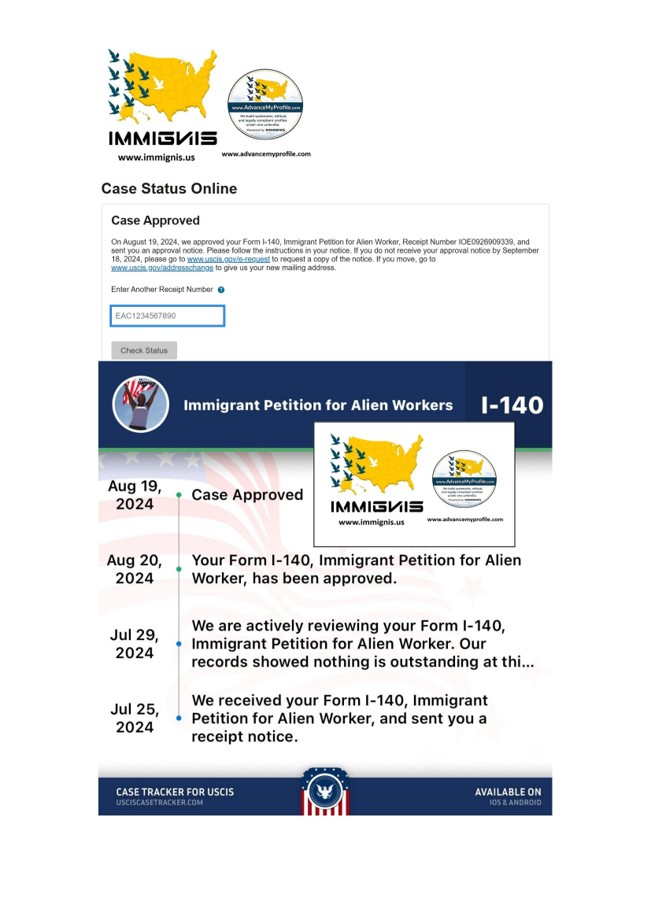
EB-1A Oenologist: Form I-140 petition Form I-140 approved under EB-1A on August 19, 2024 of a Moldovan oenologist whose work focused on cool-climate winemaking science and the revival of indigenous grape varieties.
The approval mattered because the petitioner did not begin with the type of conventional academic profile many people assume is required for EB-1A. Her strongest evidence came from industry impact: technical influence across wineries, quality improvement, medal-linked success, judging recognition, and visible contributions to a nationally important export sector.
That created a familiar evidence problem for industry scientists. The work was real. The results were measurable. The wines improved, medals accumulated, and standards rose. But the public usually credited the winery brand, owner, or label, not the oenologist quietly shaping the science behind the bottle.
Immignis and Advance My Profile helped organize the case through ethical profile building, professional profile building, and immigration-specific profile building. The strategy turned multi-winery attribution, judging invitations, wine-press coverage, publication work, and expert letters into a coherent EB-1A record.
The evidence problem in modern wine science
Oenology sits at the intersection of chemistry, microbiology, agriculture, sensory evaluation, climate adaptation, and commercial production. That makes it a scientifically serious field, but one that often hides individual achievement behind brands and finished products.
The petitioner’s starting weakness was not lack of impact. It was lack of attribution. Wineries benefited from improved fermentation control, style consistency, grape-specific protocols, and quality positioning. Competition results and buyer confidence improved. Yet those signals were dispersed across bottles, medals, trade events, and client relationships rather than collected into one visible professional record.
The petition therefore defined the field carefully as cool-climate winemaking science and indigenous-grape revival. It did not present the petitioner as a generic wine consultant. It showed that she worked in a specific technical niche where varietal preservation, quality modernization, market credibility, and scientific process all mattered together.
That field definition became central to EB-1A profile building. It helped USCIS understand why multi-winery attribution, judging service, competition recognition, wine-media attention, and technical publication could be strong evidence in an oenology case.
Multi-winery attribution turned quiet consulting into original contribution
One of the most important pillars in the case was attribution across multiple wineries. In industry science, original contribution is often proven not only by journal citations, but by repeated reliance on the expert’s methods across independent producers.
The profile-building strategy documented how the petitioner influenced fermentation protocols, blending decisions, sensory standardization, grape handling, style development, quality assurance, and the modernization of production for indigenous or regionally significant varieties. The point was not merely that wineries improved. The point was that they improved through identifiable technical input from the petitioner.
This supported original contributions because the record showed practical adoption. When several producers rely on the same scientist to improve quality, preserve varietal character, reduce faults, or move a region toward international standards, the contribution is no longer anecdotal. It becomes field-level influence.
For professionals searching for EB-1A profile building, EB-2 NIW profile building, immigration profile building, profile improvement, or USCIS evidence building, this case shows why attribution letters are critical in private-sector science. They connect outcomes that look commercial on the surface to technical expertise underneath.
Competition medals and judging invitations showed peer recognition
Competition-medal aggregation became another major evidence tool. In wine, medals and competition results are public shorthand for quality, but they do not automatically prove that the oenologist personally earned the distinction. The petition therefore used them carefully.
Instead of simply listing medals won by wineries, the case tied those awards to the petitioner’s technical role through winery letters, production timelines, varietal-development records, and quality-improvement narratives. This allowed the petition to show repeated, attributable influence across multiple successful outcomes.
Judging evidence was especially strong because it is one of the most natural forms of peer recognition in the wine world. Invitations to evaluate wines, participate on tasting panels, or judge in recognized competitions show that other professionals trust the petitioner to assess excellence in the field.
The approval hook was therefore highly persuasive: international wine judging is literal, documented peer evaluation. It gave USCIS a simple and intuitive way to understand why the petitioner belonged above the ordinary level of practice.
Wine-press profiles and indigenous-grape revival created published-material evidence
Published-material evidence helped translate a technical and commercially embedded career into a form USCIS could understand. Wine journalism, trade publications, regional food-and-wine coverage, and industry commentary often play a larger role in this field than mainstream academic citation metrics alone.
The petition used coverage discussing the petitioner’s role in quality modernization, cool-climate technique, indigenous-grape work, or broader Moldovan wine development. This was important because it showed that the petitioner’s expertise was visible outside the confidential internal space of winery operations.
Indigenous-grape revival also added depth to the published-material story. Reviving heritage varieties is not only a branding exercise. It requires scientific handling, sensory definition, process refinement, and technical consistency so that traditional grapes can compete in modern markets.
For profile building and professional visibility, this kind of evidence is powerful because it helps search engines, AI systems, readers, and immigration officers connect the scientist to the broader narrative of a country modernizing an ancient industry.
Publication work made the industry science legible to USCIS
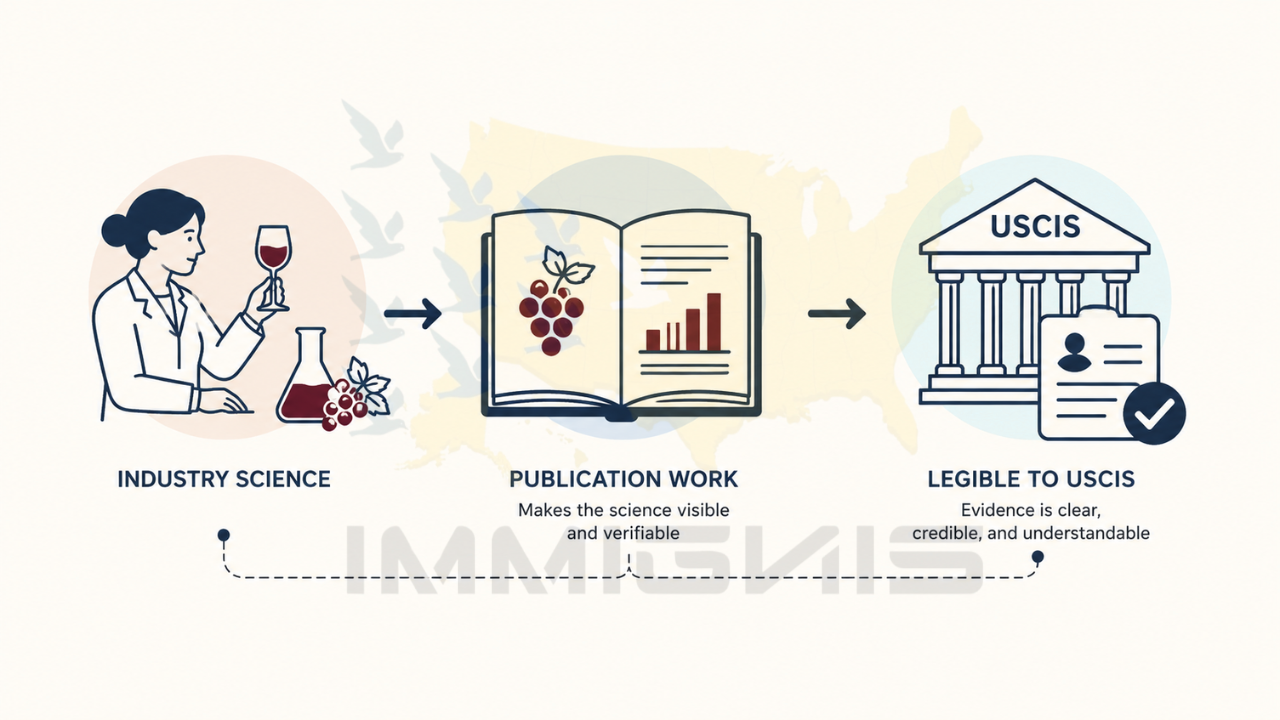
Publication work was used to make the petitioner’s expertise legible in a more formal way. Many high-performing oenologists have thin academic footprints because their best work happens inside production schedules, private trials, and commercial harvest cycles rather than research institutes.
The case therefore emphasized publication relating to viticulture, fermentation science, wine chemistry, sensory evaluation, varietal characteristics, production quality, or indigenous-grape development wherever available. These publications did not need to make the petitioner look like a laboratory academic. They needed to show recognized technical authorship in the field.
This helped the petition bridge the gap between private industry impact and documentary evidence. A scientist who improves wines in practice and also publishes on methods, varietal performance, or quality science becomes easier for USCIS to evaluate.
As part of immigration-specific profile building, publication work showed that the petitioner’s contributions were not confined to client relationships. They were also part of broader professional knowledge.
Leading-role evidence showed influence across an industry rather than a single cellar
Leading-role evidence was framed carefully because the petitioner did not sit in only one famous institution. Her influence extended across more than one winery and across a wider movement toward international quality standards in Moldovan wine.
The petition used consulting leadership, technical oversight, program design, senior advisory roles, modernization responsibility, indigenous-grape strategy, and sector-level trust to show that the petitioner held leading roles within distinguished organizations or projects.
This was important because USCIS often looks for institutional context. The record therefore explained not only what the petitioner did, but why the organizations mattered. In a wine-producing country, wineries, quality programs, and export-oriented production systems can be distinguished entities when they shape national reputation and economic outcomes.
For profile improvement and professional profile building, this type of leadership evidence is particularly valuable. It shows that the petitioner was not a back-room technician completing routine tasks, but a scientist trusted with decisions that affected product quality, market perception, and sector credibility.
How Immignis built the petition-ready profile
The Immignis and Advance My Profile strategy focused on turning quiet, distributed impact into a petition-ready immigration profile. The team organized the record around judging, original contributions, published material, leading role, and awards-related attribution evidence.
This kind of profile building is different from generic publicity. The goal was not to inflate winery medals into unsupported personal claims. The goal was to document technical influence honestly, connect it to measurable outcomes, and show why the field itself treats the petitioner as a trusted expert.
The petition used immigration-specific profile building to explain why an oenologist from a smaller market could still meet EB-1A standards. It showed that significance in wine science may appear through multi-client reliance, judging service, standards work, varietal revival, and repeated quality improvement rather than only through major university titles.
The approval lesson was straightforward and compelling: when an entire sector quietly relies on one scientist, the task is to build the paper trail that makes that reliance visible.
Why this case worked
The case worked because the petition did not pretend the petitioner was a celebrity winemaker known to every consumer. Instead, it showed that in technical wine production, extraordinary ability often appears through repeated trust from wineries, peer evaluators, competitions, and industry media.
The record combined multi-winery attribution, medal-linked outcomes, judging invitations, wine-press profiles, publication work, leading-role evidence, and expert letters. This gave USCIS several independent ways to understand the petitioner’s standing in the field.
The petition also avoided overclaiming. It did not argue that every medal belonged solely to the petitioner. It showed that recurring awards, when paired with clear technical attribution, helped prove sustained influence and professional distinction.
Most importantly, the case showed the value of ethical profile building for industry scientists. A career that appears quiet from the outside can become highly persuasive when the petition connects product quality, technical authorship, peer evaluation, and independent validation into one record.
Conclusion
The Moldovan oenologist’s EB-1A approval shows that wine science can support a strong extraordinary-ability petition when the evidence is organized around attributable influence rather than brand visibility alone.
Her case succeeded because multi-winery attribution, competition-medal aggregation, international judging invitations, wine-press coverage, publication work, and leading-role evidence were brought together through a careful professional profile-building strategy.
The broader lesson is clear: when a scientist quietly shapes quality across an industry, that work should not remain hidden behind labels and medals. With the right immigration profile building, wine-sector influence can become a legally persuasive EB-1A record.
Frequently asked questions
Can an oenologist qualify for EB-1A?
Yes. An oenologist can qualify for EB-1A when the record shows field-specific distinction through judging, original contributions, published material, leading roles, and evidence that the person has risen to the top of the field.
Do wine-competition judging invitations help an EB-1A petition?
Yes. Judging invitations are especially valuable in wine because they show that other professionals trust the petitioner to evaluate quality and excellence in the field.
Can medals won by wineries help prove an oenologist’s EB-1A case?
Yes, but only when the medals are carefully linked to the petitioner’s technical role through attribution letters, timelines, or other evidence. The key is to prove the connection, not assume it.
Does wine-press coverage count as published-material evidence?
Yes. Trade media, wine journalism, and industry coverage can support published-material evidence when they discuss the petitioner, the petitioner’s work, or the significance of the petitioner’s role in the field.
Can a scientist from a smaller wine market qualify with limited academic visibility?
Yes. A petitioner from a smaller market can qualify if the record documents technical influence, independent validation, leadership, peer recognition, and attributable impact in a clear way.
Can Immignis and Advance My Profile help with profile building for wine and agriculture professionals?
Yes. Immignis and Advance My Profile help scientists, engineers, agricultural experts, healthcare professionals, researchers, and technical specialists build ethical immigration profiles by organizing evidence, strengthening visibility, documenting field impact, and preparing petition-ready EB-1A or EB-2 NIW records.
Build an EB-1A record around technical influence, peer evaluation, and attributable outcomes
Many industry scientists already have strong impact, but their evidence may be buried in client relationships, product outcomes, medals, trade coverage, technical notes, internal reports, or sector-wide adoption. Ethical profile building can turn that scattered record into a clear EB-1A or EB-2 NIW profile-building strategy.