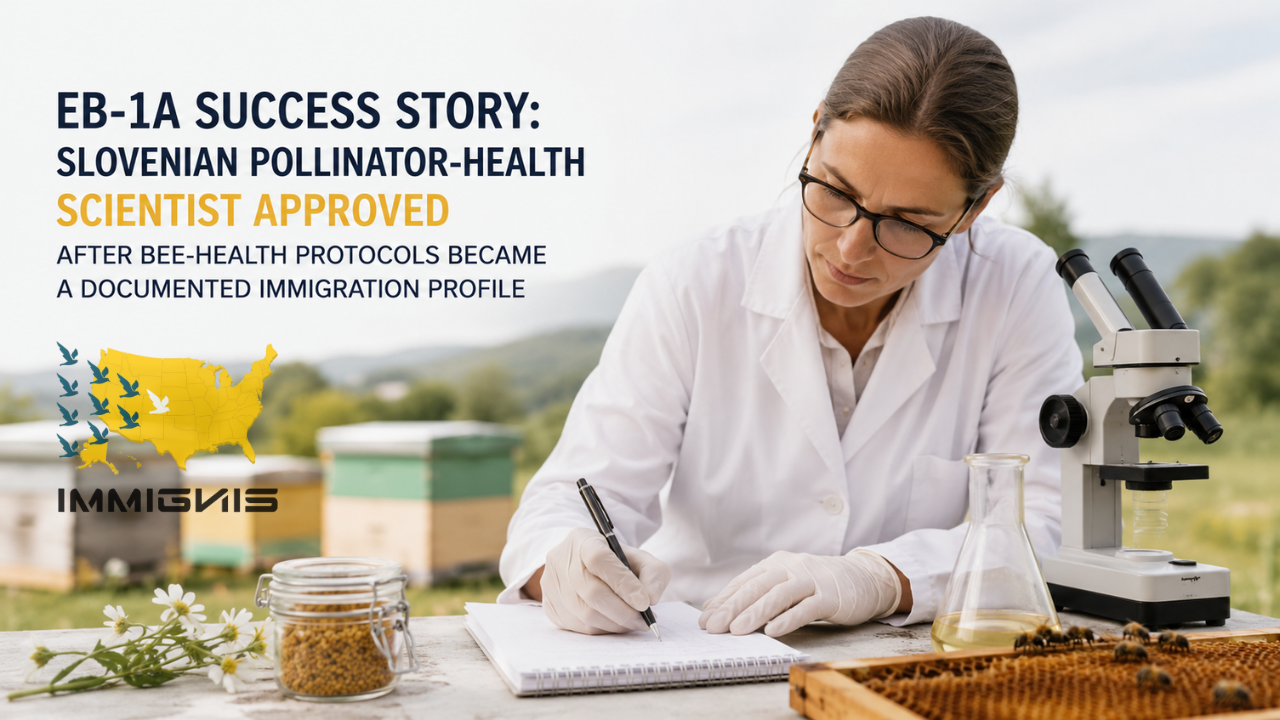
EB-1A Pollinator Health Scientist: How a Slovenian honeybee-health researcher secured EB-1A approval by turning widely adopted beekeeping protocols into a petition-ready immigration profile built on adoption documentation, scholarly publication, international apiculture roles, EU-project leadership, science-media coverage, and ethical profile building for U.S. immigration.
Key facts at a glance
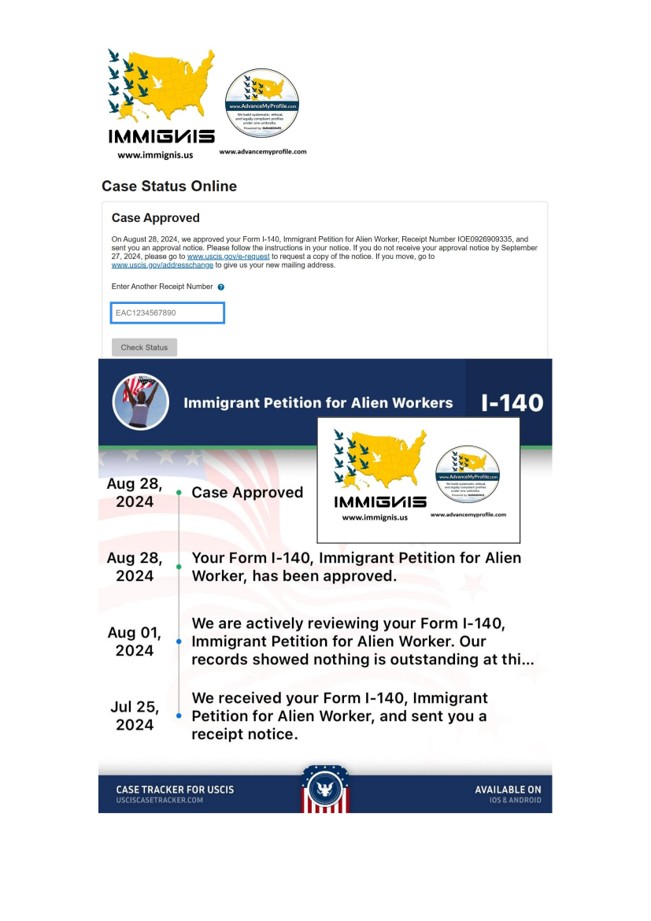
| Petition outcome | Form I-140 approved under EB-1A on August 28, 2024. |
| Professional profile | Slovenian bee researcher whose colony-health protocols spread through European beekeeping communities and national associations. |
| Field niche | Honeybee health and pollinator-decline mitigation. |
| Starting weakness | Beekeeping associations adopted the work widely, but academia noticed little and the researcher had limited name recognition outside practical apiculture circles. |
| Profile-building focus | Adoption documentation across national beekeeping associations, publication record, international apiculture-body roles, EU-project leadership, science-media coverage, and immigration-specific profile building. |
| EB-1A criteria supported | Original contributions, scholarly articles, leading role, membership, and published material. |
| Central issue | Showing that practical bee-health protocols adopted by associations and beekeepers were not merely extension activity, but field-level contributions in pollinator-health science. |
| Approval lesson | A pollinator-health EB-1A case can succeed when adoption evidence, scientific publication, field roles, and media recognition are connected to a clear profile-building strategy and a precise professional niche. |
The approval
On August 28, 2024, USCIS approved the Form I-140 petition of a Slovenian pollinator-health scientist whose work focused on honeybee health and pollinator-decline mitigation.
The approval was important because the petitioner did not fit the simplest version of a research-based EB-1A case. Her strongest impact was not only in journal citations. It was in practical colony-health protocols adopted by beekeeping associations, training networks, EU-linked projects, and field practitioners who needed usable methods for protecting bee colonies.
That created an evidence challenge. In applied agricultural science, the people who benefit most may be farmers, beekeepers, cooperatives, and associations rather than academic citation databases. If the petition had relied only on traditional scholarly metrics, the case would have understated the real importance of the work.
Immignis and Advance My Profile helped organize the record through ethical profile building, professional profile building, and immigration-specific profile building. The strategy connected protocol adoption, scientific publication, apiculture-body roles, EU-project leadership, and science-media coverage into a clear EB-1A profile.
The evidence problem in pollinator-health science
Pollinator-health science sits between laboratory research, field ecology, agriculture, veterinary-style colony management, and practical beekeeping. The field matters because honeybee decline affects food systems, rural economies, biodiversity, and crop production. Yet the professionals who create usable colony-health methods are often better known to practitioners than to citation indexes.
The petitioner faced exactly that problem. Her protocols were adopted across beekeeping associations, but the academic record alone did not fully reflect the reach of her work. Beekeepers used the methods, associations trained members on them, and EU-linked projects treated the work as practical knowledge, but USCIS needed a structured record showing individual authorship and significance.
The petition therefore defined the field carefully as honeybee health and pollinator-decline mitigation. It did not present the case as general biology or routine agricultural extension. It framed the petitioner as a scientist whose work connected colony-health research with applied field protocols that spread through European apiculture networks.
That field definition was central to EB-1A profile building. It helped USCIS understand why association adoption, EU-project leadership, apiculture-body roles, and science-media coverage could be meaningful evidence in this specialized field.
Adoption documentation became the strongest proof of original contribution
Adoption documentation across national beekeeping associations became one of the most important parts of the petition. For this type of scientist, the key question was not only whether she published. It was whether her work changed what practitioners actually did to protect colonies.
The profile-building strategy documented where the protocols were used, which associations adopted or circulated them, how they were applied in training or field guidance, and why they mattered for colony-health management. This turned a practical record into evidence USCIS could evaluate.
This evidence supported the original-contributions criterion because it showed that the petitioner had developed methods that moved beyond theory into field adoption. It also helped establish major significance by showing that the work influenced beekeeping practices across organized networks rather than remaining a private local method.
For professionals searching for EB-1A profile building, EB-2 NIW profile building, immigration profile building, profile improvement, or USCIS evidence building, the lesson is clear: adoption evidence can be powerful when it is documented with attribution, scale, and a direct link to the person who created the method.
Scholarly publication and science-media coverage made the work legible
The publication record still mattered. Scholarly articles helped show that the petitioner was not only a practitioner communicating with beekeepers, but also a scientist contributing to the formal knowledge base on honeybee health and pollinator decline.
At the same time, science-media coverage helped explain the public importance of the work. Pollinator decline is a topic that immigration officers can recognize quickly, but recognition alone is not enough. The petition had to connect that public narrative to the petitioner's specific protocols, field work, and professional standing.
The combination of publication and media evidence gave the case two kinds of visibility. Publications showed scientific seriousness. Media coverage helped show broader field and public relevance. Together, they made the petitioner's work easier to understand without oversimplifying the science.
This was an important part of immigration-specific profile building because it turned a specialized scientific niche into a clear story: practical bee-health protocols, grounded in research, adopted by practitioners, and relevant to a recognized pollinator crisis.
International apiculture roles and EU-project leadership supported leading role and membership
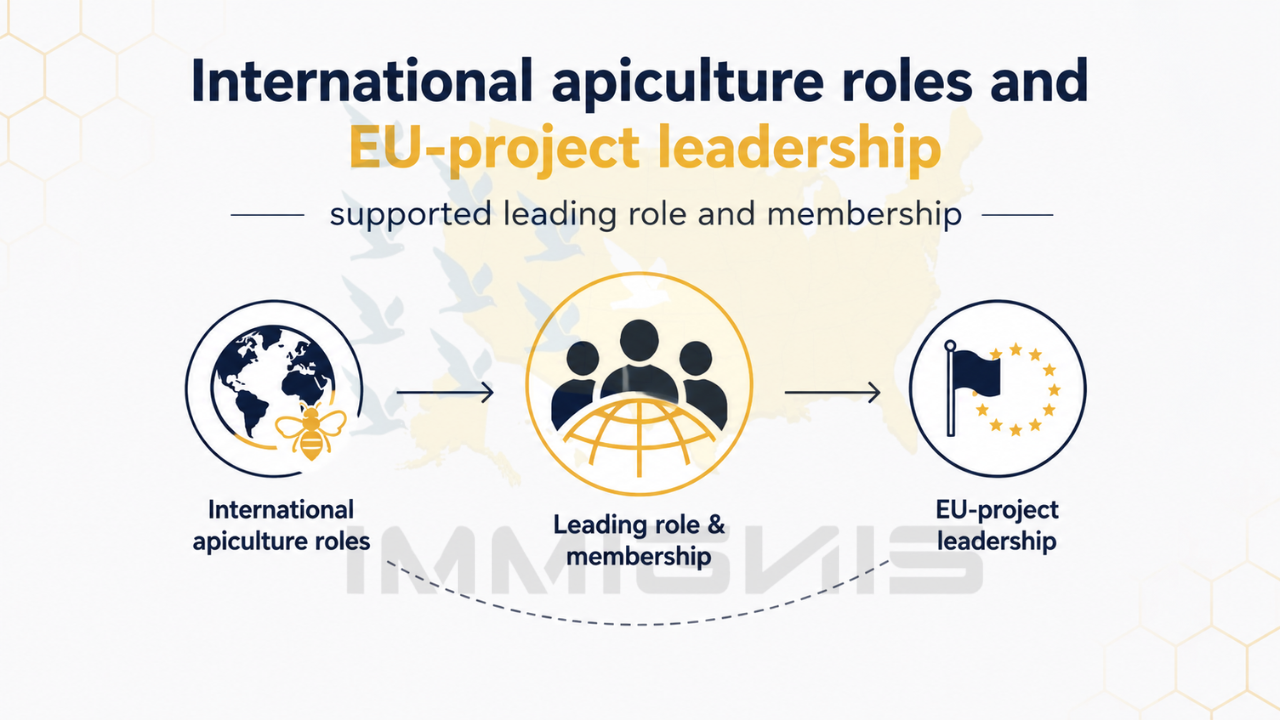
International apiculture-body roles helped establish that the petitioner was not working in isolation. Participation in recognized apiculture organizations, committees, networks, or professional bodies showed that others in the field accepted her expertise and relied on her scientific and practical judgment.
EU-project leadership also strengthened the leading-role argument. In a field where cross-border collaboration is common, leadership in EU-funded or EU-connected work can help demonstrate that the petitioner operated at a level beyond local practice. It showed that her work had relevance to wider European pollinator-health priorities.
These roles helped transform the case from a narrow national story into a broader field story. They showed that the petitioner's professional profile extended into recognized structures where honeybee health, colony survival, beekeeping standards, and pollinator-decline mitigation were being discussed and implemented.
For profile building and professional profile improvement, these positions were useful because they created institutional evidence of standing. They gave USCIS external markers showing that the petitioner held responsibility and recognition within the field.
Why association adoption mattered even when academia noticed little
One of the most important legal and narrative issues was the starting weakness: beekeeping associations adopted the work, but academia noticed little. In many applied fields, this is not a defect. It is simply how impact travels. The people most affected by the science are not always the people writing academic articles about it.
The petition addressed this directly. It explained that honeybee-health protocols often spread through beekeeping associations, extension networks, project trainings, workshops, cooperative guidance, and field manuals. These are the channels through which practical colony-health improvements reach the people managing hives.
By documenting adoption through those channels, the petition showed that the petitioner's impact was field-level even if citation metrics did not fully capture it. It also helped USCIS avoid the wrong comparison group. The question was not whether the petitioner looked like a laboratory scientist in a high-citation biomedical field. The question was whether she stood out in honeybee health and pollinator-decline mitigation.
This is where ethical profile building is especially useful. It does not pretend the person has a different kind of record. It explains the real record in the language of the field and in the evidence framework USCIS needs.
How Immignis built the petition-ready profile
The Immignis and Advance My Profile strategy focused on turning scattered impact into a structured immigration profile. The team organized the petitioner's work around specific EB-1A criteria and used each evidence category for a clear purpose.
Adoption documentation supported original contributions and field significance. Scholarly articles supported the publication record. International apiculture roles supported membership and professional standing. EU-project leadership supported leading role. Science-media coverage helped make the work publicly legible and reinforced the importance of pollinator-health science.
This type of profile building is different from generic publicity. The goal was not to make the petitioner sound famous. The goal was to build a precise, honest, and petition-ready professional profile that USCIS could understand. That required matching the evidence to the realities of honeybee science and the realities of EB-1A adjudication.
The approval hook was simple and effective: a pollinator-crisis narrative every officer has read about, grounded in real protocols. The petition connected a broadly understood public problem to the petitioner's specific scientific contribution.
Why this case worked
The case worked because the petition did not treat practical adoption as inferior evidence. It showed that in pollinator-health science, adoption by associations and beekeepers can be one of the strongest signs that a method matters.
The petition also avoided exaggeration. It did not claim that the petitioner was famous in the broad public sense. Instead, it showed that she was important in the right field, through the right channels, and with evidence that matched how the field actually recognizes useful work.
The final record combined field adoption, science, leadership, professional membership, and public visibility. That combination helped USCIS see both the petitioner's technical merit and the broader significance of her protocols.
Most importantly, the case showed the value of immigration-specific profile building for applied scientists. A record that may look ordinary when judged only by citations can become strong when real-world adoption, professional roles, and field recognition are documented properly.
Conclusion
The Slovenian pollinator-health scientist's EB-1A approval shows that applied science can support a strong extraordinary-ability petition when the evidence is organized around the way the field actually works.
Her case succeeded because protocol adoption, scholarly publication, apiculture roles, EU-project leadership, and science-media coverage were brought together into one coherent immigration profile. The result was a petition that showed not only scientific knowledge, but field-level influence in honeybee health and pollinator-decline mitigation.
The broader lesson is clear: if a scientist's work is adopted by practitioners, associations, industry groups, or public programs, that impact should not be ignored. With careful profile building and USCIS evidence development, practical adoption can become one of the strongest parts of an EB-1A case.
Frequently asked questions
Can an applied agricultural scientist qualify for EB-1A?
Yes. Applied agricultural scientists can qualify for EB-1A when the record shows original contributions, publications, leading roles, professional membership, judging or review activity, and field-level recognition.
Can honeybee-health or pollinator-decline work support an EB-1A petition?
Yes. Honeybee health and pollinator-decline mitigation can support EB-1A when the petitioner's work is documented as significant, adopted, recognized, and connected to a clear professional niche.
Does adoption by beekeeping associations help an EB-1A case?
Yes. Adoption by beekeeping associations can be strong evidence when it is clearly documented, attributed to the petitioner, and explained as a meaningful channel of field impact in apiculture.
Are citations always required for a science-based EB-1A case?
No. Citations can help, but applied science cases may also rely on adoption evidence, policy use, association implementation, industry letters, professional roles, publications, media coverage, and expert letters.
How can profile building help a pollinator-health scientist?
Profile building can organize scattered evidence, define the field, document adoption, improve public-facing visibility, and connect achievements to EB-1A or EB-2 NIW criteria in a USCIS-friendly way.
Can Immignis and Advance My Profile help scientists with immigration profile building?
Yes. Immignis and Advance My Profile help scientists, researchers, engineers, healthcare professionals, and applied experts build ethical immigration profiles through evidence development, publication strategy, visibility building, and EB-1A or EB-2 NIW profile improvement.
Build an EB-1A record around applied science, adoption evidence, and field-level recognition
Many scientists already have meaningful impact, but their strongest evidence may be scattered across associations, practitioner networks, project records, publications, media, and industry or government adoption.