Key facts at a glance
| Outcome | EB-1A approval for a Canadian quantum sensing engineer working as a contractor in a U.S.-based national-laboratory environment. |
| Approval date | Approved on September 12, 2024. |
| Field niche | Quantum sensors for navigation without continuous GPS availability, with a focus on precision sensing and inertial-navigation research. |
| Starting problem | The engineer’s strongest project environment limited what could be described publicly, leaving a thin public record around his individual technical contribution. |
| Path used | Ethical, export-conscious EB-1A profile building through non-controlled publications, patent documentation, invited technical talks, peer review, selective professional memberships, carefully scoped media coverage, independent quantum-sensing letters, and critical-role evidence. |
| USCIS EB-1A criteria activated | Scholarly articles, original contributions, judging, memberships, and leading or critical role. Patent evidence strengthened the original contribution record. |
USCIS approved his Form I-140 on September 12, 2024.
The EB-1A quantum sensing engineer did not include a photograph of the instrument he was helping to develop in the petition. It did not include a system diagram, sensitive test data, or a detailed description of the project environment.
Those omissions were deliberate. He was a Canadian quantum sensing engineer working as a contractor in a U.S. national-laboratory setting. His research concerned precision sensors that could contribute to navigation when GPS is unavailable, unreliable, or cannot be used continuously. An EB-1A case still had to show his individual contribution.
How do you prove extraordinary ability when the obvious evidence is off limits?
A university researcher may be able to attach a paper, conference slide deck, dataset, and laboratory description. An engineer working in a restricted project environment may have to remove project names, technical parameters, internal architecture, and performance data from the conversation before profile building even starts.
The EB-1A green card is a self-petition immigrant category for people who can demonstrate extraordinary ability through sustained national or international acclaim and evidence placing them among the small percentage at the top of their field. Confidentiality did not change that legal standard. It changed the evidence strategy.
Advance My Profile, powered by Immignis, began by separating public scientific work from information the engineer was not authorized to disclose.
The field was precision quantum sensing for navigation without continuous GPS
The client’s background touched quantum sensing, inertial measurement, precision instrumentation, and navigation research.
The team did not build a profile around ‘quantum technology.’ That phrase covered too much and said very little about his own work.
At a high level, inertial navigation depends on measurements of motion and rotation. Small measurement errors can accumulate as a system estimates position over time. Quantum sensing research studies ways to make certain measurements with very high precision and to improve the information available to navigation systems.
His public profile was built around that scientific problem. The petition stayed away from restricted applications, deployment scenarios, and internal system design.
What could USCIS evaluate in this quantum sensing case?
In a national laboratory contractor environment, a project may involve government personnel, prime contractors, subcontractors, physicists, controls engineers, optics specialists, software teams, and program management. A letter saying the project was important would not establish what this petitioner contributed.
For original contributions, the record identified non-controlled technical work linked to his sensing and navigation research, patent related inventor ship, and scientific methods that independent experts could discuss. The petition explained the technical problem and his role using material cleared for public or professional use.
The patent filing helped document inventorship and a technical concept. It was not treated as a separate EB-1A criterion or as automatic proof of major significance.
Judging evidence came from genuine peer review. Membership claims were used only where the association’s standards supported the regulatory requirement. The leading or critical role evidence focused on why a distinguished research program relied on his technical judgment.
The publication plan began with subjects he was allowed to discuss
With quantum sensing domain support, he worked on publishable topics involving precision measurement, sensor behavior, inertial navigation error, calibration, and the interpretation of quantum sensor data. Internal project specifications and controlled technical details were kept out.
The final publications showed the part of the field he understood without recreating the restricted project in public.
They also gave independent experts something concrete to read. A referee could discuss his scientific reasoning, published methods, and technical subject without claiming access to a national-laboratory program.
Patent documentation helped isolate his inventorship
The team documented the filing, the inventorship information, the public technical description, and the problem the disclosed concept addressed. The petition then linked his role to the contribution described in the available record.
A public patent record can show that an inventor was attached to a specific technical concept. USCIS still needs evidence explaining why the contribution has significance in the field.
Independent letters, focused publications, and professional recognition supplied that context here.
Engineers in national laboratories, aerospace, advanced manufacturing, semiconductors, defense adjacent research, and other sensitive environments often assume EB-1A is impossible because their strongest work is not public. A free profile assessment can identify what may be documented safely and which parts of the authority record still need development.
Invited talks were scoped before the slides were written
His talks covered precision sensing, quantum measurement, inertial navigation research, and general technical challenges in maintaining accurate navigation information when satellite-based positioning is not continuously available.
The presentations did not use project photographs or restricted diagrams. Technical examples came from public research, published work, or material that could be discussed openly.
Invitations and programs also showed that organizations outside his immediate work environment wanted his technical perspective.
Peer review showed that journals trusted his technical judgment
Advance My Profile developed that area through genuine peer-review opportunities tied to quantum sensing, precision measurement, inertial systems, and related research.
The file documented review invitations and completed activity where available. Generic requests from weak publications were not used simply to increase the count.
For USCIS, that activity supported the criterion concerning judging the work of others.
Selective memberships had to be selective in fact
Some are open to any professional. Others have senior or advanced grades tied to experience, achievement, nominations, or review by existing experts.
The membership strategy examined the actual rules of the professional bodies connected to his field. Where the EB-1A membership criterion was claimed, the petition included the admission or advancement standards and evidence showing how the engineer qualified.
The case did not turn ordinary dues based membership into extraordinary ability evidence.
Media coverage had to explain the field without inviting questions he could not answer
Technical outlets and science audiences could discuss quantum sensing, inertial navigation, precision measurement, and the broader need for navigation methods that do not depend on continuous GPS reception. They could not be given details from the restricted project.
His commentary therefore stayed with public science.
He explained why precision matters in inertial measurements, why small errors can accumulate, and why quantum sensing attracts interest for demanding navigation problems. When a question moved toward a protected application or specific program capability, the interview stayed within public information.
The critical-role evidence focused on why the program needed his judgment
The petition documented the functions he performed, the technical questions assigned to him, the decisions that depended on his analysis, and the way his work connected to significant research activity in the laboratory environment.
Available letters and non-sensitive project records described his responsibility for precision-sensing and navigation related work without revealing protected technical content.
The evidence also separated his role from the importance of the national laboratory itself. USCIS needed to understand why his own work was critical, not simply why the institution was distinguished.
Independent quantum sensing experts filled the space left by restricted project files
The experts did not claim access to restricted information. They discussed the scientific problem, his publications, patent related contribution, invited technical work, and the role precision sensing can play in navigation research. Their analysis stayed with evidence available to them.
Advance My Profile prepared evidence based drafts for expert review. Referees could revise the language and sign only what they considered accurate.
How the USCIS EB-1A criteria were supported
Scholarly articles: Focused publications connected his authorship to quantum sensing, precision measurement, inertial navigation error, calibration, and related open technical questions.
Original contributions: Patent documentation, non-controlled technical evidence, focused research, and independent expert letters explained his individual contribution to precision quantum sensing and its relevance to navigation research.
Judging the work of others: Peer-review assignments documented genuine evaluation of research submitted by other specialists in quantum sensing, measurement science, navigation, and allied fields.
Memberships: Selective professional membership evidence was supported with the relevant admission or advancement standards and documentation showing how his qualifications were assessed.
Leading or critical role: Non-sensitive program and role evidence showed why significant research activity in the laboratory environment relied on his technical work and judgment.
At final merits, the papers, patent record, peer review, invited talks, selective memberships, carefully scoped media work, critical-role documentation, and independent letters all described the same technical specialty.
The petition was approved on September 12, 2024
The approved EB-1A petition gave him a self-petition path without employer sponsorship or labor certification. Form I-140 approval is one stage of the employment-based immigrant process, and later permanent-residence timing may depend on visa availability and the applicant’s next immigration step.
The case reached approval without turning sensitive project details into public content.
If your strongest engineering work is sensitive, confidential, or controlled
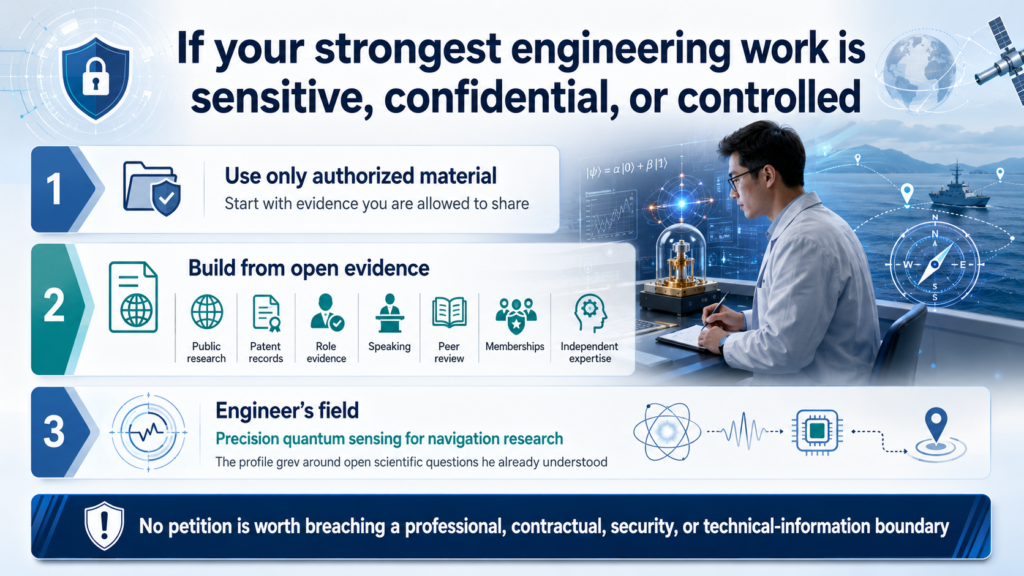
Start with material you are authorized to use. Review public research, patent records, non-sensitive role evidence, speaking, peer review, memberships, and independent expertise that can be documented without exposing the project.
For this engineer, the field was precision quantum sensing for navigation research. The profile grew around open scientific questions he already understood.
Nothing in an immigration petition is worth breaching a professional, contractual, security, or technical-information boundary.
FAQs
Can sensitive national-laboratory or government-adjacent work support an EB-1A case?
Yes, when the applicant can provide verifiable, lawfully usable evidence of individual contribution and recognition. A petition can rely on public publications, patent records, non-sensitive role evidence, peer review, invited talks, qualifying memberships, and independent expert analysis. Applicants should not disclose information they are not authorized to disclose.
How can an engineer prove an original contribution without showing restricted technical data?
The record can identify the public technical problem, the applicant’s role, patent-related inventorship, safe publications, non-sensitive method evidence, and independent expert context. The petition should use evidence that can be reviewed and verified without recreating a protected system or exposing technical details the applicant cannot share.
Does a quantum sensing patent automatically prove a contribution of major significance?
No. Patent evidence may document inventorship and an original technical concept, but USCIS still evaluates whether the contribution has major significance in the field. Publications, independent expert analysis, professional use context, and other recognition evidence may help explain the importance of the underlying work.
What is quantum sensing, and how can it relate to navigation without GPS?
Quantum sensing uses quantum properties of atoms, photons, or other systems to make highly precise measurements. In navigation research, quantum sensors may be studied for measurements related to acceleration, rotation, gravity, magnetic fields, or timing. These measurements can contribute to navigation methods that do not depend on continuous satellite-positioning signals.
Can journal peer review count as judging for a quantum engineer?
Genuine peer review can support the EB-1A judging criterion when the engineer actually evaluates research by other specialists. The record should document the invitation, the review activity, and the relationship between the reviewed work and the applicant’s field.
Do I need to publish details of a defense-adjacent or restricted project to qualify for EB-1A?
No specific rule requires an applicant to publish restricted project details. The EB-1A case still needs sufficient evidence of extraordinary ability and sustained acclaim, so the strategy should identify safe and verifiable evidence from the applicant’s real field. Protected information should remain protected.
Build an EB-1A success story from evidence you are allowed to stand behind
If you work in quantum sensing, national-laboratory research, navigation technology, aerospace, advanced instrumentation, or another sensitive engineering environment, your public CV may show only a small part of your technical career.
Immignis and Advance My Profile help identify a defensible niche, separate usable evidence from protected work, build credible professional recognition, and prepare an EB-1A record around contributions that can be verified safely.
Start with a free EB-1A profile assessment and find out whether your technical record can be developed without compromising the work you are responsible for protecting.