An EB-1A Radio Astronomer from Namibia secured approval after work-package leadership, publication authorship, array-science contributions, international consortium responsibilities, telescope-proposal review, professional recognition, and immigration-specific profile building turned a large-project staff record into an individual record of scientific leadership.
Key facts at a glance
| Petition outcome | Form I-140 approved under EB-1A on September 4, 2024. |
| Professional profile | Namibian radio astronomer helping build southern-sky observation capacity through major telescope-array and collaborative astronomy programs. |
| Field niche | Southern-hemisphere radio astronomy and array science. |
| Starting weakness | Participation in a very large scientific project initially looked like an institutional staff role. The project was visible, but the petitioner’s scientific authority inside it was not. |
| Profile-building focus | Work-package leadership documentation, publication authorship, array-method and data contribution records, international consortium committee service, science-media coverage, telescope-proposal review, expert letters, and a coherent individual research identity. |
| Principal EB-1A evidence areas developed | Leading or critical role, authorship of scholarly articles, judging the work of others, original contributions, and selective professional membership or appointment. |
| Central issue | Showing that responsibility for a defined work package in mega-science was not routine project employment, but accountable scientific leadership comparable to directing a laboratory, technical group, or research program. |
| Approval lesson | Large collaborations do not erase individual distinction when the record identifies the workstream the scientist led, the decisions made, the deliverables controlled, and the scientific outcomes that depended on that responsibility. |
The approval
On a major radio-astronomy project, one person may be responsible for an essential scientific workstream while appearing publicly as only one name among hundreds. USCIS approved this Namibian radio astronomer’s Form I-140 petition on September 4, 2024 after the record made that hidden responsibility visible.
The case did not depend on borrowing the prestige of a telescope project. It separated project reputation from personal achievement. The petition identified the work package the scientist led, explained what that unit was expected to deliver, documented the decisions and technical risks under the petitioner’s control, and connected those responsibilities to publications, array performance, professional committees, proposal review, and independent recognition.
Immignis and Advance My Profile built the case around a practical idea: in mega-science, leadership is often organized by work package rather than by laboratory name. Once the officer could see the people, methods, deadlines, interfaces, and scientific consequences attached to that role, the petitioner no longer looked like general project staff.
Mega-science can make individual scientists difficult to see
Radio astronomy increasingly depends on large, distributed systems. An array may involve antennas at multiple sites, receivers, timing systems, calibration, correlators, data transport, computing, imaging software, survey design, commissioning, operations, archives, and international science teams. No single person owns the full instrument or every paper it produces.
That structure creates a recurring immigration problem. The project may be globally important, yet a scientist’s documents may show an employer title, committee name, and long co-author list without explaining what the person actually controlled. A non-specialist reader can easily mistake scientific leadership for ordinary participation.
The petition avoided project-name inflation. Instead of repeatedly describing the scale of the array, it mapped the petitioner’s authority within it. That shift mattered because EB-1A evaluates the individual. The central question was not whether the observatory was impressive, but whether the petitioner occupied a consequential position within distinguished scientific work.
The field was narrowed to southern-hemisphere radio astronomy and array science
The case was framed around southern-hemisphere radio astronomy and array science. This was more accurate than presenting the petitioner as a general physicist or astronomer. The work concerned how multiple antennas operate together as one scientific instrument and how observations become calibrated, interpretable data.
Array science includes technical and scientific questions that are inseparable in practice. Observation strategy affects calibration. Instrument behavior affects imaging. Data pipelines affect which signals can be recovered. Commissioning decisions affect whether the system can meet the science requirements promised to researchers.
The southern-sky context also explained why the petitioner’s work belonged to a wider international research effort. Major facilities in the southern hemisphere expand access to celestial targets, complement observatories elsewhere, and require scientists who can connect local capacity with global methods, standards, and collaborations.
Work-package leadership became the center of the case
A work package can be the mega-project equivalent of running a laboratory. It has a defined scientific or technical objective, assigned personnel, interfaces with other teams, milestones, quality requirements, risks, and deliverables. The person leading it must make decisions that affect more than an individual task list.
The profile-building strategy documented the petitioner’s role through project plans, responsibility matrices, meeting records, technical reports, milestone approvals, organizational charts, correspondence, deliverable ownership, and letters from scientists who worked across connected parts of the program. The evidence explained what would have happened if that workstream failed or arrived late.
This was stronger than relying on the title “work-package lead.” The petition showed function: setting scientific priorities, coordinating specialists, resolving interface problems, reviewing results, managing performance, reporting to higher project governance, and deciding whether outputs were ready for the next stage.
That record supported a leading or critical role argument because it tied personal responsibility to the success of a distinguished scientific undertaking. It also gave the final-merits analysis something concrete: the petitioner had been trusted with a part of the project that other teams and scientific outputs depended on.
Original contribution was traced through methods, systems, and scientific dependence
A large array can absorb an individual contribution into the instrument as a whole. Once a calibration method, observing workflow, quality-control procedure, software component, commissioning result, or data product becomes standard, later users may never see who created or stabilized it.
The petition therefore followed the contribution forward. It documented the problem addressed, the petitioner’s role in developing or improving the solution, where the method or system was adopted, and which later observations, teams, publications, or operations relied on it. Independent letters were used to explain reliance rather than offer broad praise.
This distinction was important. Working on an original telescope does not automatically mean every employee made an original contribution of major significance. The case identified the petitioner’s own method, system, decision framework, or scientific result and then showed why it mattered beyond an assigned duty.
The publication record was reorganized around identifiable scientific authorship
The petitioner already had scholarly work, but mega-project publications can create the same attribution problem as the project itself. Papers may have long author lists, collaboration names, or scientific results built from infrastructure contributed by many teams.
The record was reorganized by intellectual responsibility. Publications were grouped around the petitioner’s actual research themes, methods, data products, analysis, and writing role. Contribution statements, first-author or corresponding-author work, drafting records, and expert explanation helped distinguish identifiable authorship from general collaboration participation.
The strategy also encouraged a clearer forward publication profile. Focused papers, technical notes, conference proceedings, or data-method articles could give the petitioner an individual scientific voice while remaining honest about collaborative work. The objective was not to abandon consortium science, but to make personal authorship easier to evaluate.
Telescope-proposal review provided field-native judging evidence
Astronomers compete for limited observing time. Proposal reviewers assess scientific merit, feasibility, methodology, requested resources, and whether a telescope is the right instrument for the question being asked. This is one of the field’s most direct forms of judging the work of other professionals.
The case documented completed telescope-proposal review rather than invitations alone. Appointment messages, review-panel records, conflict-of-interest procedures, completed assignments, acknowledgments, and observatory guidance helped show that the petitioner had actually evaluated the work of other astronomers.
This evidence carried particular weight because it matched the petitioner’s field. The scientist was trusted not merely to use an array, but to help decide which proposed observations were scientifically justified and technically credible. It translated a specialized astronomy practice into a criterion that USCIS could understand.
International consortium committees showed recognition beyond one employer
Consortium committee work strengthened the case when it involved real responsibility. The useful evidence was not a logo or a place on a mailing list. It was participation in scientific planning, technical governance, data policy, commissioning review, survey design, quality assurance, training, or another function for which expertise was part of the selection.
The petition documented appointment procedures, terms of reference, meeting records, assignments, and completed outputs. This helped show that scientists outside the petitioner’s home institution relied on the petitioner’s judgment in matters affecting shared research infrastructure.
Where a role was selective and based on recognized achievement, it could also contribute to the membership analysis. Ordinary membership in an astronomy association was treated as context, not as automatic satisfaction of the regulatory criterion.
Science-media coverage had to identify the scientist, not only the telescope
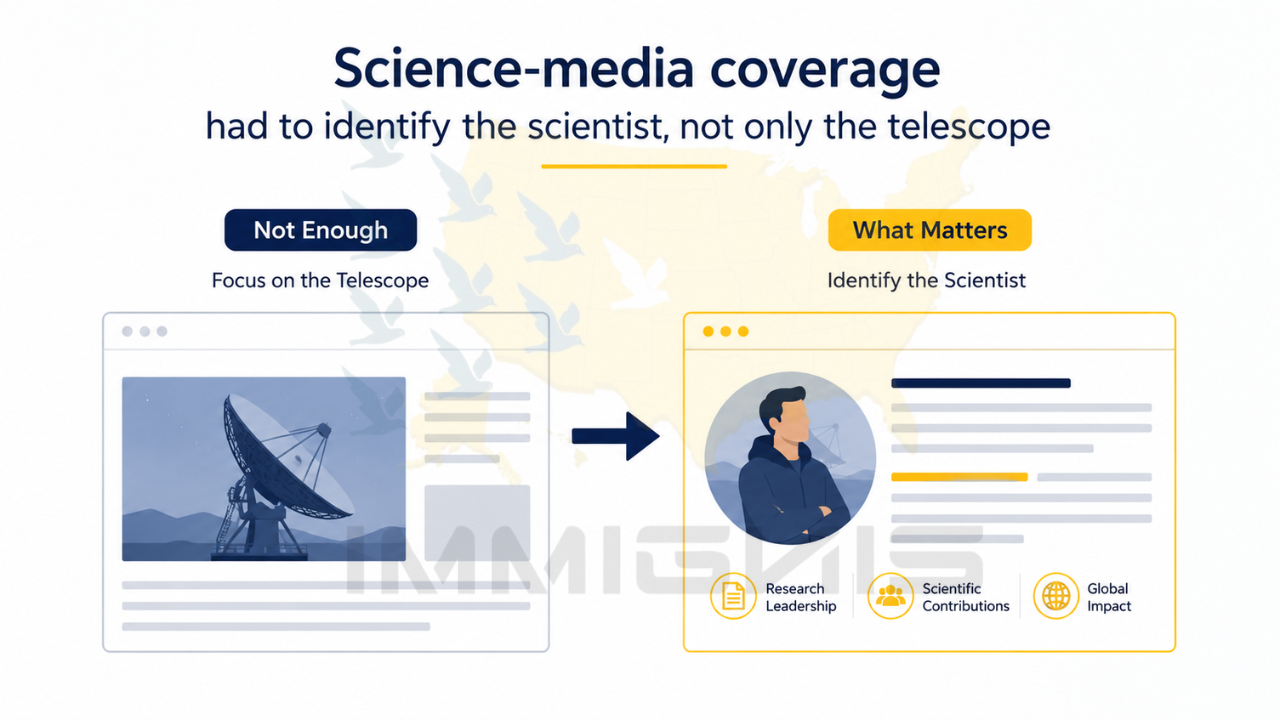
Radio telescopes attract media attention because the machines are visually striking and the science is easy to frame through discoveries. That publicity often centers on the facility, country, or international partnership. The scientist responsible for a crucial workstream may disappear from the public account.
The profile-building strategy sought coverage that explained the petitioner’s own work: what part of the array or observing program the scientist led, which scientific problem was being solved, how local capacity connected to international research, and why the petitioner’s expertise mattered. Coverage about the project alone was not treated as coverage about the individual.
This gave the published-material evidence more substance and improved the public research record. It also helped readers outside radio astronomy understand the difference between supporting a project and carrying scientific responsibility within it.
Professional membership required selectivity
Astronomy organizations often offer ordinary membership to qualified professionals, students, or interested participants. That can be useful background, but the EB-1A membership criterion requires closer analysis of the admission standards and the role of recognized experts in selecting members.
The case therefore focused on any elected grade, fellowship, appointed scientific group, organizing committee, or selective role tied to professional standing. Bylaws, nomination rules, review procedures, selection notices, and evidence of the petitioner’s responsibilities were more useful than a membership card by itself.
This careful approach protected the credibility of the petition. It did not force every association record into a criterion. It used each document for what it could actually prove.
How Immignis and Advance My Profile changed the record
Before profile building, the petitioner’s career could be summarized too easily as “worked on a major telescope project.” That sentence sounded impressive but left the essential immigration questions unanswered. Which part? With what authority? What scientific outputs depended on it? Who outside the employer recognized the work?
Immignis and Advance My Profile rebuilt the record around work-package accountability. Project documents established scope and responsibility. Publications identified authorship. Contribution evidence showed scientific dependence. Consortium committees and telescope-proposal review demonstrated peer trust. Media work created an individual public record instead of repeating the project’s institutional story.
The final case remained collaborative and technically honest. It did not suggest that the petitioner built an array alone. It showed that large scientific infrastructure is divided into accountable units and that the petitioner had repeatedly been trusted to lead one of those units at a high professional level.
Why this case worked
The evidence categories reinforced one another without performing the same job. Work-package records established leadership. Publications showed scholarly authorship. Method and adoption evidence supported original contribution. Telescope-proposal review demonstrated judging. Consortium roles and selective appointments showed recognition outside the employer. Media coverage made the individual scientist publicly identifiable.
The approval hook was simple enough for a non-astronomer to follow: work-package leadership is how mega-science assigns laboratory-sized responsibility. Once the petition showed the people, deliverables, decisions, and consequences attached to that role, the petitioner’s position no longer resembled routine staff participation.
What scientists in large collaborations can learn
Scientists should preserve evidence while the project is active. Responsibility matrices, deliverable approvals, meeting minutes, contribution statements, panel appointments, review confirmations, software or method documentation, and records of scientific reliance can be difficult to recreate years later.
They should also separate three ideas that are often mixed together: the reputation of the project, the importance of the work package, and the petitioner’s own performance. A strong case documents all three and does not assume that one proves the others.
Finally, large-team research does not require artificial individualism. The best evidence explains collaboration accurately while identifying the decisions and outputs for which one scientist was personally accountable. That is more credible than either claiming the entire project or allowing the individual contribution to disappear.
Conclusion
The Namibian radio astronomer’s EB-1A approval came from making leadership legible inside a scientific structure built for collaboration. The project was large, but the record became specific.
Work-package documents, publications, array-science contributions, consortium responsibilities, telescope-proposal review, selective professional roles, media coverage, and independent explanation showed how the petitioner moved from participation to scientific authority. The telescope remained a team achievement. The petitioner’s role within it became unmistakable.
The client’s name and identifying details are omitted to protect privacy. The professional field, approval date, and evidence strategy reflect the case information provided for this success story.
Frequently asked questions
Can a radio astronomer qualify for EB-1A?
Yes. A radio astronomer may qualify when the submitted evidence addresses the regulatory criteria and the record as a whole shows the required level of sustained professional recognition. The importance of a telescope project alone is not enough; the petition must document the individual scientist.
Does working on a major telescope array prove extraordinary ability?
No. Project prestige provides context, but USCIS evaluates the petitioner. The record should explain the applicant’s role, authority, scientific contribution, recognition, and importance to the project or organization.
What is a work package in a large science project?
A work package is a defined unit of scientific or technical responsibility with objectives, personnel, milestones, interfaces, risks, and deliverables. Leading one may support a leading or critical role argument when the project is distinguished and the applicant’s responsibility is properly documented.
How can work-package leadership be documented?
Useful records may include project plans, organizational charts, responsibility matrices, deliverable ownership, meeting minutes, approvals, reports, correspondence, milestone reviews, and detailed letters from connected project leaders.
Can long collaboration papers support EB-1A?
They can, but the petition should explain authorship conventions and identify the applicant’s contribution through contribution statements, writing records, data or method ownership, author-position evidence, and independent technical explanation.
Can telescope-proposal review satisfy the judging criterion?
It may. Telescope-time panels evaluate the scientific merit and technical feasibility of proposals submitted by other professionals. Completed review records, panel appointments, observatory acknowledgments, and review instructions are stronger than invitations alone.
Can consortium committee service support a leading-role claim?
Potentially. The strongest evidence shows a substantive scientific, technical, or governance function, the selection basis, completed responsibilities, and the importance of the committee or project rather than committee membership by itself.
Does membership in an astronomy society satisfy EB-1A?
Ordinary membership generally does not establish the regulatory membership criterion on its own. Selective fellowship, elected grade, or an achievement-based appointment may be more relevant when the admission standards and peer-selection process are documented.
What can count as an original contribution in array science?
Examples may include a calibration method, observing workflow, software component, commissioning result, data product, quality-control system, survey method, or scientific finding. The case must still show the applicant’s authorship and the contribution’s significance through adoption, reliance, or independent evidence.
Is science-media coverage about the telescope enough?
Usually not for published material about the applicant. Stronger coverage identifies the scientist, explains the person’s work, and appears in qualifying professional, trade, or major media rather than merely naming the institution or project.
Why is field definition important in a radio-astronomy petition?
A precise field such as southern-hemisphere radio astronomy and array science helps the officer understand why work-package leadership, telescope review, calibration methods, consortium governance, and collaborative publications are meaningful forms of recognition.
How can profile building help a scientist in mega-science?
Profile building can organize hidden project evidence, improve attribution, develop focused authorship, document review and committee work, and create an individual public record without overstating the person’s share of a collaborative project.
Make your role visible inside mega-science
Professionals working in astronomy, physics, space science, observatories, research infrastructure, data-intensive science, and large international collaborations may already have strong EB-1A evidence hidden in work-package records, publications, technical deliverables, panel service, consortium committees, and institutional files.
Start with a free EB-1A profile assessment to identify which achievements are already attributable, which records still describe only the project, and which ethical profile-building activities could create a clearer individual scientific record.