How an EB-1A Rehabilitation Specialist from Iraq secured approval by transforming post-conflict amputee-care work into a petition-ready immigration profile built on trainee-cohort documentation, ICRC-partner letters, technique and program publication, international prosthetics and orthotics society membership, conference faculty roles, judging evidence, and ethical profile building.
Key facts at a glance
| Petition outcome | Form I-140 approved under EB-1A on August 26, 2024. |
| Professional profile | Iraqi prosthetics and rehabilitation specialist who rebuilt amputee-care capacity after conflict and trained a generation of technicians. |
| Field niche | Post-conflict prosthetics and orthotics systems. |
| Starting weakness | The professional legacy was real and widely felt, but it lived through trained people, restored services, and humanitarian programs rather than a clean paper trail. |
| Profile-building focus | Trainee-cohort documentation, ICRC-partner letters, technique and program publication, international prosthetics and orthotics society membership, conference faculty roles, judging evidence, and immigration-specific profile building. |
| EB-1A criteria supported | Original contributions, leading role, membership, scholarly articles, and judging. |
| Central issue | Showing that the petitioner was not only a skilled rehabilitation professional, but a system builder whose training model and prosthetics capacity-building work created measurable field impact. |
| Approval lesson | A teaching legacy can become strong EB-1A evidence when profile building converts human outcomes into countable, attributable, and independently supported documentation. |
The approval
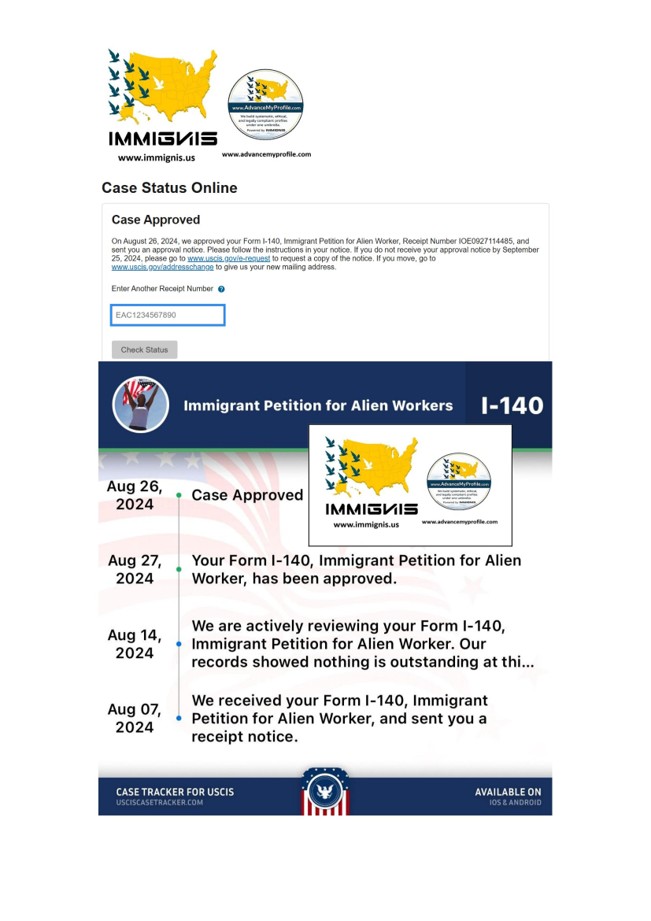
On August 26, 2024, USCIS approved the Form I-140 petition of an Iraqi prosthetics and rehabilitation specialist whose work focused on post-conflict prosthetics and orthotics systems.
The approval was important because the strongest proof did not begin as a polished immigration record. The petitioner had helped rebuild amputee-care capacity after conflict, trained technicians, supported rehabilitation systems, and contributed to prosthetics and orthotics service delivery in a setting where need was urgent and documentation was often practical rather than promotional.
That made the case a strong example of EB-1A profile building, immigration profile building, and professional profile building for rehabilitation specialists whose real impact is distributed across trainees, clinics, partner organizations, and restored service capacity.
Immignis and Advance My Profile helped convert the record into a petition-ready EB-1A profile. The strategy focused on trainee-cohort documentation, ICRC-partner letters, technique and program publication, international prosthetics and orthotics society membership, conference faculty roles, judging evidence, expert letters, and ethical profile building that made the petitioner’s teaching legacy visible without exaggeration.
The evidence problem in post-conflict prosthetics and orthotics systems
Post-conflict prosthetics and orthotics systems are highly specialized. They require clinical rehabilitation knowledge, technical prosthetic fitting, technician training, supply-chain awareness, patient follow-up systems, and the ability to rebuild care pathways for people whose injuries may be life-changing and long-term.
The petitioner’s starting weakness was not lack of achievement. The problem was that the achievement was human, not paper. A generation of technicians had been trained. Amputee-care capacity had been rebuilt. Patients received services through programs that existed because skilled people had been taught, supervised, and organized. But USCIS needed documents, not only a reputation inside the rehabilitation community.
The petition therefore defined the field precisely as post-conflict prosthetics and orthotics systems. It did not present the case as ordinary physical therapy, general rehabilitation, or routine technical work. It presented a specialized niche where clinical judgment, technical training, humanitarian rehabilitation, and system capacity-building intersect.
This field definition was essential for immigration-specific profile building. It helped USCIS understand why training technicians, building prosthetics capacity, developing protocols, and supporting rehabilitation programs could be evidence of extraordinary ability in a field where outcomes are often measured by restored services and trained professionals rather than media attention.
Why a teaching legacy needed to become countable evidence
The approval hook in this case was simple but powerful: a teaching legacy was converted into countable, attributable evidence. In rehabilitation and prosthetics, the professional who trains others may shape far more patient outcomes than any one individual case file can show.
But that kind of legacy can be difficult for USCIS to evaluate. A trainee who becomes a technician may later serve hundreds of amputees. A training curriculum may strengthen a regional rehabilitation network. A program method may improve care quality for years. Still, unless the record connects those outcomes back to the petitioner, the achievement can remain invisible.
The petition therefore treated training as a field-level contribution, not as a side activity. It documented who was trained, what the petitioner taught, how the training was structured, where the technicians served afterward, and how the training supported prosthetics and orthotics capacity in post-conflict care settings.
This was the central profile-building move. The case did not merely say the petitioner had trained many people. It converted training into a documented professional contribution with scale, attribution, and field relevance.
Trainee-cohort documentation made the legacy measurable
Trainee-cohort documentation became one of the strongest pillars of the petition. In a case built around technical and rehabilitation training, USCIS needed to see more than general statements about mentorship. It needed a structured record of cohorts, roles, curriculum areas, training periods, post-training placement, and practical service outcomes.
The petition organized evidence showing how the petitioner helped develop prosthetics and orthotics capacity through trained technicians. This evidence explained the number and type of trainees, the skill areas involved, the level of responsibility, and the downstream importance of those trainees to amputee-care services.
This evidence supported original contributions and leading role because it showed that the petitioner’s work multiplied field capacity. The contribution was not limited to direct patient care. It created a human infrastructure for post-conflict rehabilitation.
For professionals searching for profile building, immigration profile building, EB-1A profile building, EB-2 NIW profile building, medical profile building, rehabilitation profile building, or USCIS evidence building, this case shows why training evidence becomes much stronger when it is structured as a measurable professional legacy.
ICRC-partner letters provided independent humanitarian validation
ICRC-partner letters and humanitarian-organization attestations helped convert a practical rehabilitation record into independent evidence. In post-conflict prosthetics and orthotics work, partner organizations often understand the specialist’s role better than public articles or institutional websites do.
The strongest letters explained what the petitioner built, what training or technical responsibilities the petitioner carried, how the work supported amputee-care capacity, and why the contribution mattered in a difficult humanitarian rehabilitation setting. They did not rely on broad praise alone. They gave role-specific attribution.
This evidence helped USCIS understand that the petitioner was not simply one technical worker inside a humanitarian program. The petitioner was a trusted specialist whose expertise supported broader rehabilitation capacity and whose role was recognized by credible outside partners.
As part of professional profile building for immigration, these letters were essential because they translated field reputation into petition-ready evidence and gave independent support to the petitioner’s leading role and original contributions.
Technique and program publication strengthened the scholarly record
Technique and program publication gave the record a more formal professional structure. In prosthetics and rehabilitation, important knowledge is often passed through workshops, field training, protocols, and technical supervision rather than traditional academic channels. USCIS, however, still benefits from seeing the work expressed in a recognized written form.
The petition used publication evidence to show that the petitioner’s knowledge could be shared beyond one clinic or one humanitarian program. Technique writing, program documentation, rehabilitation articles, or structured case-based learning helped convert practical expertise into professional knowledge.
This supported the scholarly-articles criterion and strengthened the original-contributions argument. It showed that the petitioner was not only implementing existing methods but helping define, adapt, or communicate methods suited to post-conflict amputee care.
For rehabilitation specialists and prosthetics professionals, publication profile building can be especially important. It turns hard-earned field knowledge into a form that USCIS can evaluate and that the profession can cite, teach, or replicate.
International membership and conference faculty roles showed field recognition
International prosthetics and orthotics society membership helped place the petitioner inside a recognized professional community. This mattered because USCIS needed to understand the standards, hierarchy, and field structure of prosthetics and orthotics, especially when the work came from a post-conflict setting rather than a well-funded academic hospital.
Conference faculty roles added another layer of recognition. When a specialist is invited to teach, present, or speak at professional gatherings, the field is signaling that the person’s experience has value for other professionals. In this case, conference faculty evidence helped show that the petitioner’s teaching and rehabilitation knowledge were not purely local.
These materials supported membership, leading role, published material, and final-merits arguments. They helped show that the petitioner was connected to the professional bodies and knowledge-sharing platforms that define prosthetics and orthotics as a specialized field.
For immigration-specific profile building, these categories helped convert quiet humanitarian rehabilitation work into a visible professional identity.
Judging evidence showed evaluative authority
Judging evidence was important because it showed that the petitioner had been trusted to evaluate the work, skills, cases, training outcomes, or technical capacity of others. In prosthetics and orthotics, judging may appear through examination, training evaluation, technical review, curriculum assessment, or selection of trainees or program outputs.
The petition connected evaluative responsibilities to the EB-1A judging criterion. It did not treat them as routine supervision. It explained why the petitioner’s role required professional authority, technical judgment, and trusted expertise in a specialized rehabilitation field.
This helped the case because judging evidence can be especially persuasive when publications and media coverage are limited. It shows that others relied on the petitioner not only to perform the work, but to assess whether other professionals were performing it correctly.
As part of profile improvement and USCIS evidence building, this evidence gave the petition another criterion-based foundation and reinforced the broader argument that the petitioner stood above ordinary practice.
How profile building changed the case
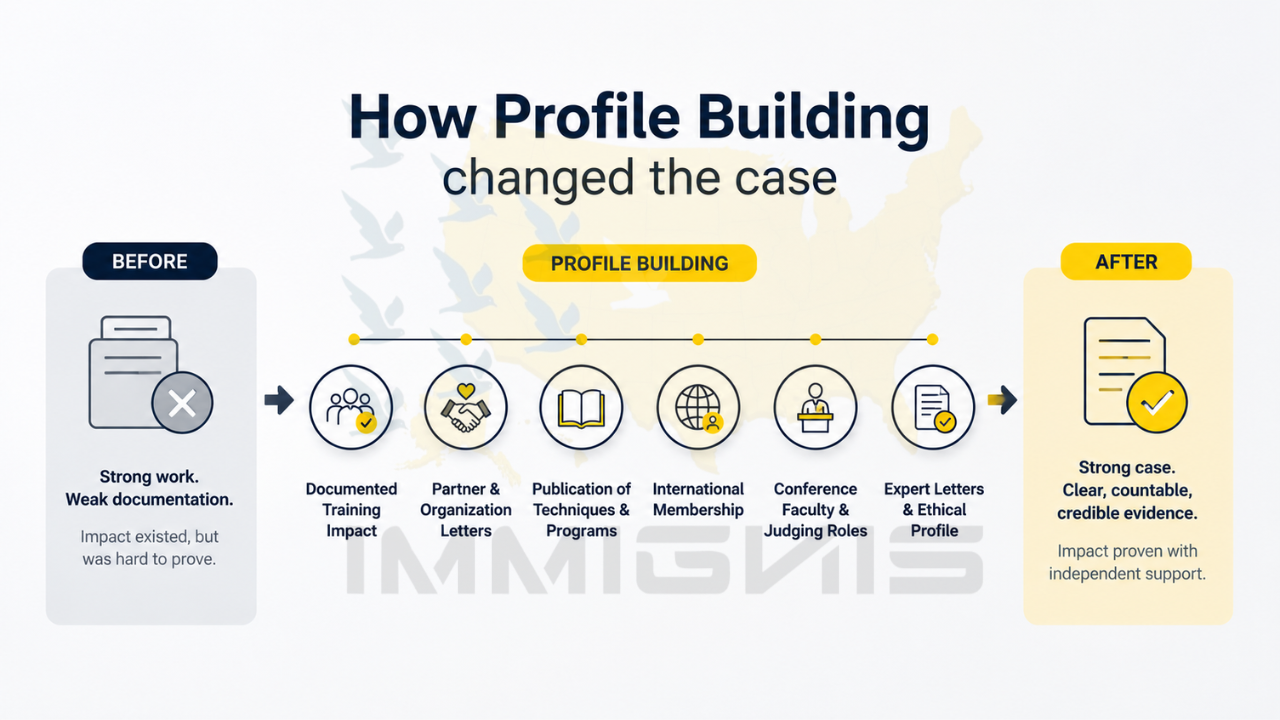
This case shows how profile building can change the way a humanitarian rehabilitation career is understood. Before the record was organized, the petitioner’s achievements could have looked scattered: training, patient care, partner work, technical instruction, program service, and professional participation.
Immignis and Advance My Profile helped align those achievements under one clear field niche: post-conflict prosthetics and orthotics systems. That made the evidence more coherent and easier for USCIS to evaluate.
The profile-building process turned trainee cohorts into measurable impact, partner letters into independent validation, publications into scholarly evidence, society membership into field recognition, conference faculty roles into professional visibility, and judging into direct criterion support.
For professionals searching online for profile building, immigration-specific profile building, professional profile improvement, EB-1A profile building, EB-2 NIW profile building, or evidence development for U.S. immigration, this case shows how quiet technical expertise can be transformed into a strong petition record without inventing achievements.
Why this case worked
The case worked because every major piece of evidence served a clear purpose. Trainee-cohort documentation showed the scale of the teaching legacy. ICRC-partner letters gave independent humanitarian validation. Technique and program publication formalized the petitioner’s knowledge. International membership and conference faculty roles showed recognition. Judging evidence demonstrated evaluative authority.
The petition also avoided a common mistake. It did not ask USCIS to approve the case only because the petitioner worked in a difficult post-conflict environment. It showed how the petitioner produced, taught, structured, and evaluated specialized prosthetics and orthotics knowledge inside that environment.
Most importantly, the case made human outcomes visible. A trained technician, a rebuilt amputee-care pathway, or a functioning rehabilitation program may not look like a citation count, but in this field those outcomes can be the strongest evidence of significance when they are properly documented.
That is why the case became a strong example of ethical EB-1A profile building for prosthetics specialists, rehabilitation physicians, orthotics professionals, humanitarian healthcare experts, and technical trainers whose achievements are real but under-documented.
Conclusion
The Iraqi prosthetics and rehabilitation specialist’s EB-1A approval shows that a teaching legacy can support extraordinary ability when it is documented with discipline.
The petition succeeded by turning post-conflict amputee-care capacity, trainee-cohort records, ICRC-partner letters, technique and program publication, international professional membership, conference faculty roles, and judging evidence into a coherent immigration profile.
The broader lesson is clear: quiet rehabilitation work can still be extraordinary. With ethical profile building and immigration-specific evidence development, a human legacy can become countable, attributable, and persuasive for USCIS.
Frequently asked questions
Can a prosthetics and rehabilitation specialist qualify for EB-1A?
Yes. A prosthetics and rehabilitation specialist may qualify for EB-1A when the record shows extraordinary ability through original contributions, leading roles, memberships, scholarly articles, judging, and strong final-merits evidence.
Can training technicians support an EB-1A petition?
Yes. Training technicians can support EB-1A when the petition documents the scale, structure, outcomes, and field significance of the training and connects the results directly to the petitioner.
Do humanitarian partner letters help an EB-1A case?
Yes. Letters from credible humanitarian partners can be very strong when they explain the petitioner’s specific role, technical contribution, training impact, and importance to a recognized program or field.
Can prosthetics and orthotics work count as original contribution?
Yes. Original contributions may include rehabilitation-system design, technical methods, training models, program development, capacity building, or other work that measurably advances the field.
Does judging apply in rehabilitation or prosthetics cases?
Yes. Judging may include evaluating trainees, reviewing technical work, assessing cases, serving on examination panels, or judging program quality when the role involves trusted professional evaluation.
Can Immignis and Advance My Profile help rehabilitation specialists build EB-1A evidence?
Yes. Immignis and Advance My Profile help healthcare, rehabilitation, prosthetics, orthotics, and humanitarian professionals define a niche, document achievements, improve visibility, and build petition-ready EB-1A or EB-2 NIW profiles through ethical profile building and immigration-specific evidence development.
Build an EB-1A record around rehabilitation leadership, prosthetics expertise, and humanitarian healthcare impact
Many rehabilitation specialists and prosthetics professionals already have meaningful impact, but the evidence is often scattered across trainee records, humanitarian partner letters, program reports, conference activity, publications, and technical documentation.