Key facts at a glance
| Category | Details |
| Outcome | EB-1A approval for a Chinese autonomous systems safety scientist working at a Canada based robotics laboratory. |
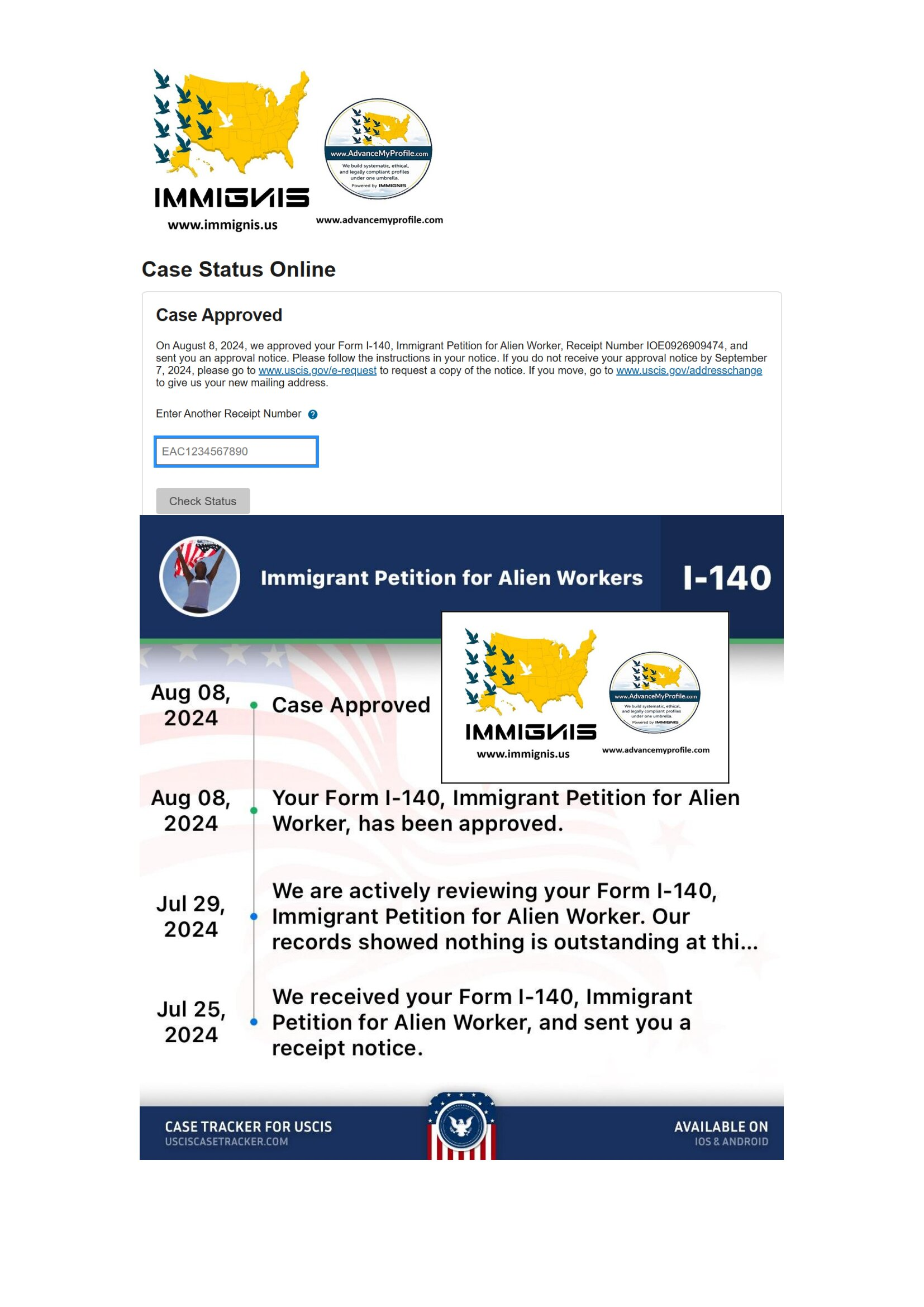
| Approval date | Approved on August 8, 2024. |
| Field niche | Formal verification for autonomous robots, with a focus on mathematically checking defined safety properties, robot decision logic, benchmark scenarios, and safety-critical autonomous behavior. |
| Starting problem | The research record was academically strong, but public recognition, judging evidence, and field facing proof of individual authority were limited. |
| Profile-building path | The record was developed through invited talks, peer review, standards participation, a safety white paper, media commentary, open benchmark datasets, selective membership elevation, and independent letters from robotics safety leaders. |
| EB-1A evidence presented | Scholarly articles, original contributions, published material, judging, and memberships. Standards participation and open benchmark evidence supported the wider final-merits record. |
On August 8, 2024, USCIS approved the Form I-140 petition of a Chinese EB-1A Robotics Safety Scientist working at a Canada based robotics laboratory.
His work was not difficult to describe inside a research group. He studied formal verification for autonomous robots: the use of mathematical methods to check whether a robot system satisfies defined safety properties under specified assumptions. The harder task was making that work visible as EB-1A evidence.
A strong academic record can still leave a petition exposed. Publications may show productivity. They do not automatically show sustained acclaim, field-level recognition, or original contributions of major significance. In this case, the petition had to show why this researcher had become a recognized authority in one precise part of robotics safety, not merely a capable scientist in a respected laboratory.
The science was strong. The public authority record was not yet complete
Before profile development, the record leaned heavily on research strength. It had technical depth, academic credibility, and a serious subject. What it lacked was a fully developed public record showing that the wider field relied on his judgment and could identify his contribution.
That weakness is common in robotics, artificial intelligence, and autonomous systems research. A scientist may work on safety-critical questions for years, but the evidence can remain scattered across papers, lab projects, datasets, internal evaluations, conference discussions, and letters from close collaborators. USCIS still needs a record that shows individual standing in the field.
Advance My Profile and Immignis approached the case by narrowing the professional identity. The client was not presented as a general robotics researcher, an AI scientist, or a machine-learning engineer. The petition focused on formal verification for autonomous robots, especially the question of how defined safety properties can be tested, checked, or reasoned about before autonomous behavior is trusted in real-world settings.
That narrower framing helped the evidence work together. Papers, benchmark datasets, invited talks, standards activity, peer review, and independent expert analysis all pointed to the same professional question: how can engineers make autonomous robot behavior more reviewable and safer before deployment?
Formal verification had to be explained without overstating it
Formal verification is powerful, but it is not magic. A petition that treated it as a guarantee of robot safety would have sounded careless. The stronger argument was more disciplined.
Formal verification can help engineers check defined properties against a model, specification, controller, or decision logic. It can test whether certain unsafe states are reachable under stated assumptions, whether a rule is always respected, or whether a system behaves consistently across modeled scenarios. The result depends on what was modeled, what assumptions were used, and where uncertainty remains.
For autonomous robots, that distinction matters. A robot may move through changing environments, react to uncertain sensor information, coordinate with other systems, or make timing-sensitive decisions. Safety cannot be reduced to one successful demonstration. Engineers need methods that expose where behavior has been checked, where assumptions sit, and where additional testing or runtime safeguards may still be needed.
The petition described the client as a scientist working on that verification problem. It did not claim that one algorithm or dataset could prove every robot safe. It showed a specialist whose work helped the field reason more rigorously about autonomous-system behavior.
What USCIS needed to see in a robotics safety EB-1A case
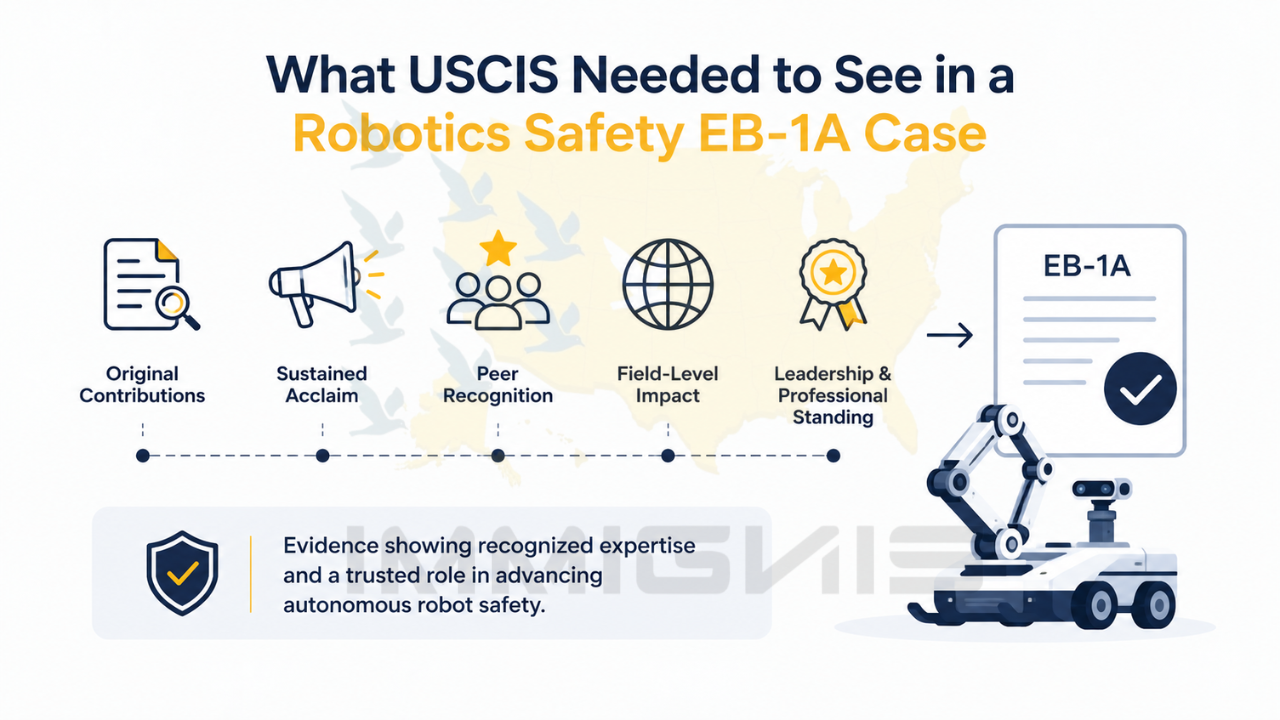
The EB-1A green card is a self-petition immigrant classification for individuals who can demonstrate extraordinary ability through sustained national or international acclaim and recognized achievements in their field. For this case, the central issue was not whether robotics safety is important. The issue was whether the record showed this scientist’s recognized role in that field.
For original contributions, the petition had to identify his verification methods, benchmark datasets, safety analysis work, or related research contributions and explain why they mattered beyond one laboratory. The evidence needed attribution, technical context, and independent explanation of significance.
For scholarly articles, the record needed focused authorship in formal verification, robotics safety, autonomous systems, or closely related technical subjects. A publication list becomes stronger when it shows a coherent specialty rather than isolated research activity.
For published material, the evidence had to be independent and relevant. Media commentary and coverage were useful where they connected him to robot safety, autonomous-system assurance, or the public importance of formal verification. Generic coverage of AI or robotics would not have carried the same weight.
For judging, the petition needed proof that he evaluated the work of other specialists. Peer review, technical program review, or other real assessment activity can support this criterion when the record documents the reviewing role and the field of work reviewed.
For memberships, the petition had to show that admission or elevation depended on professional achievement and expert assessment. Open enrollment or ordinary association membership was not treated as qualifying EB-1A evidence.
At final merits, all of the evidence still had to describe the same expert: a robotics safety scientist whose work in formal verification had drawn recognition beyond his immediate lab environment.
The record was rebuilt around the question engineers actually face
The technical record was reorganized around a practical safety question: what can be proven about autonomous robot behavior before the system is allowed to operate?
That question gave structure to the evidence. Research papers, benchmark datasets, talks, standards participation, and expert letters were not treated as separate achievements floating in the file. They were connected to the same safety problem.
The petition explained the types of decisions his work supported: defining safety properties, modeling robot behavior, examining reachable states, testing edge cases, comparing algorithms under controlled scenarios, and documenting when a system still required additional safeguards.
This structure also prevented the case from becoming too abstract. USCIS did not need to become a robotics laboratory. The petition needed to show the scientific problem, the client’s contribution, the evidence of recognition, and why experts considered the work significant.
Open benchmark datasets helped move the work outside one lab
The open benchmark datasets were important because they gave the field a way to examine the problem rather than simply hear that it mattered.
Benchmarks can serve several functions in robotics safety. They allow researchers to compare methods against common scenarios. They make assumptions more visible. They give other teams a structured way to test verification approaches, reproduce certain analyses, or identify where a method performs well and where it does not.
The petition documented the benchmark contribution carefully. It did not treat every access, download, or repository interaction as proof of major significance. Instead, the record focused on what the benchmarks were designed to test, how they related to autonomous-robot safety, and how outside use or attention helped show that the work had relevance beyond one laboratory.
Independent robotics experts could then evaluate the datasets as part of the original-contribution record. The benchmarks gave them something concrete to discuss: defined scenarios, verification questions, safety properties, and the research value of common test material.
The papers showed a coherent safety specialty
With the authority niche narrowed, his scholarly record became easier to understand. The papers were not presented as a general list of robotics publications. They were organized around formal methods, autonomous-system safety, verification logic, benchmark evaluation, and the limits of relying only on simulation or field trials.
One stream of work addressed how safety properties can be specified and checked. Another concerned benchmark scenarios and comparison of verification approaches. A third connected verification to autonomous robots operating under uncertainty or changing conditions.
That coherence mattered. In EB-1A adjudication, a publication record is stronger when it supports a defined field identity. The question is not only whether the applicant has published, but whether the record shows recognized expertise in a specialty where the applicant’s contribution can be identified and evaluated.
Invited talks made the verification problem public
Invited talks helped show that other professionals wanted to hear his judgment on robotics safety. The strongest speaking evidence did not merely list event names. It explained the subject, audience, and connection to the field niche.
His talks addressed practical questions that robotics researchers and safety engineers face: what can be proven from a model, what cannot be proven, how benchmark scenarios should be selected, and how verification evidence should be interpreted when autonomous systems interact with uncertain environments.
The speaking record was useful because it placed him in front of audiences concerned with autonomous-system safety. It also showed that the profile was no longer confined to journal pages. His expertise was being requested in professional settings where other specialists could question and evaluate the work.
Standards participation supported recognition, but it was not overstated
Standards participation can be valuable in a robotics safety case, but it must be described accurately. The petition documented his actual role, the subject of the standards-related work, and the technical relevance of his participation.
This activity was not presented as a separate EB-1A criterion. Instead, it supported the broader recognition record and helped show that his safety judgment was entering professional discussions beyond one research group.
That approach was important. USCIS is more likely to trust evidence that is precise. A working-group role, technical comment, or standards-related contribution should be documented for what it is. It should not be inflated into a claim that the person set industry policy unless the record actually proves that.
Peer review and technical evaluation filled the judging gap
The starting record needed stronger judging evidence. Publications alone could not solve that issue. The petition therefore documented how the client evaluated work by other researchers and technical specialists.
Peer review supported the judging criterion where journals, conferences, or technical venues asked him to assess manuscripts, submissions, methods, benchmark claims, verification logic, or robotics safety arguments. These activities showed that the field relied on his technical judgment, not only his own publications.
The file separated genuine review from weaker evidence. Being invited to attend an event, joining a mailing list, or appearing on a program page would not automatically establish judging. The record focused on actual evaluation activity and the subject matter reviewed.
Media commentary translated a technical field without making it simplistic
Autonomous robot safety can attract exaggerated public discussion. The media evidence in this case worked because it avoided hype.
His commentary helped explain why robot safety cannot depend only on demonstrations that appear successful. A robot may perform well in visible test conditions while still leaving unanswered questions about edge cases, specifications, model assumptions, or behavior under combinations of events not yet tested.
The coverage connected him to formal verification and safety assurance. It also made the field understandable to a wider audience without claiming that verification replaces engineering judgment, physical testing, or runtime monitoring.
Selective membership evidence was tied to the actual advancement standard
Membership evidence was handled the same way as the rest of the case: carefully and specifically.
The petition documented the selective membership or elevation process, the professional achievement standard involved, and the evidence showing that advancement required more than payment or ordinary registration. That made the membership evidence useful as part of the wider recognition record.
The value of the membership evidence came from fit. It supported the same profile shown elsewhere in the petition: a scientist recognized for robotics safety, formal verification, and autonomous-system assurance.
Independent letters explained significance without repeating the resume
The independent letters were strongest where they analyzed the technical contribution. They did not merely state that the applicant was talented or that robotics safety is important.
Robotics safety leaders explained why formal verification matters, why benchmark datasets can help the field compare methods, and why his work was relevant to the safety analysis of autonomous systems. They also helped distinguish his contribution from routine participation in a lab project.
This distinction is critical in EB-1A cases. A respected institution can create a strong environment, but USCIS still needs evidence of the individual’s own recognized contribution. Independent experts helped show that the field could see the scientist, not only the laboratory around him.
How the EB-1A evidence worked together
The final petition did not depend on one impressive item. It worked because the record became coherent.
- Original contributions: Verification methods, open benchmark datasets, documented research contributions, and independent expert analysis supported the claim that his work mattered in autonomous system safety.
- Scholarly articles: Focused publications connected his authorship to formal verification, robotics safety, benchmark evaluation, and autonomous systems research.
- Published material: Media coverage and commentary connected him to the public and technical discussion of autonomous robot safety.
- Judging: Peer review and technical evaluation records showed that journals, conferences, or professional venues relied on his assessment of other specialists’ work.
- Memberships: Selective membership or elevation evidence supported recognition where admission or advancement depended on professional achievement and expert assessment.
The case also used standards participation, invited talks, and independent letters to strengthen the final merits picture. Those materials helped USCIS see not only a productive researcher, but an autonomous systems safety scientist with a recognized role in a narrow technical specialty.
Why the approval matters for robotics and AI safety professionals
USCIS approved the Form I-140 on August 8, 2024. The online case history showed that the petition was received in late July, moved into active review, and was then approved.
The broader lesson is not that every robotics researcher with publications qualifies for EB-1A. The lesson is that a strong technical record must be organized around the right professional question.
For autonomous systems professionals, that question may be hidden inside verification methods, safety cases, benchmark datasets, runtime assurance work, standards activity, or internal validation efforts. Those materials can be powerful, but only when the petition shows attribution, recognition, and significance beyond routine employment or ordinary academic productivity.
This case succeeded by presenting formal verification for autonomous robots as a safety-critical contribution that the field could identify, test, discuss, and rely upon. It converted academic strength into a public authority record.
What this case teaches future EB-1A applicants
Robotics and AI safety applicants should not assume that technical difficulty speaks for itself. USCIS does not approve a case because a field is complex. The petition must explain what the applicant contributed, why the work matters, and how the field has recognized the applicant’s expertise.
Applicants should also be careful not to oversell safety claims. A disciplined record is often stronger than an exaggerated one. Formal verification, benchmark datasets, standards work, and media commentary should be tied to what they actually prove.
The best EB-1A robotics cases often show a pattern: a clear specialty, public authorship, independent recognition, evaluation of other specialists’ work, evidence of adoption or use, and expert analysis explaining why the contribution matters. When those elements point to the same professional identity, the petition becomes much easier to understand.
Frequently asked questions
Can formal verification research support an EB-1A case?
Yes, formal verification research can support an EB-1A case when the record shows original contributions, recognized expertise, and significance in the field. The petition should explain the properties being checked, the systems or models involved, and why other experts consider the work important.
Are publications enough for a robotics safety EB-1A petition?
Publications can be important, but they are rarely enough by themselves. USCIS will still evaluate the quality of the record, the applicant’s role, citations or recognition where relevant, judging activity, independent expert support, and whether the evidence as a whole shows sustained acclaim.
Can open benchmark datasets count as original contributions?
They can help support an original-contribution argument when the datasets are attributable to the applicant, address a meaningful field problem, and show outside use, evaluation, or significance. The petition should avoid treating basic repository activity as automatic proof of major significance.
Does standards participation qualify as an EB-1A criterion?
Standards participation is not a standalone EB-1A criterion, but it can support the broader record when it shows technical recognition, field involvement, or reliance on the applicant’s expertise. The applicant’s actual role must be documented accurately.
What is the main risk in an autonomous-systems EB-1A case?
The main risk is presenting the applicant too broadly. A general robotics or AI profile may look impressive but unfocused. A stronger petition usually identifies the specific safety, verification, control, perception, or assurance problem the applicant is known for solving.
Build an EB-1A record around the safety problem your work actually solves
If you work in robotics, autonomous systems, AI safety, formal verification, runtime assurance, or safety critical software, your strongest evidence may be spread across publications, datasets, standards work, review activity, and internal validation records.
Immignis and Advance My Profile help professionals identify a defensible authority niche, develop credible public evidence, document original contributions, and prepare an EB-1A record around evidence that can be verified and defended professionally.