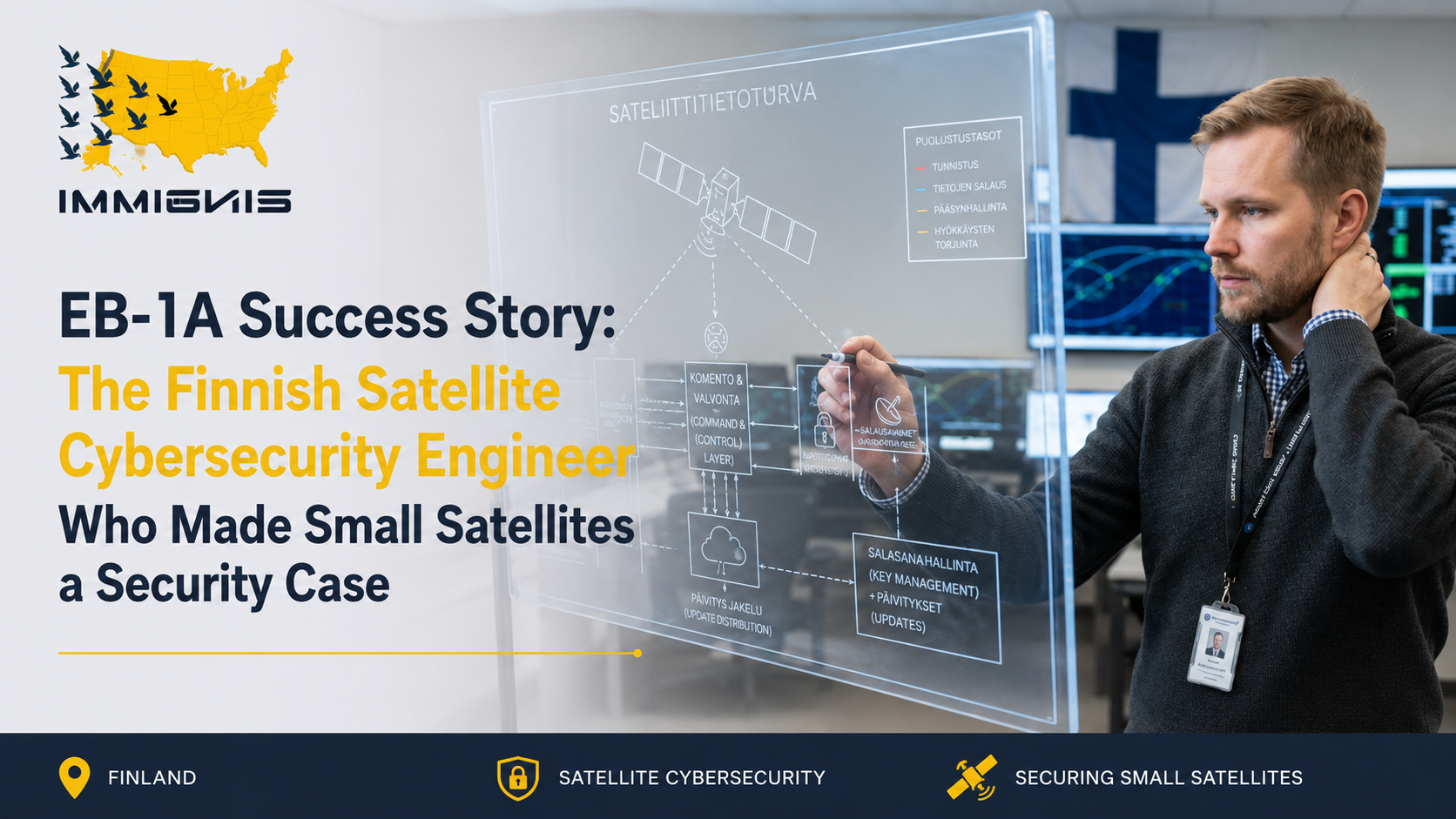
How a space-technology specialist turned threat modeling, standards work, and peer recognition into an EB-1A approval
Key facts at a glance
| Outcome | EB-1A approval for a Finnish satellite cybersecurity engineer working with a Finland-based space technology firm. |
| Approval date | Approved on May 12, 2026. |
| Field niche | Cybersecurity frameworks for small-satellite constellations, with a focus on threat modeling, command protection, ground-segment security, secure operations, and constellation-level resilience. |
| Starting weakness | The specialty was emerging, and the early record did not clearly show that his work mattered beyond one project or one employer. |
| Profile-building path | Advance My Profile, powered by Immignis, built a space-cyber authority record through publications, a threat-model framework, a white paper for space-security stakeholders, conference committee service, media commentary, peer review, selective membership, and independent letters. |
| Evidence presented under EB-1A criteria | Scholarly articles, original contributions, published material, judging, and memberships. |
| Approval focus | The petition showed that cybersecurity for small-satellite constellations was a recognized technical contribution with relevance to satellite infrastructure, mission assurance, and national security concerns. |
On May 12, 2026, USCIS approved the Form I-140 petition in this EB-1A Satellite Cybersecurity Engineer case. The beneficiary was a Finnish satellite cybersecurity engineer working with a Finland-based space technology firm.
The approval did not rest on the idea that space technology is automatically important. The petition had to do more than mention satellites, cybersecurity, and national security in the same sentence. It had to show a defined technical specialty, an identifiable contribution, and recognition that reached beyond one company project.
That specialty was cybersecurity frameworks for small-satellite constellations.
Small satellites have changed how space systems are designed and deployed. A constellation can involve many spacecraft, multiple ground interfaces, software-defined operations, frequent updates, partner integrations, and data paths that move between space, ground stations, cloud environments, and mission users. The cybersecurity problem is not one locked server or one spacecraft. It is the full operating chain.
That was the point the petition needed to make clearly. His work was not ordinary software security. It concerned how small-satellite systems can be modeled, protected, reviewed, and operated when the mission depends on many connected components.
The field was emerging, but the petition still needed proof
Emerging fields can create difficult EB-1A records. The work may be technically advanced, but public recognition can lag behind the technology. Standards may still be developing. Many of the best documents may be internal, export-sensitive, customer-sensitive, or tied to confidential system designs.
That was the starting weakness in this case. His professional work was meaningful, but the early evidence risked looking like specialized engineering inside one space company. The record needed to show why the contribution belonged to a field, not merely to a project.
Advance My Profile, powered by Immignis, reviewed the available evidence with legal strategists and space-cybersecurity specialists. The first task was to narrow the profile. The petition could not simply call him a cybersecurity engineer, a satellite engineer, or a space-technology professional. Those labels were too broad.
The field was defined around cybersecurity frameworks for small-satellite constellations. That phrase gave the case a technical center: threat modeling, secure command paths, ground-segment risk, software update governance, mission data protection, incident response, and resilience across a distributed constellation.
Why small-satellite cybersecurity is different from ordinary IT security
A small-satellite constellation has security questions that do not map cleanly onto a typical enterprise network. A command path may involve mission operations, ground infrastructure, spacecraft software, communication windows, third-party services, and operational constraints that make immediate intervention difficult.
A threat model for this environment must consider what happens before launch, during commissioning, during routine operations, during software updates, and when the system is operating with limited contact windows. A weak access control, a poorly reviewed update process, a compromised ground interface, or an untested operational assumption can become a mission problem.
The petition used that context to explain why his work mattered. The record did not claim that he personally secured every satellite system. It identified the technical framework he developed and the way that framework helped teams analyze threats and controls across a constellation environment.
That discipline was important. EB-1A cases become weaker when they rely on sweeping claims. The stronger approach is to show the problem, the method, the evidence of use or recognition, and the reason independent experts consider the contribution significant.
The threat-model framework became the center of the case
The strongest evidence stream concerned his threat-model framework. It organized satellite-cybersecurity review around the parts of a constellation that an attacker or operational failure could exploit: ground systems, command authorization, telemetry handling, software updates, payload data paths, cloud interfaces, supply-chain components, and mission-operations workflows.
The framework helped translate a broad question, “Is the satellite system secure?” into more specific questions. Which system can send a command? Which user or service can modify an update package? Which link carries mission data? Which interface connects to third-party infrastructure? What happens if a ground segment is unavailable or suspected of compromise?
Those questions made the record concrete. They also made the petitioner visible. Instead of presenting him as one engineer inside a space company, the petition showed an attributable method for reviewing cyber risk in small-satellite constellations.
The public version avoided protected system diagrams, customer names, proprietary security controls, and operational details that should not be disclosed. It still gave USCIS enough to understand the contribution.
What USCIS needed to see in a satellite cybersecurity EB-1A case
For original contributions, the petition had to identify the petitioner’s own framework, technical method, tool, or security architecture and explain why it had significance beyond a routine job assignment. Internal importance alone was not enough.
For scholarly articles, the record needed focused authorship connected to satellite cybersecurity, threat modeling, small-satellite operations, mission assurance, or related technical subjects. A publication list without a coherent specialty would have made the case harder to evaluate.
Published material required independent coverage about him or his expertise, not only articles he wrote himself. Judging evidence required actual evaluation of other specialists’ work through peer review, conference review, or comparable professional review activity.
Membership evidence required a selective standard tied to achievement or expert assessment. Ordinary open membership was kept separate. At final merits, the evidence still had to show that the record as a whole reflected sustained acclaim and a high level of expertise in the defined field.
The publications gave the field a public technical record
The publications were not written as general space-industry commentary. They addressed the technical problems that appeared across his work: threat modeling for distributed spacecraft systems, secure ground-segment operations, authentication of command pathways, cyber risk in mission software updates, and resilience when a constellation depends on several connected systems.
One article examined why a small satellite can be physically small but operationally complex from a cybersecurity perspective. Another addressed the risk created when mission software, ground infrastructure, cloud services, and partner systems are treated as separate security domains even though an attacker may move through the connections between them.
This authorship helped solve the public-evidence problem. It gave the petition a way to show expertise without publishing confidential system information. It also helped independent experts discuss his contribution using a public technical record rather than relying only on internal employer documents.
The white paper connected space cybersecurity to mission assurance
The white paper was written for space-security stakeholders, satellite operators, mission planners, and technical leaders who needed a practical way to think about small-satellite security. It did not try to turn the article into a classified or proprietary security manual.
Instead, it organized the subject around threat modeling, command authority, ground infrastructure, software updates, monitoring, incident response, and resilience. The paper explained why cybersecurity has to be considered as part of mission assurance, not as a separate checklist completed after the system is already designed.
That point was central to the EB-1A case. His work mattered because a satellite mission can fail from more than a hardware defect. It can fail because an attacker, access error, update failure, or weak operational assumption disrupts the ability to command, monitor, or trust the system.
The white paper helped show that the petitioner was not only participating in technical work; he was shaping a field conversation about how small-satellite constellations should be secured.
Conference committee work and peer review showed trusted technical judgment
Judging evidence came from peer review, conference review, and committee service where the petitioner evaluated work produced by other specialists. The record identified the venues, subjects, and review activity that could be documented.
That evidence mattered because cybersecurity expertise is not shown only by building systems. It can also be shown when journals, conferences, or technical bodies ask a professional to evaluate the work of others. In this case, the review activity involved space systems, cybersecurity, software assurance, threat modeling, and related engineering topics.
The petition did not treat every invitation as equally important. It distinguished between speaking, committee service, peer review, and actual judging of other professionals’ work. That avoided a common weakness in EB-1A filings, where different forms of professional participation are blurred together.
Media commentary made a niche problem understandable
The published material and media commentary helped translate the field for a broader audience. Small satellites are often discussed in terms of launch cost, Earth observation, communications, or innovation speed. The cybersecurity issue is less visible.
His commentary explained that the security of a constellation depends on software, ground systems, command channels, user access, monitoring, and the ability to respond when something behaves unexpectedly. A satellite may be in orbit, but many of the vulnerabilities begin on the ground.
That coverage helped establish independent attention to his expertise. It also supported the petition’s broader point: cybersecurity frameworks for small-satellite constellations have significance because satellite infrastructure can support communications, sensing, emergency response, and security-sensitive operations.
Selective membership evidence strengthened the recognition record
Membership evidence was handled with care. The case relied on selective membership or elevation where the record showed professional achievement, expert assessment, or a meaningful admission standard. It did not inflate routine association membership into extraordinary recognition.
For a technical space-cyber case, this distinction was important. The membership evidence had to reinforce the central story: the petitioner was recognized as a specialist in a demanding technical area, not simply enrolled in a professional group.
Combined with publications, peer review, committee service, media commentary, and independent letters, the membership evidence helped show a professional record that extended beyond the employer.
Independent experts explained why the work mattered beyond one project
Independent letters were essential because the field is technical and still developing. The letters did not merely say that the petitioner was talented. They explained the problem his work addressed, the framework or method linked to him, and why small-satellite cybersecurity is significant for modern space infrastructure.
Space-security and cybersecurity leaders discussed how threat modeling, command-path protection, ground-segment security, update governance, and resilience planning can affect mission reliability. They also explained why the petitioner’s work had value beyond one employer or one constellation.
This was the difference between praise and evidence. Praise says a person is excellent. Evidence explains what the person contributed, how others recognize it, and why the contribution matters in the field.
How the EB-1A evidence came together
The approved record worked because the evidence described the same specialist from several directions.
The scholarly articles gave him a public technical voice in satellite cybersecurity. The threat-model framework identified an original contribution. The white paper connected the work to space-security stakeholders. Media commentary gave independent public attention to his expertise. Peer review and conference committee activity supported judging and trusted professional assessment. Selective membership evidence strengthened recognition. Independent letters explained why the work had significance beyond one project.
Together, those pieces addressed the starting weakness. The petition no longer asked USCIS to infer extraordinary ability from participation in an emerging industry. It showed a specific professional niche and a record of recognition built around that niche.
Why the approval matters for space and cybersecurity professionals
This case is useful for professionals working in fields where the best evidence is often hidden inside technical systems. Space cybersecurity, satellite engineering, defense-adjacent software, cloud-enabled mission operations, secure communications, and autonomous infrastructure all create similar documentation problems.
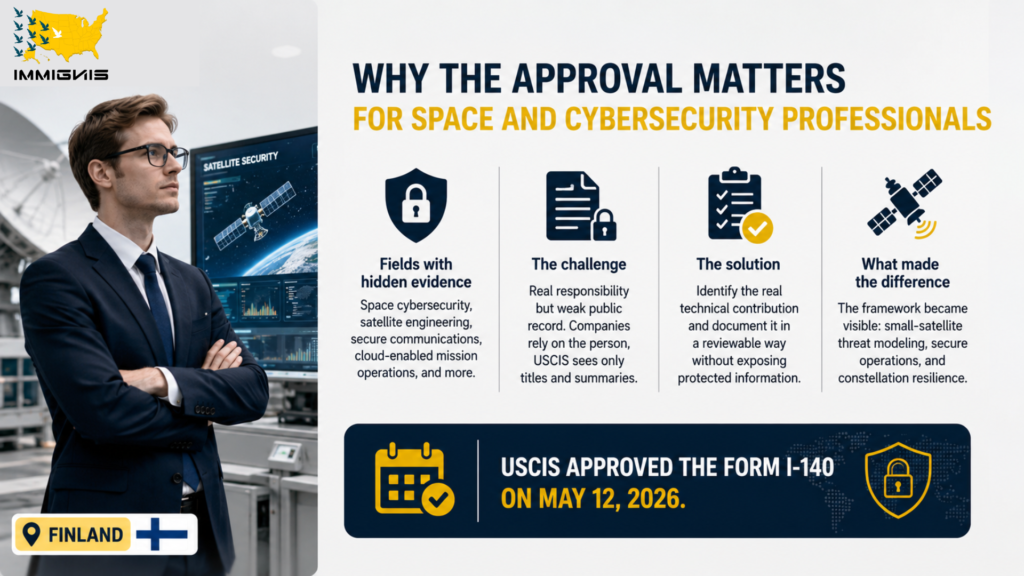
A person may have real responsibility and still have a weak public record. A company may rely on the person heavily, while USCIS sees only a job title and project summaries. The solution is not to exaggerate the work. The solution is to identify the real technical contribution and document it in a form that can be reviewed without exposing protected information.
For this Finnish satellite cybersecurity engineer, that meant making the framework visible. Once the record showed how his work addressed small-satellite threat modeling, secure operations, and constellation resilience, the petition could present a coherent extraordinary-ability case.
USCIS approved the Form I-140 on May 12, 2026.
Frequently asked questions
Can satellite cybersecurity support an EB-1A petition?
Yes, where the evidence shows a defined field, an identifiable technical contribution, and recognition beyond ordinary employment. The case should explain the petitioner’s work in threat modeling, secure architecture, mission assurance, software security, or related space-cyber methods.
Can confidential space-technology work be used in EB-1A?
Yes, but it must be documented carefully. A petition can use non-confidential technical summaries, public authorship, white papers, peer review, conference activity, expert letters, and other evidence without exposing protected system architecture or customer details.
Does conference committee service count as judging?
It can support judging when the evidence shows actual evaluation of other professionals’ work, such as reviewing papers, technical submissions, or conference materials. Simple attendance or general participation should not be presented as judging.
Why is field definition important in an emerging specialty?
Emerging fields can sound impressive but vague. A narrow field definition helps USCIS understand what the petitioner is known for and how the evidence fits together. In this case, the record focused on cybersecurity frameworks for small-satellite constellations rather than general cybersecurity or general space technology.
What is the biggest mistake in a space-cyber EB-1A case?
The biggest mistake is relying on the importance of space infrastructure without proving the petitioner’s own recognized contribution. EB-1A requires evidence about the individual, not only the industry.
Build an EB-1A record around the technical security work others cannot easily see
If you work in satellite cybersecurity, space systems, mission assurance, secure software, cloud-enabled infrastructure, defense-adjacent technology, or critical communications, your strongest work may be inside internal threat models, review boards, operational frameworks, or protected technical documents.
Immignis and Advance My Profile help professionals identify a defensible authority niche, document individual contributions, build credible recognition, and prepare an EB-1A record around evidence that can be verified and professionally defended.