Key facts at a glance
| Outcome | EB-1A approval for a Thai aquaculture disease researcher working in a Thailand based university laboratory. |
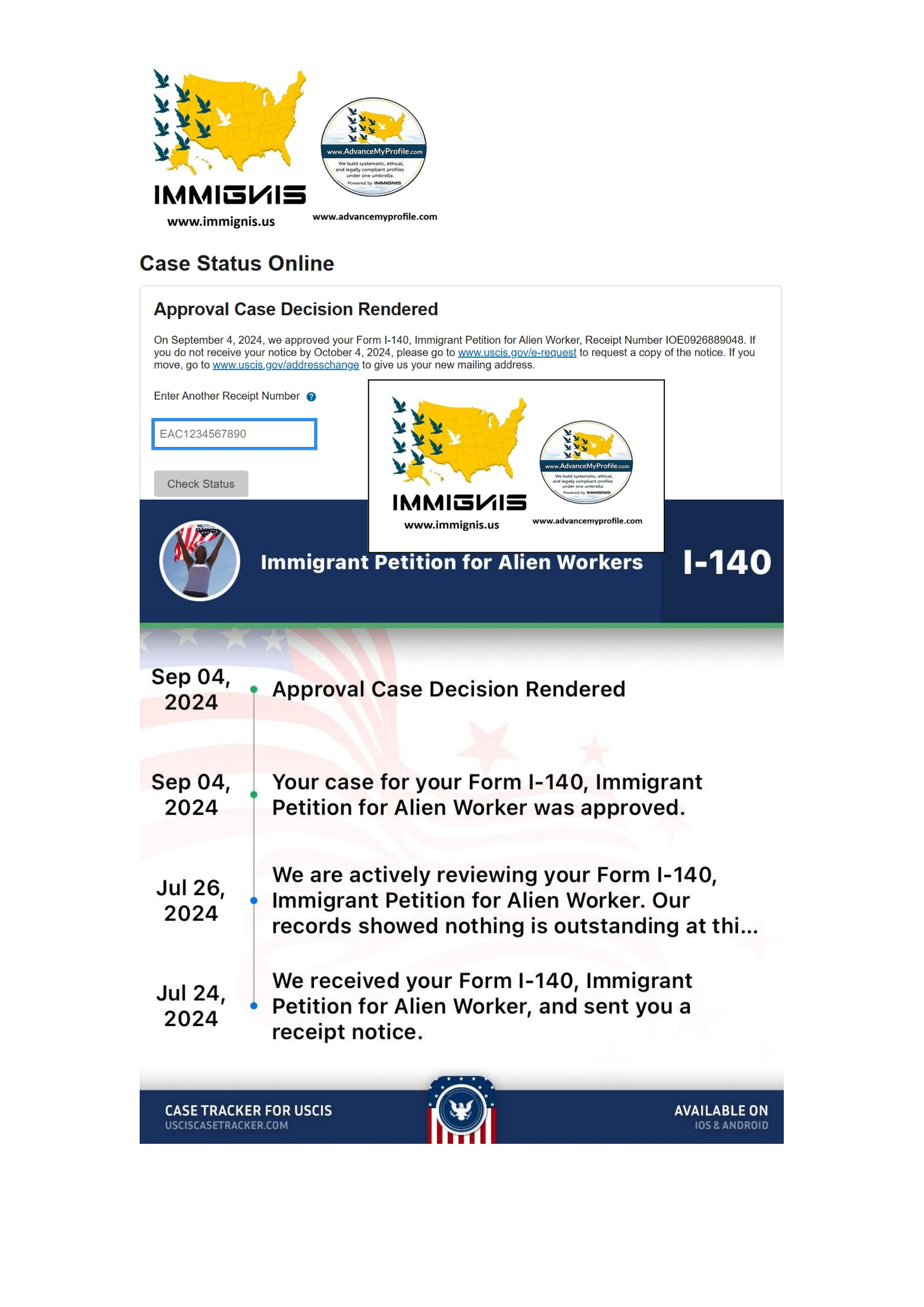
| Approval date | Approved on September 4, 2024. |
| Field niche | Early disease detection and surveillance in sustainable shrimp aquaculture, with a focus on recognizing risk signals early enough to trigger sampling, review, and diagnostic action. |
| Starting problem | His research had strong regional relevance, but the public record did not show sustained international recognition or a clear personal authority niche in shrimp disease surveillance. |
| Path used | Ethical EB-1A profile building through focused disease-surveillance papers, diagnostic protocol adoption evidence, a seafood-sustainability white paper, trade-media coverage, conference talks, peer review, selective professional membership, and independent aquatic-animal-health letters. |
| USCIS EB-1A criteria activated | Scholarly articles, original contributions, published material, judging, and memberships. |
USCIS approved his Form I-140 on September 4, 2024.
This EB-1A success story began with a shrimp pond that did not look sick.
That was the problem. This EB-1A shrimp disease researcher case had no dramatic mortality event to point at. The useful clues were quieter: changes in feeding behavior, pond observations, the pattern of emerging signs, and the question of when surveillance should move from routine monitoring to targeted sampling and diagnostic review.
He was a Thai aquaculture disease researcher working in a university laboratory. His work focused on early disease detection in shrimp aquaculture.
Why did strong shrimp-disease research still look too regional for EB-1A?
The strongest projects were connected to regional production problems. Diagnostic work, surveillance discussions, and laboratory experience appeared across separate files. International readers could see an active researcher, but they could not immediately identify the professional question he was known for answering.
The EB-1A green card is a self-petition immigrant classification for individuals who can demonstrate extraordinary ability through sustained national or international acclaim and recognized achievements in their field.
Advance My Profile, powered by Immignis, reviewed the work with legal strategists and aquaculture domain specialists and narrowed the profile to early disease detection and surveillance in sustainable shrimp aquaculture.
What exactly was his aquaculture niche?
Shrimp health teams may observe changes in pond conditions, feeding response, behavior, mortality pattern, or visible signs. Those observations do not automatically establish a diagnosis. They can still help determine when routine monitoring should become targeted investigation.
The evidence was organized around surveillance indicators, sampling triggers, the sequence of review, and the relationship between field observations and later diagnostic work. The focus stayed on making early disease suspicion more systematic and actionable.
The petition did not claim that an observation checklist could replace validated diagnostic testing. His contribution concerned how early warning information was structured and used to support timely sampling and disease-control decisions.
What would USCIS need to see in a shrimp aquaculture EB-1A case?
At the first stage, the petition had to present evidence under the applicable USCIS EB-1A criteria. At final merits, USCIS could examine the quality of that evidence and whether the whole record showed sustained acclaim and top-level expertise.
For original contributions, the file needed to identify the researcher’s own surveillance methods, protocol work, or disease detection framework and explain why the contribution had major significance in the field. A local farm problem by itself could not carry that argument.
Scholarly articles needed a consistent disease surveillance subject. Published material required independent coverage about him or his expertise. Peer review supported judging only where he actually evaluated work produced by other researchers.
The memberships criterion required a selective admission or advancement process based on professional achievement and expert assessment. Ordinary open enrollment was kept separate.
How was the regional research record rebuilt around one disease surveillance method?
Research records, diagnostic materials, field-surveillance descriptions, protocol drafts, laboratory roles, and non-confidential adoption evidence were grouped by the decision they supported.
What changes should trigger closer review? When should a field observation lead to targeted sampling? Which information needs to travel with a sample? How should surveillance findings be documented so that farm teams and diagnostic personnel are working from the same event history?
One evidence stream concerned early warning indicators. Another covered sampling and escalation. A third showed how the protocol connected field surveillance with diagnostic follow-up.
The peer-reviewed papers stopped treating disease surveillance as a side topic
With domain support, he developed focused papers on shrimp disease surveillance, early warning signals, field-to-laboratory information flow, and the timing of sampling or diagnostic escalation.
One paper examined how several weak field indicators may become more useful when interpreted together instead of waiting for one dramatic sign. Another addressed the value of consistent event documentation when farm observations are followed by diagnostic testing.
Aquaculture researchers often have years of useful field and laboratory work spread across local disease projects. A free EB-1A profile assessment can identify the technical question that links those projects and show where authorship, judging, membership, adoption evidence, or international recognition still needs development.
Why did diagnostic protocol adoption matter so much?
The diagnostic-surveillance protocol organized observation, event documentation, sampling triggers, sample handling information, and escalation for diagnostic review. It was designed to help farm and health teams move from concern to a defined next step.
The record traced the problem, the method linked to the researcher, and the part of the surveillance process that changed. Adoption was documented according to the evidence available; the story did not invent farm counts, disease reductions, or economic savings that the records could not prove.
For the original-contribution argument, the protocol gave USCIS a concrete method to evaluate. Independent aquatic-animal-health experts could discuss why structured early warning and sampling decisions matter in disease surveillance.
What did the seafood sustainability white paper add to the record?
Written for seafood sustainability and aquaculture stakeholders, it explained why disease-control systems depend on the timing and quality of information moving from production sites to technical and diagnostic teams.
The paper covered surveillance consistency, early warning, documentation, sampling decisions, and the value of responding before a farm has lost every practical control option.
It also kept the claims disciplined. Early detection cannot guarantee that an outbreak will be prevented, and a surveillance protocol is not a substitute for validated diagnostic methods or appropriate disease-management decisions.
How did trade media turn a laboratory subject into an industry conversation?
He explained why obvious mortality is a late signal for many operational decisions. He also explained the danger of treating every feeding change or pond observation as proof of disease.
The useful work happens between those extremes: collect information consistently, understand the farm history, identify patterns that justify closer review, and use appropriate sampling or diagnostic steps.
What happened when he explained the protocol to other aquaculture specialists?
He presented surveillance scenarios involving changes in feeding response, emerging signs, unusual mortality patterns, and uncertainty about when diagnostic investigation should begin.
Audience questions focused on timing, sampling, false alarms, incomplete farm records, and the risk of acting on one observation without context.
The talks were documented as speaking and professional recognition. Judging evidence came from peer review, where he evaluated research produced by other specialists.
How did peer review create genuine judging evidence?
Journals and technical venues invited him to review work in aquaculture health, shrimp disease, diagnostics, surveillance, and related aquatic-animal fields.
The reviewed research required him to assess study methods, disease claims, sampling logic, diagnostic interpretation, and whether conclusions followed from the evidence.
Mass invitations and weak review opportunities were not used to manufacture a judging record.
Why was selective professional membership handled separately?
Advance My Profile reviewed the rules for the relevant aquaculture or aquatic-animal-health professional grade, the achievements considered, and the expert assessment used in admission or advancement.
What did independent aquaculture disease experts say about his contribution?
The strongest letters began with the practical disease control problem. Production teams often need to decide when ordinary variation has become serious enough to justify targeted sampling, specialist review, or escalation.
They explained why consistent early warning, event documentation, and field to laboratory information flow can improve the quality and timing of disease investigation.
For USCIS, the international letters helped show that his expertise was recognized as relevant to the wider aquaculture disease field, not only to one regional research setting.
How did the USCIS EB-1A criteria come together in this aquaculture case?
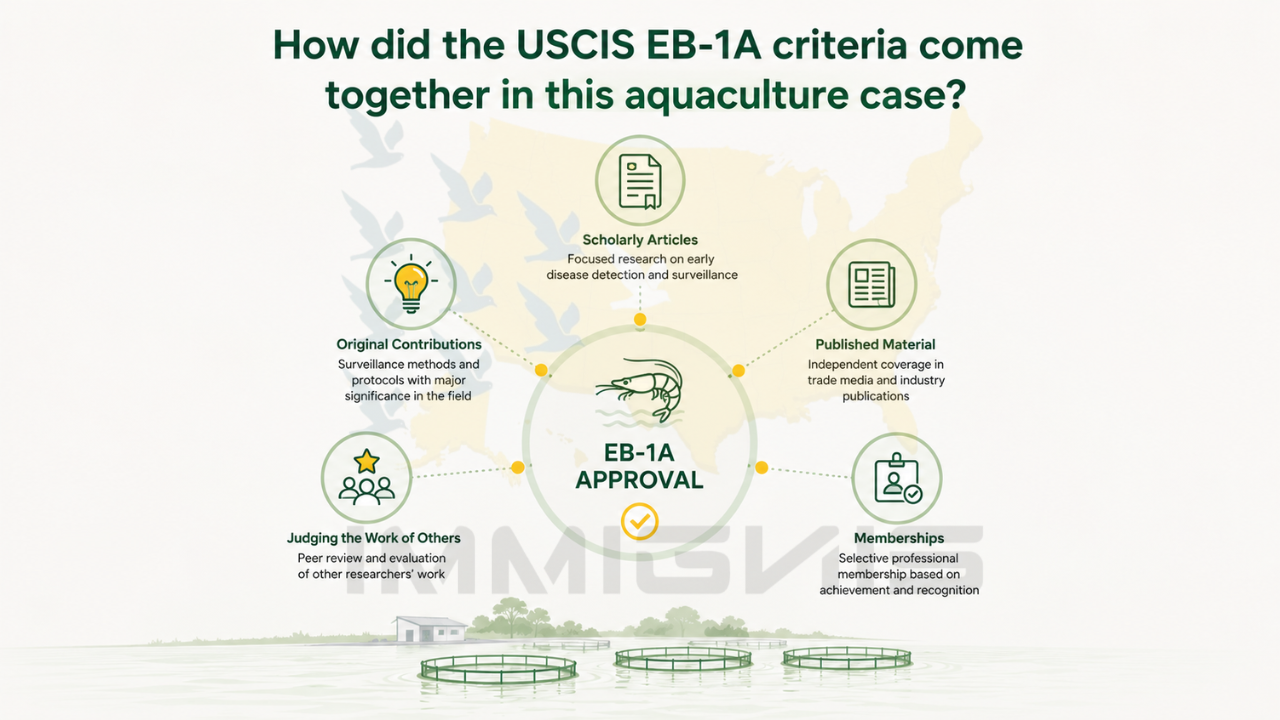
Scholarly articles: Focused peer-reviewed papers connected his authorship to shrimp disease surveillance, early warning, sampling decisions, and field to laboratory information flow.
Original contributions: The diagnostic surveillance protocol, adoption evidence, focused research, and independent aquatic-animal-health letters explained his individual contribution and its significance in early disease detection.
Published material: Independent aquaculture and seafood industry coverage discussed him or his expertise in shrimp disease detection and surveillance.
Judging the work of others: Peer-review records documented genuine evaluation of research by other specialists in aquaculture health, diagnostics, surveillance, and allied aquatic animal fields.
Memberships: Selective professional membership evidence included the applicable admission or advancement standards and documentation of expert assessment based on professional achievement.
The papers defined the research question. The protocol showed a method. Adoption evidence showed use. The white paper and trade media carried the subject into seafood and sustainability discussions. Conference talks, peer review, selective membership, and independent letters documented professional recognition.
What did the September 4, 2024 EB-1A approval mean?
The approved EB-1A petition gave him a self-petition immigration path without employer sponsorship or labor certification. The Form I-140 filing established a priority date for the immigrant petition, while later permanent-residence timing can depend on visa availability and the applicant’s next immigration step.
If your strongest research is important locally but almost invisible internationally
Maybe your work concerns disease surveillance, sampling, diagnostics, biosecurity, water quality, feed response, or farm-health decision systems. Define the question closely enough that another specialist can see your method and evaluate it.
Document protocol use honestly. Publish around real scientific questions. Build judging through genuine peer review. Use memberships only when the admission or advancement standard supports the criterion. Ask independent experts to discuss work they can actually evaluate.
Do not build an aquaculture profile from fake awards, paid citations, junk journals, invented diagnostic accuracy, or disease control claims unsupported by data. A researcher should be able to defend the record to USCIS, a laboratory director, a journal reviewer, and an aquaculture health team.
FAQs
Can regional aquaculture research qualify for EB-1A?
Yes. EB-1A does not require that every achievement originate in the United States. The record still has to show extraordinary ability, sustained national or international acclaim, and qualifying evidence under the USCIS framework. Independent recognition and evidence that the work matters in the wider field can be especially important when most projects began in one region.
Can adoption of a shrimp disease-surveillance protocol support original contributions?
It can support an original contribution claim when the protocol is attributable to the petitioner and the evidence helps show major significance in the field. Adoption records, technical documentation, focused publications, and independent expert analysis may help explain the contribution and how the method was used.
Is an early warning surveillance protocol the same as a shrimp diagnostic test?
No. An early warning protocol can help identify when observations or patterns justify closer review, sampling, or diagnostic action. A diagnosis may require validated laboratory or other appropriate diagnostic methods. Keeping that distinction clear makes the scientific and immigration record more credible.
Can peer review count as judging for an aquaculture researcher?
Genuine peer review can support the judging criterion when the researcher evaluates work produced by other specialists in the same or an allied field. The record should document the invitation and review activity, and the research subject should fit the reviewer’s expertise.
What kind of professional membership may help an EB-1A aquaculture case?
Membership may support the criterion when the relevant association or membership grade requires outstanding achievements and those achievements are judged by recognized experts in the field. Open dues-based membership normally does not establish that criterion by itself. The petition should include the actual admission or advancement rules.
Do I need a PhD to pursue EB-1A as an aquaculture disease researcher?
No specific PhD is required for EB-1A extraordinary ability. An aquaculture researcher may rely on applicable evidence such as original contributions, scholarly authorship, judging, published material, qualifying memberships, and sustained independent recognition. USCIS evaluates the full extraordinary ability record.
Build an EB-1A success story around the disease surveillance problem your research keeps solving
If you work in shrimp aquaculture, aquatic animal health, disease surveillance, diagnostics, biosecurity, or sustainable seafood systems, your strongest contribution may still be scattered across regional projects and laboratory files.
Immignis and Advance My Profile help identify a defensible scientific niche, document individual methods, build credible field recognition, and prepare an EB-1A record around evidence you can verify and defend professionally.
Start with a free EB-1A profile assessment and find out whether your aquaculture disease work can be developed into a clearer authority record.