Key facts at a glance
| Outcome | EB-1A approval for a Vietnamese smart manufacturing engineer working at a U.S.-based electronics manufacturer. |
| Approval date | Approved on August 13, 2024. |
| Field niche | Computer-vision quality control for electronics assembly, with a focus on visual defect detection, inspection reliability, false calls, and measurable manufacturing-quality improvement. |
| Starting problem | His implementation work was impressive, but almost all proof sat inside factory programs. Public authorship, independent recognition, judging, and evidence of field-level influence were thin. |
| Path used | Ethical EB-1A profile building through method papers, defect-reduction evidence, a manufacturing white paper, expert commentary, an invited technical workshop, professional award recognition, judging in manufacturing competitions, and independent industry letters. |
| USCIS EB-1A criteria activated | Original contributions, scholarly articles, published material, awards, judging, and leading or critical role. |
This EB-1A Smart Manufacturing Engineer success story began with a defect that could fit inside a camera frame and still cost a production line time, reinspection, and confidence.
To a rushed human glance, the assembly looked ordinary. The computer-vision model marked a small region for review. That was the point of the engineer’s work. The system did not need to sound intelligent. It needed to find a real manufacturing problem early enough for the factory to act.
He was a Vietnamese smart manufacturing engineer working at a U.S.-based electronics manufacturer. His strongest work involved computer-vision quality control for electronics assembly.
The factory could measure his work. The field could barely see it
He had deployed inspection methods, refined visual-quality processes, and helped improve defect control, but the evidence kept returning to company systems and production programs.
Computer-vision inspection depends on image conditions, defect definitions, labeling quality, lighting, process variation, false calls, missed defects, review thresholds, and where inspection sits in the manufacturing flow.
The EB-1A green card is a self-petition immigrant classification for individuals who can demonstrate extraordinary ability through sustained national or international acclaim and recognized achievements in their field.
Advance My Profile, powered by Immignis, reviewed his record with legal strategists and manufacturing domain specialists and narrowed the profile to computer-vision quality control for electronics assembly.
His specialty was not ‘AI in manufacturing.’ It was inspection reliability
His recurring problem was how to make visual inspection dependable enough for an electronics production environment. The evidence showed work on image capture, defect categories, labeling, model tuning, thresholds, false positives, missed defects, operator review, and the use of inspection results in quality decisions.
A model that flags everything creates reinspection burden, while a conservative model can allow defects to escape. Performance can also weaken when products, lighting, cameras, or process conditions change.
The petition described methods and measurable quality changes that could be attributed to him without disclosing protected product designs or confidential factory data.
What did USCIS need to see in this computer-vision EB-1A case?
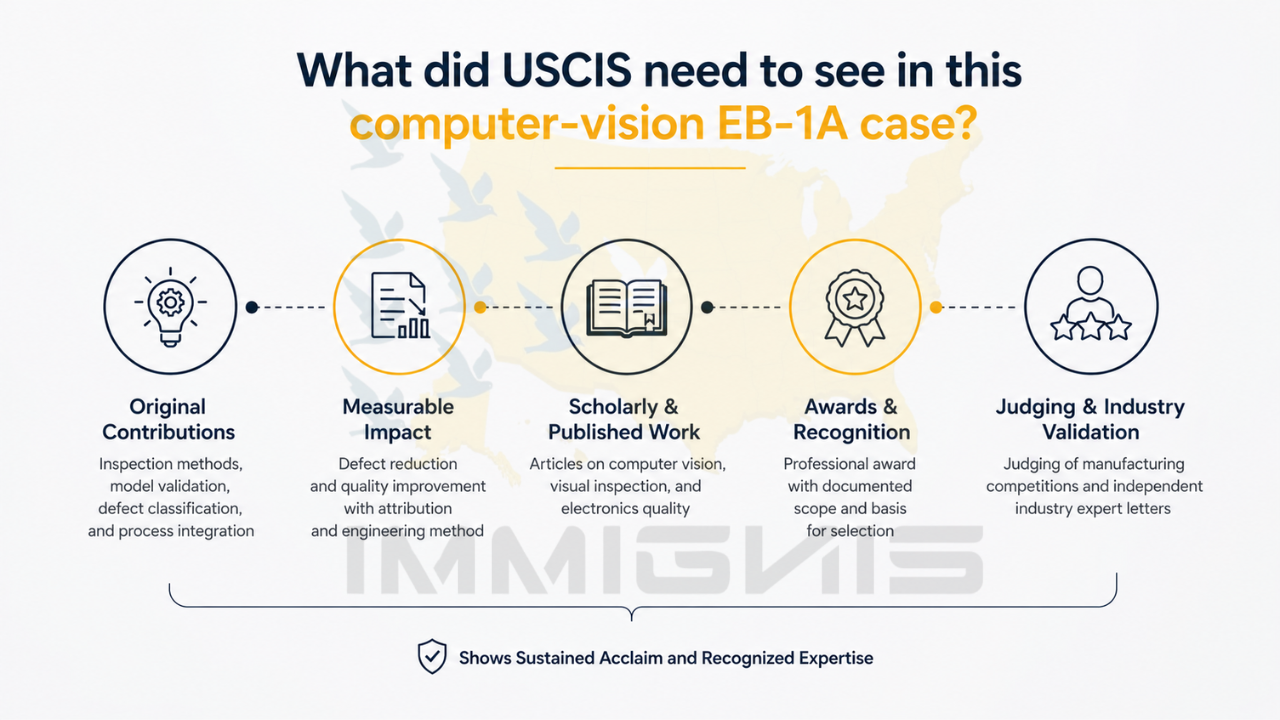
For original contributions, the petition identified his inspection methods, model-validation approach, defect-classification work, and process-integration decisions and explained why the contribution mattered beyond a routine job assignment.
Defect-reduction evidence could not stand alone. The record also needed attribution, the engineering method behind the change, and independent explanation of why the work mattered.
Scholarly articles addressed computer vision, visual inspection, and electronics quality. Published material required independent coverage about him or his work, and judging required actual evaluation of other specialists’ work.
Professional award evidence had to document genuine recognition, scope, and the basis for selection. A nomination or paid badge could not be presented as a qualifying prize.
Under the two-step review often associated with Kazarian, meeting regulatory criteria is only the first stage. Final merits still asks whether the evidence as a whole shows sustained acclaim and the level of expertise required for EB-1A extraordinary ability.
The internal evidence was rebuilt around the path from image to quality decision
Project summaries, quality documents, defect categories, validation records, and role evidence were grouped by engineering question.
What made an image usable? How was a defect class defined? What happened after a false call? Who reviewed the flagged image, and which manufacturing action followed?
A detection result could lead to operator review, process investigation, rework, or another quality step. That sequence showed how his work entered factory decisions.
Defect-reduction metrics were used only where program records supported them, without inventing percentages or claiming every quality improvement came from one algorithm.
The method papers examined why factory vision systems fail in ordinary conditions
With domain support, he developed papers on computer-vision inspection, defect classification, production-image variability, false-call management, and manufacturing-AI validation.
One paper examined why a high test score can be less informative when defect classes are rare. Another addressed how lighting, orientation, and process variation change a defect’s visual appearance.
Manufacturing engineers often have their strongest evidence buried inside quality systems, plant metrics, and confidential implementation programs. A free EB-1A profile assessment can identify which methods and measurable results are attributable to you and where authorship, judging, awards, media, or independent recognition still needs development.
The quality metrics were documented without turning correlation into a claim of causation
The manufacturing evidence showed measurable quality improvement associated with inspection and defect-control work in which he had a documented technical role.
Advance My Profile traced each metric to the relevant process, his role, and the supported change in method.
Where several process changes occurred together, the petition did not claim that computer vision alone produced the full result.
The evidence explained the method’s contribution to earlier identification, more consistent review, lower escape risk, or improved quality decisions, according to the records available.
The manufacturing white paper dealt with the gap between a model demo and a production inspection system
A computer-vision model can perform well in a demonstration and still struggle when lighting changes, products vary, rare defects are hard to label, and operators must act on model output.
The paper covered image conditions, defect taxonomy, dataset preparation, validation, false calls, human review, process feedback, and monitoring after deployment.
Electronics assembly gave the discussion a precise setting because small visual differences matter and teams must balance inspection depth with throughput.
An invited workshop let quality engineers challenge the inspection logic
Participants worked through rare defect classes, changing image conditions, threshold selection, and the point at which a flagged image should move to human review.
The workshop asked a practical question: when false calls increase, is the problem the model, camera environment, process, or defect definition?
He explained how teams can investigate that sequence before retraining a model or lowering a threshold.
Expert commentary made smart manufacturing less abstract
He explained that manufacturing quality still depends on defect definitions, production context, image conditions, validation, and review of uncertain cases. Computer vision becomes useful when the inspection method is connected to quality decisions.
He also discussed rare defects: a production team may have thousands of normal images and comparatively few reliable examples of a critical defect.
Professional awards documented recognition for real manufacturing work
The file documented the awarding body, scope of recognition, available selection process, and technical work connected to the award. Purchased honors, vague certificates, and awards created only for immigration profiles were excluded.
The strongest award evidence matched the quality-control specialty visible in his papers, workshop, and manufacturing record.
Judging manufacturing competitions showed that other professionals trusted his evaluation
Manufacturing and industrial-technology competitions invited him to assess technical submissions, process-improvement concepts, and smart-manufacturing projects.
He assessed technical feasibility, manufacturing relevance, evidence of quality improvement, and whether a proposed technology actually matched the production problem.
Independent manufacturing experts explained why inspection reliability mattered
The strongest letters began with the production problem: electronics assembly requires consistent visual inspection, while production variation can make automated recognition difficult.
Independent experts discussed his method papers, quality evidence, white paper, workshop, award record, judging, and non-confidential implementation work.
They explained why defect taxonomy, validation, false-call management, and integration of model output into the quality process are central to usable inspection systems.
How the USCIS EB-1A criteria came together in this smart manufacturing case
Original contributions: Documented inspection methods, defect-control work, measurable quality evidence, non-confidential implementation records, and independent expert letters explained his individual contribution and its significance.
Scholarly articles: Focused method papers connected his authorship to computer-vision inspection, defect classification, image variability, false-call management, and manufacturing-AI validation.
Published material: Independent manufacturing and technology coverage discussed him or his expertise in computer-vision quality control and electronics assembly.
Awards: Professional award evidence documented genuine recognition tied to manufacturing, quality, or industrial technology work and included the available basis for selection.
Judging the work of others: Manufacturing competition and technical evaluation records showed that he assessed projects, methods, or submissions produced by other participants or specialists.
Leading or critical role: Company and program evidence showed why important electronics quality-control work relied on his technical judgment, inspection-method development, and implementation responsibility.
The papers explained the method. The metrics showed measurable quality relevance. The white paper, workshop, media, professional awards, judging, role evidence, and independent letters carried the same specialty beyond the factory program.
Approval came on August 13, 2024
The approved EB-1A petition gave him a self-petition immigration path without employer sponsorship or labor certification. The Form I-140 filing established a priority date for the immigrant petition, while later permanent-residence timing can depend on visa availability and the applicant’s next immigration step.
Publications, a manufacturing white paper, an invited workshop, award recognition, judging, media, and independent industry relationships left him with a public authority record in smart manufacturing and visual quality control.
If your best manufacturing work exists only inside the plant
Maybe it is defect detection, false calls, process drift, image quality, traceability, or the point where an automated result enters a human decision. Define the problem closely enough that another manufacturing engineer would recognize your work.
Document the method and manufacturing result separately. Publish from real technical questions. Keep metrics tied to supporting records. Build judging through actual evaluation work and use awards only when the recognition is genuine and independently documented.
Do not fill an EB-1A profile with staged awards, paid citations, junk journals, or claims that an AI model transformed an entire factory. USCIS can examine the evidence at final merits, and manufacturing professionals will test whether the method survives technical scrutiny.
FAQ
Can internal factory quality metrics support an EB-1A original-contribution claim?
Yes, when the applicant’s individual contribution can be identified and the evidence shows major significance in the field. Quality records, defect metrics, implementation documents, method papers, role evidence, and independent expert analysis can help explain the contribution. The petition should avoid claiming that one engineer or one model caused every improvement when the records show several process changes.
What is the difference between computer-vision inspection accuracy and manufacturing quality impact?
Model accuracy is a technical measure of prediction performance under defined data and testing conditions. Manufacturing quality impact concerns what happens in the production process, such as earlier defect identification, review consistency, lower escape risk, or better quality decisions. A strong evidence record explains the connection without treating the two concepts as identical.
Why do false positives matter in electronics visual inspection?
A high false-call rate can create unnecessary review, reinspection, and operator burden. It can also reduce trust in the inspection system. Manufacturing engineers therefore evaluate thresholds, image conditions, defect definitions, and review processes together with model performance.
Can judging a smart manufacturing competition count for EB-1A?
It can support the judging criterion when the applicant actually evaluates the work of other participants or specialists. The evidence should document the invitation, evaluator role, and type of technical submissions reviewed. Giving a workshop or attending the competition is not the same as judging.
What should an engineer prove when using professional manufacturing awards for EB-1A?
The award evidence should show the actual recognition, the awarding organization, the scope of the competition or honor, and the basis for selection when available. A nomination, paid listing, or generic certificate is not automatically the same as a qualifying prize or award. The evidence should be described according to the documented facts.
Should a smart manufacturing engineer consider EB-1A or EB-2 NIW?
The categories use different legal standards. EB-1A focuses on extraordinary ability, sustained acclaim, and recognition in the field. EB-2 NIW requires EB-2 eligibility and a proposed endeavor that satisfies the national-interest-waiver framework. Manufacturing evidence may be relevant to both, but the petition strategy should match the selected category.
Build an EB-1A success story around the manufacturing-quality method behind your work
If you work in smart manufacturing, computer vision, electronics assembly, machine vision, industrial AI, or quality engineering, your strongest contribution may still be hidden inside factory systems and internal metrics.
Immignis and Advance My Profile help identify a defensible technical niche, document individual methods, build credible field recognition, and prepare an EB-1A record around evidence you can verify and defend professionally.