How an Omani renewable-water engineer turned regional implementation work into an EB-1A record built around solar-powered desalination, water security, and rural resilience
Key facts at a glance
| Outcome | EB-1A approval for an Omani solar desalination engineer connected to an Oman-based renewable water project. |
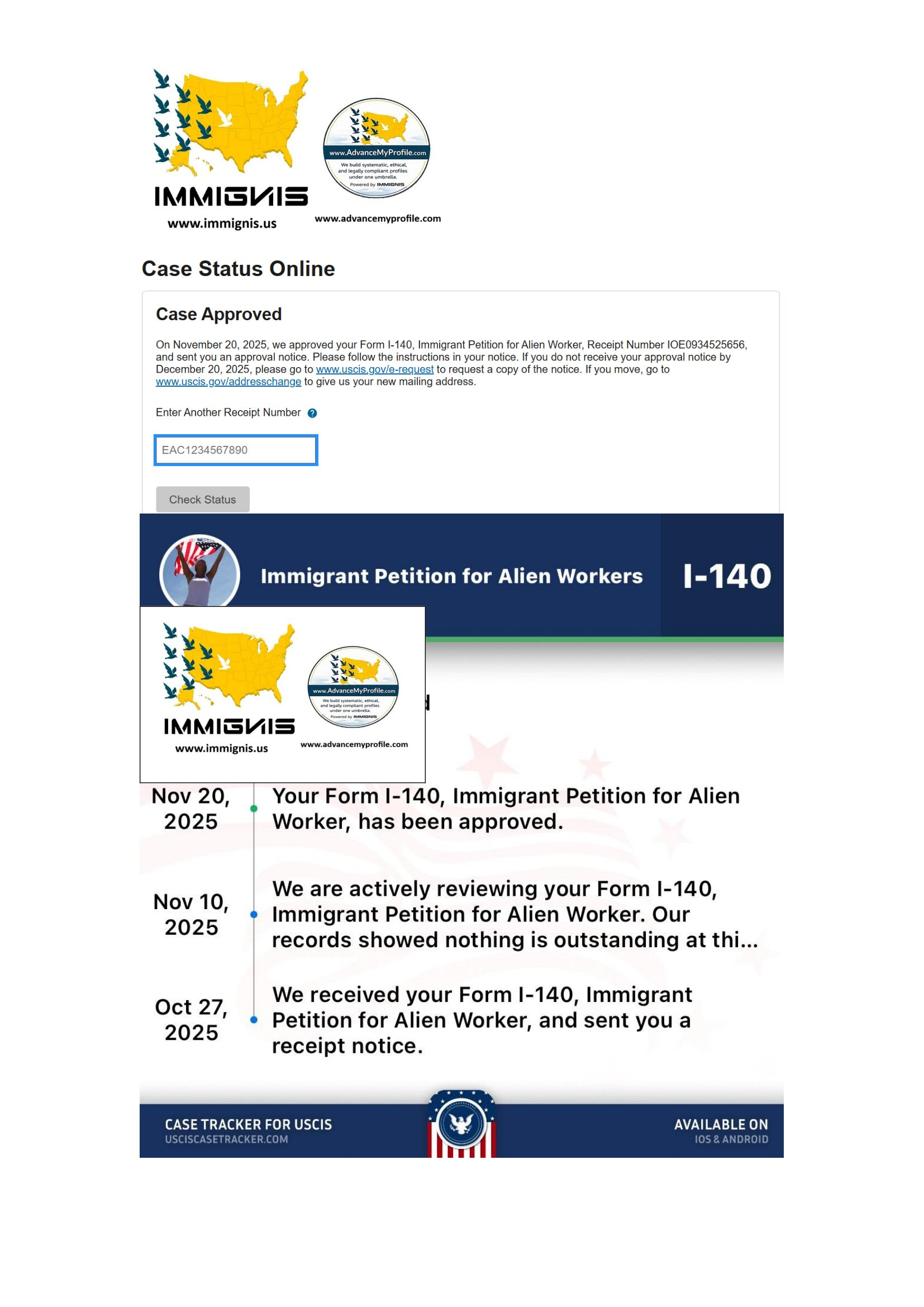
| Approval date | Approved on November 20, 2025. |
| Field niche | Solar-powered desalination for remote communities, with a focus on system reliability, water-energy integration, pilot implementation, and rural water-security use cases. |
| Starting weakness | Regional implementation work had value, but the record had limited formal recognition and needed clearer evidence that the engineer’s methods were known and useful beyond one project. |
| Profile-building path | Advance My Profile, powered by Immignis, developed a focused authority record through publications, pilot-outcome documentation, a water-energy white paper, industry media coverage, invited talks, a patent filing, professional membership evidence, judging in sustainability competitions, and independent expert letters. |
| EB-1A evidence presented | Scholarly articles, original contributions, published material, judging, and memberships. Patent evidence supported the original-contribution record and was not treated as a separate EB-1A regulatory criterion. |
USCIS approved the Form I-140 petition of an EB-1A Solar Desalination Engineer on November 20, 2025.
The approval did not come from presenting solar desalination as a broad clean-energy slogan. The case succeeded because the record showed a narrower professional contribution: how solar-powered desalination systems can be designed, documented, and evaluated for remote communities where water access, energy availability, maintenance, and reliability all meet in the same engineering problem.
The client was an Omani engineer connected to an Oman-based renewable water project. Their work sat at the point where renewable-energy design becomes a public-service question. A desalination unit does not help a remote community simply because it has solar panels. It has to produce usable water, tolerate variable sunlight, operate with limited local maintenance, and make sense for the people who depend on it.
Before profile building, the record had a familiar weakness. The engineering work was real, but much of it looked regional. It appeared inside pilot records, implementation files, project descriptions, and sustainability materials. Those documents showed activity, but they did not yet explain why this engineer’s methods rose to the level of EB-1A extraordinary ability.
Why the original record looked smaller than the work
Many engineers in water, energy, infrastructure, and sustainability have the same problem. Their strongest work is visible to project teams but not to the wider field.
A pilot may show that a technology can operate in a difficult environment. A regional project may help a real community. A company or public partner may rely on the engineer’s decisions. Still, USCIS does not approve EB-1A petitions simply because a project sounds useful. The petition must show the individual’s contribution, the significance of that contribution, and recognition that reaches beyond routine employment or local implementation.
That was the central issue in this case. The engineer had worked on solar desalination in a setting where the need was easy to understand. Remote and water-stressed communities often face a difficult choice between water access and energy cost. Desalination can help, but it can also be expensive, maintenance-heavy, and technically fragile if the system is not designed for the operating environment.
The original evidence described the project. It needed to describe the professional method.
The EB-1A niche: solar desalination as a reliability problem
Advance My Profile, powered by Immignis, reviewed the record with legal strategists and renewable-water specialists. The profile was not framed as general renewable energy. It was not framed as generic desalination. The case was narrowed to solar-powered desalination for remote communities.
That narrow field gave the petition a more useful question: how can desalination be integrated with variable renewable power while still producing dependable water in places that may not have stable grid support or specialized maintenance staff?
The evidence focused on solar generation, pumping loads, membrane or filtration performance, pretreatment needs, storage assumptions, water demand, maintenance intervals, brine-management considerations, and the operating conditions that can cause a pilot to perform differently in the field than it does in a controlled demonstration.
This framing mattered. A reader did not have to be a desalination engineer to understand the contribution. The case was about designing a system around constraints, not merely attaching renewable power to a water-treatment unit.
What USCIS needed to see in this solar desalination EB-1A case
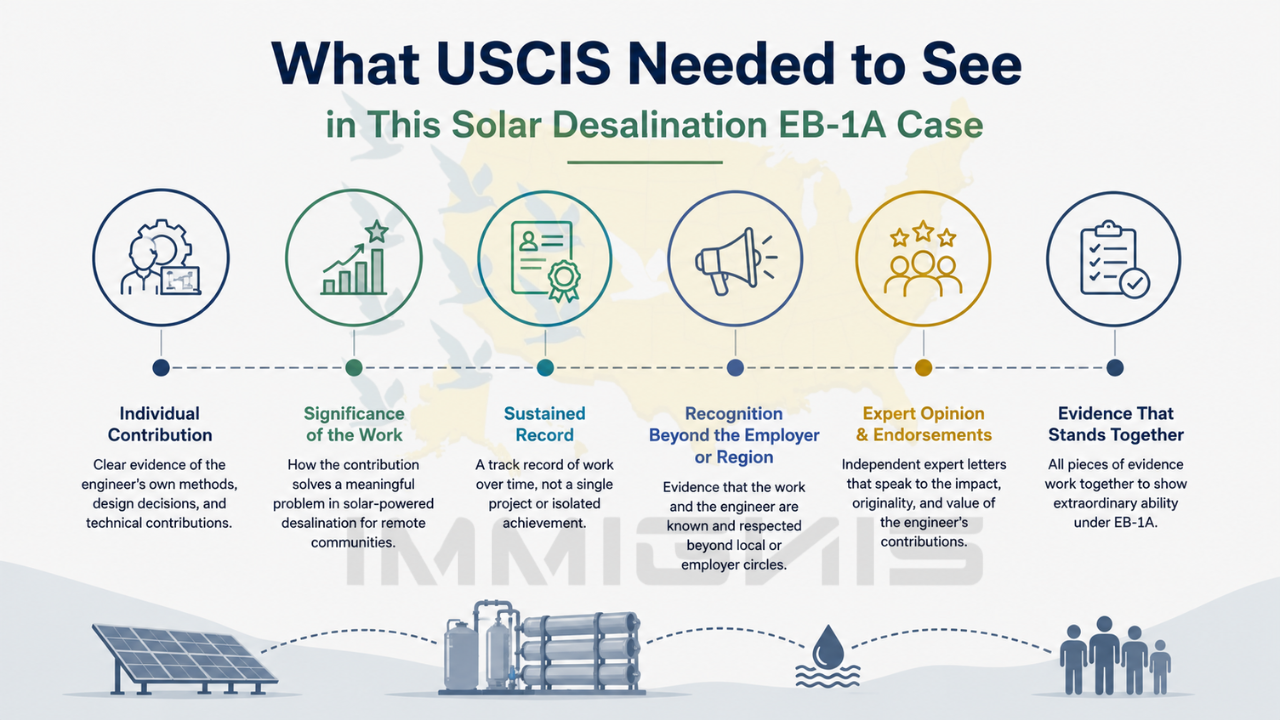
For EB-1A, strong implementation evidence by itself can still leave gaps. USCIS needed to see whether the engineer had a record of sustained acclaim and whether the evidence, taken together, showed a level of expertise associated with extraordinary ability.
The original-contribution argument required more than saying that the project helped a community. The petition had to identify the engineer’s methods, system-design decisions, pilot evidence, or technical concepts and explain why those contributions mattered in the renewable-water field.
Scholarly articles needed to connect authorship to solar desalination, water-energy integration, off-grid operation, system reliability, or related subjects. Published material required independent coverage about the engineer or the engineer’s expertise, not general publicity about clean water. Judging evidence required real evaluation of other professionals’ work, such as sustainability or engineering submissions. Membership evidence required admission or advancement standards tied to achievement, not open enrollment.
The patent filing was useful because it helped connect a technical concept to the engineer. But a patent filing is not a separate EB-1A criterion. It strengthened the original-contribution evidence when combined with method documentation, pilot outcomes, publications, and expert analysis.
The final merits analysis also mattered. The petition had to show that the same professional appeared across the whole record: the author, the inventor, the speaker, the judge, the member, the media source, and the engineer behind the pilot evidence all needed to point to one recognizable authority in solar-powered desalination.
The pilot evidence was rebuilt around engineering decisions
The strongest implementation materials were not used as a stack of project documents. They were reorganized around the decisions that made the work attributable to the engineer.
What water quality target was being addressed? How did the system respond to sunlight variation? Which operating conditions affected output? What maintenance assumptions were realistic for a remote site? How were storage, pumping, and treatment stages connected? What changed after pilot observations were reviewed?
Those questions allowed the petition to move from project participation to individual contribution. The record described pilot outcomes only where the documents supported them. It did not invent water volumes, cost savings, community counts, or environmental benefits that the evidence did not prove.
That restraint helped the case. Overstating pilot results can weaken a technical EB-1A petition. The stronger approach is to show what the evidence can support: the problem, the method, the engineer’s role, the observed result, and why an independent expert would consider the work meaningful.
Publications gave the technical work a field language
With domain support, the engineer developed focused publications on solar desalination, renewable-powered water treatment, off-grid system reliability, pilot evaluation, and water-energy constraints in remote settings.
The papers did not treat solar desalination as a miracle technology. One article examined why variable solar input can affect treatment performance and system planning. Another addressed the practical gap between a working pilot and a repeatable water-supply model for remote use.
This helped the EB-1A record in two ways. First, it placed the engineer’s knowledge into a public, citable form. Second, it made the technical subject more specific. The petition was not asking USCIS to admire a clean-energy project. It was asking USCIS to recognize an engineer whose work addressed a defined challenge in renewable-water infrastructure.
The water-energy white paper made the field significance easier to understand
A separate white paper was written for water, energy, and sustainability stakeholders. Its purpose was not to promote one private project. It explained the operating questions that determine whether solar desalination can become useful for remote communities.
The paper covered solar-resource variation, system sizing, pretreatment, water demand, storage, maintenance planning, cost sensitivity, and the risk of designing a technically impressive unit that cannot be operated consistently after deployment.
The white paper also connected the work to water security and rural resilience. That framing was important, but it remained disciplined. The petition did not claim that one engineer solved water scarcity. It showed that the engineer contributed to a practical area of infrastructure where better design and evaluation can affect whether renewable water systems are usable outside major urban networks.
The patent filing helped connect the technical concept to the engineer
The patent filing gave the petition a public record of inventorship and technical subject matter. Where the available materials identified the engineer’s role, the petition linked the filing to solar desalination system design or operation.
The filing was not treated as proof of major significance by itself. Its value came from the way it reinforced other evidence. Publications explained the technical problem. Pilot records showed practical use. The white paper placed the method in a water-security setting. Independent experts then explained why the concept mattered to renewable water infrastructure.
That combination is often more persuasive than a patent filing presented alone. USCIS still has to understand what the contribution was and why it had importance in the field.
Media coverage explained the problem without turning it into advertising
Industry media coverage helped translate the work for a wider professional audience. The engineer discussed why remote desalination is not simply a matter of choosing a treatment unit and adding solar power.
The coverage focused on practical constraints: variable energy input, maintenance access, water demand, pretreatment quality, and the difference between a successful demonstration and dependable operation in the field.
This mattered for the published-material criterion because the coverage had to be about the engineer or the engineer’s expertise. It also helped the overall narrative by showing that outside audiences were beginning to associate the engineer with a specific renewable-water specialty.
Invited talks and judging showed professional recognition beyond the project site
The engineer’s invited talks gave water and sustainability audiences a chance to examine the method. The presentations addressed pilot design, operating assumptions, system sizing, maintenance planning, and the question of what evidence is needed before a solar desalination model can be adapted to another community.
Audience questions centered on reliability, cost, membrane or filter maintenance, solar variability, water-demand planning, and whether a design proven in one region can be transferred elsewhere.
Judging evidence was handled separately. The petition documented evaluation of sustainability or engineering submissions by other professionals. That distinction mattered. Speaking about one’s work can support recognition, but judging requires evidence that the person assessed the work of others.
Professional memberships were evaluated by the admission standard
The membership evidence was not presented as a list of organizations. The petition documented the membership or elevation standard, the professional achievement required, and the basis for admission where available.
For EB-1A, ordinary paid membership does not carry the same weight as membership requiring recognized accomplishments. The case separated selective professional recognition from general networking or open enrollment.
Independent letters explained why the work mattered outside one project
The independent expert letters were important because they did not merely praise the engineer as talented. They explained the renewable-water problem, the technical difficulty of remote solar desalination, and the significance of building systems that can operate under real constraints.
The strongest letters connected the engineer’s work to field questions: how to evaluate pilot outcomes, how to design for operating conditions, how renewable-power variability affects water production, and why remote-community deployments need reliability planning from the beginning.
These letters helped USCIS understand the difference between ordinary project implementation and a contribution with broader relevance. They also helped show that the engineer’s recognition did not depend only on the employer or project sponsor.
How the EB-1A evidence came together
The petition presented a record that was more coherent than the original project file.
Scholarly articles connected the engineer’s public authorship to solar desalination, off-grid water treatment, pilot evaluation, and water-energy integration.
Original contributions were supported through system-design evidence, pilot-outcome documentation, the patent filing, the water-energy white paper, and independent expert letters explaining why the work mattered.
Published material showed outside coverage of the engineer’s expertise in solar desalination and remote water systems.
Judging evidence documented real evaluation of other professionals’ work in sustainability or engineering contexts.
Membership evidence showed professional recognition where the admission or elevation process required achievement-based assessment.
At final merits, the petition argued that these evidence streams described a professional whose work had moved beyond one regional implementation record and into a recognized specialty in renewable-water engineering.
The approval
USCIS approved the petition on November 20, 2025.
The approval was significant because the starting record could have been misunderstood. A regional pilot project may appear local. A renewable-water engineer may appear to be one contributor among many. A sustainability project may sound useful without proving individual acclaim.
The final EB-1A record did something different. It showed the engineer’s own technical work, placed that work in a narrow field, built public evidence around it, documented recognition by other professionals, and explained why solar desalination reliability matters for water security and rural resilience.
What other renewable-water engineers can learn from this case
Engineers working in desalination, water reuse, water-energy systems, off-grid infrastructure, rural water access, or sustainability projects often assume their implementation record will speak for itself. It usually does not.
USCIS needs a record that identifies the professional contribution and shows how the field has recognized it. Project value matters, but attribution matters just as much. A clean-water system can be socially important, but the petition must still explain what the individual did, why it was technically meaningful, and how others outside the immediate project recognized that expertise.
For many professionals, the strongest EB-1A evidence is already present in pieces: pilot records, technical methods, publications, conference activity, expert use, judging invitations, selective memberships, and industry discussion. The work becomes stronger when those pieces are organized around one defensible authority niche.
Frequently asked questions
Can a regional renewable-water project support EB-1A?
Yes, but not merely because the project is useful. The petition must identify the applicant’s individual contribution and show why the work has significance beyond ordinary project duties or one local implementation.
Is a patent filing enough for EB-1A?
No. A patent filing can help prove inventorship and support an original-contribution argument, but it is not a standalone EB-1A criterion. USCIS still needs evidence of significance, recognition, and the applicant’s role.
Can pilot outcomes be used as EB-1A evidence?
Yes, if they are documented carefully. Pilot evidence should show the problem, the method, the applicant’s role, the supported outcome, and why the result matters. Unsupported numbers or exaggerated claims can create risk.
Why does media coverage matter in an engineering EB-1A case?
Qualifying published material can show that outside sources recognized the applicant or the applicant’s expertise. It is most useful when the coverage explains a real technical subject rather than simply promoting a project.
What made this case different from ordinary sustainability consulting?
The petition did not rely on broad sustainability language. It focused on solar-powered desalination for remote communities and documented the engineer’s methods, public authorship, judging, membership evidence, patent filing, pilot evidence, and independent recognition in that specific field.
Build an EB-1A record around the renewable-water work that can be proven
If you work in solar desalination, water-energy systems, rural water access, water reuse, renewable infrastructure, or sustainability engineering, your strongest contribution may be hidden inside pilot reports, implementation records, technical decisions, and project documents.
Immignis and Advance My Profile help professionals identify a defensible EB-1A niche, document individual contributions, build credible public recognition, and prepare an evidence-based record around work that can be verified and professionally defended.