Key facts at a glance
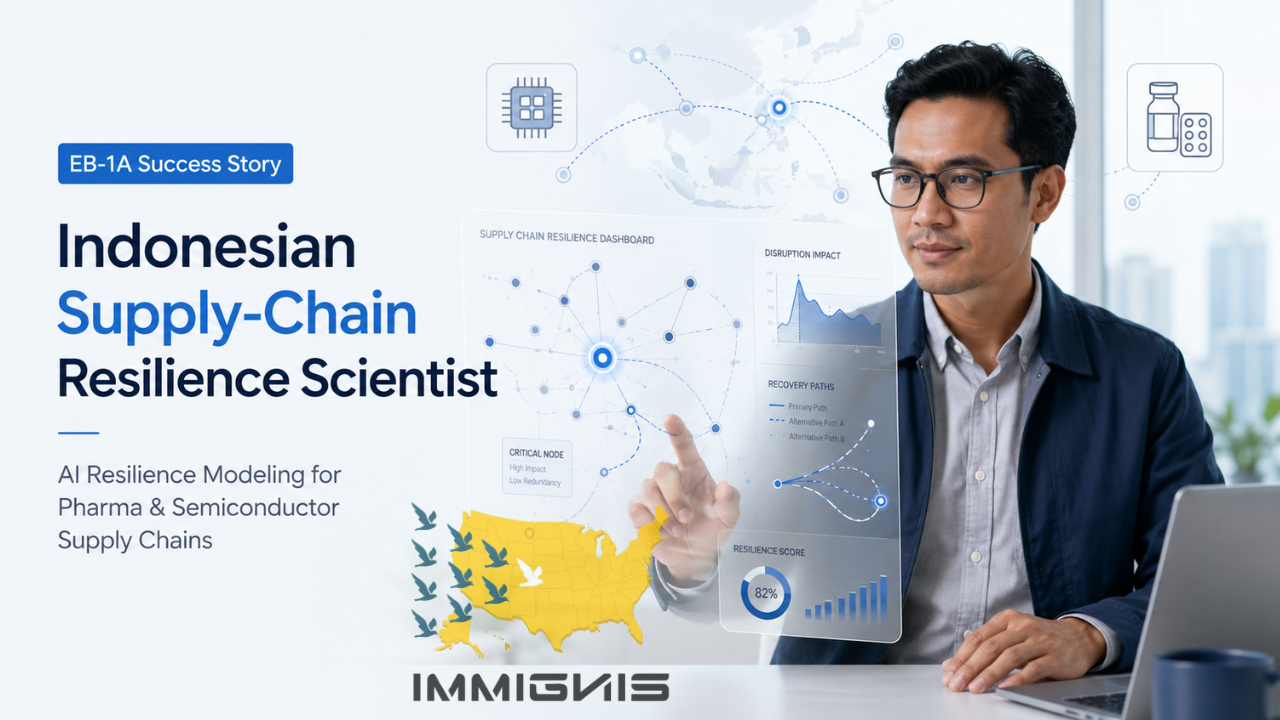
| Outcome | EB-1A approval for an Indonesian supply chain resilience scientist working at a Singapore based logistics firm. |
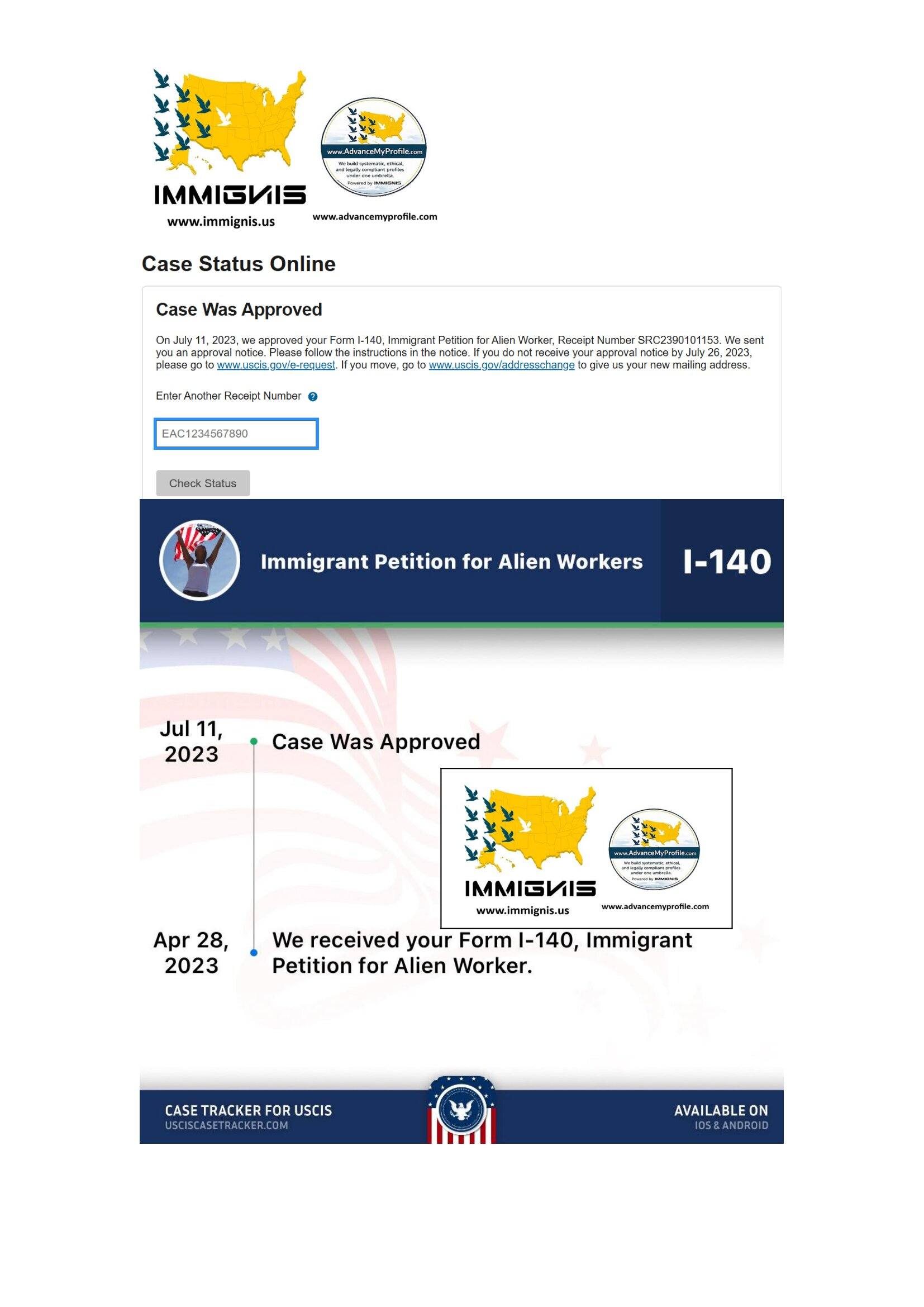
| Approval date | Approved on July 11, 2023. |
| Field niche | AI resilience modeling for pharmaceutical and semiconductor supply chains, with a focus on disruption scenarios, critical nodes, recovery time, and alternative sourcing paths. |
| Starting problem | His record looked like client optimization work. Strong projects were described as logistics improvements for individual accounts, with little evidence that his methods had wider scientific or industry significance. |
| Path used | Ethical EB-1A profile building through focused publications, a patent filing, open model documentation, a resilience white paper for logistics bodies, media commentary, peer review and judging, senior professional membership, and independent supply chain expert letters. |
| USCIS EB-1A criteria activated | Scholarly articles, original contributions, published material, judging, and memberships. Patent evidence strengthened the original-contribution record. |
USCIS approved his Form I-140 on July 11, 2023.
The shipment dashboard was still green. His resilience model was already warning that the network had become fragile.
A supplier delay by itself was manageable. A delay combined with a constrained transport lane and dependence on one downstream node produced a different result. The orders had not failed yet. The recovery options were already shrinking.
He was an Indonesian EB-1A Supply Chain Scientist working for a Singapore based logistics firm. His projects included pharmaceutical and semiconductor supply chains, two environments where delay, substitution, and recovery decisions can become technically difficult very quickly.
Why did strong logistics work look ordinary on paper?
One file discussed inventory. Another discussed routing. A third concerned supplier performance. The reports showed useful work, but the professional method linking them was difficult to see.
The repeated question was resilience: how a supply network behaves when several constraints appear at the same time and how quickly viable options disappear after a disruption begins.
The EB-1A green card is a self-petition immigrant classification for individuals who can demonstrate extraordinary ability through sustained national or international acclaim and recognized achievements in their field.
A long client list did not establish sustained acclaim by itself. The Form I-140 needed evidence of his own methods, their field significance, and recognition beyond the logistics accounts he served.
Advance My Profile, powered by Immignis, reviewed the work with legal strategists and supply-chain domain specialists and defined the field as AI resilience modeling for pharmaceutical and semiconductor supply chains.
His niche was the point where a disruption becomes a network problem
His work examined networks of suppliers, facilities, transport paths, inventory positions, dependencies, and recovery options. The model asked what happened when a disruption affected more than one part of the system or when the apparent backup depended on the same hidden constraint.
The evidence showed recurring work with scenario simulation, critical node analysis, lead time behavior, time-to-recover assumptions, alternate sourcing, and the effect of limited buffers.
Pharmaceutical and semiconductor supply chains gave the work a clear technical setting. Both can involve specialized inputs, qualification constraints, long lead times, and dependencies that cannot always be replaced immediately.
What did USCIS need to see in an AI supply-chain resilience case?
The petition identified his network resilience methods, scenario structures, critical node analysis, and model documentation and then explained why the work had significance beyond one account. Evidence of reuse, adaptation, public technical work, and independent expert analysis helped make that argument.
Scholarly articles needed to address resilience modeling, supply network risk, recovery, or allied analytical questions. Published material required independent coverage about him or his expertise. Judging evidence required actual evaluation of work produced by other specialists.
The memberships criterion depended on the admission or elevation standard for the senior professional grade used in the case.
Patent evidence helped trace inventorship and a technical concept. It supported the original contribution record; a patent is not a separate EB-1A regulatory criterion.
At final merits, USCIS could still examine the quality of the evidence and whether the full record showed sustained acclaim and top-level expertise. A thin collection of criterion labels could still create RFE or denial risk.
The client files were reorganized into a resilience method
Project summaries, analytical notes, model descriptions, role records, and safe examples of disruption analysis were grouped by the problem being solved.
Which node was critical? Which alternate route depended on the same port or supplier? How quickly would inventory protection disappear? Which recovery path required qualification or capacity that might not be available during a wider disruption?
One evidence stream concerned node criticality. Another focused on time-to-recover and lead-time variability. A third showed how scenario analysis changed sourcing or routing decisions.
The model work was described as a sequence: define the network, identify dependencies, apply disruption scenarios, measure loss of options, and compare recovery paths.
This gave independent experts a method they could evaluate without seeing a client’s confidential network map.
The publications turned client analytics into a scientific subject
With domain support, he developed papers on AI-assisted disruption modeling, critical node analysis, time-to-recover assumptions, and scenario-based resilience in pharmaceutical and semiconductor supply chains.
One paper examined why a backup supplier may fail as a resilience strategy when both suppliers depend on the same upstream node. Another studied how recovery assumptions can change when lead times and capacity constraints are modeled together.
The subject matched the analytical work he had already been doing for clients, but the publications gave the wider field a way to examine the method.
Supply-chain professionals often have serious analytical methods hidden inside client projects, dashboards, and confidential network reviews. A free EB-1A profile assessment can identify which methods are attributable to you and where authorship, judging, membership, public documentation, or independent recognition still needs development.
The open model documentation proved that the method could be examined outside a client account
The client documented a non-confidential version of the resilience model, including the logic of disruption scenarios, node dependencies, recovery assumptions, and comparison of alternate paths.
The documentation did not publish customer volumes, supplier identities, contract terms, or proprietary operating data.
Researchers and supply-chain professionals could see the model structure, understand the assumptions, and evaluate the type of resilience question it was designed to answer.
A patent filing helped connect a technical concept to the scientist
Where the public filing identified him as an inventor, the petition connected him to a technical concept in disruption analysis or resilience modeling.
Significance came from the wider evidence: the supply-network problem, his documented method, the model’s applicability across complex supply chains, and independent explanations from recognized logistics and resilience specialists.
The white paper asked logistics bodies to test resilience before a disruption
Its central argument was operational: a network should be tested against plausible combinations of disruption before the real event removes the best recovery options.
The paper organized the issue around dependency mapping, critical nodes, scenario combinations, recovery time, alternate sourcing, and the difference between nominal capacity and capacity that remains available during a wider disruption.
Pharmaceutical and semiconductor examples helped show why substitution can be constrained by qualification, specialized inputs, or lead time.
Media commentary focused on the false comfort of a single backup supplier
He explained that a second supplier does not automatically remove concentration risk. Two suppliers may share a raw-material source, production region, transport chokepoint, or specialized upstream provider.
He also discussed why a dashboard can show current orders as on schedule while the network is already losing recovery options.
Judging and peer review showed that other specialists trusted his analytical judgment
Journals, technical venues, and supply chain innovation programs later invited him to evaluate work in logistics analytics, resilience, optimization, and related fields.
The file documented genuine peer-review assignments and judging roles where he assessed research, technical submissions, or proposed methods created by other specialists.
The reviewed work required the same type of analytical questions visible in his own career: whether assumptions were supported, whether a model captured the relevant dependencies, and whether the conclusions followed from the evidence.
Senior membership was documented through the advancement rules
Advance My Profile reviewed the senior-grade or elevated membership standard, the achievements considered, and the expert assessment involved in advancement.
The petition included the applicable rules and evidence showing how his professional record was evaluated.
Independent experts explained why the method could scale beyond one client
The strongest letters began with the technical problem. Complex supply networks can contain hidden common dependencies, and a disruption can reduce recovery choices before the primary failure becomes visible in customer delivery data.
The experts discussed his publications, open model documentation, patent evidence, white paper, and non-confidential examples of the method in use.
They explained why scenario combinations, critical-node analysis, and recovery-path comparison can be relevant across different supply networks when the method is adapted to the facts of each network.
How the USCIS EB-1A criteria came together in this supply chain case
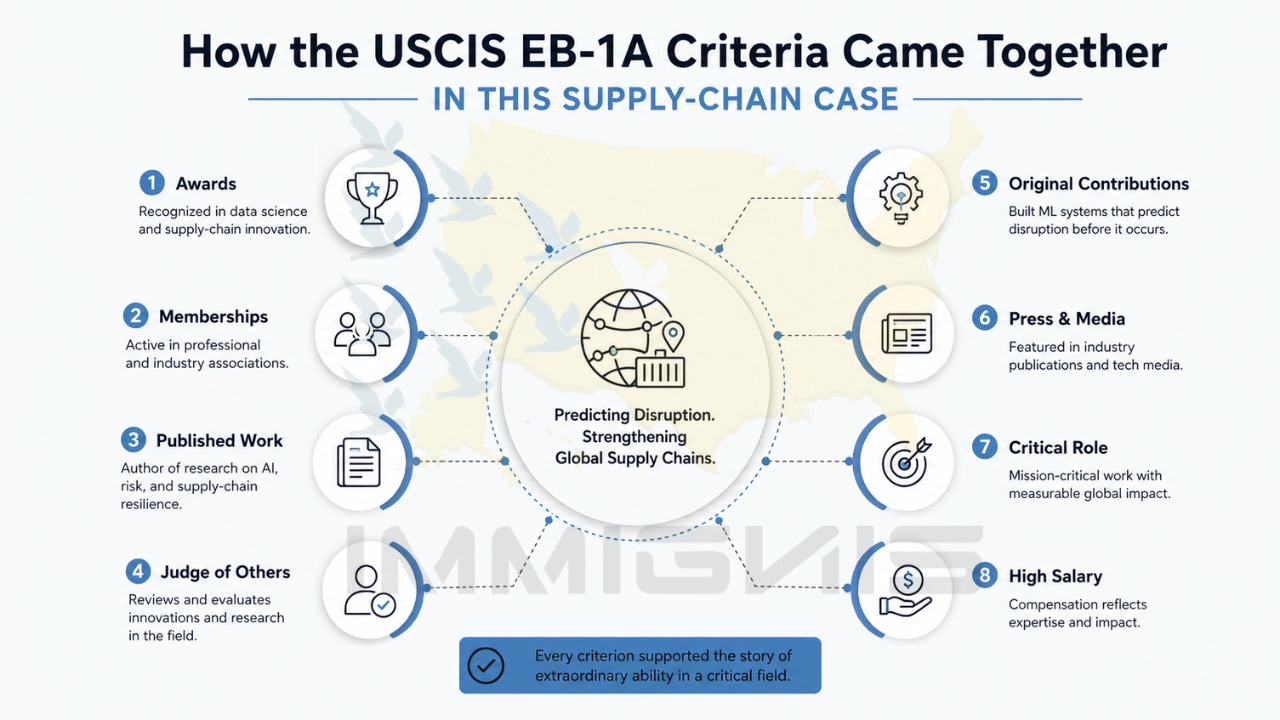
Scholarly articles: Focused papers connected his authorship to AI resilience modeling, critical-node analysis, time-to-recover assumptions, and scenario-based supply network risk.
Original contributions: The resilience model, open technical documentation, patent evidence, documented application of the method, and independent expert letters explained his contribution and its significance beyond individual client optimization.
Published material: Independent logistics and business coverage discussed him or his expertise in AI supply chain resilience, network dependencies, and disruption modeling.
Judging the work of others: Peer-review and technical judging records documented genuine evaluation of research or submissions by other specialists in supply-chain analytics, resilience, logistics, and allied fields.
Memberships: Senior professional membership evidence included the applicable advancement standards and documentation of expert assessment based on professional achievement.
The papers defined the science. Open model documentation made the method examinable. Patent evidence supported attribution. The white paper carried the resilience framework to professional audiences. Media, judging, senior membership, and independent letters documented recognition outside individual accounts.
Approval came on July 11, 2023
The approved EB-1A petition gave him a self-petition immigration path without employer sponsorship or labor certification. The Form I-140 filing established a priority date for the immigrant petition, while later permanent-residence timing can depend on visa availability and the applicant’s next immigration step.
If your supply chain career looks like a collection of client projects
Maybe you model disruption scenarios, identify hidden dependencies, design recovery paths, evaluate supplier concentration, or build decision rules for scarce inventory. Define the problem closely enough that another supply chain specialist would recognize your method.
Document non-confidential analytical work and decisions attributable to you. Publish from real network questions. Make public model documentation useful and honest. Use patents according to their actual status. Build judging through genuine evaluation work and membership evidence through real advancement standards.
Do not create an extraordinary ability profile from fake awards, paid citations, junk journals, or invented claims that a model protected an entire industry. USCIS scrutiny matters, and supply-chain professionals will remember methods that fail technical review.
FAQs
Can client supply chain optimization work support an EB-1A original contribution claim?
Yes, when the applicant’s individual method can be identified and the evidence shows major significance in the field. Reuse of a method, documented application across settings, publications, open technical documentation, patent evidence, and independent expert analysis can help show why the contribution extends beyond one client engagement.
What is AI supply chain resilience modeling?
It uses analytical or machine learning-assisted methods to examine how a supply network may behave under disruption. A model may study dependencies, critical nodes, lead-time behavior, recovery assumptions, alternate sourcing, inventory protection, and combinations of events. The method and data depend on the supply chain being studied.
Why are pharmaceutical and semiconductor supply chains useful fields for resilience research?
Both can involve specialized inputs, qualification requirements, constrained capacity, and long or variable lead times. Those features can make substitution and recovery difficult when several dependencies are affected at once. A resilience model can help teams test assumptions before a real disruption occurs.
Does an open-source or publicly documented model automatically prove an EB-1A original contribution?
No. Public documentation can make a method easier to examine, but USCIS still evaluates the contribution and its significance. The wider record may need evidence of use, influence, technical originality, independent expert analysis, or recognition in the field.
Can judging supply chain innovation submissions count for EB-1A?
It can support the judging criterion when the applicant actually evaluates the work of other specialists. The record should document the invitation, the evaluation role, and the type of submissions reviewed. Speaking, mentoring, or attending an event is not the same as judging unless evaluation was part of the role.
Should a supply-chain scientist pursue EB-1A or EB-2 NIW?
The categories use different legal standards. EB-1A focuses on extraordinary ability, sustained acclaim, and recognition in the field. EB-2 NIW requires EB-2 eligibility and a proposed endeavor that satisfies the national interest waiver framework. A supply chain profile may contain evidence relevant to both, but the petition strategy should match the selected category.
Build an EB-1A success story around the resilience method behind your supply chain work
If you work in supply-chain analytics, pharmaceutical logistics, semiconductor operations, network resilience, AI forecasting, or disruption modeling, your strongest contribution may still be hidden inside confidential client projects.
Immignis and Advance My Profile help identify a defensible technical niche, document individual methods, build credible field recognition, and prepare an EB-1A record around evidence you can verify and defend professionally.