How a Pakistani executive modernized a mill’s sustainable-denim line into major Western retail contracts by turning NDA-protected work, certification leadership, trade visibility, and industry recognition into a USCIS-approved EB-1A record.
Key facts at a glance
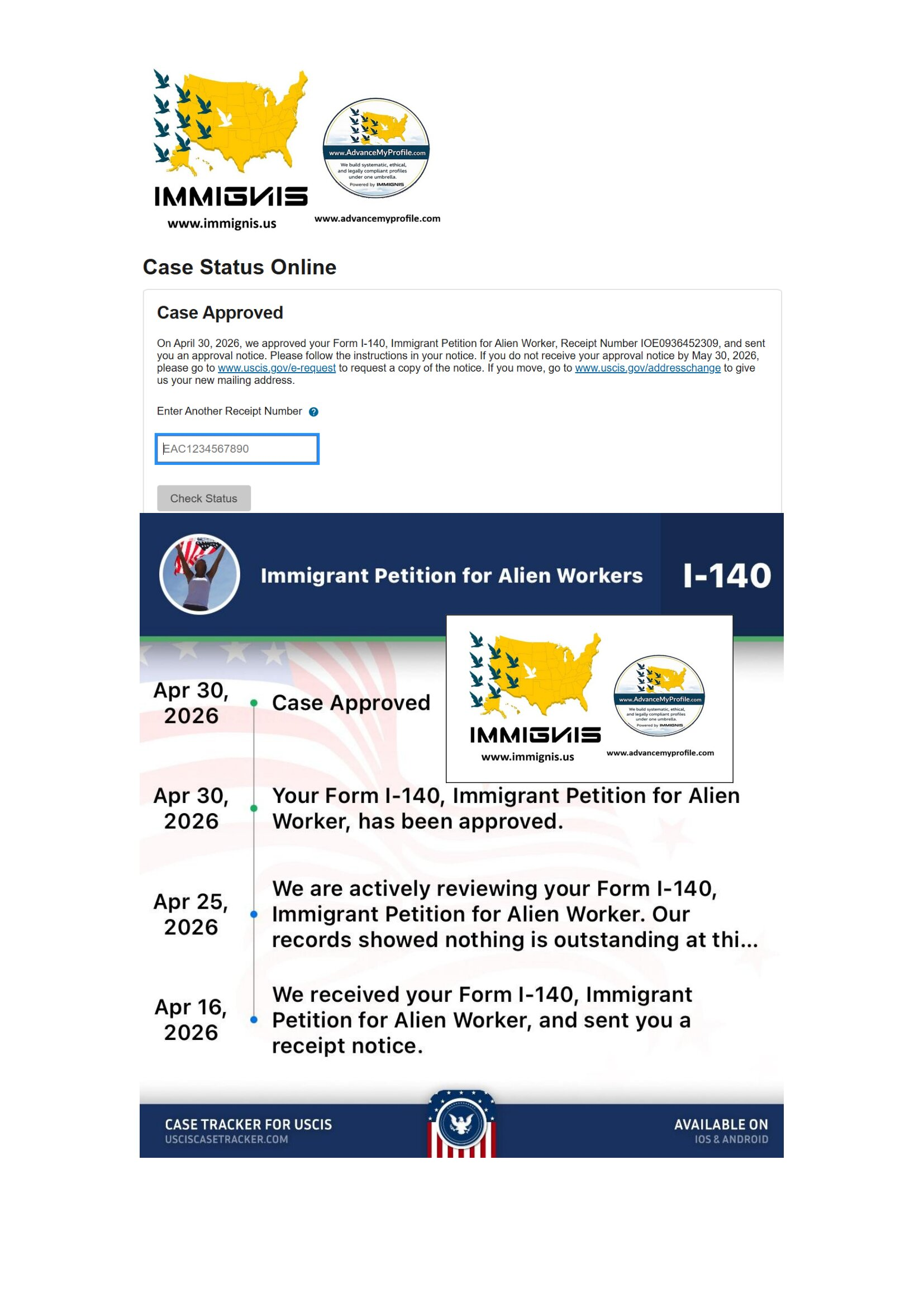
| Petition outcome | Form I-140 approved under EB-1A on April 30, 2026. |
| Professional profile | Pakistani executive who modernized a mill’s sustainable-denim line into major Western retail contracts. |
| Field niche | Sustainable textile manufacturing and export strategy. |
| Starting weakness | Retail contracts were under NDA, and the innovation was largely credited to the company rather than the individual executive. |
| Profile-building focus | Cleared contract-scope documentation, sustainability-certification leadership records, trade-press interviews, textile-fair speaking, industry-award submissions, and compensation benchmarking. |
| EB-1A criteria supported | Leading role, original contributions, published material, high remuneration, and awards. |
| Central issue | Proving individual leadership and field-level textile-export innovation without exposing confidential buyer or contract details. |
| Approval lesson | Certification leadership can become a public, verifiable fingerprint on private textile-export work when retail contracts and company innovation records are confidential. |
The approval
On April 30, 2026, USCIS approved the Form I-140 petition of an EB-1A Textile Export Innovator whose work helped move a denim manufacturing operation toward sustainable production, stronger compliance systems, and major Western retail opportunities.
Inside the textile and apparel industry, the value of his work was easy to understand. Sustainable denim is not just a branding exercise. It depends on cleaner production methods, credible certifications, buyer audits, traceable sourcing, water and chemical management, and the ability to meet the requirements of demanding international retailers.
For EB-1A, however, the petition had to prove more than business success or senior employment. It had to show extraordinary ability in sustainable textile manufacturing and export strategy, with evidence that connected private commercial work to field-level recognition.
That became the center of the case: converting confidential retail contracts, company-owned innovation, certification leadership, trade visibility, and industry recognition into a record USCIS could evaluate.
The evidence problem in sustainable textile-export work
Textile-export leadership can be difficult to document because the strongest proof often sits inside private contracts, audit reports, buyer communications, production data, and employer-controlled systems. The work may be highly valuable, but the public record can look surprisingly thin.
The petitioner’s starting weakness was not lack of impact. The weakness was attribution. Major Western retail contracts were under NDA. Sustainability improvements were credited to the mill. Product-development achievements appeared under the company name, not the individual executive who helped make them possible.
This required a focused field definition. The case was not presented as generic factory management, general exporting, fashion sales, or ordinary business development. It was framed as sustainable textile manufacturing and export strategy, with emphasis on denim modernization, compliance leadership, and international buyer readiness.
That field definition gave the petition a realistic measuring stick. The question was not simply whether the company sold denim. The question was whether the petitioner had become a recognized leader in building sustainable textile-export capability for international markets.
Why retail contracts were only the beginning
It would have been tempting to rely on the existence of major retail contracts alone. That would have been risky. USCIS could reasonably ask whether those contracts reflected the company’s brand, the sales department, preexisting buyer relationships, or the petitioner’s own contribution.
The record therefore treated retail contracts as a starting point, not the conclusion. The petition had to show what the petitioner personally did to help the mill satisfy buyer expectations, strengthen sustainability systems, and position its denim line for export growth.
The strongest evidence came from disclosure-safe contract-scope documentation, sustainability-certification leadership records, trade-press interviews, textile-fair speaking activity, industry-award submissions, and compensation evidence tied to the petitioner’s level of responsibility.
That distinction changed the case. Instead of asking USCIS to accept a private business success story, the petition translated the work into field-native proof: certified sustainability leadership, buyer-readiness strategy, export-market credibility, and recognition from the textile industry.
Certification leadership became the public fingerprint on private work
In some EB-1A fields, strong evidence appears in patents, citations, or public awards. In textile manufacturing, especially sustainable denim, one of the most important evidence categories can be certification and compliance leadership. Certifications can show that private operational work met external standards the industry recognizes.
The petition used that evidence carefully. The goal was not to claim that every certification automatically proved extraordinary ability. The goal was to show that the petitioner’s leadership helped the mill meet demanding sustainability, audit, and buyer-compliance requirements that influenced international retail acceptance.
Good evidence did not say only that the company held certifications. It explained what the petitioner led, how the certification pathway was implemented, what systems changed, and why those records made his work visible even when the retail contracts themselves could not be fully disclosed.
Those materials gave USCIS a concrete way to understand the petitioner’s contribution. Certification leadership became a verifiable fingerprint on work that otherwise might have remained hidden behind NDAs and company branding.
Leading-role evidence had to show strategic authority, not employment title alone
Executives often assume that a senior title proves a leading role. For EB-1A, that is not enough. The petition had to show that the petitioner personally carried important responsibility for the sustainable-denim strategy, export positioning, and buyer-compliance process.
The record documented his authority over sustainability implementation, buyer-facing readiness, production modernization, certification coordination, textile-fair representation, and export strategy for Western retail markets.
That evidence helped separate real leadership from ordinary management. The case showed that his role influenced how the mill presented, certified, and delivered sustainable denim for international buyers rather than merely supervising routine operations.
For business and manufacturing professionals, this distinction matters. A company profile may show sales or contracts. An EB-1A petition must prove the individual’s role in creating the recognized result.
Original contribution in a sustainable textile-manufacturing case
Original contribution can be difficult in manufacturing cases because innovation may appear as a process improvement, sourcing model, compliance system, product line, or export strategy rather than a single public invention.
For this petitioner, the original-contribution argument was built around sustainable-denim modernization. The evidence showed how he helped align production, certification, compliance, and export strategy so that a traditional textile operation could compete for higher-value Western retail business.
That mattered because USCIS looks for contributions of significance, not routine job performance. The evidence had to show that his work was recognized as meaningful within sustainable textile manufacturing and export strategy, not merely profitable for one employer.
The petition did not claim that he invented sustainable denim or transformed the entire textile industry alone. It made a narrower and stronger point: within the specialized field of sustainable textile manufacturing and export strategy, his work produced externally verifiable results and helped move a denim line into more credible international retail channels.
Published material and trade-press visibility
The original profile had limited public visibility because textile trade coverage often focuses on brands, buyers, mills, or national export trends rather than the executives who build the systems behind successful contracts.
Trade-press interviews, textile-fair speaking records, industry commentary, and event visibility helped make the petitioner’s work understandable to a reader outside the denim sector. These materials also showed that his expertise was not confined to internal company dashboards or confidential buyer files.
The petition treated published material as support rather than decoration. The most useful public evidence connected his name to sustainable textile manufacturing, denim export strategy, certification leadership, and industry-facing discussion of responsible production.
High remuneration evidence needed industry context
High remuneration can be useful in EB-1A business cases, but only when it is presented with a proper comparison. A salary figure or compensation package has limited value unless USCIS can see how it compares with similarly placed professionals in the same field, region, and level of responsibility.
The petition therefore used compensation benchmarking in context. The goal was not simply to say that the petitioner earned well. The goal was to show that his remuneration reflected the market value of a specialized executive who could lead sustainability, export compliance, and international buyer strategy in a demanding textile sector.
That evidence supported the broader story. It showed that the petitioner’s expertise was not only praised internally but also valued economically at a level consistent with top-tier responsibility in his niche.
Awards and industry recognition made the work externally visible
Industry-award submissions and recognition materials helped address another common weakness in manufacturing cases: much of the work happens quietly before buyers and auditors, not in public acclaim systems.
For this petitioner, the awards strategy focused on sustainability, export performance, responsible production, and textile innovation rather than generic business success. That helped place his achievements within a recognizable field hierarchy.
Even where the awards evidence was part of a broader development plan, it strengthened the case by showing that the work could be evaluated by the textile industry’s own standards rather than only by private employer claims.
How the EB-1A criteria worked together
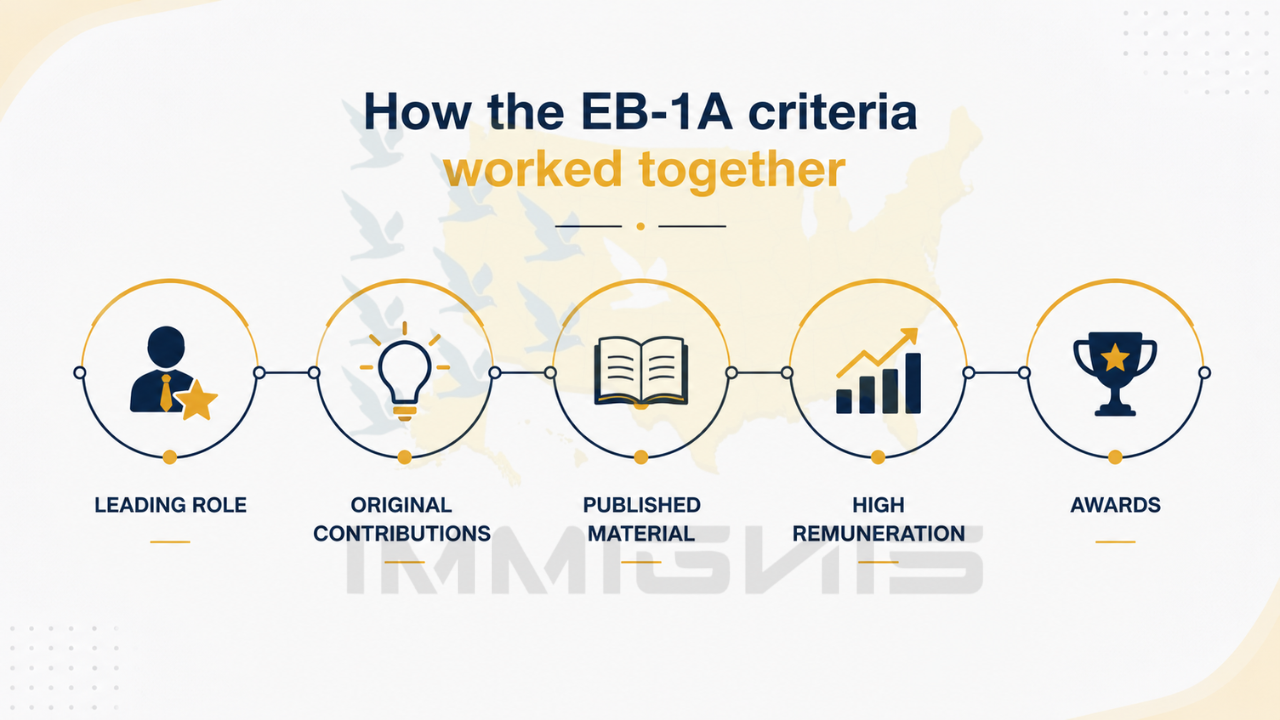
The petition did not depend on one perfect exhibit. It worked because several forms of evidence pointed in the same direction and supported the same theory of the case:
- Leading role: Company, contract-scope, certification, and export-strategy records showed that the petitioner held real authority in sustainable-denim modernization and buyer readiness.
- Original contributions: Sustainability systems, product-line modernization, compliance leadership, and export positioning showed meaningful contribution within the textile-export field.
- Published material: Trade-press interviews, textile-fair visibility, and industry commentary made his expertise visible beyond private company records.
- High remuneration: Compensation benchmarking helped show that the market valued his specialized leadership at a level above ordinary textile management.
- Awards: Industry-award submissions and recognition materials positioned the work inside the textile sector’s own evaluation framework.
The strongest part of the record was coherence. The case did not drift into generic exporting, ordinary factory management, or broad business growth. It stayed focused on sustainable textile manufacturing and export strategy.
The final-merits argument
At the final-merits stage, the petition had to show more than satisfaction of individual criteria. It had to demonstrate that, taken together, the evidence established sustained acclaim and extraordinary ability in the petitioner’s specific field.
The argument centered on verifiable industry proof rather than confidential revenue alone. The petitioner was not presented merely as an executive who helped close contracts. He was presented as a sustainable textile-export innovator whose work could be verified through certifications, trade visibility, buyer-facing documentation, compensation benchmarking, and industry recognition.
The final record showed that his expertise had been recognized through sustainable-denim modernization, certification leadership, trade-press visibility, industry-facing activity, and responsibility for export-market growth under demanding retail standards.
That is why the case was stronger than a file built around contract volume alone. It told USCIS what the sustainable-denim field values, then showed where the petitioner’s work fit inside that field.
Why the approval mattered
The approval mattered because it showed how a private manufacturing and export career can become a strong EB-1A record when the evidence is tied to a precise field and supported by external validation.
For this Pakistani textile-export innovator, the petition did not try to make confidential contracts public or exaggerate company achievements as personal acclaim. It used disclosure-safe records, certification leadership, trade visibility, and industry recognition to show his own contribution clearly.
The approval confirmed the central lesson of the case: when retail contracts are private and innovation is credited to the company, certification leadership can become a public, verifiable fingerprint of individual expertise.
Lessons for textile executives, exporters, and manufacturing leaders
This case is useful for textile executives, apparel-export leaders, manufacturing strategists, sustainability officers, compliance professionals, and product-line innovators whose strongest work is valuable but hidden inside company systems.
A strong record usually begins with the following questions:
- Can contract impact be documented without exposing buyer identities, pricing, or sensitive commercial terms?
- Can certifications, audits, sustainability standards, or compliance milestones show a public fingerprint of private work?
- Do trade publications, textile fairs, industry panels, or award programs recognize the petitioner’s expertise or leadership?
- Can compensation benchmarking show that the market values the petitioner’s specialized role above ordinary management?
- Can the business result be connected to original sustainable-manufacturing or export-strategy work rather than routine sales activity?
When those questions are answered with documents, a private textile-export story becomes much easier for USCIS to evaluate. That is the difference between company success and a petition-ready record of individual achievement.
Frequently asked questions
Can a textile-export executive qualify for EB-1A?
Yes. A textile-export executive may qualify for EB-1A if the evidence shows sustained acclaim and extraordinary ability in a clearly defined field, such as sustainable textile manufacturing, export strategy, denim innovation, or apparel supply-chain leadership.
Can confidential retail contracts support an EB-1A case?
Yes, but they should be documented carefully. Disclosure-safe contract summaries, employer-cleared letters, audit records, certification materials, and buyer-readiness documentation can help show impact without revealing sensitive commercial terms.
Can sustainability certifications help prove original contribution?
They can help when the record explains the petitioner’s personal role in achieving or leading those certifications. Certifications are strongest when they show external validation of systems, standards, or processes that the petitioner helped build or implement.
Does high salary matter in an EB-1A business or manufacturing case?
High remuneration can support EB-1A when it is compared against relevant industry benchmarks. The evidence should show that the petitioner’s compensation reflects specialized expertise and senior responsibility in the field.
Can textile-fair speaking or trade-press interviews support EB-1A?
Yes. Textile-fair speaking, trade-press interviews, and industry commentary can support published material, field visibility, and recognition when they connect the petitioner by name to a specialized area of textile or export leadership.
Can Immignis and Advance My Profile help textile and export professionals build EB-1A evidence?
Immignis and Advance My Profile help textile executives, export strategists, sustainability professionals, and manufacturing leaders define a clear field niche, organize confidential work safely, document attribution, and build a credible EB-1A evidence record.
Build an EB-1A record around sustainable-export leadership and verifiable proof
Many textile and manufacturing professionals create major business value, but their strongest proof stays inside contracts, buyer audits, certification files, and employer-controlled systems. That does not make the record weak; it means the evidence has to be translated carefully.