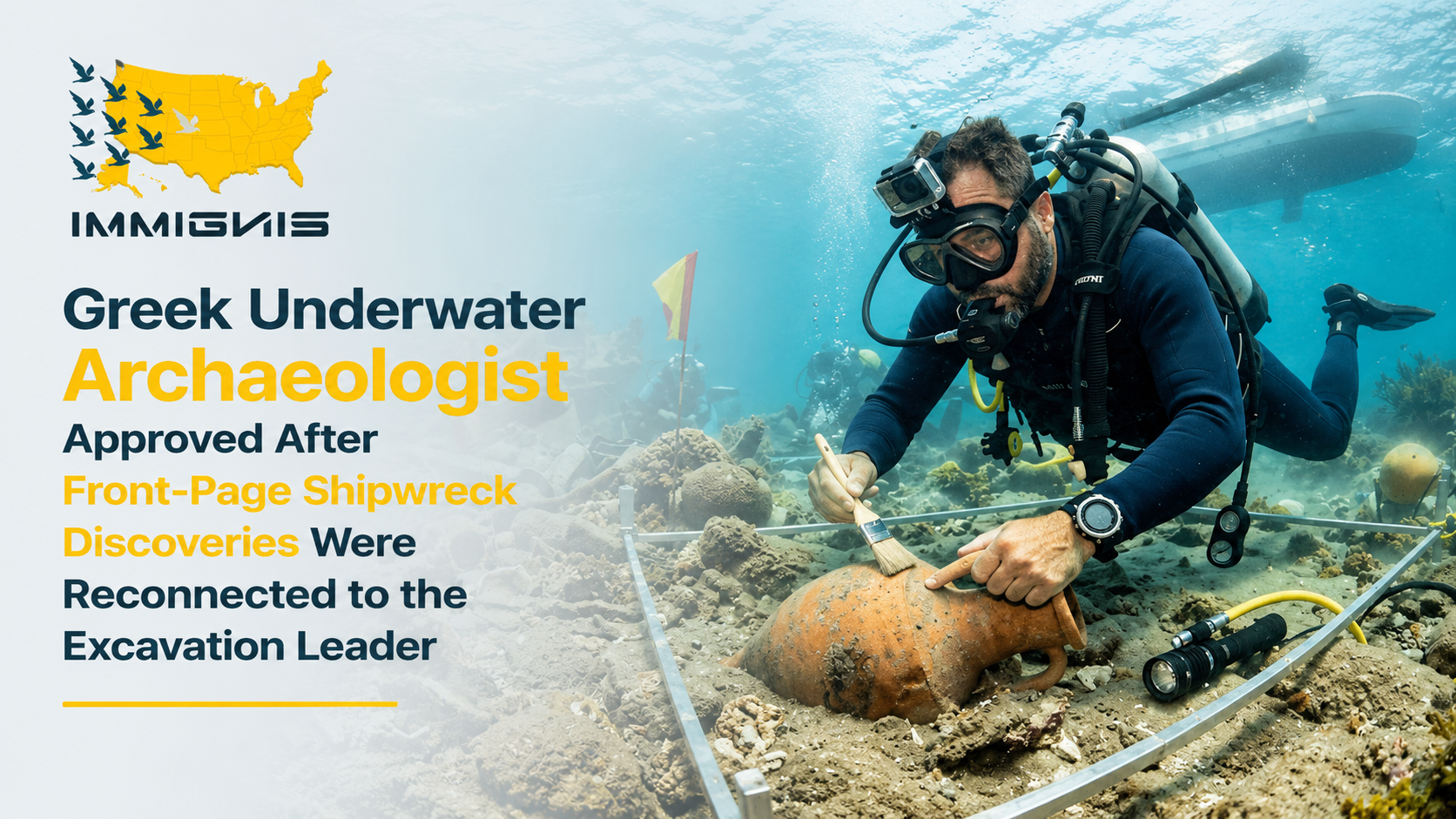
EB-1A Underwater Archaeologist: How a Greek underwater archaeologist secured EB-1A approval by turning excavation leadership, authorship of archaeological interpretation, scholarly publication, documentary and media coverage, museum-exhibition collaboration, international professional roles, grant leadership, and peer-evaluation service into a personal record of extraordinary ability.
Key facts at a glance
| Petition outcome | Form I-140 approved under EB-1A on December 8, 2023. |
| Professional profile | Greek underwater archaeologist who led Mediterranean shipwreck excavations and helped change scholarly understanding of ancient trade, movement, and material exchange. |
| Field niche | Mediterranean underwater archaeology and shipwreck-based reconstruction of ancient trade. |
| Starting weakness | The discoveries attracted attention, but excavation leadership and intellectual authorship were buried in institutional reports, team credits, permits, museum labels, and long publication lists. |
| Profile-building focus | Excavation-leadership documentation, contribution mapping, scholarly publication, person-focused documentary and media coverage, museum-exhibition collaboration, international archaeology-body roles, grant leadership, judging records, and expert validation. |
| Principal EB-1A evidence areas developed | Original contributions, authorship of scholarly articles, published material about the petitioner, leading or critical role, and judging the work of others. |
| Central issue | Showing that the petitioner did not merely participate in famous discoveries, but personally directed difficult fieldwork and produced interpretations on which later scholarship, exhibitions, and public understanding relied. |
| Approval lesson | A celebrated discovery is only context until the record identifies who designed the investigation, controlled the evidence, authored the interpretation, and earned recognition beyond the project name. |
The shipwreck reached the front page. The excavation leader was still in the footnotes.
Underwater archaeology has a public-image problem. A shipwreck emerges from the seabed, an unusual cargo is documented, and the discovery is quickly presented as a story about a lost vessel, an ancient route, or a civilization. The institution receives credit. The objects become museum pieces. The archaeologist who organized the work may appear once in a technical report, if at all.
That gap defined this case. The petitioner had led demanding Mediterranean excavations whose findings changed how specialists understood parts of ancient trade. Yet the initial professional record did not make the individual contribution easy to see. Project pages named teams. Reports used institutional authorship. Media stories emphasized the wreck and artifacts. Even strong publications could leave readers unsure who had framed the research questions, directed the excavation, controlled the documentation, and developed the interpretation.
USCIS approved the Form I-140 petition on December 8, 2023. Immignis and Advance My Profile did not try to make the petitioner the sole author of collective archaeology. The work instead traced specific leadership and intellectual responsibility through permits, field records, publications, grants, exhibitions, professional service, independent coverage, and expert testimony. The result was a person-centered case built without diminishing the divers, conservators, technicians, students, historians, laboratories, and public institutions involved.
Why an internationally known discovery may still produce a weak personal record
A shipwreck excavation is not an individual performance. It can involve archaeological authorities, research institutions, survey crews, diving teams, remote-sensing specialists, conservators, ceramicists, numismatists, osteologists, maritime historians, photographers, laboratories, museums, and funding bodies. The final discovery belongs to the project, and rightly so.
For EB-1A purposes, however, project importance and personal extraordinary ability are different questions. A famous wreck does not establish that every participant worked at the top of the field. A senior title does not prove what the person actually controlled. Media attention to artifacts is not automatically published material about the archaeologist. The petition needed evidence connecting the petitioner to defined decisions, methods, interpretations, and outcomes.
The profile-building process therefore began with attribution rather than publicity. It asked who formulated the research design, who held responsibility under the excavation authorization, who directed field decisions, who approved changes when conditions shifted, who supervised archaeological recording, who coordinated specialist analysis, and who carried the findings into publications and exhibitions. Those answers created the spine of the case.
The field was narrowed to Mediterranean underwater archaeology
The petition did not describe the petitioner only as an archaeologist. That label was too broad to explain why shipwreck excavation is unusually difficult or how distinction is recognized inside the specialty. The field was defined as Mediterranean underwater archaeology, with particular emphasis on reconstructing ancient trade from shipwreck sites and their material assemblages.
This niche combines archaeology with marine survey, stratigraphic control, diving or remotely operated systems, conservation, geospatial recording, object provenance, cargo analysis, chronology, and historical interpretation. The evidence is fragile. Once an object is moved, its original context cannot be recreated. Documentation must therefore preserve relationships among the hull, cargo, seabed, sediments, and surrounding finds before recovery changes the site.
The narrower field definition made the evidence intelligible. Excavation leadership, methodological judgment, publication authorship, grant responsibility, museum collaboration, peer review, and specialist media coverage all became parts of one professional identity rather than unrelated accomplishments from a general academic career.
Excavation leadership had to be proved through decisions, not job titles
The leading-role evidence focused on what the petitioner was entrusted to decide. The record drew from excavation permits, project appointments, organizational charts, field-director designations, grant files, work plans, dive and survey records, reporting obligations, specialist coordination, and letters from professionals with direct knowledge of the work.
The strongest documents explained responsibility at the moments that mattered. Underwater sites can force rapid choices about safety, visibility, weather, sediment movement, object stability, conservation limits, sampling, recording priorities, and whether recovery should proceed at all. Evidence showing that the petitioner directed or approved such decisions was more useful than a generic statement that the person “participated in the excavation.”
This also kept the claim proportionate. The petition did not assign every discovery to one archaeologist. It showed the petitioner’s defined leadership inside distinguished archaeological undertakings and explained why the role was critical to the reliability of the resulting evidence.
The original contribution was not the object. It was the knowledge recovered from context.
The public often treats the recovered artifact as the discovery. Archaeology treats context as evidence. A cargo item, tool, coin, amphora, structural element, or personal object becomes historically useful when its position, association, date, origin, and relationship to the vessel can be established.
The case therefore avoided a shallow argument based on spectacular finds. It documented how the petitioner’s excavation strategy, recording controls, analytical framework, and interpretation allowed the site to answer larger questions about routes, exchange networks, production centers, shipboard practice, chronology, or economic connection. The significance lay in what the field learned, not in the market value or visual appeal of an object.
Original-contribution evidence connected the petitioner’s work to later scholarly reliance. Publications, citation context, museum interpretation, conference discussion, research collaborations, and independent expert letters helped explain where the petitioner’s conclusions altered or sharpened existing understanding. The petition was careful not to equate every citation with major significance; it showed what later authors actually used and why the contribution mattered to the defined field.
Contribution mapping separated one archaeologist from a long team list
Large archaeological projects can create the same attribution problem seen in consortium science. A report may have many authors, while a publication may compress years of field leadership into one name among several. Contribution mapping was used to restore the missing detail.
The record matched the petitioner to particular research questions, excavation seasons, site areas, methods, datasets, specialist integrations, interpretive sections, and publications. Draft histories, correspondence, field reports, acknowledgments, author-contribution statements, grant roles, and informed letters were useful when they were consistent with one another and with the formal project record.
This did not turn collaboration into sole authorship. It gave USCIS a fair way to understand which part of the collective result belonged to the petitioner. That distinction strengthened both the original-contributions argument and the final assessment of sustained standing in the field.
Scholarly publication carried the excavation from the seabed into the discipline
Excavation alone does not complete archaeological work. Findings must be conserved, analyzed, interpreted, challenged, and published. Without a reliable publication record, an important site can remain a public story rather than a contribution to knowledge.
The petition organized the petitioner’s articles, chapters, excavation reports, catalog essays, and other scholarly writing around the defined field. It explained authorship, the relationship between each publication and the underlying excavation, the reputation and audience of the publication venue, and the way the work was received or used by other specialists.
First-author or lead-author work gave a clear signal where available, but author order was not treated mechanically. Archaeology has different publication customs across projects and countries. The case used the actual record to explain intellectual responsibility rather than assuming that one place in an author list always carried the same meaning.
Documentaries and news coverage had to be about the archaeologist, not only the wreck
Shipwrecks naturally attract journalists and filmmakers. That visibility can help an EB-1A case, but only when the material concerns the person and the person’s work. A documentary about an ancient vessel is not automatically published material about every scientist who appears on screen.
The profile-building strategy identified coverage that named the petitioner, discussed the petitioner’s role, relied on the petitioner’s explanation, or treated the person as a principal source. It distinguished independent editorial coverage from institutional announcements, promotional clips, project websites, and short quotations that added little person-focused substance.
This made the media record more credible. The goal was not to count every appearance. It was to show that independent outlets and documentary producers repeatedly turned to the petitioner to explain the discovery, its method, and its historical meaning.
Museum-exhibition collaboration showed that the interpretation traveled
A museum exhibition can extend archaeological work far beyond the excavation site. Objects must be selected, conserved, sequenced, labeled, contextualized, and connected to an understandable historical account. The intellectual work behind that presentation may involve the excavation leader even when the public sees only the museum’s name.
The case documented the petitioner’s contribution to exhibition development through curatorial correspondence, catalog authorship, object-selection records, interpretive text, advisory roles, public lectures, and museum letters. This evidence was not used simply to claim that artifacts were displayed. It showed that the petitioner’s interpretation shaped how institutions presented the site to wider audiences.
Museum collaboration also provided a bridge between academic and public significance. It demonstrated that the work had enough reliability and relevance to enter long-term cultural interpretation, not merely a temporary news cycle.
Grant leadership showed who was trusted before the discovery existed
Some of the strongest evidence preceded the excavation. Competitive grants and research authorizations can show who was trusted to define the project, manage resources, meet reporting duties, coordinate institutions, and carry responsibility for a complex investigation before there was any guarantee of a dramatic result.
The petition documented the petitioner’s role as principal investigator, project leader, work-package leader, or other supported grant function where the records established it. It explained the competitiveness and professional review attached to the funding without treating every grant as an award for extraordinary ability.
This evidence strengthened the leading-role analysis because it showed that qualified bodies entrusted the petitioner with the project’s design and execution. It also supported final merits by demonstrating continuity: professional trust existed before, during, and after the headline discovery.
Peer evaluation became the judging evidence
Archaeologists judge the work of others in several ordinary but important ways. They review journal manuscripts, assess conference submissions, evaluate grant proposals, advise on excavation or research applications, and participate in specialist academic committees. The case documented such service where the petitioner had actually evaluated professional work rather than merely attended meetings.
The evidence identified the reviewing body, the type of material assessed, the selection process, the petitioner’s role, and the professional level of the people whose work was being judged. Invitations, reviewer acknowledgments, editorial records, committee appointments, and confirmation letters helped establish the service without revealing confidential submissions.
This was especially useful because peer evaluation is native to the field. It showed that other institutions trusted the petitioner not only to produce archaeology, but to decide whether the work of other archaeologists met professional standards.
International archaeology-body roles supported standing, but membership was handled carefully
Professional bodies can create useful evidence through committee service, standards work, advisory appointments, elected roles, and cross-border research networks. The case used international archaeology-body participation to show that the petitioner’s expertise was recognized beyond one excavation and one institution.
The petition did not assume that ordinary membership satisfied the EB-1A membership criterion. Open enrollment, payment of dues, or possession of a professional credential is usually not enough. Where a membership claim was considered, the evidence had to establish achievement-based admission judged by recognized experts. Other roles were placed where they genuinely belonged: leading role, judging, professional recognition, or final merits.
That restraint improved the overall presentation. A narrower, well-supported claim is more persuasive than turning every affiliation into a regulatory criterion it does not meet.
Why this case worked
The case worked because it did not confuse a famous shipwreck with a famous archaeologist. It built the connection document by document. The project’s importance supplied context. Leadership records showed authority. Contribution mapping identified the petitioner’s own work. Publications carried the interpretation into scholarship. Museum and media records showed wider reliance. Grants and peer evaluation demonstrated professional trust across time.
The record also respected collaboration. No responsible underwater archaeologist works alone, and the petition did not need to pretend otherwise. The strongest argument was that a collective discovery can still contain identifiable personal leadership and intellectual contribution when the evidence is precise enough.
For archaeologists, historians, conservators, museum professionals, and field scientists, the broader lesson is practical: do not wait for the institution to preserve personal attribution. Keep permits, role letters, grant records, field reports, contribution statements, publication drafts, curatorial correspondence, reviewer confirmations, and independent coverage. Years later, those records may be the only way to reconnect public knowledge to the person who helped create it.
What professionals can learn from this approval
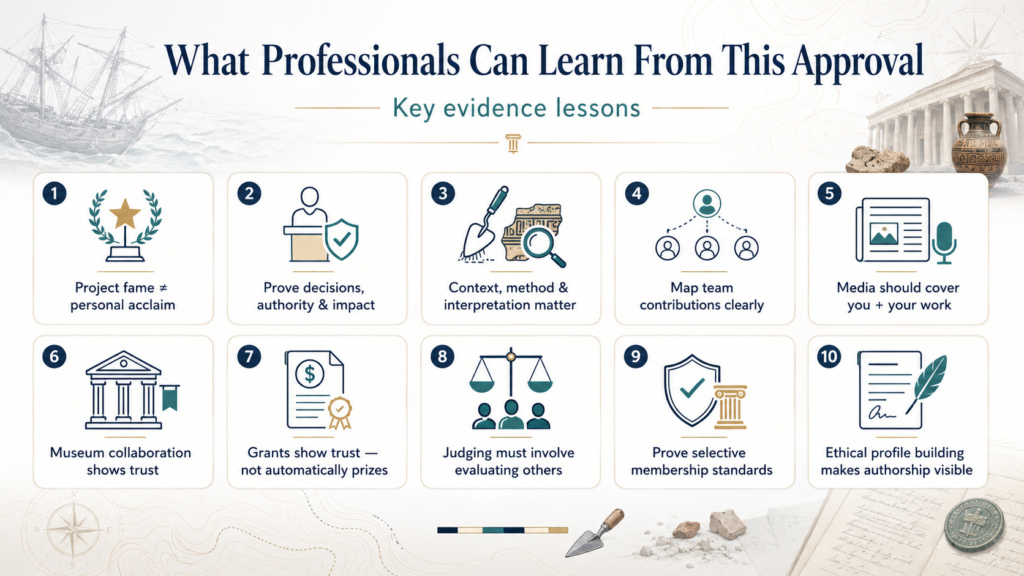
• Project fame and personal acclaim must be proved separately.
• Field leadership is stronger when the record shows decisions, authority, and consequences rather than title alone.
• In archaeology, context, method, and interpretation may be more important than the visual appeal of the recovered object.
• Long team lists require contribution mapping, not exaggerated sole-credit claims.
• Media coverage should discuss the petitioner and the petitioner’s work, not merely the discovery.
• Museum collaboration can show that an interpretation was trusted and carried into public knowledge.
• Grants can demonstrate professional trust, but should not automatically be described as nationally or internationally recognized prizes.
• Judging evidence must involve actual evaluation of other professionals’ work.
• Ordinary association membership should not be presented as achievement-based membership without proof of the admission standard.
• Ethical profile building preserves collaboration while making personal authorship visible.
Frequently asked questions
Can an underwater archaeologist qualify for EB-1A?
Yes, when the record establishes sustained acclaim and satisfies the legal standard through qualifying evidence. A strong case may involve original scholarly contributions, publication, person-focused media coverage, leading roles in distinguished projects, judging, grants, exhibitions, and other field-specific recognition. Approval always depends on the complete facts and evidence.
Does discovering a famous shipwreck prove extraordinary ability?
No. The discovery can establish important context, but USCIS still needs evidence showing what the petitioner personally did, why that work mattered, and how the field recognized the individual. A celebrated site cannot substitute for contribution attribution.
How can excavation leadership be documented?
Useful evidence may include permits, formal appointments, organizational charts, grant files, field-director records, work plans, reporting obligations, decision records, project publications, and detailed letters from professionals with direct knowledge. The documents should explain authority and actual responsibility.
Can team-based archaeology support an original-contributions claim?
Yes, when the petitioner’s contribution can be separated from the collective project and shown to have major significance. Contribution mapping may connect the person to specific methods, datasets, site interpretations, specialist integrations, publications, or later scholarly reliance.
Do recovered artifacts themselves prove an original contribution?
Not by themselves. The stronger analysis explains how the petitioner’s method, documentation, contextual interpretation, or research framework produced knowledge that affected the field. Archaeological significance usually depends on context and interpretation, not merely recovery.
What counts as a scholarly article for an archaeologist?
Peer-reviewed journal articles and other qualifying scholarly publications may count when they are written for learned audiences in the field. Excavation reports, book chapters, catalogs, and technical publications require a fact-specific analysis of authorship, venue, intended audience, and scholarly character.
What counts as published material about the petitioner?
Independent articles, interviews, profiles, documentary segments, or substantial features may qualify when they are about the petitioner and the petitioner’s work. Coverage focused only on a wreck, museum, or institution may be insufficient unless it meaningfully identifies the person.
Can a museum exhibition help an EB-1A case?
It can support the overall record when the petitioner’s curatorial, interpretive, scholarly, or advisory contribution is documented. The exhibition’s existence alone does not establish personal acclaim, and non-artistic exhibitions should not be treated automatically as the regulatory artistic-exhibition criterion.
How can grant leadership support the case?
Grant records may help prove leading responsibility, competitive professional trust, project design, and sustained recognition. The petition should explain the petitioner’s actual role and the grant-selection process rather than assuming that all funding is a nationally or internationally recognized prize.
What judging activities are relevant for underwater archaeologists?
Examples may include reviewing journal manuscripts, conference abstracts, grant proposals, excavation applications, research submissions, or the professional work of peers. The evidence must show that the petitioner actually evaluated the work of others in the field.
Can membership in an archaeology organization satisfy the EB-1A membership criterion?
Only when admission requires outstanding achievements and those achievements are judged by recognized national or international experts. Ordinary paid, credential-based, or open membership generally does not satisfy this criterion, although committee or leadership service may support other arguments.
Can confidential excavation or heritage records be used?
Often yes, through authorized summaries, redacted documents, cleared reports, and letters that explain the work without disclosing protected site locations, security details, ownership disputes, unpublished coordinates, or restricted cultural-property information.
Why is first-author work helpful in a team-based field?
It can provide a visible authorship signal, but it is not the only way to prove contribution. Publication customs differ. The case should use author-contribution records, project documents, and other evidence to explain intellectual responsibility accurately.
How does profile building help an archaeologist?
Ethical profile building identifies hidden attribution, organizes field and publication records, develops authorized person-focused visibility, documents museum and professional roles, strengthens judging and authorship records, and presents the work in language a non-specialist adjudicator can understand.
Make the person visible without rewriting the team
Underwater archaeologists, excavation directors, maritime historians, conservation scientists, museum specialists, and heritage researchers may already have persuasive EB-1A evidence. The difficulty is often that the site, institution, or exhibition became visible while the individual contribution remained scattered across technical and administrative records.