Key facts at a glance
| Outcome | EB-1A approval for a Japanese video game art director whose work helped define the visual identity of a globally shipped interactive title. |
| Approval date | Approved on March 9, 2026. |
| Field niche | Stylized art direction for interactive entertainment. |
| Starting problem | Studio NDA culture and team-credit practices made the individual contribution hard to prove. The game was visible; the art director was not. |
| Profile-building path | Studio-cleared contribution letters, industry-press interviews, conference talks, game-award nominations tied to art direction, a public portfolio record, jury roles at game festivals, high-remuneration evidence, and independent letters from game-art leaders. |
| EB-1A evidence presented | Leading or critical role, published material, original artistic contributions, judging, and high remuneration. Award nominations supported the broader recognition record where properly documented. |
USCIS approved the case. The real work was proving who made the game look that way.
EB-1A Video Game Art Director: USCIS approved his Form I-140 on March 9, 2026.
On paper, the case looked simple at first glance. He was a Japanese video game art director connected to a globally shipped title. Players recognized the game’s visual world. Reviewers discussed its atmosphere. The studio could point to a successful release. But EB-1A does not approve a game. It evaluates the person.
That distinction created the real challenge. His work sat inside a studio system where credit is shared, confidential material stays confidential, and public interviews often feature the director, producer, or studio brand. The visual identity that made the title memorable had his fingerprints on it, but the public record did not clearly explain his authorship.
Advance My Profile, powered by Immignis, reviewed the record with legal strategists and game-industry specialists and narrowed the case to stylized art direction for interactive entertainment. The petition then had to answer a practical question: how do you prove extraordinary ability in a creative field when the strongest evidence is protected by NDAs and buried inside studio collaboration?
The case was not about showing secret art. It was about proving creative authorship.
Game studios generate an enormous amount of visual work: concept art, environment direction, character rules, color systems, lighting references, user-interface mood, animation style guides, and internal review notes. Much of that material cannot leave the studio. Even when public screenshots and trailers are available, they rarely identify the person who made the art-direction decisions behind them.
For this client, the early record described employment, shipped products, and broad creative duties. It did not yet show why his role rose above ordinary participation in a game-development team.
The petition had to separate three things that are often confused in creative EB-1A cases: the reputation of the game, the reputation of the studio, and the reputation of the individual artist. The final record could use the game and the studio as context, but it still needed evidence of his own recognized work.
That required a careful, NDA-safe strategy. The case did not reveal unreleased assets, internal pipelines, source files, budgets, sales secrets, or confidential production documents. Instead, it built a public and verifiable record around the creative decisions that could be discussed: visual language, style consistency, art-direction systems, team guidance, and the way those choices shaped the player-facing experience.
What did USCIS need to see in a video game art-direction EB-1A case?
A strong game credit by itself was not enough. USCIS needed evidence that the petitioner had achieved sustained acclaim in his field and that the evidence, considered as a whole, showed the level of expertise required for EB-1A extraordinary ability.
For a leading or critical role, the petition had to show more than employment in a studio. It needed to document why the title or organization was distinguished and why his art-direction role mattered to the final creative product.
For original contributions, the record had to identify the visual methods, art-direction systems, or creative frameworks linked to him and explain why they had significance in interactive entertainment. A beautiful portfolio alone could not answer that question.
Published material had to be about him, his work, or his expertise. Articles that praised the game without mentioning his role were useful background, but they were not treated as qualifying published material about the petitioner.
Judging evidence required real evaluation of other artists’ or game creators’ work, such as jury service for game festivals, portfolio reviews, award panels, or art-direction competitions. Casual mentorship was kept separate.
High remuneration required the right comparison group. His pay could not be compared to the general labor market. The analysis had to use evidence relevant to senior game-art professionals, art directors, or comparable creative leads in the interactive-entertainment industry.
Studio-cleared letters made the invisible role documentable
The first major improvement was not publicity. It was attribution.
The petition used studio-cleared contribution letters and role evidence to explain what he was responsible for without exposing protected material. Those letters did not simply call him talented. They identified the creative functions he performed: setting visual rules, guiding concept development, aligning character and environment design, reviewing art execution, and maintaining coherence across the title’s world.
The strongest letters connected his role to decisions that players could see. They explained how the art direction affected the mood, readability, identity, and consistency of the game. That mattered because EB-1A evidence becomes stronger when a recommender can move from praise to attribution: this person made these decisions, those decisions shaped this product, and this product reached a meaningful audience.
The petition avoided vague creative adjectives. It used documents, programs, credits, studio confirmations, public assets, and independent letters to show the relationship between his individual work and the game’s recognized visual identity.
The published record was rebuilt around the artist, not only the game
In video games, press coverage often follows the product. A review may discuss the art style, atmosphere, or visual direction while never naming the person behind those choices. That can create a misleading immigration record: the work is public, but the author is not.
The profile-building process therefore developed interviews and industry coverage that discussed his art-direction practice directly. The media record explained how he approached visual storytelling, how style choices supported gameplay, and how an art director creates coherence across environments, characters, interfaces, and cinematics.
This did not replace the shipped-title evidence. It made that evidence usable. Product reviews helped show that the visual identity mattered to the game’s reception. Interviews and articles about him helped connect that reception to the professional whose decisions shaped the look of the title.
For USCIS, that distinction is important. A petition cannot rely on the popularity of a game and assume the officer will infer personal acclaim. The record must show the line from public recognition to the individual’s documented role.
Conference talks and portfolio publication gave the work a public language
The client could not simply publish internal art bibles or confidential production decks. The solution was to create a public language for the work without disclosing protected assets.
Conference talks addressed the problems that game art directors solve: building a consistent style across many contributors, protecting readability in interactive environments, designing characters and spaces that belong to the same world, and balancing visual novelty with production constraints.
A curated portfolio record did the same. It presented cleared images, process descriptions, and public work samples with proper permissions. It showed what could be shown and explained what could be explained. The petition did not ask USCIS to trust hidden work. It showed the officer a safe, documented version of the creative record.
This also helped independent experts evaluate the case. They could discuss his art-direction approach, not merely his job title.
Award nominations helped only when tied to art direction
The record included game-award nominations or recognition connected to the title’s visual presentation. This evidence was useful, but it had to be handled carefully.
An award nomination for a game is not automatically an award for every person on the development team. The petition identified the category, the basis for recognition, the title’s connection to visual or artistic achievement, and his documented role in the art-direction work being recognized.
Where the evidence supported only a nomination or product-level recognition, the petition did not inflate it into an individual prize. Instead, it used the nomination as part of the broader record showing that the game’s visual identity received industry attention and that his role in that visual identity was documented elsewhere.
That discipline made the case stronger. USCIS can discount evidence when a petition overstates it. A precise argument often carries more weight than a louder one.
Judging showed that the field used his eye, not just his labor
One of the most important recognition signals came from judging.
After profile development, the record included invitations to evaluate game-festival submissions, art-direction work, portfolio presentations, or emerging interactive-media projects. These activities showed that other professionals were willing to rely on his judgment when assessing creative work by others.
The petition documented the organization, the selection process where available, the subject matter reviewed, and the nature of his judging role. It also explained why the evaluated work belonged to the same or a closely related field.
That made judging more than a checkbox. In a creative EB-1A case, judging can show that the field recognizes the person’s taste, standards, and expertise. For an art director, that is especially relevant because the work itself depends on evaluation: deciding which visual choices belong, which do not, and why.
High remuneration had to be proven with the right comparison
The case also used high-remuneration evidence, but not as a simple salary number.
A senior creative professional in games may receive compensation through salary, bonuses, contract terms, stock, royalties, project fees, or other documented remuneration. The petition used only components that could be verified and explained.
The comparison evidence had to be meaningful. A game art director should not be compared to all designers, all artists, or all employees in a city. The petition compared his compensation with reliable market evidence for senior art directors, game-art leads, or comparable creative professionals in interactive entertainment.
The goal was not to claim that money alone proved extraordinary ability. It was to show that the market treated his creative leadership as significantly valuable when compared with others in the field.
How the EB-1A record came together
By the time the case was ready, the petition no longer looked like a studio resume.
The leading-role evidence showed that he held a meaningful creative position on a distinguished project. The original-contribution evidence explained the visual systems and art-direction methods linked to him. Published material connected his name to his expertise rather than relying only on product coverage. Judging showed that his professional assessment was used outside the studio. High-remuneration evidence showed market recognition for his level of creative work.
Independent letters tied those strands together. The strongest experts did not merely say that he was excellent. They explained how art direction functions in game development, why visual identity matters to interactive entertainment, and why his documented work represented more than routine studio participation.
The approval followed a record that made the officer’s task easier: identify the field, identify the person, identify the work, and understand why the evidence reflected recognized expertise.
Why this approval matters for game-industry professionals
Many game professionals assume EB-1A is only for researchers, founders, or public-facing celebrities. This case shows why that assumption is too narrow.
Interactive entertainment has its own hierarchies of excellence. A game artist may be known through shipped titles, festival recognition, art-direction credits, platform reach, conference invitations, portfolio influence, awards attention, or the respect of other creative leaders. The difficulty is that those signals are often scattered across credits, trailers, interviews, internal letters, and NDA-limited work samples.
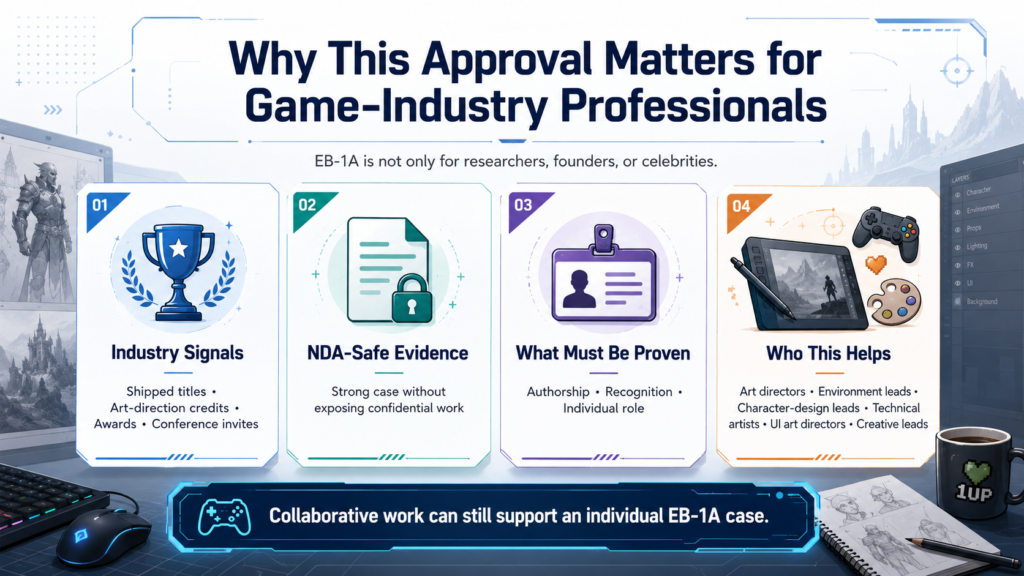
This approval matters because it shows that a game-art record can be built without breaking confidentiality. The petition did not need to expose unreleased designs or private production information. It needed to document the client’s authorship, recognition, and role using evidence the studio could clear and independent professionals could evaluate.
For art directors, environment leads, character-design leads, cinematic directors, technical artists, UI art directors, and creative leads in games, that is the practical lesson: the work may be collaborative, but the evidence still has to identify the individual.
Lessons from this EB-1A case
A shipped game is not the same as individual acclaim. USCIS still needs to understand what the petitioner personally contributed.
NDA restrictions do not end the case. They require a safer evidence strategy built around cleared materials, public assets, permissioned letters, and non-confidential explanation.
Awards and nominations must be tied to the person’s role. Product-level recognition is useful only when the petition can connect it to the relevant individual contribution.
Published material should not rely only on reviews of the title. Coverage about the petitioner or the petitioner’s expertise is stronger for the published-material criterion.
Judging can be especially valuable for creative professionals because it shows that the field relies on their standards and professional evaluation.
High remuneration is strongest when the comparison group is narrow, credible, and relevant to the person’s actual creative role.
Frequently asked questions
Can a video game art director qualify for EB-1A?
Yes, a video game art director can qualify for EB-1A if the record shows sustained acclaim, recognized achievements, and evidence under the EB-1A criteria. The petition must identify the person’s own contribution, not only the reputation of the studio or title.
Can NDA-protected work be used in an EB-1A case?
Yes, but it must be handled carefully. A petition can use studio-cleared letters, public work samples, contribution descriptions, published interviews, and independent expert analysis without disclosing confidential assets, unreleased material, or proprietary processes.
Do game-award nominations help an EB-1A petition?
They can help when the category, significance, and relationship to the petitioner’s role are documented. A nomination for a game should not be overstated as a personal award unless the evidence supports that treatment.
What is the strongest evidence for a game art director?
The strongest evidence often includes credited leading roles on distinguished projects, published material about the artist, cleared portfolio documentation, judging invitations, expert letters, conference talks, art-direction recognition, and properly compared remuneration evidence.
Is a famous studio enough for EB-1A?
No. A distinguished studio can support a leading or critical role argument, but USCIS still needs evidence of the petitioner’s individual role, recognition, and contribution.
Build an EB-1A record that shows your creative authorship
If you work in video games, animation, digital art, interactive media, cinematic design, technical art, or creative direction, your strongest work may be visible to millions of users while your name remains hard to find in the public record.
Immignis and Advance My Profile help creative professionals identify a defensible field niche, document their individual contribution, build credible recognition, and prepare an EB-1A record around evidence that can be verified, cleared, and professionally defended.