EB-1A Volcanologist: How an Ecuadorian volcanologist secured EB-1A approval by transforming life-saving eruption-monitoring work into a petition-ready immigration profile built on warning-event attribution documentation, first-author publications, international volcanology-network roles, media coverage of eruption responses, hazard-map authorship, and ethical profile building.
Key facts at a glance
| Petition outcome | Form I-140 approved under EB-1A on September 25, 2024. |
| Professional profile | Ecuadorian scientist whose monitoring work underpinned eruption warnings for populations living near active volcanoes. |
| Field niche | Andean volcano monitoring and eruption forecasting. |
| Starting weakness | Warnings saved lives anonymously, while agency publications and emergency-response materials buried the petitioner’s individual role. |
| Profile-building focus | Warning-event attribution documentation, first-author publications, international volcanology-network roles, media coverage of eruption responses, hazard-map authorship, judging or review activity, and immigration-specific profile building. |
| EB-1A criteria supported | Original contributions, scholarly articles, leading role, published material, and judging. |
| Central issue | Showing that the petitioner was not merely part of a government or agency monitoring team, but a named scientist whose hazard maps, forecasting work, and warning-event contributions carried field-level significance. |
| Approval lesson | In disaster-science cases, EB-1A profile building must convert anonymous public-safety work into clear, attributable, and technically credible evidence of individual achievement. |
The approval
On September 25, 2024, USCIS approved the Form I-140 petition of an Ecuadorian volcanologist whose work focused on Andean volcano monitoring and eruption forecasting.
The approval was important because the petitioner worked in a field where the most meaningful professional impact often appears only as a public warning, a hazard map, a monitoring bulletin, or an evacuation decision. The public sees the alert. Government agencies issue the notice. Communities move to safety. But the scientist whose analysis helped make the warning possible can remain unnamed.
That created the central evidence problem. The petitioner had strong real-world impact, but the record did not initially look like a conventional EB-1A profile. Agency publications buried individual roles, warning systems were collaborative, and the petitioner’s work was often visible only through emergency response outcomes rather than personal publicity.
Immignis and Advance My Profile helped convert that record into a petition-ready EB-1A profile. The strategy focused on warning-event attribution documentation, first-author publications, international volcanology-network roles, media coverage of eruption responses, hazard-map authorship, and professional profile building that made the petitioner’s individual scientific contribution clear without overstating the collaborative nature of disaster science.
The evidence problem in volcano monitoring and eruption forecasting
Volcano monitoring is a public-safety field where success is often measured by what does not happen. When an eruption warning is timely, people evacuate, transportation routes close, emergency teams prepare, and casualties may be prevented. Yet the individual scientific work behind that decision can disappear behind an agency logo or a national disaster-management bulletin.
The petitioner’s starting weakness was therefore not a lack of importance. It was attribution. His monitoring work helped support warning systems for populations living on active volcanoes, but much of the visible record belonged to institutions, government agencies, or emergency-response systems rather than to him personally.
The petition defined the field carefully as Andean volcano monitoring and eruption forecasting. It did not present the case as general geology, broad environmental science, or routine civil-service work. It framed the petitioner’s niche around seismic signals, gas monitoring, eruption patterns, hazard mapping, risk communication, and the translation of scientific data into public warnings.
This field definition was essential for immigration-specific profile building. It helped USCIS understand that the petitioner’s work was not only academic research, and not only government service. It was applied disaster science with direct consequences for public safety, emergency planning, and national resilience.
Why anonymous public-safety work needed person-centered evidence
A major challenge in this case was the anonymity of public-safety science. Eruption warnings are rarely issued in the name of one scientist. Hazard maps are often published by agencies. Monitoring bulletins are usually institutional. Emergency media coverage may quote officials rather than the researcher whose analysis shaped the warning.
That anonymity can be a serious problem in EB-1A cases. USCIS evaluates the individual, not the institution. A petition cannot succeed simply by showing that a national monitoring program is important. It must show how the petitioner personally contributed to that program’s scientific quality, operational decisions, or recognized outputs.
The profile-building process therefore focused on attribution. Each major warning event, map, publication, network role, and media reference had to be examined for what it proved about the petitioner. Where the public record was institutional, the petition used letters, authorship evidence, and technical documentation to connect the scientific work back to the petitioner.
This is a key lesson for professionals searching for profile building, immigration profile building, EB-1A profile building, EB-2 NIW profile building, professional profile improvement, or USCIS evidence building: impact becomes stronger when it is not only described, but attributed.
Warning-event attribution documentation showed real-world impact
Warning-event attribution documentation became one of the strongest pillars of the case. In volcanology, an important contribution may be reflected in a specific eruption-warning sequence, monitoring interpretation, hazard-level adjustment, evacuation support, or technical briefing that helped authorities understand risk at the right time.
The petition organized evidence around the petitioner’s role in warning-related work. It documented how his monitoring analysis, field observations, data interpretation, or hazard assessment contributed to warnings or emergency decisions. The goal was not to claim sole credit for a multi-agency response, but to show that his scientific judgment was an important part of the process.
This evidence supported the original-contributions criterion because it connected the petitioner’s work to practical consequences in the field. The contribution was not theoretical only. It helped shape decisions that affected communities living near active volcanoes.
For scientific profile building, this type of documentation is valuable because it translates technical work into adjudicator-readable evidence. USCIS may not understand the full complexity of eruption forecasting, but it can understand that named scientific input supported warning events with public-safety consequences.
First-author publications gave the record a scholarly foundation
First-author publications helped separate the petitioner from the institution and gave the record a clear scholarly foundation. In a collaborative scientific field, authorship matters because it helps show intellectual leadership and personal responsibility for research output.
The petition used first-author publications to show that the petitioner was not only collecting data inside a monitoring agency. He was producing scientific work that other volcanologists could read, evaluate, cite, and apply. These publications supported the scholarly-articles criterion and strengthened the original-contributions argument.
The publications also helped explain the field itself. They showed the technical basis for eruption forecasting, hazard analysis, monitoring interpretation, and regional volcano behavior. That gave USCIS a clearer way to understand why the petitioner’s work was significant in a specialized scientific niche.
As part of research profile building and immigration-specific profile building, first-author work served a dual purpose: it proved scholarship and made the petitioner visible as an individual scientist.
Hazard-map authorship turned public safety tools into EB-1A evidence
Hazard-map authorship was one of the most distinctive pieces of the case. In volcanology, hazard maps are not simple graphics. They are scientific tools used by governments, emergency planners, local authorities, and communities to understand danger zones, likely flows, evacuation areas, and response priorities.
The petition treated hazard-map authorship as both technical authorship and applied field contribution. It showed that the petitioner helped create or shape materials that a nation and its communities could rely on during eruption risk planning. This made the petitioner’s work concrete, public, and attributable.
That was the approval hook: named authorship of the hazard maps a nation evacuates by. The record showed that the petitioner’s science did not remain inside a laboratory or a database. It became decision-making infrastructure.
This was especially powerful for EB-1A profile building because hazard maps sit at the intersection of scholarship, original contribution, public safety, and leading role. They convert scientific expertise into a tool the field actually uses.
International volcanology-network roles showed recognition beyond one agency
International volcanology-network roles helped prove that the petitioner’s expertise was not limited to a local agency context. In scientific EB-1A cases, external professional roles matter because they show that the field recognizes the petitioner’s knowledge beyond the employer or home institution.
The petition used network roles to demonstrate that the petitioner participated in the broader volcanology community, shared technical insight, and engaged with international professionals working on eruption forecasting, hazard mapping, monitoring standards, and volcanic-risk communication.
These roles supported leading role, membership, and final-merits arguments. They showed that the petitioner was not simply a local technician or internal employee. He was part of the professional systems through which the field develops and validates expertise.
For immigration profile building, international network participation is particularly useful when a professional works in a government or agency setting. It helps prove that recognition travels beyond the job title.
Media coverage of eruption responses helped make the impact understandable
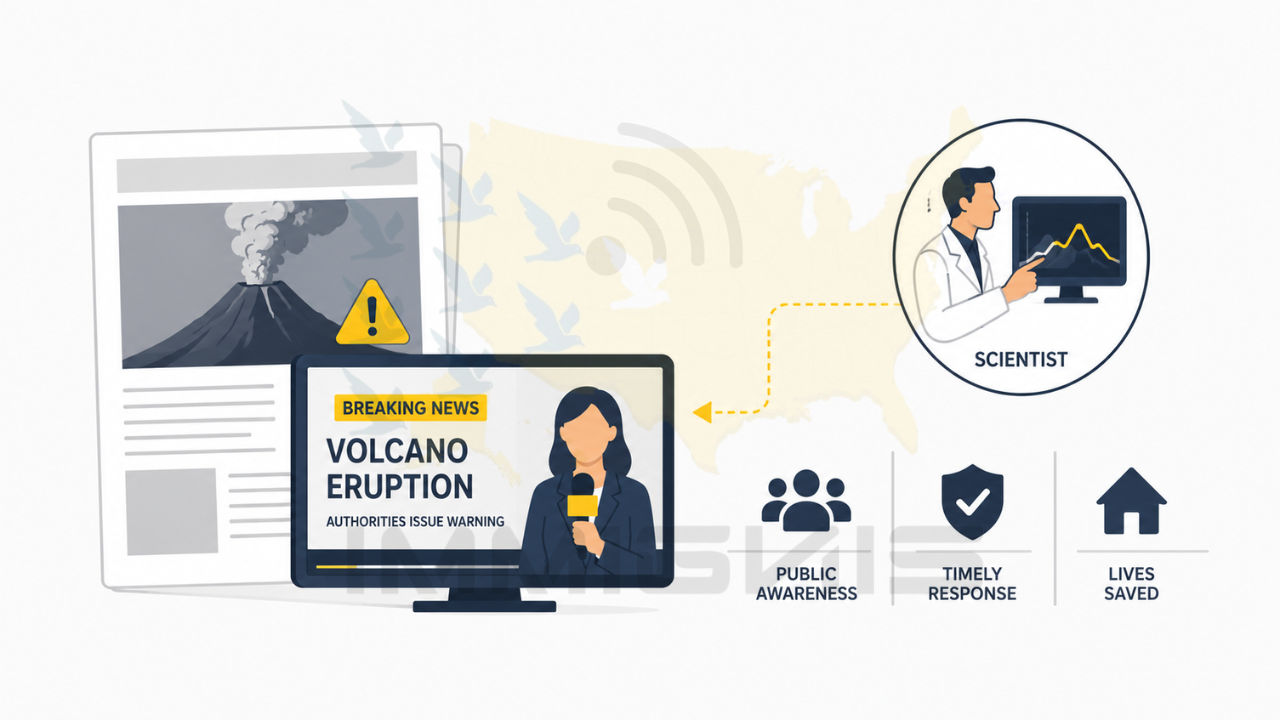
Media coverage of eruption responses helped translate technical monitoring work into public-facing significance. Volcanology can be difficult for non-specialists, but eruption-response coverage makes the stakes immediately understandable: warnings, communities, evacuations, ashfall, emergency routes, and risk communication.
The petition used media evidence carefully. It did not treat media attention as celebrity evidence. Instead, it used coverage to show that the petitioner’s field was important, that eruption responses were nationally significant, and that the scientific work behind them mattered to the public.
Where media coverage named the petitioner, it supported published material. Where coverage discussed warning events, hazard maps, or official response, it helped contextualize the significance of the underlying scientific contribution. Combined with attribution letters and technical records, the media evidence became part of a broader, credible profile.
This is what profile improvement often requires: not merely collecting press, but explaining why the press connects to the petitioner’s contribution and to the EB-1A criteria.
Judging and review activity reinforced professional trust
Judging or review activity helped strengthen the case because it showed that other professionals trusted the petitioner to evaluate scientific work, hazard materials, technical submissions, or field-related outputs. In research and applied science, judging is often reflected through peer review, technical review committees, conference abstract review, or professional assessment roles.
The petition connected this activity to the judging criterion. It showed that the petitioner was not only producing work, but also being asked to assess the work of others. That kind of responsibility is a strong marker of professional standing.
In volcanology, review activity can be especially meaningful because the field is small and technical. When a scientist is trusted to review hazard research or eruption-related work, the field is effectively recognizing that person’s expertise.
As part of EB-1A profile building, this evidence helped round out the petition. It showed scholarship, applied impact, public significance, and professional trust working together.
How profile building changed the case
Before profile building, the petitioner’s record could have looked too institutional and too anonymous. The warnings were important, the hazard maps mattered, and the monitoring work was valuable, but USCIS needed a clear person-centered story.
Immignis and Advance My Profile helped organize the record around a focused EB-1A theory: original contribution in Andean volcano monitoring and eruption forecasting, supported by scholarly articles, leading role, published material, judging, and evidence of field-level recognition.
The profile-building process turned warning-event attribution into impact evidence, first-author publications into scholarly proof, hazard-map authorship into original contribution, volcanology-network roles into professional recognition, and media coverage into public-significance context.
For scientists, researchers, disaster-risk specialists, geologists, and public-safety professionals searching online for profile building, immigration-specific profile building, EB-1A profile building, EB-2 NIW profile building, or professional profile improvement, this case shows how applied scientific work can become a strong immigration profile when the evidence is organized correctly.
Why this case worked
The case worked because every evidence category solved a real problem. Warning-event attribution solved the anonymity problem. First-author publications solved the individual-scholarship problem. Hazard-map authorship solved the public-tool problem. International network roles solved the external-recognition problem. Judging activity solved the professional-trust problem.
The petition also respected the collaborative nature of disaster science. It did not claim that one scientist alone saved entire populations. Instead, it showed that the petitioner made identifiable contributions inside a high-stakes scientific system where individual judgment and technical authorship mattered.
Most importantly, the case translated public-safety science into USCIS language without flattening it. It showed that eruption forecasting is not only government service. It is a specialized scientific field where top professionals can have measurable, attributable, and life-saving impact.
That is why this case became a strong example of ethical profile building for volcanologists, disaster scientists, geologists, hazard-mapping specialists, and researchers whose most important work is often credited to institutions.
Conclusion
The Ecuadorian volcanologist’s EB-1A approval shows that disaster-science achievements can support extraordinary ability when the evidence is built with discipline and attribution.
The petition succeeded by turning eruption-warning work, first-author publications, volcanology-network roles, media coverage, hazard-map authorship, and judging activity into a clear immigration profile that USCIS could evaluate.
The broader lesson is clear: anonymous public-safety science does not have to remain invisible. With ethical profile building and immigration-specific evidence development, the scientist behind the warning can become visible as a documented authority in the field.
Frequently asked questions
Can a volcanologist qualify for EB-1A?
Yes. A volcanologist may qualify for EB-1A when the record shows extraordinary ability through original contributions, scholarly articles, leading roles, published material, judging, and strong final-merits evidence.
Can eruption-warning work support an EB-1A petition?
Yes. Eruption-warning work can support EB-1A when the petition documents the petitioner’s specific role, the technical importance of the work, and its impact on public safety or field practice.
Do hazard maps help prove original contribution?
Yes. Hazard maps can be strong evidence when they are scientifically significant, used by agencies or communities, and clearly connected to the petitioner’s authorship or technical contribution.
Can agency-based scientists build strong EB-1A profiles?
Yes. Agency-based scientists can build strong EB-1A profiles when institutional work is translated into person-centered evidence such as publications, authorship, letters, technical roles, media recognition, and judging activity.
Does media coverage help in a scientific EB-1A case?
Yes, when used carefully. Media coverage can help show public significance and published material, especially when it connects the petitioner or the petitioner’s work to important scientific or emergency-response outcomes.
Can Immignis and Advance My Profile help scientists build EB-1A evidence?
Yes. Immignis and Advance My Profile help scientists, researchers, disaster-risk professionals, and technical experts define a niche, document achievements, improve visibility, and build a petition-ready EB-1A or EB-2 NIW profile through ethical profile building and immigration-specific evidence development.
Build an EB-1A record around disaster science, hazard mapping, publication, and public-safety impact
Many scientists and public-safety professionals already have meaningful field impact, but the evidence is often scattered across agency publications, maps, technical reports, media coverage, internal records, and collaborative emergency-response systems.
Start with a free EB-1A profile assessment and find out whether your geology, volcanology, disaster-risk, hazard-mapping, environmental science, publication, or public-safety record can be developed into a stronger immigration profile through ethical profile building, profile improvement, and USCIS evidence building.