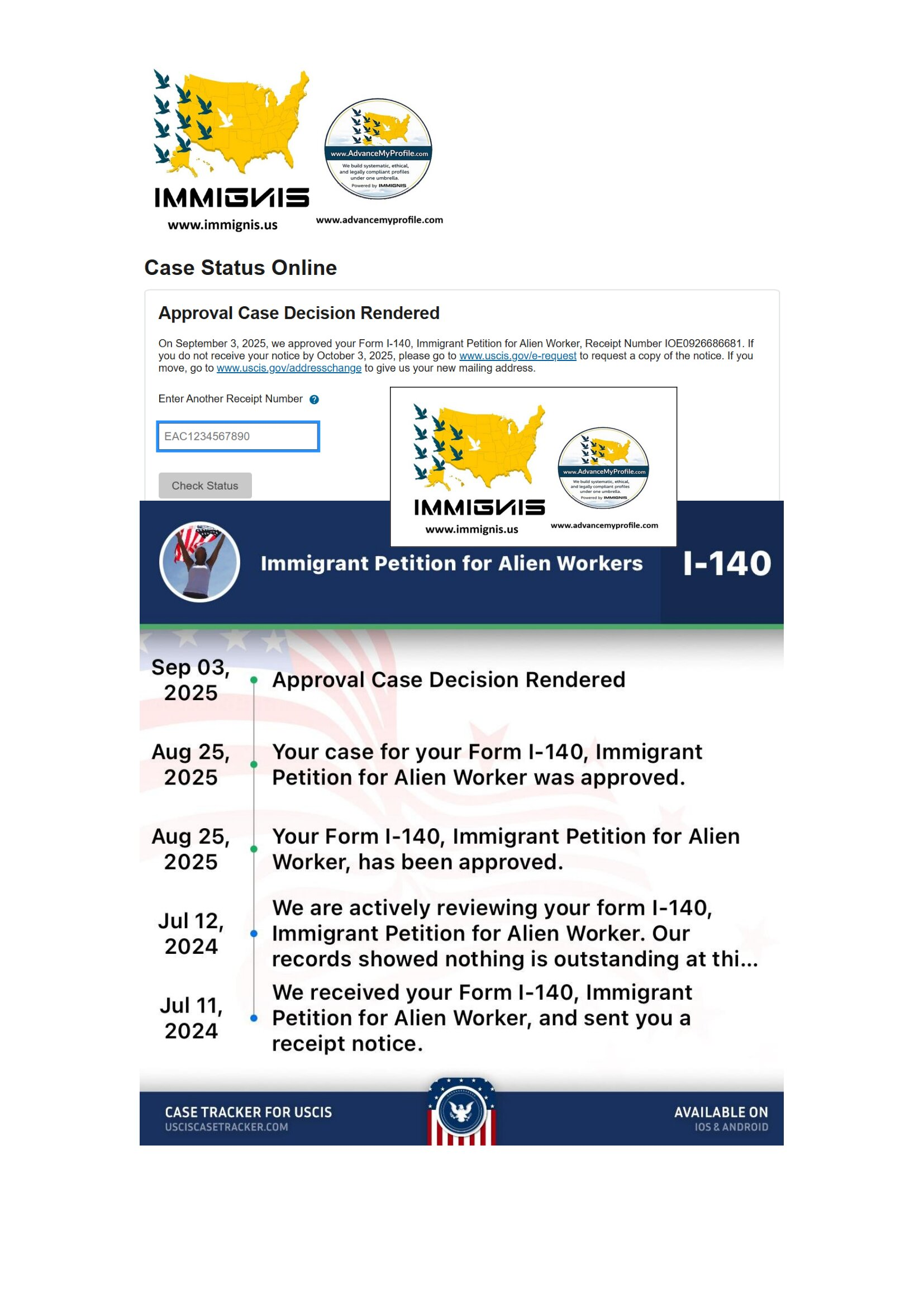
USCIS approved the Form I-140 after the petition connected leak prediction, municipal adoption evidence, public recognition, and independent expert support to one focused water-loss analytics specialty.
Key facts at a glance
| Outcome | EB-1A approval for a Jordanian water security data scientist working with a U.S.-based water utility partner. |
| Approval date | Approved on September 3, 2025. |
| Field niche | Leak prediction and water-loss analytics for utilities, with a focus on identifying probable losses, prioritizing field investigation, and helping water systems act before small losses become larger infrastructure problems. |
| Starting problem | His strongest evidence came from utility implementation work. The record initially showed useful projects, but it did not clearly show sustained acclaim or field-level recognition of his own data-science methods. |
| Profile-building path | Focused water-loss analytics papers, municipal adoption metrics, a policy brief for water associations, media interviews, invited talks, peer review, professional recognition evidence, leading-role documentation, and independent letters from utility and water-security experts. |
| EB-1A criteria supported | Original contributions, scholarly articles, published material, awards or professional recognition where supported by the final record, judging, and leading or critical role. |
The EB-1A Water Security Data Scientist received USCIS approval of his Form I-140 on September 3, 2025.
The case was not approved because water loss is a serious issue. That part was easy to understand. Cities, utilities, engineers, and taxpayers already know that leaking distribution systems waste treated water, strain budgets, and make infrastructure planning harder.
The harder EB-1A question was more specific: did the record show a Jordanian data scientist whose own leak-prediction and water-loss analytics methods had been recognized as significant beyond ordinary utility implementation work?
He worked with a U.S.-based water utility partner. His field was water security data science, especially leak prediction and water-loss analytics for utilities. His work helped utility teams use operational records, pressure-zone information, meter patterns, historical leaks, field activity, and risk indicators to decide where investigation should happen first.
Before profile building, the record had a common problem. The work was practical and valuable, but it looked like project delivery. It described utility dashboards, data models, implementation support, and municipal use. It did not yet explain why his methods made him an authority in water-loss analytics.
Advance My Profile, powered by Immignis, reviewed the evidence with legal strategists and water-infrastructure specialists. The petition was narrowed to a defensible field niche: leak prediction and water-loss analytics for utilities. That focus allowed the case to show a data scientist whose work was connected to water security, infrastructure efficiency, and utility decision-making.
The best evidence was not the leak. It was the decision before the leak became obvious.
A visible main break is easy to recognize. Water appears at the surface, pressure drops, customers call, and crews respond. A hidden loss is harder. It may appear first as a pattern: unusual night flow, pressure behavior that does not match demand, repeated repairs in a zone, a meter anomaly, or a set of work orders that looks ordinary until the system is viewed as a whole.
His professional contribution sat in that earlier moment. The goal was not to replace field crews, hydraulic engineers, or utility managers. It was to help them decide where the evidence pointed, which areas deserved attention, and how limited inspection resources could be used more intelligently.
That distinction mattered for EB-1A. If the petition described only software implementation, the case risked looking like ordinary analytics work. If it explained how his models supported leak investigation, water-loss prioritization, and infrastructure decision-making, the officer could see the professional method behind the utility results.
Why useful utility projects can still look ordinary to USCIS
Water utilities create many kinds of records: meter data, pressure readings, repair histories, customer complaints, inspection logs, asset age, district metered area results, and non-revenue water reports. A data scientist may spend years making those records usable. Inside the utility, that work can change how teams search for losses. Outside the utility, it may appear as a dashboard or an implementation project.
That was the evidentiary weakness. The initial record showed municipal work and implementation value, but it did not clearly separate his individual contribution from the broader utility program. It also did not show enough independent recognition, public authorship, judging, or professional explanation of why his approach mattered to the water field.
The petition needed to answer practical questions. What did he build or design? What problem did it solve? How were municipal adoption metrics used without exaggeration? Who recognized the value of the method outside the immediate project? Why was this more than a useful consulting assignment?
Those questions shaped the final record.
His niche was the point where water-loss data becomes field action
Leak prediction depends on more than finding unusual numbers. A utility has to know whether a pattern is reliable enough to justify field investigation, acoustic testing, pressure review, meter inspection, valve checks, or maintenance planning. False alarms waste crew time. A missed signal can allow treated water to continue disappearing underground.
His work focused on connecting data signals to utility action. The evidence showed recurring work with leak-risk indicators, meter and pressure patterns, historical repair records, asset conditions, zone-level behavior, prioritization models, and the operational use of predictive outputs.
The petition did not describe him as a general data scientist who happened to work in utilities. It described a water security data scientist whose methods helped utilities identify probable losses and prioritize response.
That narrower description made the EB-1A case more credible. It connected the technical record to a public-infrastructure problem that cities and water systems understand.
What USCIS needed to see in a water-loss analytics EB-1A case
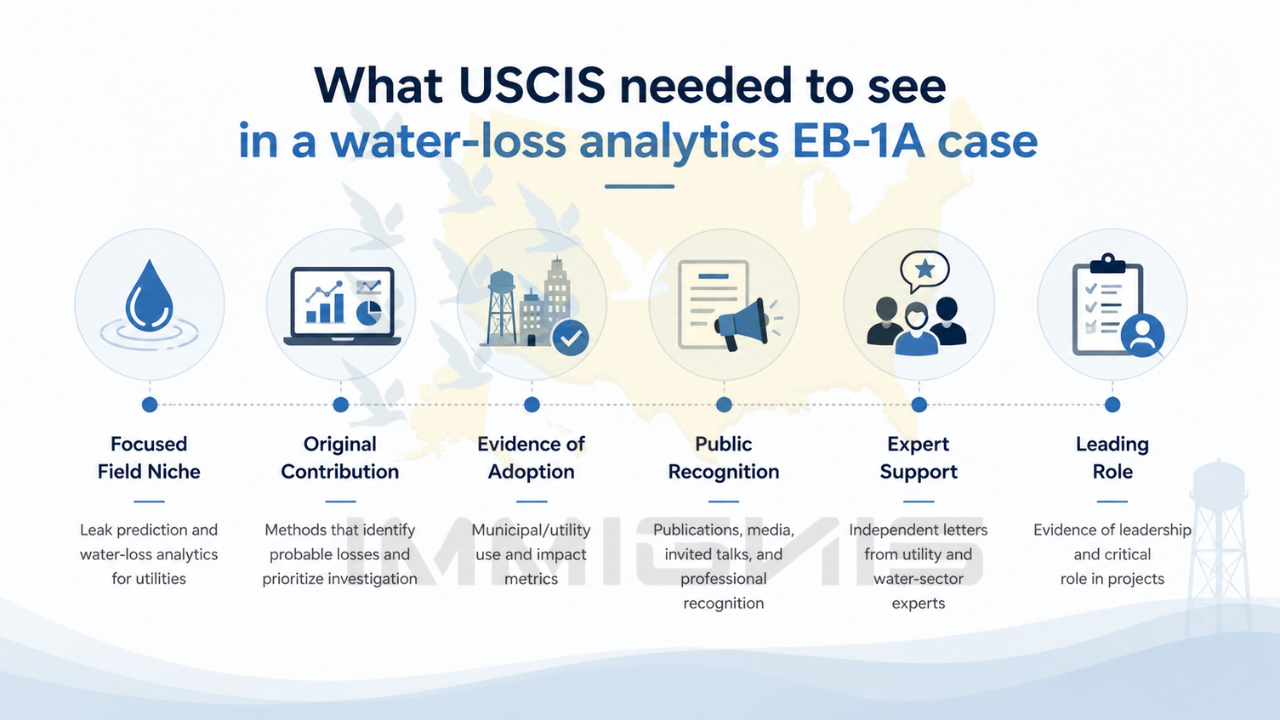
USCIS needed evidence that the applicant had extraordinary ability in a defined field, not simply experience on important water projects.
For original contributions, the petition identified his leak-prediction methods, prioritization logic, utility analytics framework, and documented use of his work. Independent experts explained why these contributions mattered for water-loss management, infrastructure planning, and utility decision support.
Scholarly articles had to support the same professional niche. The papers addressed leak prediction, non-revenue water analytics, municipal data reliability, and the practical problem of converting utility records into investigation priorities.
Published material required independent coverage about him or his expertise. Media interviews helped show that he was explaining water-loss analytics and infrastructure risk to a broader audience rather than remaining invisible inside implementation work.
Peer review supported judging where he evaluated the work of other specialists. Leading or critical role evidence had to show that significant water-analytics work depended on his technical judgment. Professional recognition and award evidence were handled carefully: the petition documented what the record actually proved and did not turn a submission or nomination into a win unless the evidence supported that conclusion.
At final merits, the petition still had to show sustained acclaim. A utility project may be useful, but EB-1A requires a record of recognized achievement. The evidence had to work together.
The municipal evidence was rebuilt around method, adoption, and attribution
The profile-building process began by reorganizing municipal records around the data-science contribution rather than the project label.
The petition grouped evidence by problem. Which signals were used to identify possible loss? How were zones prioritized? What historical data helped validate the model? Which utility decisions relied on the output? Where did the applicant design or improve the method? What adoption or use could be documented without overstating the result?
That structure helped the case avoid a common weakness in infrastructure petitions: presenting implementation as if implementation alone proves extraordinary ability.
The stronger record explained the analytical method and its use. It showed how his work helped convert scattered utility records into a more organized way to investigate loss. It also showed that adoption evidence was tied to documented use, not unsupported claims that every reduction in water loss came from one model.
Customer records, protected utility details, specific network vulnerabilities, and confidential municipal data stayed outside the public story. The petition used safe summaries, technical descriptions, adoption evidence, expert letters, and public-facing work.
The papers turned utility analytics into a public technical record
With domain support, he developed focused papers on leak prediction, non-revenue water analytics, municipal data quality, and prioritization methods for utility investigation.
One paper examined why water-loss prediction can fail when models treat all anomalies the same. Another addressed the practical limits of using incomplete utility data, where meter records, pressure patterns, repair histories, and field observations may not align perfectly.
The papers did not claim that data science can find every leak or replace utility engineering judgment. They explained how predictive analytics can help utilities decide where to look first, how to interpret risk signals, and how to use limited field resources more effectively.
This public authorship mattered because many utility analytics professionals have their most useful work buried inside implementation records. The papers gave the field, independent experts, and USCIS a technical basis for evaluating his contribution.
Municipal adoption metrics were useful because they were disciplined
Adoption evidence can be powerful in an EB-1A case, but it can also create risk if the petition overclaims. A utility may reduce water loss because of many factors: pipe replacement, pressure management, improved metering, field inspection, repairs, operational changes, drought response, or better analytics.
The case did not claim that one data model caused every documented improvement. Instead, the petition used municipal adoption metrics to show where the applicant’s analytics methods entered utility decision processes and where the output supported leak investigation or prioritization.
The record connected the method to documented use. It traced the problem, the applicant’s role, the analytical approach, the utility process affected, and the evidence available for adoption or practical value.
That careful approach made the adoption evidence more credible. It showed significance without turning correlation into an unsupported claim of causation.
The policy brief connected leak prediction to water security
The policy brief was written for water associations, utility leaders, municipal officials, and infrastructure professionals who needed a practical explanation of why data quality and prediction matter in water-loss management.
It organized the issue around non-revenue water, aging infrastructure, pressure zones, maintenance prioritization, field investigation, and the cost of waiting until a leak becomes visible. The brief explained that water security is not only about supply; it also depends on whether treated water can reach customers without avoidable loss.
The brief did not present predictive analytics as a cure-all. It treated leak prediction as one part of a larger utility strategy that can include asset management, field inspection, pressure review, repair planning, and public investment.
That tone helped the profile. It showed a professional who could explain his technical work in a way that utilities and policy audiences could use.
Media interviews made the problem understandable without turning it into publicity
Water-loss analytics can become too technical for a general audience. His media interviews helped translate the work without reducing it to buzzwords.
He explained why not every leak becomes visible, why utilities often need to prioritize where crews investigate, and why data from meters, pressure zones, work orders, and asset records can help identify patterns. He also discussed the limits of prediction. A model can point to risk; the utility still needs field confirmation and engineering judgment.
This coverage supported the published-material record when it focused on him or his expertise. It also helped the final merits argument because it showed public recognition of his role in an infrastructure subject that matters to cities and water systems.
Invited talks put the method in front of the people who understood the stakes
The invited talks were not general presentations about artificial intelligence. They focused on water-loss analytics, prediction reliability, municipal data limitations, and how utilities can use risk scores without blindly trusting them.
Audience questions addressed practical issues: incomplete data, older assets, pressure changes, field-verification costs, false positives, and how to explain model recommendations to utility decision-makers.
These talks helped show recognition by professional audiences. They also gave the petition another way to explain the applicant’s field: not data science in the abstract, but analytics that help utilities decide where hidden loss is most likely and what action should follow.
Peer review and judging showed that others relied on his technical judgment
Peer review and judging evidence was documented carefully. The record showed where journals, conferences, or professional venues asked him to evaluate work by other specialists in water analytics, infrastructure data science, environmental engineering, utility systems, or related fields.
This evidence mattered because EB-1A judging is not the same as holding a senior job title. The petition had to show that he evaluated the work of others, not merely managed his own projects.
His reviews required technical judgment. He assessed data methods, validation logic, municipal applicability, model claims, infrastructure assumptions, and whether conclusions followed from the available evidence.
That helped show professional reliance beyond his own utility projects.
The professional recognition evidence was kept accurate
The case included professional recognition and award-related evidence, but the petition did not inflate it.
Where the final record showed a qualifying award, selection, or professional recognition, the evidence documented the scope, criteria, selection basis, and relevance to the field. Where the record showed only a submission or nomination, it was described accurately and was not treated as a completed award win.
That distinction matters. USCIS can reject exaggerated award claims quickly. A disciplined record is usually stronger than one that tries to make every application, shortlist, or organizational badge look like major acclaim.
The professional recognition evidence worked best when it supported the larger story: his leak-prediction and water-loss analytics work was being recognized by people outside the immediate project environment.
Independent utility experts helped explain why the work mattered
Independent letters were important because an officer may understand the general importance of water infrastructure but still need help evaluating the applicant’s specific data-science contribution.
The strongest letters did not simply praise him. They explained the water-loss problem, the limitations of traditional reactive response, the role of predictive analytics, and why his methods or documented work mattered to utility decision-making.
The letters also helped separate his individual contribution from the broader projects around him. They discussed attribution, technical method, practical use, and significance in the field.
That independent analysis helped the petition move from implementation evidence to recognized expertise.
How the EB-1A evidence came together
The petition did not rely on one piece of evidence. It built a record where the parts supported each other.
The scholarly articles gave the case a public technical record in leak prediction and water-loss analytics. The municipal adoption evidence showed that the methods entered practical utility decision processes. The policy brief connected the work to water security and infrastructure planning. Media interviews and invited talks showed broader explanation and recognition. Peer review and judging documented reliance on his technical judgment. Professional recognition evidence strengthened the record where it was supported. Independent letters explained significance and attribution.
For original contributions, the case focused on methods and documented utility use, not job duties. For published material, it relied on coverage about him or his expertise. For judging, it documented evaluation of other specialists’ work. For leading or critical role, it showed where utility analytics work depended on his technical judgment or leadership.
At final merits, the record described one coherent professional: a water security data scientist recognized for leak prediction and water-loss analytics for utilities.
The approval showed why infrastructure data cases need a clear field narrative
USCIS approved the Form I-140 after the record showed more than municipal implementation. The petition connected his data-science methods to a water-security problem, documented practical use, and supported the case with public authorship, professional recognition, judging, media, invited talks, leading-role evidence, and independent letters.
The approval did not mean that every utility data scientist qualifies for EB-1A. It showed that a carefully documented record can make an under-recognized infrastructure specialty visible to USCIS.
For this client, the key was not presenting water loss as important. The key was proving that his own work in leak prediction and water-loss analytics had become recognized, attributable, and significant enough to support an EB-1A petition.
What other water and infrastructure professionals can learn from this case
Many infrastructure professionals assume that practical value will speak for itself. It often does not. A utility may rely on an engineer, data scientist, or analyst for years while the public record shows very little about that person’s standing in the field.
A strong EB-1A record usually needs more than project descriptions. It needs a defined niche, evidence of individual contribution, public authorship, independent recognition, judging, and proof that others in the field understand the value of the work.
For water professionals, the most important step is often narrowing the story. A person may work on water data, smart utilities, infrastructure analytics, asset management, drought response, or non-revenue water. The EB-1A case becomes stronger when the petition identifies the precise professional question the applicant is known for answering.
Frequently asked questions
Can a water security data scientist qualify for EB-1A?
Yes. A water security data scientist may qualify if the record shows extraordinary ability through sustained acclaim, recognized achievements, and contributions that go beyond ordinary implementation or employment responsibilities.
Can utility implementation work support an EB-1A original-contribution claim?
Yes, but it must be documented carefully. The petition should identify the applicant’s own method, show practical use or significance, and include independent expert explanation. A dashboard or project deployment alone is usually not enough.
Can municipal adoption metrics help an EB-1A case?
Yes. Adoption metrics can help when they are tied to the applicant’s method and documented use. The petition should avoid claiming that one model caused every improvement unless the evidence clearly proves that.
Does media coverage about water loss count as published material?
Only if the coverage is about the applicant or the applicant’s expertise in a qualifying way. General articles about water loss or infrastructure, without meaningful discussion of the applicant, may not support the published-material criterion.
Can peer review count as judging for a water analytics professional?
Yes. Peer review can support the judging criterion when the applicant actually evaluated the work of other specialists. The record should document the review activity and its relevance to the field.
Is an award nomination the same as an EB-1A award?
No. A nomination or submission should not be presented as an award win unless the record proves selection or recognition. Professional recognition evidence should be described accurately and supported by documentation.
Build an EB-1A record around the water-security method your utility work already proves
If you work in water analytics, leak prediction, non-revenue water, municipal infrastructure, smart utilities, environmental data science, or asset-management modeling, your strongest EB-1A evidence may already be hidden inside project records and utility adoption evidence.
Immignis and Advance My Profile help professionals identify a defensible authority niche, document original contributions, develop credible public recognition, and prepare an EB-1A record around evidence that can be verified and defended professionally.