EB-1A Women’s Health Physician: How an Afghan OB-GYN secured EB-1A approval by transforming a difficult, safety-sensitive record into a petition-ready immigration profile built on ethical profile building, security-conscious evidence protocol, international-organization attestations, protective publication, global-health platform appearances, training-program leadership, and immigration-specific profile building.
Key facts at a glance
| Petition outcome | Form I-140 approved under EB-1A on September 4, 2024. |
| Professional profile | Afghan women’s-health physician and OB-GYN who sustained maternal-health services under conditions few clinicians anywhere in the world have faced. |
| Field niche | Maternal healthcare delivery in access-restricted environments. |
| Starting weakness | The work was heroic and important, but the documentation environment was hostile, safety-sensitive, and not naturally structured for USCIS review. |
| Profile-building focus | Security-conscious evidence protocol, international-organization attestations, publication with protective anonymization of locations, global-health platform appearances, training-program leadership records, expert letters, and ethical profile building. |
| EB-1A criteria supported | Leading role, original contributions, published material, membership, and judging. |
| Central issue | Showing that the petitioner’s maternal-health work reflected extraordinary ability while protecting patients, colleagues, partner organizations, and locations that could not safely be exposed in a public-facing record. |
| Approval lesson | A strong EB-1A case can be built even in a hostile documentation environment when immigration-specific profile building organizes real impact through a safety-first evidence architecture. |
The approval
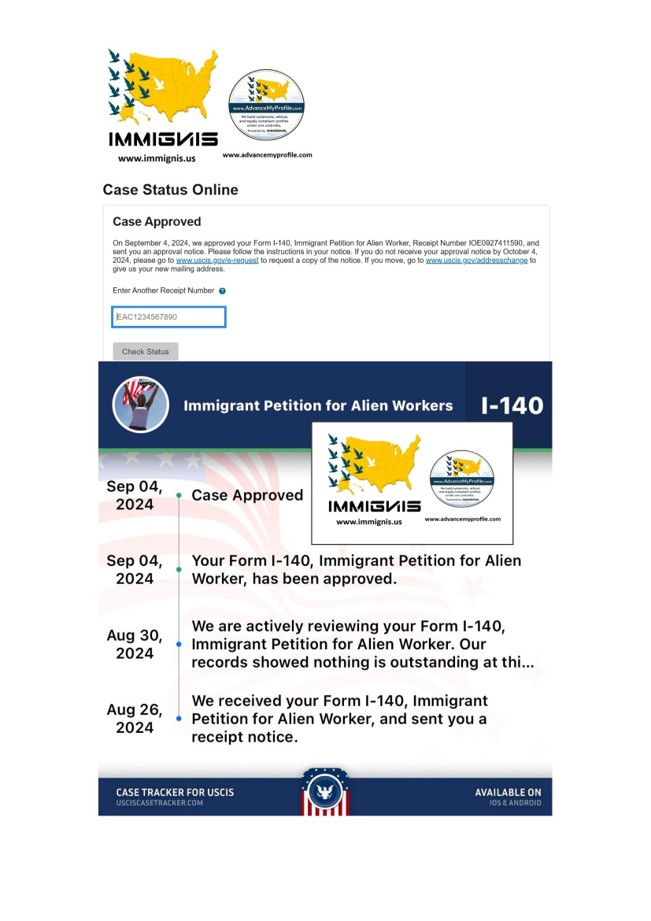
On September 4, 2024, USCIS approved the Form I-140 petition of an Afghan women’s-health physician whose work focused on maternal healthcare delivery in access-restricted environments.
The approval mattered because the petitioner’s strongest evidence did not come from the kind of stable institutional setting USCIS usually expects. Her medical work involved service continuity, maternal-health delivery, clinical leadership, and training under circumstances where public attribution could create safety risks and where ordinary documentation systems were often incomplete, fragmented, or deliberately restrained.
That made this case a strong example of EB-1A profile building, immigration profile building, and ethical professional profile building. The physician already had real extraordinary-value experience, but the record had to be built in a way that made USCIS understand both the significance of the work and the reasons the evidence looked different from a typical hospital-based academic record.
Immignis and Advance My Profile helped convert the petitioner’s work into a petition-ready EB-1A profile. The strategy focused on a security-conscious evidence protocol, international-organization attestations, publication with protective anonymization of locations, global-health platform appearances, training-program leadership records, expert letters, and profile improvement that increased visibility without endangering anyone involved.
The evidence problem in access-restricted maternal-health work
Maternal-health work in access-restricted environments creates one of the hardest EB-1A evidence problems in medicine. The clinical need is urgent, the outcomes are high stakes, and the work can be genuinely field-shaping, yet the public record is often intentionally thin because names, sites, patient flows, and partner systems may be safety-sensitive.
The petitioner’s starting weakness was not a lack of impact. It was that the impact lived inside service continuity, maternal emergency management, training systems, referral pathways, community trust, and practical care delivery under pressure rather than inside a conventional prestige record. USCIS could not simply be asked to assume significance from difficult conditions alone.
The petition therefore had to define the field carefully as maternal healthcare delivery in access-restricted environments. It was not framed as ordinary OB-GYN practice, general women’s health, or routine hospital service. It was framed as a specialized niche in which clinical leadership, operational judgment, and the ability to sustain care under extraordinary constraints were central markers of professional distinction.
This definition became the foundation of the profile-building strategy. It allowed the evidence to be judged through the correct lens: whether the petitioner had risen to the top of a demanding and highly unusual professional niche, not whether she had enjoyed the advantages of a stable academic institution.
Why safety-sensitive cases require a different profile-building strategy
Many physicians working in fragile or restricted environments face the same problem. Their strongest accomplishments cannot simply be uploaded to the internet, tied to exact coordinates, or publicly attributed in the way a standard immigration case might prefer. What proves the work is often the same information that could expose patients, colleagues, or facilities.
In this case, immigration-specific profile building was essential because the objective was not to make the case louder. It was to make the case safer and clearer at the same time. USCIS needed enough detail to understand the petitioner’s leading role and original contribution, but not so much specificity that the evidence would create avoidable risk.
That required disciplined evidence design. Each item had to be evaluated for what it proved, what it revealed, and whether the same point could be supported in a more protective way through corroboration, redaction, anonymization, or expert explanation.
The approval hook emerged from that strategy: evidence built without endangering anyone. The case succeeded because profile building and immigration-specific profile building turned a hostile documentation environment into a coherent, credible, and ethically defensible petition architecture.
A security-conscious evidence protocol protected people and preserved proof
A security-conscious evidence protocol became one of the most important pillars of the petition. In high-risk healthcare settings, evidence collection is not merely administrative. It is a professional and ethical exercise that must protect vulnerable people while still preserving the truth of what the clinician accomplished.
The petition organized records in a way that documented the physician’s roles, service continuity, maternal-health interventions, training responsibilities, and program-building contributions without unnecessarily disclosing operationally sensitive details. Where appropriate, the record relied on redacted materials, carefully framed summaries, and corroborating attestations rather than raw exposure of all underlying facts.
This supported leading role and original contributions because it showed that the petitioner was not simply participating in difficult work. She was helping sustain and shape maternal-health services under conditions where capable leadership had life-or-death consequences.
As part of professional profile building for immigration, this protocol gave USCIS a measurable bridge between safety concerns and evidentiary credibility. It showed that protective evidence handling was not a weakness in the case, but part of the reality of the field.
International-organization attestations created independent validation
International-organization attestations helped solve the problem of limited public attribution. In access-restricted healthcare contexts, outside organizations often become the most important independent validators because they can confirm the petitioner’s role, the importance of the work, and the professional reliance placed on her expertise.
The petition used attestations from credible external organizations to establish that the physician’s work was known, relied upon, and respected beyond her immediate operating environment. These letters were especially valuable because they helped USCIS see that the petitioner’s contribution was not self-described and not confined to internal claims.
This evidence supported leading role, published-material reasoning, and the overall final-merits picture by showing that the petitioner had earned trust from recognized organizations operating in maternal health and global health settings.
For EB-1A profile building and immigration profile building, this type of evidence is extremely important in difficult jurisdictions because it converts restricted local work into independently verified professional recognition.
Protective publication and global-health platform appearances built visibility
Publication with protective anonymization of locations helped build a public-facing scholarly and professional record without undermining safety. In this case, publication did not need to reveal everything. It needed to show the petitioner’s ideas, methods, and lessons in a way the field could understand and respect.
The petition presented publication and public-facing work as part of a broader visibility strategy. Articles, commentary, or structured written contributions were connected to maternal-health delivery, women’s-health practice, access constraints, and practical innovations that other professionals could learn from.
Global-health platform appearances also mattered. When the petitioner spoke or appeared on professional platforms, the record showed that her experience was valuable to other clinicians, program leaders, and health stakeholders. These appearances helped support published material and reinforced the view that her expertise had significance beyond the immediate site of service.
For professionals searching for profile improvement, professional profile building, or immigration-specific profile building, this case shows that visibility can be built ethically even where full disclosure is impossible. What matters is credible transmission of expertise, not reckless exposure of sensitive facts.
Training-program leadership, judging, and professional membership supported the criteria
Training-program leadership records helped demonstrate that the petitioner was not only providing care, but also multiplying capacity through instruction and structured professional guidance. In difficult maternal-health environments, training can be one of the clearest signs of top-level expertise because the field depends on trusted practitioners to transfer lifesaving knowledge to others.
The petition connected these training roles to leading role and original contributions. It showed how the petitioner’s experience informed teaching, program development, or mentoring functions that influenced other healthcare workers and service delivery systems.
Judging evidence was also important. In a case like this, judging can include evaluating training, assessing protocols, reviewing professional work, or serving in expert-selection or assessment roles. That kind of responsibility helps prove that others trusted the petitioner to evaluate standards in the field.
Professional membership further supported the case by placing the petitioner within the recognized community of maternal-health and women’s-health professionals. When combined with training leadership and evaluative roles, membership showed that her expertise was situated inside the profession’s broader structure rather than isolated from it.
Expert letters explained why the work was extraordinary under hostile conditions
Expert letters played a central role because they translated the petitioner’s work for a non-specialist immigration audience. A USCIS officer may understand that maternal health matters, but the officer still needs help understanding what is unusual about sustaining women’s-health services under access restrictions and why the petitioner’s role rose above ordinary professional competence.
The strongest letters did not rely on emotion alone. They explained what the petitioner built, how her leadership or methods affected service delivery, why documentation was unusually difficult, and why peer institutions or international actors regarded her expertise as exceptional in the niche.
This evidence was critical to ethical profile building because it gave context without exaggeration. The letters did not claim fame where the field was cautious. Instead, they mapped significance carefully and showed why extraordinary ability in this setting may look different from extraordinary ability in a fully open academic system.
For physicians, global-health professionals, and other applicants considering EB-1A profile building or even EB-2 NIW profile building, this case shows why expert letters are often the bridge between invisible impact and legally persuasive evidence.
How profile building changed the case
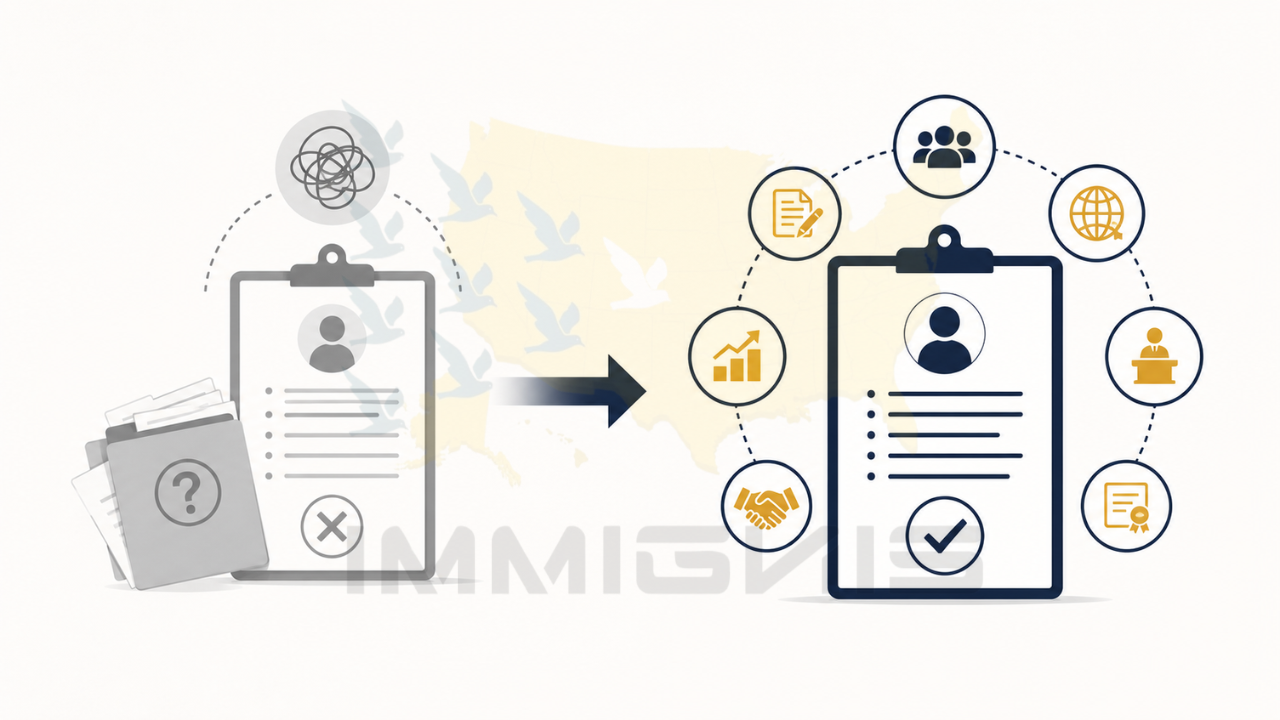
This case shows how profile building can change the way a strong but difficult career is understood. The petitioner already had substantial value, skill, and impact. What she lacked was a record arranged for immigration adjudication.
Immignis and Advance My Profile helped organize the evidence around the EB-1A criteria that mattered most: leading role, original contributions, published material, membership, and judging. The profile-building process did not invent a new career. It made the existing one visible, structured, and legally legible.
The professional profile building and immigration-specific profile building process also improved the petitioner’s broader presentation. It clarified field definition, aligned evidence with the right legal theories, strengthened outside validation, and developed a safer but more persuasive public-facing record.
For professionals searching online for profile building, immigration profile building, EB-1A profile building, EB-2 NIW profile building, or help with improving profile quality for extraordinary-ability immigration, this case is a clear example of how ethical evidence architecture can transform a difficult case into an approvable one.
Why this case worked
The case worked because it respected both the law and the realities of the field. USCIS could see that the petitioner operated in a uniquely difficult maternal-health niche, that her work had significance, and that the unusual evidence structure was a function of safety conditions rather than a lack of achievement.
The security-conscious evidence protocol made the record credible. International-organization attestations made the record independent. Protective publication and global-health platform appearances made the record visible. Training-program leadership, judging roles, and professional membership made the record criterion-specific.
The petition also avoided a common mistake. It did not argue that hardship conditions alone proved extraordinary ability. Instead, it showed how the petitioner performed at a high level within those conditions and how outside validators recognized the importance of her work.
That is why the case became a strong example of EB-1A profile building for physicians and women’s-health leaders whose impact is real but difficult to document publicly.
Conclusion
The Afghan women’s-health physician’s EB-1A approval shows that extraordinary ability can be documented even where evidence must be handled with exceptional care. Maternal-health leadership in access-restricted environments may be hard to present, but it is not impossible to prove.
The petition succeeded by turning women’s-health service continuity, maternal-care leadership, and safety-sensitive professional work into a clear immigration profile supported by independent attestations, protective publication, global-health visibility, training records, and expert explanation.
Most importantly, the case proved that ethical profile building can protect people and still satisfy USCIS. With the right professional profile building strategy, even a highly restricted evidence environment can support a strong EB-1A petition.
Frequently asked questions
Can an OB-GYN or women’s-health physician qualify for EB-1A?
Yes. An OB-GYN or women’s-health physician may qualify for EB-1A when the record shows extraordinary ability through evidence such as leading roles, original contributions, published material, judging, membership, and strong final-merits proof.
Can maternal-health work in difficult environments support an EB-1A petition?
Yes. Maternal-health work can support EB-1A when the petition explains the field clearly, ties outcomes to the petitioner’s personal role, and presents the evidence through a careful immigration-specific profile building strategy.
What if the evidence is safety-sensitive or cannot be fully disclosed?
A strong petition can still be built. Security-conscious evidence collection, redaction, anonymization, corroborating attestations, and expert explanation can help USCIS understand the contribution without exposing vulnerable details.
Do international-organization letters help in medical EB-1A cases?
Yes. Letters from credible outside organizations can be especially powerful because they provide independent validation of the petitioner’s expertise, role, and field significance.
Can speaking and training roles strengthen a physician’s EB-1A profile?
Yes. Speaking roles, faculty appearances, training leadership, and evaluative responsibilities can help prove that the field trusts the petitioner not only to perform the work, but also to teach, assess, and guide others.
Can Immignis and Advance My Profile help build a safer EB-1A record?
Yes. Immignis and Advance My Profile help physicians and other professionals build ethical, petition-ready immigration profiles by organizing evidence, defining the field, strengthening validation, and improving visibility without overclaiming.
Build an EB-1A record around maternal-health leadership, protected evidence, and international significance
Many physicians already have extraordinary impact, but the evidence is scattered across institutions, trainings, internal records, humanitarian work, and restricted environments. Ethical profile building can turn that scattered record into a clear EB-1A or even EB-2 NIW profile-building strategy.