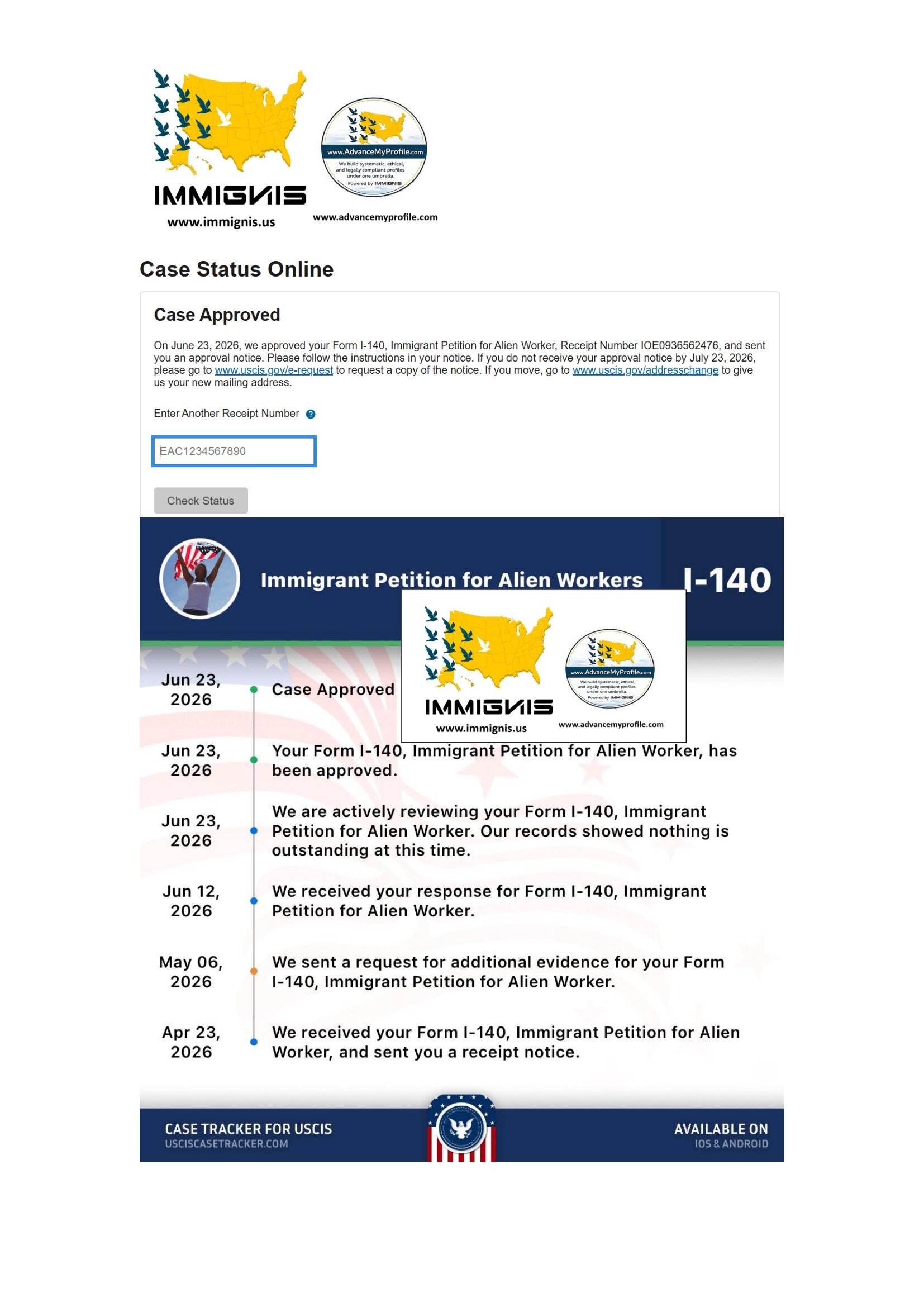
EB-2 NIW antimicrobial researcher: She had been forced to leave Ukraine and rebuild her antimicrobial research life in Poland. USCIS questioned whether she remained well-positioned after institutional disruption. The final record proved continuity: active research, current support, U.S.-relevant antimicrobial impact, and a clear path to continue work against drug-resistant infections.
| Nationality | Ukrainian |
| Working in | Poland, after displacement from a Ukrainian research institution |
| Profession | Drug-discovery scientist focused on novel antimicrobial compounds for drug-resistant bacterial pathogens |
| Career stage | Approx. 10 years, senior researcher |
| Pathway | EB-2 National Interest Waiver |
| Starting point | Fresh filing; institutionally displaced; research active but affiliation disrupted |
| Engagement | Approx. 11 months of profile building, filing, and RFE response strategy |
| Outcome | RFE answered and EB-2 NIW approved |
The Approval Result |EB-2 NIW antimicrobial researcher
The EB-2 NIW petition was approved after an RFE response that directly addressed the officer’s concern: whether a researcher displaced from Ukraine and working from Poland remained specifically well-positioned to advance antimicrobial discovery in the United States. The answer was built through continuity evidence, not sympathy. The record showed active appointment, current laboratory access, ongoing publications, post-displacement invention activity, U.S.-relevant collaborations, and independent expert support.
The approval gave her a stable immigration foundation and moved the case into the appropriate consular-processing stage through Warsaw while she continued her antimicrobial research in Poland.
The National Problem
Drug-resistant bacterial infections threaten hospitals, routine surgeries, cancer care, intensive care, military medicine, and broader public-health resilience. For the United States, antimicrobial resistance is not only a laboratory concern. It is a health-system risk that affects patient safety, treatment continuity, emergency preparedness, and the long-term ability of clinicians to control infections that existing drugs no longer treat effectively.
Her work fit that national need because she focused on identifying and validating novel antimicrobial compounds, studying resistance mechanisms, and improving screening and structural-modification methods that can move promising compounds toward further research and development.
The Client’s Starting Point
The client had a real scientific record, but her CV contained a visible disruption. Publications from a Ukrainian institution were followed by a move to Poland. Without context, that record could look like a break in research activity. For NIW purposes, this mattered because the well-positioned prong is forward-looking: USCIS wants to see that the petitioner is not only accomplished in the past, but also positioned to continue advancing the proposed endeavor.
The strategy was to explain the institutional change without turning the case into a hardship narrative. The address had changed. The science had not stopped.
The Proposed Endeavor
“To develop and validate novel antimicrobial compounds that overcome the resistance mechanisms of the most dangerous drug-resistant bacterial pathogens – advancing the U.S. National Action Plan for Combating Antibiotic-Resistant Bacteria and protecting the national health system from the growing clinical and economic burden of untreatable infections.”
This framing identified the problem, the scientific mechanism, and the U.S. national-interest connection. It also created a clean field-endeavor nexus: her career record was in antimicrobial compound discovery and resistance-mechanism targeting, and the proposed endeavor asked her to continue that same work in a U.S.-relevant context.
What AdvanceMyProfile and Immignis Built
The build focused on proving research continuity and active capacity after displacement. Additional first-author papers were developed in microbiology, pharmaceutical science, and antimicrobial discovery, with topics kept tightly within compound screening, structural modification, mechanism-of-action evaluation, and activity against resistant bacterial pathogens. These publications did more than add volume; they showed that the research program had resumed in a new institutional environment.
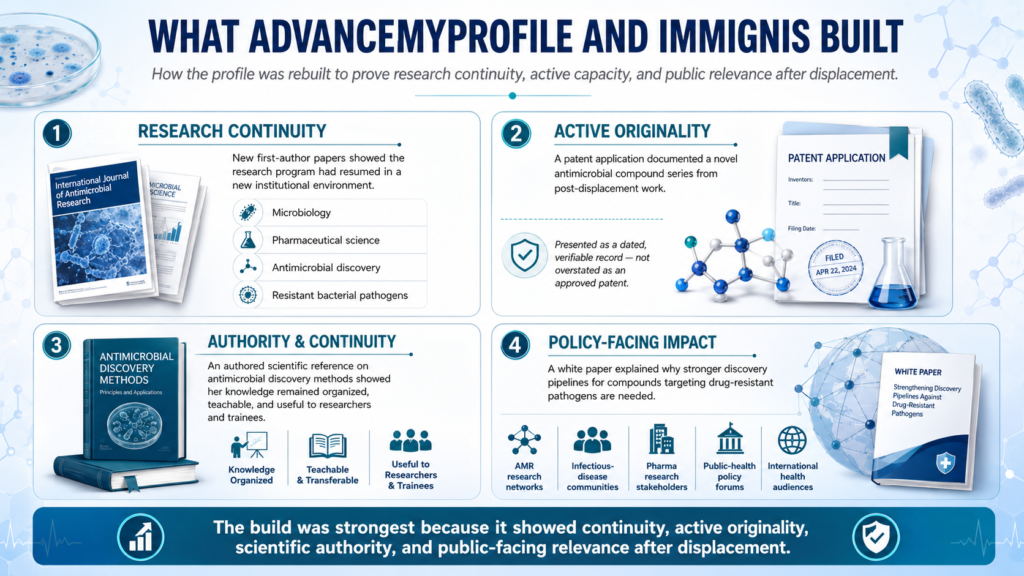
A patent application was prepared for a novel antimicrobial compound series identified and characterized through her post-displacement work. It was not overstated as an approved patent. It served as a dated, verifiable record of active originality after the move to Poland.
An authored scientific reference on antimicrobial discovery methods was also developed. For this profile, the book supported authority and continuity because it showed that her technical knowledge remained organized, teachable, and useful to other researchers and trainees.
A policy-facing white paper explained why stronger discovery pipelines for novel compounds targeting drug-resistant pathogens are needed. It was shared with AMR research networks, infectious-disease and microbiology communities, pharmaceutical research stakeholders, public-health policy forums, and international health-focused audiences that could credibly understand the issue.
How the Evidence Supported Dhanasar
- Prong 1 was supported through the national public-health need for new antimicrobial compounds capable of addressing drug-resistant bacterial pathogens.
- Prong 2 was supported through current appointment evidence, laboratory access, active publications, post-displacement patent activity, an authored reference work, U.S.-relevant collaboration evidence, expert commentary, senior professional recognition, and independent letters.
- Prong 3 was supported by showing that her specialized antimicrobial discovery work served a public-health priority that could reasonably benefit from her continued independent advancement without requiring a specific job offer first.
The RFE and the Continuity Answer
USCIS issued an RFE focused on whether she was specifically well-positioned given the institutional disruption and her location in Poland. The response did not avoid the issue. It documented her current Polish appointment, active research support, laboratory access, current collaborations, U.S.-specific professional plan, U.S. conference presentation, and a data-sharing relationship with a U.S. antimicrobial research group.
A supplemental letter from a U.S. national-laboratory researcher addressed the point directly: despite displacement, her antimicrobial research remained active, relevant, and positioned for continued contribution. The RFE response treated displacement as context, not weakness.
What Changed After Approval
After approval, she continued her work in Poland while the case moved into consular processing. Her patent application remained under examination, her book began circulating among researchers and trainees, and her work attracted attention from U.S. biotech and academic groups involved in antimicrobial discovery. Her role in Poland also developed into stronger research leadership, including greater responsibility for compound-screening activity and external collaborations.
The most important change was stability. USCIS had not been asked to overlook a broken record. It was shown a continuing one.
What This Case Teaches
- Displacement can be addressed through continuity evidence. The issue is whether the research remained active, supported, and capable of advancing the proposed endeavor.
- A current funded position, laboratory access, appointment evidence, and active collaborations can be powerful well-positioned evidence.
- A patent application can document post-displacement originality when it is genuine, relevant, and accurately described.
- An authored technical reference can show depth that survived disruption and can supplement journal evidence.
- White papers should be shared with relevant research, professional, pharmaceutical, public-health, or international audiences; generic outreach adds little.
- An RFE can be answered effectively when the response follows the officer’s question and builds evidence around the precise concern.
If you are a displaced researcher, a scientist rebuilding after institutional disruption, or a professional whose record contains a gap that needs proper explanation, the first step is not panic. It is an honest assessment of what continued, what can be documented, and what must be built next.