An AI and machine learning engineer whose precision farming tools reach tens of millions of hectares received a direct challenge to his national importance argument. Here is what happened, and how it was answered.
In short: An AI and machine learning engineer specializing in agricultural technology, based in Germany on an EU
Blue Card, filed an EB-2 NIW self-petition. USCIS accepted eligibility and substantial merit but issued an RFE
specifically challenging the national importance of the proposed endeavor, stating the impact appeared limited to
the petitioner and his potential clients. Immignis prepared the RFE response, reframing the case around
documented U.S. agricultural decline, precision farming adoption gaps, climate impact on U.S. farmland, and the
petitioner’s specific, measurable track record across large-scale deployments. The petition was approved.
The petitioner’s name and employer name have been withheld for privacy. Professional field, employer type, achievements, and outcome are real.
The Letter Nobody Wants to Receive
When a Request for Evidence arrives from USCIS, most people’s first reaction is the same. They assume the worst. An RFE feels like a near-denial, a signal that the petition is failing and the outcome is probably bad.
That is not what an RFE is. An RFE means USCIS has reviewed the case and found specific gaps in the evidence. It is an opportunity to address them. Whether the petition ultimately succeeds depends entirely on whether those gaps are filled with the right material.
In this case, the gap was precise and significant. USCIS accepted that the petitioner qualified for the E-21 classification and that his proposed endeavor had substantial merit. Then it drew a line at national importance and stated:
USCIS position: “The self-petitioner’s endeavor of intending to work as a software/machine learning engineer in the
farming industry does not demonstrate a national importance; rather the impact is limited to the self-petitioner and his
potential clients.”
That objection is not unreasonable when a petition presents an AI engineer building farming software without clearly connecting it to systemic, documented national need. The original petition made the connection, but not sharply enough. The RFE response had to do it precisely.
What He Had Actually Built
Before getting to the response, it helps to understand what the petitioner actually does. This is not someone writing general agricultural software. He is a senior AI and machine learning engineer at a globally operating crop nutrition and digital agriculture company, one with operations across more than 60 countries working from its European digital centre.
The scale of his work is specific. AI solutions he contributed to are deployed across over 50 million hectares. Machine learning tools he helped build have enabled hundreds of thousands of farmers to achieve higher crop yields while using fewer resources. One precision farming platform he worked on increased crop yields by 17% while reducing fertilizer usage by 30%. A variable rate application system reduced fertilizer use by up to 38% and water usage by 40%. An automated irrigation project cut water consumption by 25% and reduced energy consumption by 20%.
Before joining this company, he spent three years at a route optimization software firm, where his work on commercial fleet management reduced fuel consumption by over 9%, cutting thousands of tons of carbon emissions annually.
The credentials behind this work include a Bachelor of Science in Mechanical Engineering, advanced certifications in sustainable agriculture, precision ag-tech development, multiple AI and machine learning professional programs, and membership in globally recognized engineering and computing bodies. He also holds an EU Blue Card – the European Union’s equivalent of a U.S. Green Card, granted only to highly skilled non-EU professionals.
The issue was not what he had done. The issue was that the original petition had not connected what he had done to
a specific, documented crisis in U.S. agriculture. The RFE response fixed that.
Why USCIS’s Challenge Was Valid – and How the Response Met It
USCIS’s EB-2 NIW national importance objection was specifically that the proposed endeavor appeared to be standard industry work rather than something with systemic national implications. The Dhanasar test requires more than a good career. It requires a proposed endeavor that addresses a documented national need and a petitioner positioned to advance it at scale.
The EB-2 NIW RFE response was built around making that connection explicit, with real numbers from real government sources.
The national need was documented and urgent. The 2022 Census of Agriculture showed the total number of U.S. farms had declined by 7% since 2017, leaving only 1.9 million farms remaining. Total farmland had fallen by 2%. The USDA reported that food insecurity in the U.S. reached 44 million people in 2022. U.S. agriculture accounts for approximately 10% of total U.S. greenhouse gas emissions. Only 27% of U.S. farms had adopted precision agriculture practices as of 2023, a substantial adoption gap despite the technology being available for decades.
His EB-2 NIW proposed endeavor ‘a National Integrated Agro-Environmental System combining AI-driven precision farming, climate resilience tools, and sustainable resource management’ was reframed not as a software project but as a direct response to these documented national gaps. The Biden-Harris Administration had invested over $5 billion in climate-smart agriculture. The USDA’s Agriculture Innovation Agenda specifically targeted a 40% increase in production with a 50% reduction in environmental footprint by 2050. The Government Accountability Office had published reports on precision agriculture adoption barriers. Every part of his proposed work mapped to a named, documented federal priority.
The response also directly addressed USCIS’s observation that the petitioner had presented himself primarily as a developer. The RFE reply clarified the scope: not just AI and ML skills, but specialized expertise in sustainable agriculture and precision ag-tech development, backed by certifications and years of applied work in those domains specifically.
And critically, the project table added in the RFE response showed, for each of his major initiatives, the measured impact already achieved in current deployments and the projected equivalent impact for U.S. agriculture. This replaced generic estimates with evidence-based projections grounded in real outcomes from live deployments.
What the RFE Response Changed
Three things shifted between the original petition and the RFE response.
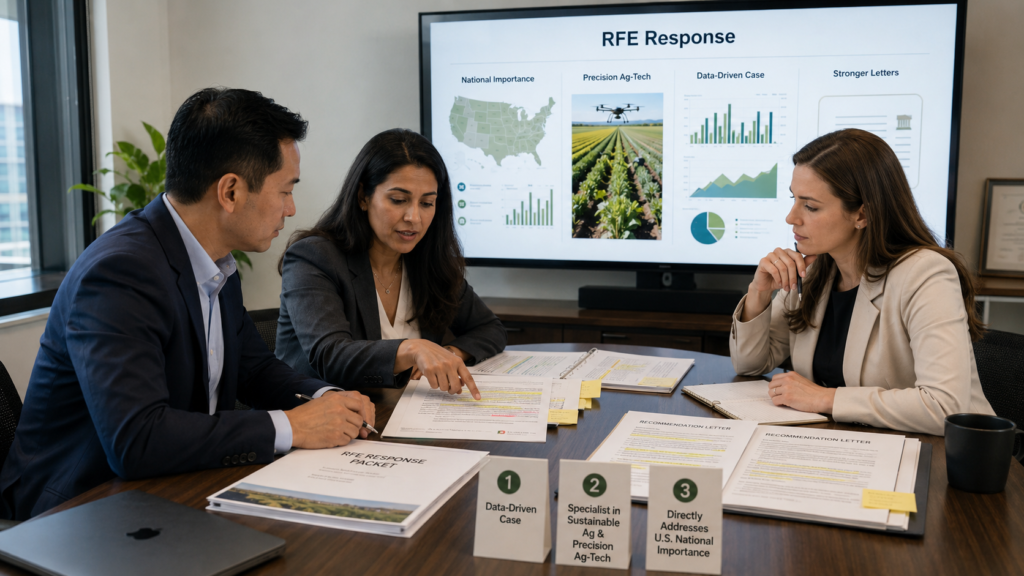
– The national importance argument moved from general claims about AI in agriculture to specific, sourced data on U.S. farmland decline, food insecurity, precision farming adoption gaps, and climate impact on U.S. agricultural output.
– The petitioner’s identity shifted from “a software/machine learning engineer who works in agriculture” to “a specialist in sustainable agriculture and precision ag-tech” a meaningfully different framing of the same career.
– The recommendation letters were replaced with new ones that addressed U.S. national importance directly, rather than focusing on the petitioner’s professional qualities.
None of these changes involved fabricating anything. The expertise existed. The projects existed. The national need existed. The RFE response organized it in the way the Dhanasar test actually requires.
The Outcome
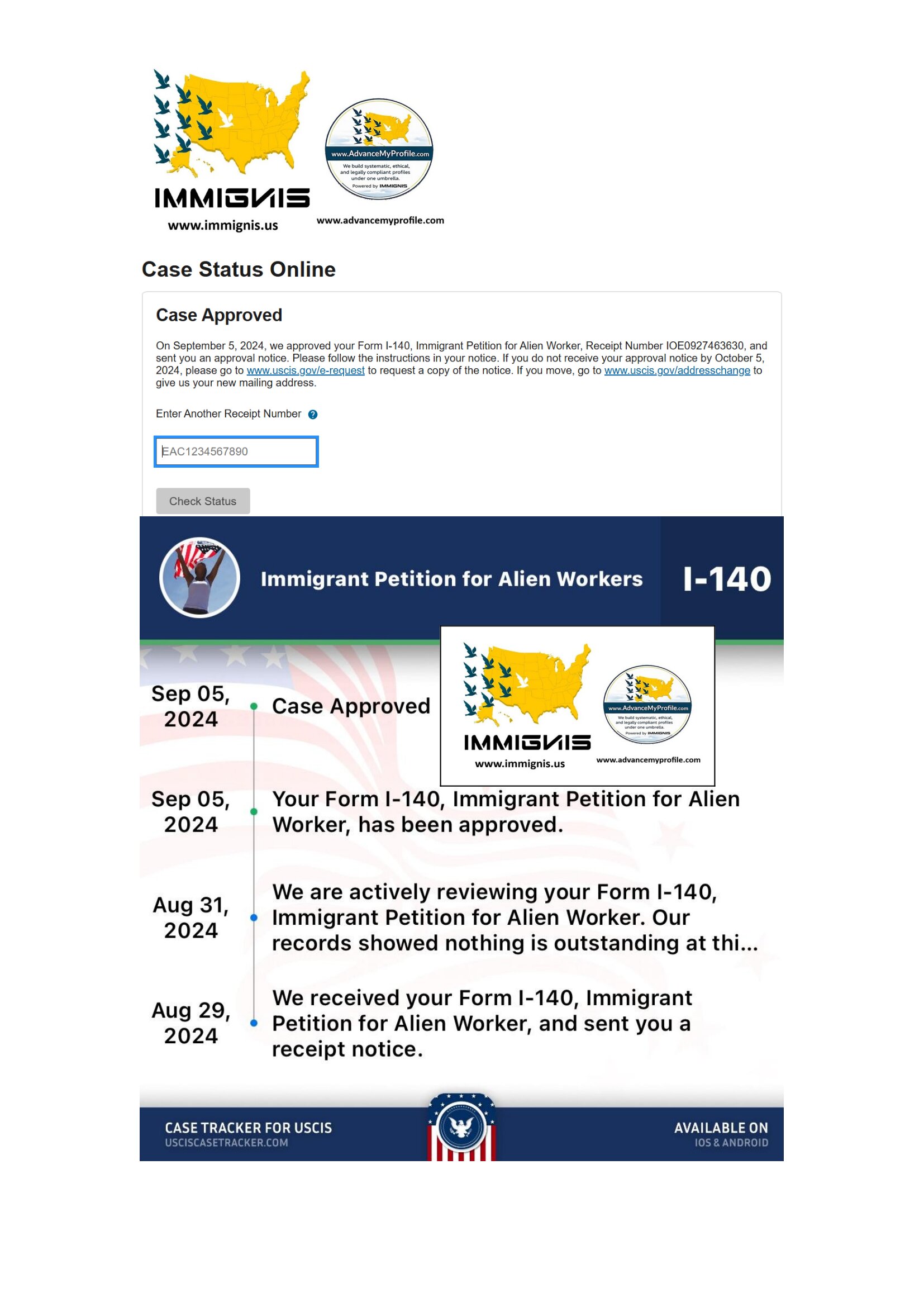
Approved.After the RFE response, USCIS approved the self-petitioned EB-2 NIW. No U.S. job offer. No labor certification. An EU Blue Card holder based in Germany, with a degree in mechanical engineering and six years of AI and machine learning work in agricultural technology, approved on a proposed endeavor to bring precision farming at scale to U.S. agriculture.
An RFE is not a denial. It is a set of specific questions that require specific answers. The cases that fail after an RFE are
the ones that do not answer them precisely enough.
For People Who Have Already Received an RFE
If you have received a Request for Evidence on your EB-2 NIW petition, the most important thing to understand is what it actually says. USCIS is not rejecting your petition. It is identifying exactly which part of the Dhanasar framework it cannot yet approve, and why.
In this case, the gap was national importance – one of the most common RFE objections. USCIS accepted the substantial merit. It accepted the eligibility classification. The question it asked was whether the work was nationally important or just personally beneficial. The answer was there. It just needed to be organized, sourced, and framed correctly.
The window to respond is real. The outcome is not predetermined. How the response is written matters significantly.
Questions People Ask About RFEs and National Importance
What does it mean when USCIS says national importance is not established in an RFE?
It means USCIS agrees that your work has merit but cannot see, from the evidence submitted, that it addresses a need at the national level rather than benefiting individual clients or your own career. The response needs to connect your proposed endeavor to documented national priorities, federal programs, published statistics, and systemic gaps, not just describe the value of your field in general terms.
Can an EB-2 NIW petition be approved after receiving an RFE?
Yes, and it happens regularly. An RFE is a request for more or better evidence, not a denial. The outcome depends almost entirely on how well the response addresses the specific objections USCIS raised. Cases approved after RFEs are often stronger than those that were not challenged, because the RFE forced a more precise case to be built.
My RFE says the impact of my work appears limited to my clients and employer. How do I respond?
This is one of the most common national importance objections. The response needs to show that your proposed endeavor addresses a systemic, documented national need, not just individual clients. That means real U.S. government sources, named federal programs, published statistics on the scale of the problem your work addresses, and a proposed endeavor framed around systemic benefit rather than business activity. The stronger the sourcing and the more specific the connection to documented federal priorities, the better.
Does working for a foreign employer or living abroad affect an EB-2 NIW case?
No. The I-140 self-petition can be filed from outside the United States, and the petitioner’s current employer and residence have no bearing on the Dhanasar analysis. What matters is the proposed endeavor and the petitioner’s qualifications to advance it in the U.S. In this case, the experience built at a globally operating company while based in Europe was directly relevant to the national importance argument.
Does a degree in a field different from the proposed endeavor cause problems?
Not necessarily. A Bachelor of Science in Mechanical Engineering, combined with six years of specialized AI and machine learning experience and advanced certifications in precision agriculture and sustainable farming, was sufficient for USCIS to accept the E-21 classification. The key is that the combination of education and post-degree experience establishes an advanced-degree equivalent and is directly relevant to the proposed endeavor.
If you have received an RFE on your NIW petition, or want to file without one, Immignis handles both. Free assessment: immignis.us/contact-us