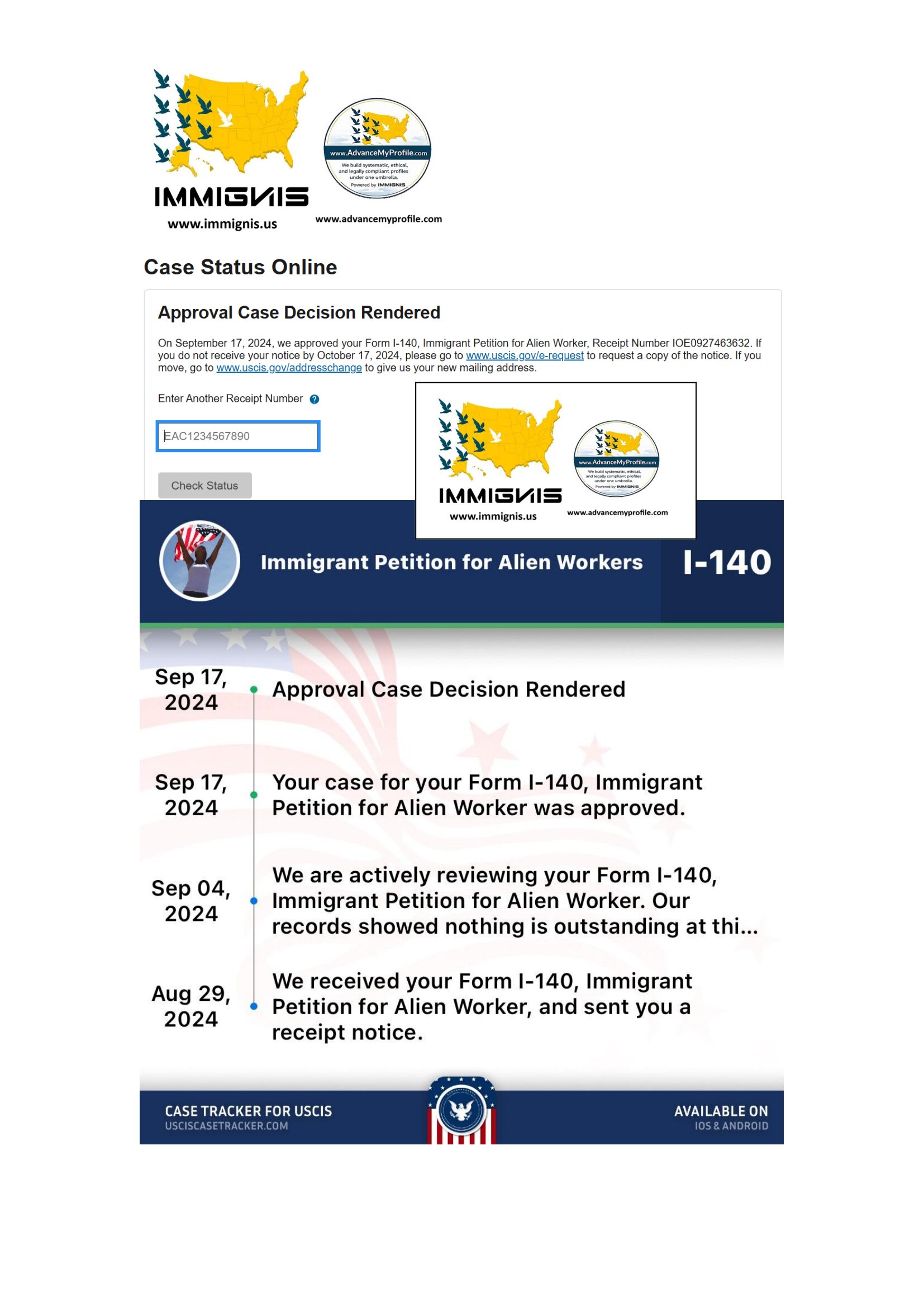
An AI economic intelligence analyst with nine years of cross-sector experience, building the exact systems she proposed – real-time risk forecasting, anomaly detection, multimodal economic dashboards. Approved as a self-petitioner, based in Saudi Arabia, with no U.S. employer.
In short: An economic intelligence analyst and AI specialist with a Master of Science in Computer Science and nine
years of progressive experience was approved for an EB-2 NIW as a self-petitioner. Based in
Saudi Arabia and working remotely for a UK-based data analytics firm, she had already developed and deployed a
predictive economic risk tool, a real-time anomaly detection system, and a multimodal economic intelligence
platform in her current role. Her proposed endeavor was to scale those capabilities to U.S. national infrastructure.
Approved under Matter of Dhanasar with no U.S. employer and no profile-building phase required.
The petitioner’s name and employer details have been withheld for privacy. Profession, field, experience, and outcome are real.
The Problem Traditional Forecasting Cannot Solve
The 2008 financial crisis came and went without meaningful early warning from the models the world’s financial institutions relied on. The pandemic-driven economic shock of 2020 was not predicted. Supply chain crises unfold across weeks while quarterly reports catch up months later. Each time, the pattern is the same: traditional forecasting frameworks fail not because the data was absent but because the tools could not process it fast enough, or in the right form.
Research from a leading U.S. economic research body confirms the scale of the problem: conventional models provide no reliable forecasting beyond an 18-month horizon. Financial fraud costs the U.S. economy more than $40 billion annually. Only 3.9% of U.S. businesses currently use AI in goods or services. And small and medium enterprises which represent 44% of U.S. economic activity typically have no access to the kind of real-time risk intelligence that large financial institutions take for granted.
That gap between the complexity of modern economic risk and the capacity of existing tools to detect it is what her proposed endeavor was built to close.
Not a Proposal. A Track Record.
What made this case unusually strong was not the vision. It was the proof.
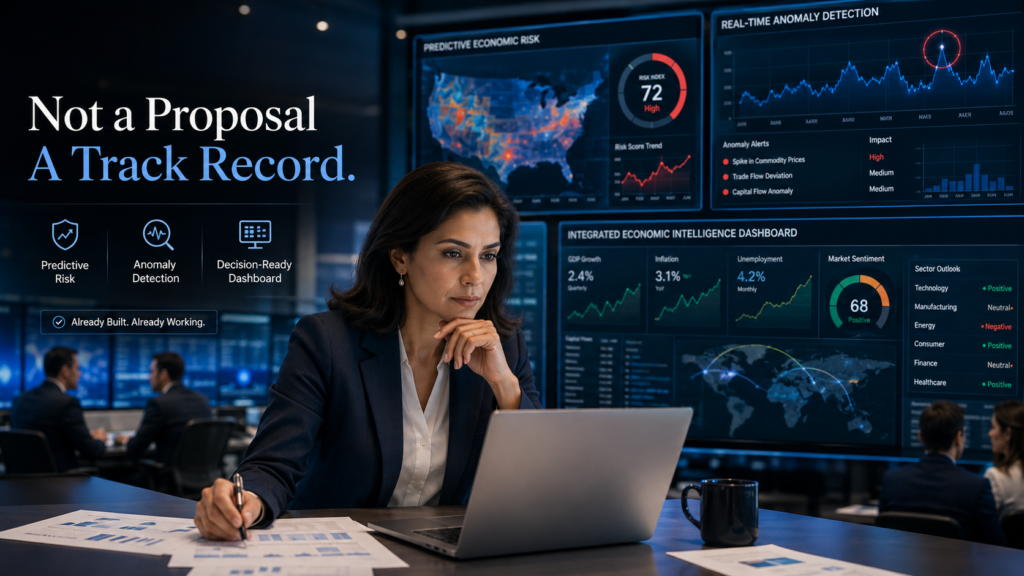
In her current position at a UK-based data analytics and intelligence firm, she had already designed and deployed each of the core components she proposed to bring to U.S. national infrastructure. This was not a future plan, it was a description of work already done, for a foreign employer, at real scale.
She built a predictive economic risk assessment tool that reduced the lag in risk identification from weeks to hours, giving stakeholders the ability to take early, informed action. She engineered a real-time market anomaly detection system that cut reaction times for emerging financial threats by over 80%. She designed a multimodal economic intelligence dashboard that combined macroeconomic indicators, financial market data, and policy information into a single decision-ready interface with explainable AI outputs.
The petition did not ask USCIS to imagine what she might do. It showed what she had already done and made a precise argument that U.S. national infrastructure had the same gaps her tools were built to address.
The Dhanasar test asks whether you are positioned to advance your proposed endeavor. The strongest answer is not a
certification. It is a project that already works.
The Path to This Point
Her nine years, as presented in the EB-2 NIW case, spanned more ground than most single-field careers. She started at a payment technology firm, moved through software engineering at a logistics tech company, taught computer science at a university where she co-supervised the development of a healthcare data platform, worked as a business analyst at a major commercial bank handling payment card systems and compliance integration, consulted remotely for a UAE-based technology firm, and eventually transitioned into her current specialization in AI-driven economic intelligence.
That breadth was not incidental to the EB-2 NIW case. It was the foundation. Each sector she worked in (banking, logistics, healthcare, technology) gave her a different lens on how economic and operational data moves, where it fails, and what decision-makers actually need when systems come under pressure. The academic work embedded habits of research and publication she carried into her professional practice.
She holds a Master of Science in Computer Science, with coursework covering machine learning, data visualization, social network analysis, and software project management. She has published in a peer-reviewed, internationally indexed journal and contributed to an industry publication through a leading global computing society. She is a member of the Association for Computing Machinery (ACM) and the International Association of Engineers in the EB-2 NIW record.
How the Case Was Argued
The EB-2 NIW proposed endeavor was an AI-powered economic intelligence system, eight integrated technical components covering
natural language processing for financial texts, real-time streaming analytics, multimodal data fusion, explainable AI and
interactive visualization, hybrid AI-econometric predictive modeling, adaptive learning pipelines, cloud-native infrastructure,
and API integration with financial and policy systems.
That scope may sound broad, but the EB-2 NIW petition grounded each component in a specific, documented gap in U.S. economic
infrastructure. The national importance argument was built from real government sources: the White House AI Action Plan, the
U.S. Treasury’s report on AI in financial services, the Critical and Emerging Technologies List (which includes AI and data
security), the Congressional Budget Office’s finding that delayed detection of economic risks leads to costly interventions, and
the Federal Reserve’s own financial stability reporting. Every component had a corresponding national need.
The well-positioned argument pointed at her current employer’s projects. The anomaly detection system. The risk forecasting
tool. The dashboard. Each was documented with outcomes, described in technical detail, and framed as direct evidence of her
ability to execute the proposed endeavor, not as a theoretical capability but as a demonstrated one.
This was a direct petition. No profile-building phase was needed. She committed $20,000 in personal funds toward
development and provided a detailed, five-year plan from prototype through national deployment to international expansion.
Academic publications, professional memberships, certifications, and a five-year business plan with revenue projections
included in the EB-2 NIW evidence dossier.
Proposed endeavor drafted against all three Dhanasar prongs, tied to White House AI priorities, Treasury guidance, CBO
economic intelligence gaps, and the Critical and Emerging Technologies List.
National importance built from specific government publications and verified statistics on forecasting failures, financial crime
costs, AI adoption gaps, and SME access to risk analytics.
Well-positioned argument anchored in current employer project outcomes: measurable results from live deployments of the
same systems she proposed to bring to U.S. national infrastructure.
The Outcome
Approved.A self-petitioned EB-2 NIW, filed from Saudi Arabia, working for a UK-based employer, with no U.S. employer backing the application. Approved on the strength of nine years of converging experience, measurable results from already-deployed systems, and a national importance argument built from documented U.S. policy priorities.
The gap between a good NIW petition and an approved one is usually not credentials. It is whether the proposed
endeavor is tied to something USCIS can see as nationally urgent and whether the petitioner’s record gives them
reason to believe she can actually deliver it.
For AI and Data Professionals Wondering Whether Their Work Qualifies
If you work in AI, data analytics, machine learning, or economic forecasting and the work you do for your current employer is essentially the same work you would propose for the United States, this case is worth studying.
USCIS is not looking for hypothetical capability. It is evaluating whether your proposed endeavor addresses a documented national need and whether you are positioned to advance it. If you can point to real deployments, real outcomes, and real gaps in U.S. infrastructure that your work addresses, those are the building blocks of a well-positioned argument. The fact that your current employer is foreign is not an obstacle. The work is the evidence.
Questions AI and Data Professionals Ask Us
Can an AI or data analytics professional qualify for an EB-2 NIW?
Yes. Artificial intelligence is listed as a critical and emerging technology domain by the U.S. government, and multiple federal programs from the White House AI Action Plan to Treasury guidance on AI in financial services, document the national need. What matters is whether the proposed endeavor addresses a specific, documented gap in U.S. infrastructure and whether the petitioner has the background to advance it.
Does working for a foreign employer or living outside the U.S. affect the petition?
No. The I-140 self-petition can be filed from any country. The Dhanasar test evaluates the proposed endeavor and the petitioner’s qualifications not where she currently works or lives. In this case, the experience built while working remotely for a UK-based firm, and before that across banking, academia, and technology consulting, directly supported the well-positioned argument.
If I am already building the same thing for my current employer, does that help my petition?
It can be the strongest part of the case. Being able to point to deployed systems with measured outcomes rather than describing what you could build makes the well-positioned argument concrete and verifiable. USCIS is evaluating whether you can actually advance the proposed endeavor. Showing that you have already done so, in a comparable context, answers that question directly.
How specific does the technical component of the proposed endeavor need to be?
Quite specific. A vague description of “using AI to improve economic forecasting” gives USCIS little to evaluate. A proposed endeavor with eight named, technically described components each tied to a documented U.S. gap and each supported by the petitioner’s actual project experience — gives USCIS something concrete to assess. Specificity in both the proposed endeavor and the national importance argument is what separates petitions that clear Dhanasar from those that do not.
Does a career that spans multiple sectors hurt or help an NIW petition?
In the right circumstances it helps, particularly when the breadth was purposeful and converges on the proposed endeavor. Banking, logistics, academia, and technology consulting are disparate on a resume. But when each contributed a different dimension of the expertise needed for an AI-driven economic intelligence system, financial data structures, operational systems, teaching and communication, software architecture, that convergence strengthens the well-positioned argument rather than diluting it.
If your AI or data work already addresses problems that the U.S. government has named as national priorities, there may be more of a case here than you realize. Free assessment: immignis.us/contact-us