A decade building AI vision systems for container terminals at one of the world’s leading industrial automation companies. A proposed endeavor that addressed a documented national infrastructure gap. Approved as a self-petitioner from Germany.
In short: An electrical and electronics engineer with a Master of Science in Electrical Engineering & Information
Technology and ten years of progressive experience, the majority spent building vision-based AI products for
container crane and port terminal operations at a globally recognized industrial automation company, was
approved for an EB-2 NIW as a self-petitioner. Citizenship: Germany. No U.S. employer. The
proposed endeavor was to digitize and modernize U.S. container terminal operations using vision-based AI and
machine learning, addressing a documented national infrastructure shortfall. Approved under Matter of Dhanasar.
The petitioner’s name and employer details have been withheld for privacy. Profession, field, experience, and outcome are real.
The 2021 Moment Everyone Remembers
In the autumn of 2021, more than 70 container ships sat anchored off the California coast, waiting to unload. Store shelves had gaps. Delivery times stretched from weeks to months. Supply chains that had functioned reliably for decades seized under the combined pressure of surging demand, pandemic disruptions, and infrastructure that had not kept pace with the volume it was being asked to handle.
The White House issued an action plan for U.S. ports and waterways. Congress passed a Bipartisan Infrastructure Law that committed $17 billion to modernizing port infrastructure. The American Society of Civil Engineers had already flagged the problem: while U.S. ports supported over 30 million jobs and approximately 26% of national GDP, none ranked in the world’s top 10. The highest-ranked U.S. ports sat at 83rd and 85th globally. Only four made the top 50.
The congestion problem had a technological dimension. Ports that automated their container terminal operations, the tracking, sequencing, and handling of containers as ships arrived, were unloaded, and departed, processed cargo faster, with fewer errors, less dwell time, and lower cost. More than 50 container terminals globally had already implemented AI-driven automation, most of them in Europe and Asia. North America was, in the words of one academic analysis, “beginning to automate.”
He had been building that technology for nearly a decade.
What Vision-Based AI for Cranes Actually Means
Container terminals run on cranes. Ship-to-shore cranes lift containers off vessels. Automated rail-mounted and rubber-tired gantry cranes sort and stack them in the yard. Cranes load them onto trucks and trains. The efficiency of a terminal is largely the efficiency of its cranes.
Vision-based AI gives cranes the ability to see. Cameras and sensors feed real-time data to machine learning models that identify container positions, track movements, detect anomalies, and make decisions that previously required manual operator intervention. This is not a marginal improvement. Research published in academic literature on port automation estimates operating expense reductions of up to 33% from well-implemented automation, along with measurable gains in safety, throughput, and environmental performance.
His role at the industrial automation company was not peripheral to this work. He was the product owner for the AI vision-based system, responsible for the camera hardware, the software, the machine learning pipeline, and the entire data strategy. He managed the backlog, worked directly with port terminal customers to translate operational requirements into product features, presented the technology at international container terminal industry conferences, and led the development of digital twin simulations that let customers visualize how automation would transform their operations before committing to it. He also supported the development of tools for a Hong Kong container terminal and contributed to framework development for several crane automation projects across major global ports.
The U.S. government had committed $17 billion to modernize port infrastructure. The technology that modernizes it
already existed. The question was whether the U.S. had the right people to deploy it.
A Decade of Depth, Not Breadth
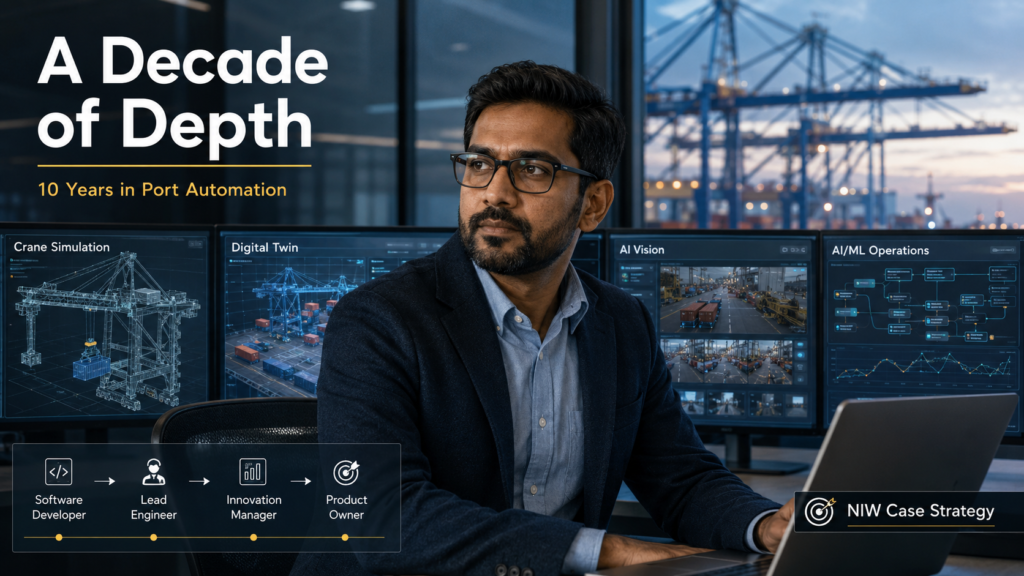
Something different about this EB-2 NIW case compared to most NIW petitions was the nature of the experience. It was not broad
exposure across many industries. It was exceptional depth in one specific domain, accumulated over ten years at the same
company, progressing from software developer through lead engineer and scrum master to innovation manager and product
owner.
He started building crane simulations. Then digital twin interfaces between simulation environments and hardware control
systems. Then camera sensor systems for port equipment. Then he stepped into the innovation role, overseeing AI vision
product strategy, data architecture, and a machine learning operations pipeline. Throughout, the subject never changed:
making the machines that move containers work faster, safer, and more intelligently.
His EB-2 NIW credentials reflected the same focus. A Master of Science in Electrical Engineering & Information Technology from a
German applied sciences university, where his thesis covered industrial communication systems. An executive certificate in
Designing and Building AI Products and Services from MIT xPRO. Certifications in project management, agile product
ownership, and scrum methodology. An early research paper at a European modeling symposium. Ongoing enrollment in AI
product management and design thinking courses.
He held German citizenship, had built his career in Germany, and held a position at a company whose industrial automation
division directly served the global port sector. The combination of technical depth, domain specificity, and the documented
U.S. need made for a clear EB-2 NIW argument under the Dhanasar test.
How the Petition Was Built
The national importance case was grounded entirely in U.S. government publications. The White House action plan for ports. The Bipartisan Infrastructure Law. Department of Transportation supply chain reports. The Biden administration’s port infrastructure grant announcements. The DOT’s own AI activities documentation. FinCEN national security supply chain executive orders. Each source pointed to the same documented reality: U.S. ports lagged behind global competitors, the government had identified this as a national problem, committed substantial funding to solving it, and specifically called for technology modernization.
His proposed endeavor ‘to work as an independent consultant digitizing U.S. container terminal operations through vision-based AI and machine learning’ connected to that documented need precisely. He was not proposing to build something new from scratch. He was proposing to bring technology that already worked, that he had already been developing and deploying at global ports, and apply it to U.S. terminals that needed it.
The well-positioned argument was similarly concrete.
– A decade of progressive experience in crane and port terminal automation, from software developer to innovation manager.
– Active product ownership of an AI vision system deployed at container terminals globally, with full responsibility for hardware, software, and ML pipeline.
– Hands-on experience with digital twin technology, crane simulation, and the integration of automation systems with industrial control environments.
– Conference presentations at international container terminal industry events, with demonstrated ability to communicate the technology to customers and partners.
– MIT xPRO executive certificate in AI product and service design, supported by ongoing professional development in AI product management.
The I-140 was filed as a self-petition. No U.S. employer. No labor certification. Immignis handled the full case: proposed endeavor, Dhanasar mapping, national importance sourcing, well-positioned evidence, and supporting documentation.
The Outcome
Approved.
A German citizen, based in Germany, with ten years of specialized experience in vision-based AI for container port automation, approved as a self-petitioner for an EB-2 NIW. The case rested on a precise match between what he had spent a decade building, what the U.S. government had publicly identified as a national infrastructure need, and the Dhanasar framework for waiving the job offer requirement.
Specificity is an asset, not a limitation. When your expertise matches a documented national gap with enough
precision, the national importance argument almost writes itself.
For Engineers With Deep Specialization in Critical Infrastructure
If your career has been built in a narrow but critical domain, industrial automation, logistics technology, port systems, energy infrastructure, transportation, or any other sector where the U.S. government has documented a need and committed funding, this EB-2 NIW case is worth reading closely.
The breadth of a career can support an EB-2 NIW case. But so can its depth. Ten years in one domain, at one company, advancing from technical contributor to product leadership, is a different kind of evidence than a varied career and in the right sector, it can be a more compelling one. The key is whether the expertise is specific enough to connect to a specific documented national need. In this EB-2 NIW case, it was.
Questions Engineers in Specialized Fields Ask Us
Can a highly specialized engineer in industrial automation or infrastructure qualify for an EB-2 NIW?
Yes, and the specificity of the expertise can actually strengthen the case. The EB-2 NIW requires a proposed endeavor of substantial merit and national importance, and evidence that the petitioner is positioned to advance it. When a very specific technical domain, vision-based AI for container terminal cranes, for example, maps precisely to a documented U.S. government infrastructure priority, the national importance argument is direct and concrete rather than aspirational.
Does working for a foreign employer in a specialized sector help or hurt an NIW petition?
It can help significantly. Experience building technology at a globally operating industrial company, and deploying it at ports across multiple countries, demonstrates a proven track record in exactly the domain being proposed for the U.S. The Dhanasar test evaluates whether the petitioner is positioned to advance the proposed endeavor and a decade of work at a leading company in the specific field is strong evidence of that positioning.
Does a career spent primarily at one employer look weaker than varied experience?
Not necessarily. Progressive advancement within one company from developer to lead engineer to product owner demonstrates depth, reliability, and domain mastery. What matters is whether the accumulated experience supports the proposed endeavor and the national importance argument. In fields where deep specialization is the differentiator, a focused career trajectory can be more persuasive than a broad one.
Does citizenship matter for an EB-2 NIW petition?
The citizenship of the petitioner does not directly affect whether the NIW is granted. The Dhanasar test evaluates the proposed endeavor and the petitioner’s qualifications, not their country of citizenship. A German citizen, a Pakistani national, someone based in Saudi Arabia, the standard is the same. What matters is the substance of the case.
How important is the infrastructure and government policy evidence in a port or logistics NIW case?
Very important. The Bipartisan Infrastructure Law, White House port action plans, DOT supply chain reports, and specific federal programs like the Port Infrastructure Development Program are real, verifiable evidence of national importance, not general claims. When a proposed endeavor aligns with a federal program that has received specific congressional funding and executive priority, it is much harder for USCIS to argue that the national importance is not established.
If your work in industrial automation, logistics, infrastructure, or a related field touches documented U.S. government priorities, there may be a stronger case here than you expect. Free assessment: immignis.us/contact-us