A certified avionics engineer with over a decade of helicopter maintenance experience, type certifications from manufacturers in Italy, the US, and the UK, and a co-founded U.S.-registered aviation startup – approved for an EB-2 NIW to advance fault tolerance, cybersecurity, and autonomous emergency systems in U.S. aviation.
In short: A certified avionics engineer holding a Master’s in Transportation Planning and Management, a Bachelor’s in Computer Engineering, and a national unrestricted avionics license with over a decade of progressive experience in helicopter avionics maintenance and troubleshooting was approved for an EB-2 NIWE as a self petitioner. Nigeria based, Nigerian national, co-founder of a U.S. registered aviation technology company. Proposed endeavor: develop innovations in avionics fault tolerance, cybersecurity, and autonomous emergency landing systems. Approved under Matter of Dhanasar with a documented record of hands on maintenance achievement, type training from leading manufacturers, and alignment with documented FAA and TSA national priorities.
What Avionics Are, and Why They Matter:
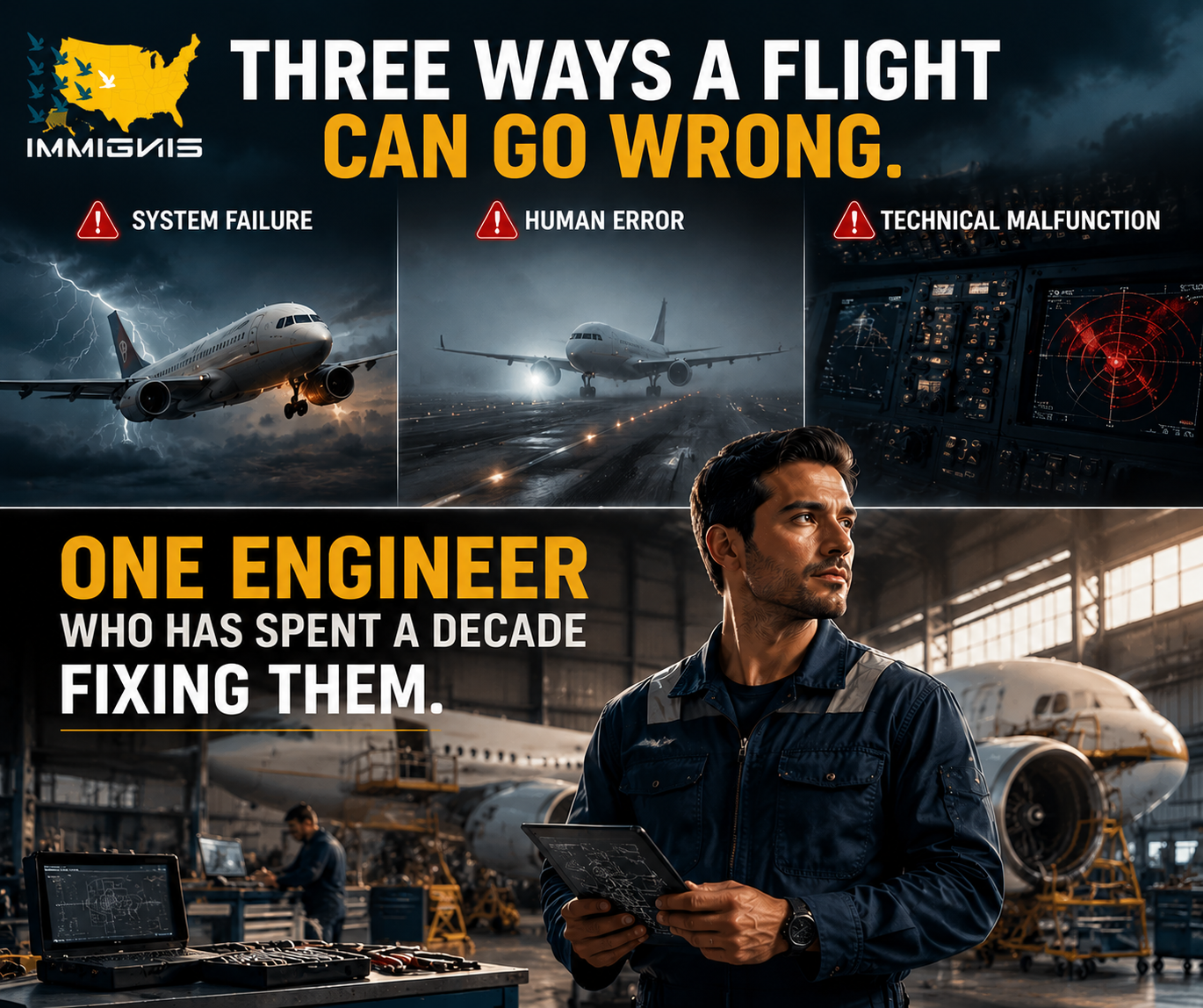
The United States has the busiest airspace in the world over 44,000 flights every single day. Most passengers on those flights have no idea that the computers and electronics systems running alongside the engines ‘the avionics’ are making thousands of decisions per second about navigation, communication, autopilot, and safety. In an EB-2 NIW context, most passengers also don’t think about three specific things that can go wrong.
One: the avionics fail. Component malfunctions, software errors, sensor faults, avionic system failures are a documented contributor to aviation accidents, and as aircraft become more complex and software dependent, the failure modes multiply. Two: the aircraft gets hacked. In 2023, the Transportation Security Administration issued emergency cybersecurity requirements for airport and aircraft operators, citing persistent cybersecurity threats against U.S. critical infrastructure. The GAO published a report calling on the FAA to strengthen its oversight of avionics cybersecurity risks, which directly supports the EB-2 NIW national-importance argument. Three: the pilot is incapacitated. It happens in roughly 1 in 50,000 flights, and when it does, the aircraft’s ability to respond autonomously determines whether everyone on board survives.
He has spent over a decade maintaining, troubleshooting, and repairing the exact systems that sit at the center of all three problems. His proposed endeavor for EB-2 NIW is to develop solutions to each of them for the U.S. aviation industry.
The Work That Built the Case:
His career as a certified avionics engineer spans 17 years of progressive hands on experience, concentrated in helicopter avionics in demanding operational environments.
Most of that time was spent at two major helicopter operators in Nigeria, including extended assignments supporting military aviation teams. His current role is at a helicopter operation servicing a major offshore oil and gas facility, one of the most technically demanding and operationally critical environments in aviation. Offshore helicopters cannot abort to a nearby airport. Maintenance decisions are made under real pressure, and the consequences of missed faults are serious.
He holds an unrestricted avionics license from the national civil aviation authority covering instruments, AC/DC electrics, airborne radio, autopilot, navigation, and compass systems. His FAA license is in progress. His type training includes certifications on the AgustaWestland AW139 (earned at a manufacturer’s academy in Italy), the Bell 407 (earned at Bell’s training facility in the United States), and the Bell 412 (earned at a training center in the UK). These are not general certifications, each represents type specific training on a particular aircraft by the manufacturer that built it.
His documented achievements are specific. He reduced flight line defects by 20% at his current employer by identifying recurring failure patterns and implementing targeted solutions. He resolved a persistent two-week avionics fault involving flight management system updates and radio altimeter issues that others had not cleared. He managed the aircraft’s recovery offshore within a short timeframe, preventing revenue loss to the operator. He set up the entire IT infrastructure for a $630 million aviation logistics contract, covering multiple operational bases.
He received both the five year and ten year service awards from his prior employer, formal recognition of sustained, above-standard performance over a long period in the same organization.
An avionics engineer who has resolved multi week faults on aircraft operating offshore, under time pressure, with real consequences, has a different kind of well positioned argument than one who has only done so in a lab.
Three Problems, One Proposed Endeavor:
The proposed endeavor covered three specific technical domains, each with documented national importance.
First: fault tolerance and reliability. The goal is to make avionics systems resilient, able to continue operating safely even when a component fails. This means redundant systems, real time fault detection, and isolation mechanisms that prevent one failure from cascading into a larger one. The FAA’s budget has consistently prioritized safety operations, and the research community has made significant advances in deep learning-based fault diagnosis and detection. His decade of hands-on fault diagnosis on active aircraft informs what those systems need to handle in practice, not just in simulation.
Second: cybersecurity in avionic systems. Modern aircraft are highly networked. Navigation, communication, flight management, and maintenance systems all exchange data and all present potential attack surfaces. The International Civil Aviation Organization reported a 200% increase in cyberattacks targeting aviation systems between 2019 and 2022. TSA issued emergency cybersecurity amendments to airport and aircraft operators in 2023, specifically requiring network segmentation, access controls, continuous monitoring, and patch management. His background in both avionics maintenance and IT systems administration a combination rarely held by a single person, positions him to work at the intersection of both domains.
Third: autonomous emergency systems. When a pilot becomes incapacitated, autonomous emergency landing capability could mean the difference between a controlled landing and a catastrophe. Airbus has conducted flight tests on autonomous emergency diversion capabilities. FAA research has identified autonomous systems as a priority area. His proposed focus on the sensor technologies, decision algorithms, and control systems that enable autonomous emergency response addresses a documented gap the industry is actively working to close.
The U.S. Connection:
His proposed endeavor is not theoretical. He has already taken concrete steps toward U.S. engagement. His FAA aircraft maintenance license application is in progress. He completed a certification program in aircraft maintenance and overhaul through a leading U.S. aviation university. He received type training at Bell Helicopter’s U.S. training facility. And he co-founded a company registered in Wyoming, USA and Nigeria, focused on private aircraft charter services using a mobile platform, which keeps him active in U.S. aviation business.
That combination (an FAA license in process, U.S. manufacturer training already completed, a U.S. registered company already operating) supports the third Dhanasar prong: that it benefits the United States to waive the job offer requirement because this person is already building U.S. presence and will contribute to U.S. aviation regardless.
How the Petition Was Built:
This was a direct petition. The career record was already there. The case was built on connecting his specific avionics expertise to three documented national priorities in U.S. aviation safety.
National importance sourcing: FAA budget documents prioritizing safety operations and NextGen technology, TSA’s 2023 emergency cybersecurity amendment for airport and aircraft operators, White House National Cybersecurity Strategy, GAO report on FAA avionics cybersecurity oversight, Biden administration aviation safety fact sheet, FAA Aviation Climate Action Plan, and the Bipartisan Infrastructure Law’s $15B in airport infrastructure funding.
Well positioned evidence: unrestricted national avionics license, manufacturer type certifications in Italy, USA, and UK, documented 20% reduction in flight line defects, 10-year service award, IT infrastructure setup for a $630M contract, and an FAA license in progress.
Proposed endeavor precision: three specific, named technical domains each tied to a documented FAA or TSA national priority, not general aviation improvement but specific fault tolerance, cybersecurity, and autonomous emergency system development.
The I-140 was filed as a self-petition without a U.S. employer.
The Outcome:
Approved.
A self petitioned EB-2 NIW for a certified avionics engineer, filed from Nigeria, with no U.S. employer. The case rested on over a decade of hands-on maintenance in some of the most operationally demanding helicopter environments in West Africa, manufacturer type certifications from leading aviation companies, a documented record of measurable performance improvement, and a proposed endeavor that addressed three specific, documented national priorities in U.S. aviation safety and security.
The person who diagnoses an avionics fault at an offshore oil platform under time pressure has practical knowledge that the laboratory researcher does not. When that experience is directed toward innovations the FAA and TSA have named as national priorities, the well positioned argument is direct and concrete.
For Aviation Engineers and Avionics Specialists:
If you are an avionics engineer, aircraft maintenance professional, or aviation systems specialist with hands on experience and manufacturer certifications and your work touches areas the FAA, TSA, or DHS have identified as national priorities, the NIW can be a viable path. The Dhanasar test evaluates whether your proposed endeavor has substantial merit and national importance, and whether you are positioned to advance it. A career spent maintaining and troubleshooting the exact systems you propose to improve, supported by type certifications and documented performance results, is a strong foundation for that argument.
Questions Aviation Professionals Ask Us:
Can a hands-on avionics engineer or aircraft maintenance professional qualify for an EB-2 NIW?
Yes. The EB-2 NIW requires an advanced degree and a proposed endeavor of substantial merit and national importance. A Master’s degree plus progressive avionics experience satisfies the advanced degree requirement. A proposed endeavor focused on fault tolerance, cybersecurity, or autonomous systems in aviation addresses documented national priorities, FAA has explicitly identified avionics cybersecurity oversight as a gap, TSA has issued emergency cybersecurity requirements for aviation operators, and the FAA has named autonomous systems as a research priority. Hands on maintenance experience, manufacturer certifications, and documented performance results support the well positioned argument.
Does having a national aviation license from another country count toward U.S. NIW eligibility?
It counts as evidence of professional standing and competence in the relevant field. An unrestricted avionics license from a national civil aviation authority particularly one covering multiple system categories including instruments, autopilot, navigation, and communications demonstrates that the petitioner has been formally evaluated and authorized to maintain aircraft in regulated environments. It is additional supporting evidence for the well-positioned prong, alongside other credentials.
Does having an FAA license application in progress help the NIW case?
It helps the third Dhanasar prong. One of the factors USCIS considers is whether it benefits the U.S. to waive the job offer requirement. A petitioner who has already taken concrete steps toward U.S. professional integration applying for an FAA license, completing U.S. manufacturer training, founding a U.S. registered company, demonstrates that the proposed U.S. contribution is not hypothetical but actively in motion.
Do manufacturer type certifications (Bell, AgustaWestland, etc.) strengthen an NIW petition?
Yes. Type training by the manufacturer that built the aircraft is a specific, verifiable credential that goes beyond general aviation knowledge. It demonstrates that the petitioner has been formally trained and certified on a particular aircraft system by the organization with the most comprehensive knowledge of it. Multiple type certifications from manufacturers in multiple countries (Italy, USA, UK) further demonstrate the breadth of technical exposure and the ability to operate across different regulatory environments.
Is founding a U.S.-registered aviation company relevant to an EB-2 NIW petition?
It can support the case in multiple ways. It demonstrates existing U.S. business ties and commitment to participation in the U.S. aviation industry. It provides evidence that the proposed endeavor is not simply a future aspiration but an ongoing activity. And it strengthens the third Dhanasar prong, which evaluates whether waiving the job offer requirement benefits the United States a petitioner already building U.S. aviation capacity through a registered company makes that benefit concrete rather than speculative.
If you work in avionics, aircraft maintenance, or aviation systems engineering and want to understand whether your background and proposed work qualify for an EB-2 NIW, start with an honest assessment.