A senior architectural engineer who has spent 12 years designing healthcare spaces and who designed 100 no fee hospitals for remote communities on his own time approved for an EB-2 NIW to address the very same gap in the United States.
In short: A senior architect and project manager with an MS in Project Management and a Bachelor of Architecture Engineering, and over 12 years of progressive experience in healthcare and commercial architecture in Pakistan and Saudi Arabia, was approved for an EB-2 NIW as a self petitioner. Proposed endeavor: design health-oriented built environments that support public health, and modernize existing healthcare facility infrastructure for improved patient safety and sustainability. Approved under Matter of Dhanasar with a career that includes hospital design across multiple countries, pro bono design of 100 rural healthcare facilities, dual architectural practice licenses, and active membership in an international task force on health promoting built environments.
The 100 Hospitals:
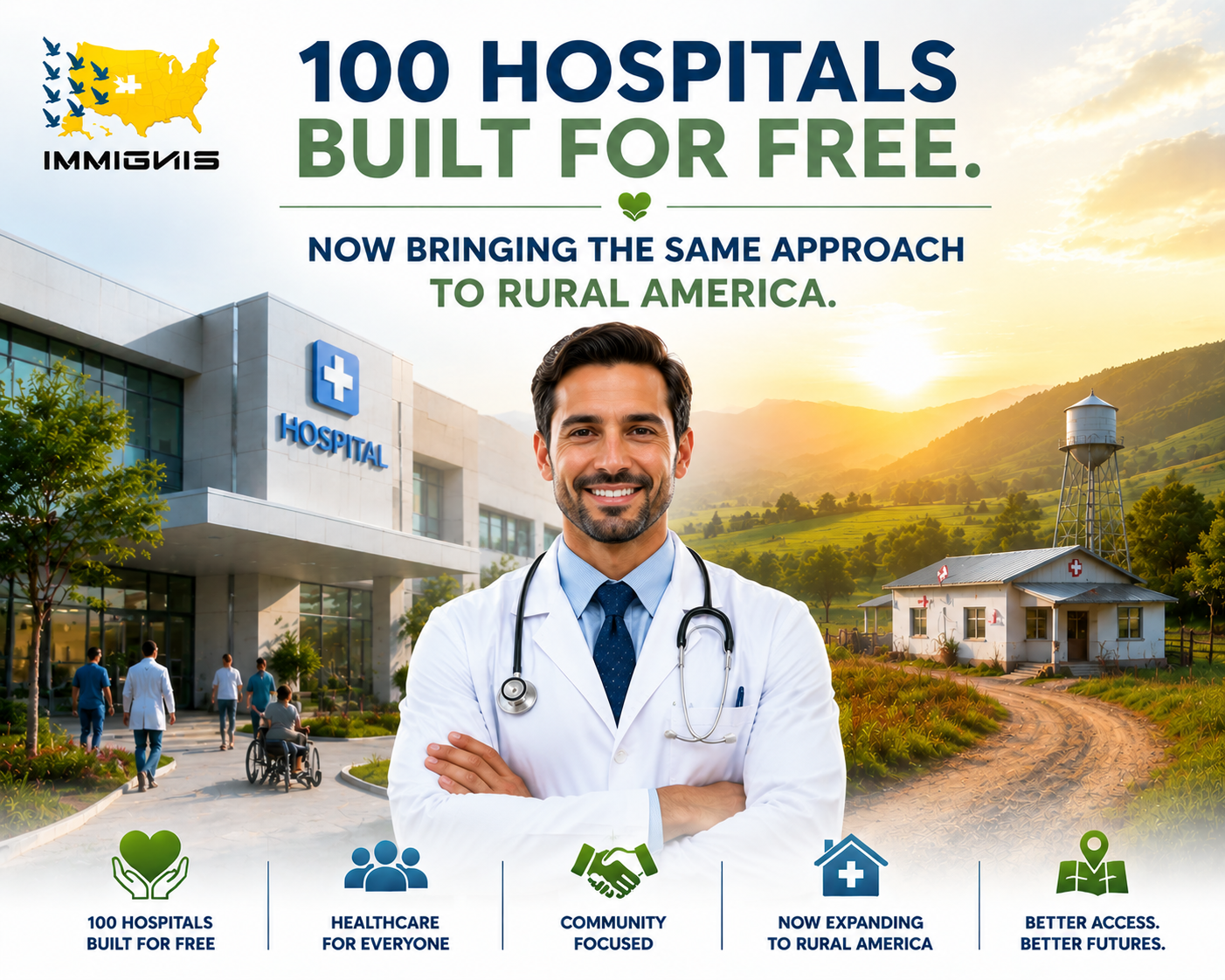
The work that stands out in this case is not the commercial projects though those are substantial. It is this: on a voluntary basis, he designed a prototype hospital model for a major charitable foundation and helped deliver those designs to more than 100 remote communities in Pakistan. No fees. For the people who have no healthcare nearby and no realistic path to getting any without someone choosing to build it. This work later became a key part of his EB-2 NIW case.
That work is not on his primary resume. It is the kind of thing that does not typically appear on an architect’s project list, because it was not a commercial engagement. But for an NIW proposed endeavor specifically focused on improving healthcare access in rural and underserved U.S. communities, it is exactly the right evidence because it shows that the proposed work is not a new aspiration. It is a continuation of what he was already doing. This continuity is often important in an EB-2 NIW petition.
The well positioned prong of the Dhanasar test asks whether you have the background to advance your proposed endeavor. Designing 100 free hospitals for communities that had no healthcare is a specific kind of answer to that question. In this EB-2 NIW case, it served as compelling evidence of the applicant’s ability to carry out the proposed endeavor.
Architecture as a Public Health Tool:
His proposed endeavor has two parts, and understanding them requires understanding how architects working in health think about their field differently from traditional architects.
The first part is what he calls health-oriented built environments. The idea is straightforward but underappreciated: how a neighborhood is designed directly affects the health of the people who live in it. Streets that encourage walking reduce cardiovascular disease. Green spaces reduce stress and improve mental health. Inclusive, well lit public areas reduce falls and increase social participation. Communities without walkability and without green infrastructure have measurably worse health outcomes. Published research cited in the petition suggests that well designed urban environments can reduce the prevalence of cardiovascular conditions by up to 25%. The CDC has published data showing that walkable communities reduce obesity prevalence by approximately 11% and heart disease risk by 30%.
The second part is more direct: modernizing existing healthcare facilities. The U.S. has roughly 6,090 hospitals. Many are aging. The American Hospital Association has estimated the country needs to invest at least $1 trillion by 2030 just to maintain its hospital infrastructure. Rural hospitals are closing faster than new ones are being built. The number of rural community hospitals fell from 1,980 in 2014 to 1,796 in 2020. He proposes to apply the same design expertise he has developed over 12 years (healthcare architecture, infection control, biophilic design, modular construction, smart building systems) to the modernization of those facilities.
Together, the two parts address the same national priority from different directions: keep people healthier through their environment before they need healthcare, and ensure that healthcare is available and functional when they do.
The Career Behind It:
His 12 years span a genuinely wide range of projects, but the most relevant thread runs through a healthcare architecture firm where he spent five years as Senior Project Architect. During that period, he worked on hospitals ranging from 60 bed specialty facilities to 500 bed teaching hospitals across Pakistan, Afghanistan, and Saudi Arabia. His scope included comprehensive healthcare facility planning with architects, biomedical engineers, and clinical experts, ensuring compliance with international infection control standards and preparing plans for facilities serving specialized departments, laboratories, and rehabilitation centers.
He holds a full category architectural practice license in Pakistan covering all building types and a Saudi Engineering Council registration. He is a licensed architect in both countries where he has practiced. He is a member of the Task Force on Health Promoting Built Environments, a specialized body focused on the intersection of architectural design and public health. He has taught as a visiting lecturer at two Pakistani engineering universities.
His current role is as Senior Technical Architect at an architectural engineering consultancy in Jeddah. Projects range from major mixed use commercial developments to hospitality projects for internationally recognized brands, to residential compounds. That commercial portfolio demonstrates one important credential for the NIW case: he is not a specialist who has only ever worked in healthcare. He understands how design decisions are made, costed, and executed at commercial scale. That knowledge transfers directly to healthcare facility modernization projects where budget, compliance, and execution timelines are all in tension.
The Technical Approach:
His petition outlined a technically specific methodology rather than a general aspiration. The design principles he intends to apply in the U.S. context are grounded in current evidence-based healthcare design practice.
Biophilic design (natural light, indoor planting, water features, natural materials) based on established research showing that connection with natural elements reduces patient recovery times and staff stress levels.
Smart healthcare infrastructure through IoMT sensors and AI-assisted building management, enabling real-time patient monitoring and predictive resource allocation.
Evidence-Based Design, using validated research to inform decisions on acoustics, lighting, ventilation, and spatial flow. EBD has shown consistent reductions in healthcare-associated infections and patient falls.
Modular and prefabricated construction to reduce project timelines, lower construction waste by up to 90%, and create flexible facilities that can be adapted as healthcare needs change.
Advanced infection control measures including UV-C disinfection, HEPA filtration, antimicrobial surface materials, and positive pressure ventilation in critical care zones.
Healing gardens and therapeutic outdoor spaces, which peer-reviewed literature consistently associates with improved mental health, reduced pain perception, and faster recovery.
These are not speculative approaches. They are current practices in evidence-based healthcare design that the U.S. healthcare system is adopting incrementally, and his proposed endeavor is to accelerate and systematize that adoption particularly in rural and underserved facilities where the upgrade gap is widest.
How the Petition Was Built:
This was a direct petition. The professional record was already there. The case was built on connecting his specific expertise to a documented national need.
National importance sourcing: CDC built environment and health data (11% obesity reduction in walkable communities, 30% reduced heart disease risk), American Hospital Association infrastructure investment projections ($1 trillion by 2030), AHA rural hospital decline data, HHS Strategic Plan for 2022-2026, White House executive orders on healthcare access and federal sustainability, Healthy People 2030 objectives, CDC’s Built Environment and Health Initiative, the Infrastructure Investment and Jobs Act.
Well positioned evidence: five years of hospital design experience across multiple countries, the 100 pro bono hospitals for a charitable foundation, dual architectural practice licenses, Task Force on Health Promoting Built Environments membership, visiting lecturer roles, detailed technical execution plan covering biophilic design through modular construction.
Proposed endeavor framed as two connected national interests: preventive health through built environment design, and reactive health through facility modernization, both tied to documented federal priorities.
Immignis prepared the full petition: proposed endeavor, Dhanasar mapping, national importance sourcing, evidence dossier, and I-140 preparation and submission.
The Outcome:
Approved.
A self petitioned EB-2 NIW for a healthcare architect and project manager, filed from Saudi Arabia, with no U.S. employer. The case was built on 12 years of architectural practice that included hospital design across multiple countries, a documented record of pro bono work designing healthcare facilities for remote communities, and a proposed endeavor precisely aligned with the documented need to expand and modernize healthcare infrastructure in rural and underserved parts of the United States.
Architecture that serves public health is not a niche specialty. It is one of the most direct interventions available designing spaces where people live and receive care so that both experiences become better.
For Architects and Built Environment Professionals:
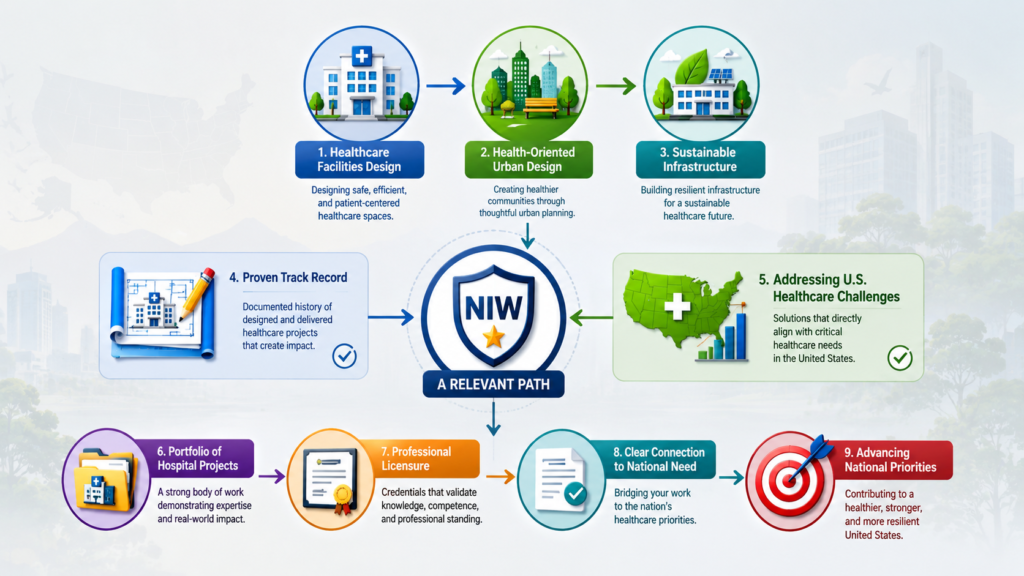
If your architectural or engineering practice focuses on healthcare facilities, health-oriented urban design, or sustainable infrastructure and you have a track record of designed and delivered projects, the NIW can be a relevant path. The Dhanasar test does not require publications or a research degree. It requires a proposed endeavor that has substantial merit and national importance, and a career that positions you to advance it. A portfolio of hospital projects, professional licensure, and a clear connection to the documented U.S. healthcare infrastructure challenge is a solid foundation for that argument.
Questions Healthcare Architects and Built Environment Professionals Ask Us:
Can an architect or built environment professional qualify for an EB-2 NIW without academic publications?
Yes. The EB-2 NIW does not require publications. For design and construction professionals, the equivalent evidence includes a portfolio of delivered projects, professional licenses and registrations, memberships in recognized professional bodies, and a track record that directly supports the proposed endeavor. What matters is whether your background positions you to advance a nationally important proposed endeavor, not whether you have published in journals.
Does pro bono or charitable design work help an NIW petition?
It can, particularly when it directly supports the proposed endeavor. Designing hospitals for free for underserved communities demonstrates both technical competence (the skills required to design a hospital are the same regardless of whether the client pays) and a documented history of applying those skills to the exact kind of national interest problem the NIW is designed to incentivize. It also distinguishes the petitioner from other architects who have only worked commercially.
Is healthcare architecture a strong basis for national importance in an EB-2 NIW?
Yes. The documented U.S. healthcare facility infrastructure gap is substantial, the American Hospital Association estimates $1 trillion in needed investment by 2030. Rural hospital closures are ongoing. Aging facilities are a direct patient safety concern. A proposed endeavor that addresses this gap through evidence based healthcare facility design, particularly in rural and underserved areas, aligns directly with multiple federal priorities, including HHS strategic goals, White House executive orders on healthcare access, and the Infrastructure Investment and Jobs Act.
What is the difference between a healthcare architect and a biomedical equipment planner for the purposes of an NIW?
They serve different functions, though both contribute to healthcare facility development. A biomedical equipment planner determines what medical technology and instruments go in each room. A healthcare architect designs the physical spaces, the building systems, the infection control environment, the patient flow, and the aesthetic and functional character of the facility itself. Both can support NIW petitions, but the proposed endeavors are distinct and the evidence required differs accordingly.
Does holding professional licenses in two countries strengthen an NIW well-positioned argument?
It can. Holding architectural practice licenses in multiple countries reflects demonstrated professional standing and compliance with different regulatory standards. A full category license in Pakistan and a registration with a national engineering council in Saudi Arabia establish that the petitioner has been formally recognized as qualified to practice in regulated markets, which is relevant to a proposed endeavor that will require engagement with U.S. building codes and healthcare design standards.
If your architectural practice includes healthcare facilities or health-oriented built environments and you want to understand whether your background supports an EB-2 NIW, start with an honest assessment.