EB-2 NIW approval through self-petition: A biomedical sales and applications engineer specializing in In Vitro Diagnostics was approved for a National Interest Waiver after thirteen years of expertise and a strategy that reframed an ordinary-looking career as a matter of national interest.
In short: A principal database and software architect with 15 years of experience including direct work on U.S.
healthcare data integration using HL7 and FHIR standards, was approved for an EB-2 National Interest Waiver as a
self-petitioner. No doctorate. No published research. No U.S. employer at the time of filing. The case was approved
under the Matter of Dhanasar three-prong test on the strength of a healthcare data integration proposed
endeavor backed by documented U.S. government priorities and a demonstrable, hands-on track record.
The petitioner’s name has been withheld for privacy. Profession, field, and outcome are real.
Not a Doctor. The Person Who Makes Doctors’ Systems Work.
There is a version of this story that people expect. You treat patients. You publish research. You earn a doctorate. Then, maybe, an EB-2 National Interest Waiver becomes something worth looking at.
This is the other version.
He is a principal database and software architect. For fifteen years, his job was building the plumbing behind healthcare delivery, the systems that move a patient’s lab result, medication order, or discharge summary from one facility to the next. Nobody notices that kind of work when it functions. You only notice it when it breaks, and when it breaks, patients are affected.
He built HL7 v2 interfaces at a hospital that reduced data integration errors by 25%. He developed FHIR servers to connect disparate healthcare systems within a large medical organization. He led the healthcare integration work on a U.S. product used in hospitals and clinics, handling patient identity, access management, and clinical data exchange across multiple systems simultaneously.
He never treated a patient. He never published an academic paper. His petition was still approved.
The Assumption That Nearly Stopped Him
He had looked into the EB-2 NIW before. Most technical professionals in his position do – they read about it, decide it isn’t for them, and go back to waiting for a U.S. job offer.
The reason is predictable. Almost everything written about the EB-2 NIW centers on academics: researchers with citation counts, scientists with grants, doctors with clinical records. If your background is in software and data architecture, you keep seeing the same message from forums, from Reddit threads, from some consultants: come back with a PhD.
That is not what the law actually says. And in fifteen years of real healthcare integration work, he had already built
something worth arguing for.
The EB-2 NIW does not require a doctorate or a list of publications. It requires a proposed endeavor with substantial merit and national importance, evidence that the applicant is positioned to advance it, and a reason why the United States benefits from waiving the usual job offer requirement. Those criteria do not specify a field. They specify a standard of proof.
Why the Case Was Stronger Than It Looked
His proposed endeavor was a data integration platform for the U.S. healthcare system – built on HL7 and FHIR standards, incorporating AI-driven clinical decision support, and designed to address one of the most well-documented and expensive failures in American healthcare: the inability of hospitals and providers to reliably share patient data with each other.
The national importance argument was not invented. It came directly from published U.S. government sources.
The U.S. spends roughly 18% of its GDP on healthcare (nearly double the average of comparable countries) and consistently ranks last among high-income nations on actual health outcomes. An estimated 80% of U.S. hospitals cannot effectively exchange data between their electronic record systems. The Office of the National Coordinator for Health Information Technology has listed healthcare interoperability as a national goal since 2020.
The White House has explicitly tied AI-powered health data tools to national priority initiatives. These are not talking points. They are published policy documents, and they made his proposed endeavor relevant to stated national objectives.
He also had a track record that matched the proposal. His work on a U.S.-headquartered security and access management platform included direct healthcare integrations using industry-standard tools like Mirth Connect and HAPI FHIR, data exchange across hospital management systems, and HL7 v2 interface development for real clinical workflows. For over a decade, he had been building, in practice, a version of what he was now proposing to bring to the United States.
That combination ‘a nationally important problem, a specific solution, and a credible record of already solving pieces of it’ is what the Dhanasar test is actually looking for.
What the Petition Covered
This was a direct petition. No profile-building period was needed; the professional record was already there. What the petition needed to do was translate fifteen years of technical work into the specific language USCIS evaluates, and do it without leaving anything to inference.
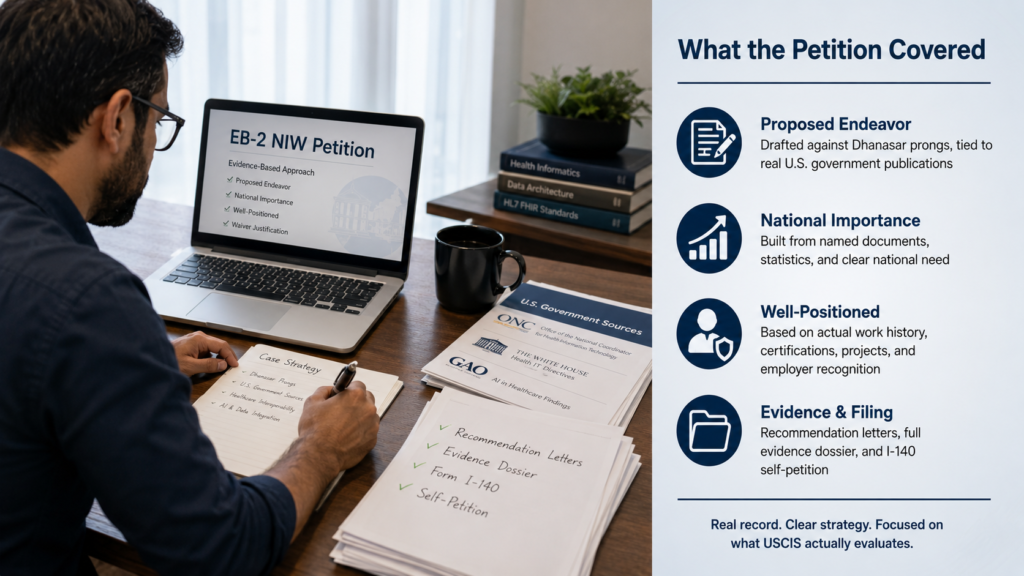
– A proposed endeavor section drafted against the Dhanasar prongs, tied to real U.S. government publications: ONC strategic plans, White House health IT directives, GAO findings on AI in healthcare, and published statistics on data fragmentation and its cost to the system.
– A national importance argument built from specifics, not generalities, named documents, named statistics, a clear line between what he would build and why the U.S. needs it built.
– A well-positioned case drawn from his actual work history: his HL7 and FHIR certifications, his data analytics credentials, his project record, and formal recognition from his employer.
– Letters of recommendation, a full evidence dossier, and the I-140 prepared and filed as a self-petition.
No inflated credentials. No vague language. His real record, organized to answer the questions USCIS asks.
The Outcome
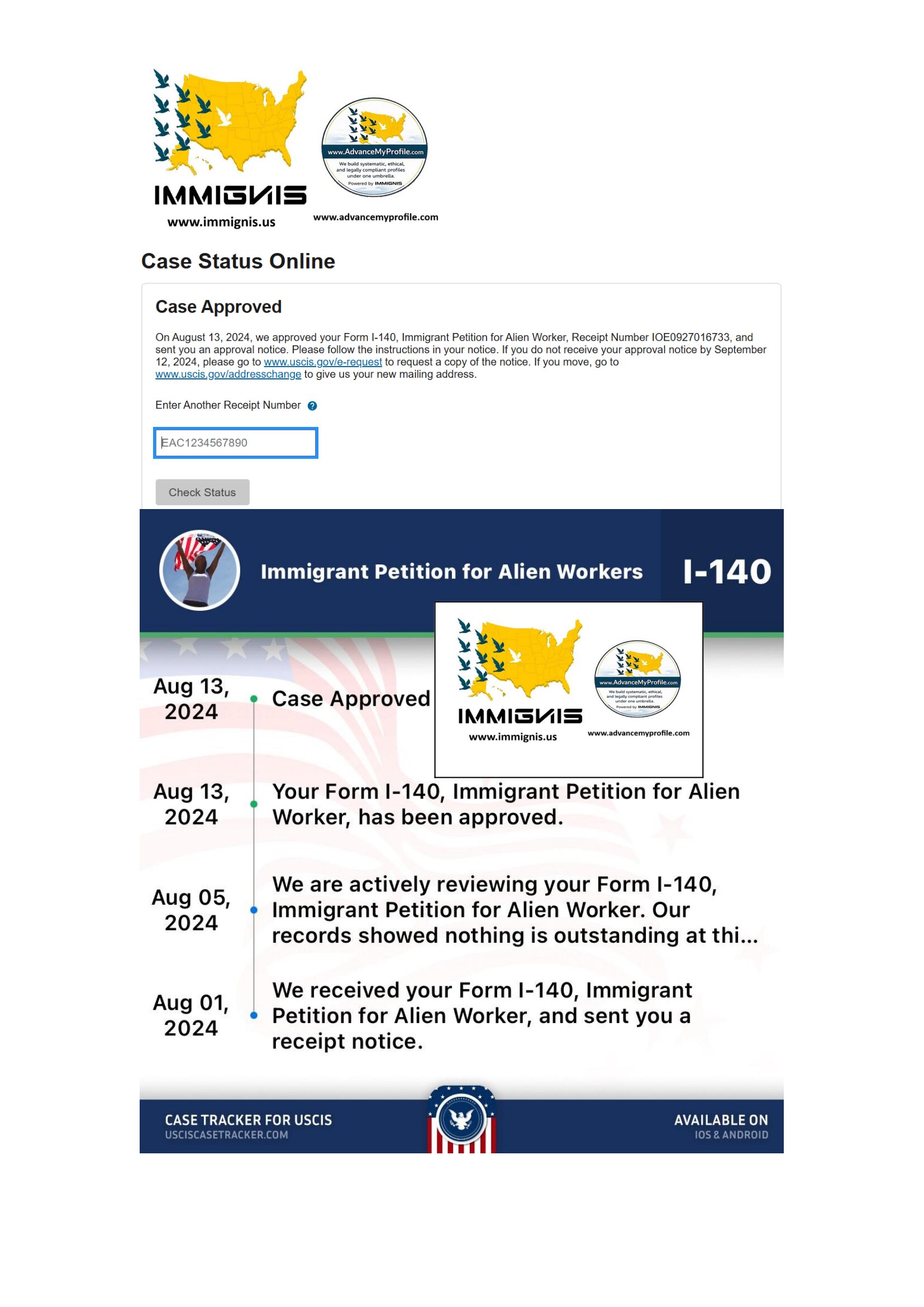
Approved.
He self-petitioned – no U.S. employer, no labor certification, no doctorate, no academic publications. The petition was approved because the proposed endeavor was specific and credible, the national importance was documented and real, and fifteen years of hands-on healthcare data integration work made him the right person to advance it.
The work was always there. What was missing was a petition that made USCIS see it the same way
For Tech Professionals Who Have Already Talked Themselves Out of
For Tech Professionals Who Have Already Talked Themselves Out of This
If you work in software, data architecture, AI, or any technical discipline that touches U.S. healthcare, infrastructure, or national priorities and you have assumed the EB-2 NIW is not for you because you are not a researcher, this case is worth a few minutes of your time.
The EB-2 NIW does not ask how many papers you have published. It asks whether your work matters to the United States and whether you are demonstrably the right person to do it. Technical professionals who work at the intersection of their field and genuine national needs can answer that question. What they often cannot do, without help, is translate that answer into an EB-2 NIW petition that USCIS reads the same way.
That translation is exactly what Immignis does.
Questions People in This Situation Ask Us
Can a software engineer or database architect qualify for an EB-2 NIW?
Yes, in the right circumstances. The category is not limited to healthcare professionals or academics. What matters is whether the proposed endeavor has substantial merit and national importance, and whether the applicant has the background to credibly advance it. This case was approved on exactly that basis – a software architect with deep healthcareintegration experience, a specific plan, and documented national need behind it.
What is a proposed endeavor, and how specific does it need to be?
It is a concrete description of the work you intend to do in the United States – not a general statement of ambition, but a specific plan tied to a real, documented need. The more directly it connects to a named, evidenced national priority, the stronger the case. Vague endeavors are one of the most common reasons NIW petitions fail.
Does working for a U.S. company while based abroad count toward the EB-2 NIW?
It can be very useful. Work done for U.S.-market products and clients (even from abroad) can demonstrate that the applicant is already advancing work relevant to U.S. needs. In this case, the petitioner had been building U.S.-market healthcare integrations for over a decade, which directly supported the well-positioned prong of the Dhanasar test.
Do you need to be inside the U.S. to file a self-petitioned EB-2 NIW?
No. The I-140 self-petition can be filed from abroad. Once approved, the applicant proceeds through consular processing at the nearest U.S. embassy or consulate. Immignis handles post-approval consular processing support as well.
If you work in tech and you’re not sure whether your background qualifies, start with an honest assessment. Immignis offers a free profile review with no obligation.
Free assessment: immignis.us/contact-us