EB-2 NIW approved telecommunications engineer: A telecommunications engineer with 21 years of building first-of-their-kind wireless networks across seven countries – including the world’s first nationwide WiMAX broadband deployment – approved for an EB-2 NIW to advance Open RAN, rural broadband, and IoT networks in the United States.
In short: A telecommunications engineer holding a Bachelor of Engineering in Electronics, with 21 years of progressive
international experience in wireless network rollout, Open RAN product development, rural broadband strategy, and
IoT deployments across Bahrain, Oman, Pakistan, Ghana, South Africa, France, and the United States, was approved for
an EB-2 National Interest Waiver as a self-petitioner.
His career includes managing the deployment of the world’s first nationwide WiMAX broadband network (a major Bahraini telecommunications operator, 2007), rolling out Pakistan’s first corporate LTE network (2017), and concurrent active engagements as independent consultant for a U.S.-based Open RAN startup working on TV Whitespace rural broadband solutions. He serves as VP Products & Business Development at an Open RAN solutions company and is an active contributor to the Telecom Infra Project (TIP) and Open Air Interface (OAI) communities.
Proposed endeavor: develop Open RAN solutions, improve and expand rural broadband networks, and apply IoT technologies across U.S. market verticals. Approved under Matter of Dhanasar.
The petitioner’s name and employer names have been withheld for privacy. Career record and outcome are real.
A Single Fact From 2007
In 2007, Bahrain became the first country in the world to launch a nationwide WiMAX broadband network. WiMAX was the technology that was going to solve the same problem 5G and Open RAN are being asked to solve today: how do you get broadband to people who are not connected to a wired infrastructure, at a cost and speed that a country can actually afford to deploy?
He managed that deployment. Not as a member of a large team on a small piece of the work. As the Project Manager responsible for bringing the network live, ensuring it met quality standards, managing technology vendors, and delivering the coverage targets that made it a globally recognized first for that operator.
Two years later, he did it again in Oman – a nationwide fixed wireless network rollout reaching 84% population coverage and more than 100,000 customers, using the Fixed Wireless Access platform as the technology vehicle. The same engineering discipline, the same logistics management, a different country and a different scale.
Seventeen years after Bahrain, he is working as an independent consultant for a U.S.-based Open RAN startup developing a solution built on TV Whitespace spectrum – unlicensed frequencies that have gone largely unused since the digital television transition freed them up. The idea is the same one he was advancing in 2007: use available radio spectrum to bring broadband to places that don’t have it. The technology is different. The problem is the same.
Twenty-One Years, Seven Countries, Five Generations of Wireless
His career follows the arc of the wireless industry itself: from fixed WiMAX to LTE to 4G/5G small cells to Open RAN to TV Whitespace. Each transition required learning a new technology stack while applying the same underlying engineering principles to deployment, quality management, and network architecture.
After Oman, he joined a global LTE and 5G small cells equipment manufacturer as Regional Director for the Middle East and Africa, where he led the introduction of LTE small cell technology to markets across Pakistan, Asia Pacific, the Gulf, and Africa. His most visible achievement there was directing the deployment of Pakistan’s first corporate LTE network across 11 cities, an initiative recognized with a formal Certificate of Excellence from the company’s CEO. This was not a carrier consumer network. It was the first enterprise-grade LTE deployment in the country, connecting corporations and SMEs with high-speed data links in cities that previously had no alternative to ADSL or WiMAX.
He then served as VP Middle East and Africa for a global 5G equipment company, during which he established the company’s products in the region, developed Open RAN ecosystem partnerships with Mavenir, Rakuten, Open Air Interface, and Meta’s TIP platform, and led the launch of an Open RAN network in Gibraltar. This was the period during which he moved from managing network rollouts to helping define the ecosystem that made multi-vendor Open RAN deployments possible.
He is now VP Products and Business Development at an Open RAN solutions company, where he serves as the bridge between R&D and customers, developing product roadmaps and use cases for 5G Fixed Wireless Access, mobile, private 5G, public safety, and IoT applications. He is an active contributor to theTelecom Infra Project (TIP) and the Open Air Interface (OAI) community – two of the primary venues where Open RAN standards are shaped and tested. His participation in these bodies means his work influences the ecosystem, not just his employer’s products.
The three-part arc (world’s first nationwide WiMAX, Pakistan’s first corporate LTE, current Open RAN ecosystem
contributor) is a rare credential set. Each step was a first-of-kind in its geography or technology. That track record is the
well-positioned argument.
The U.S. Connection Is Already Active
His most direct U.S. nexus is his current independent consultant role with a U.S.-based Open RAN startup developing the world’s first TV Whitespace 4G/5G Open RAN solution. TV Whitespace refers to the unused licensed broadcast spectrum freed up when the U.S. transitioned from analog to digital television. Those frequencies travel further and penetrate obstacles better than the higher-frequency bands used by conventional 5G – which makes them particularly valuable for rural broadband coverage where the distances are large and fiber is not economical.
The TV Whitespace Open RAN solution his U.S. partner is building could materially change the economics of rural broadband deployment. He is the Solution Architect on that product, contributing the same expertise in Open RAN architecture, spectrum engineering, and multi-vendor integration that he has applied across networks in seven countries over 21 years.
He also brings active project experience from rural broadband deployments in Ghana and South Africa, two environments where the challenge of connecting remote communities with affordable broadband closely parallels the challenge facing U.S. rural areas. In Ghana, he served as Technology and Strategy Advisor to the national operator planning a $300 million nationwide Wi-Fi and Smart Cities network. In South Africa, he served as Chief Solution Architect for a national 5G operator deploying coverage to underserved communities through private and enterprise 5G solutions. Each engagement required the same skills the proposed U.S. endeavor requires: network strategy, regulatory navigation, supply chain management, and community-level deployment planning.
The Three-Part Proposed Endeavor |EB-2 NIW approved telecommunications engineer
His proposed endeavor for the United States has three interconnected components.
The first is Open RAN solution development – advancing the design and deployment of multi-vendor, open-interface 5G and beyond-5G networks that reduce the telecommunications industry’s dependence on single-vendor, closed systems. This directly addresses the U.S. government’s documented concern about vendor concentration, supply-chain security, and national self-reliance in critical communications infrastructure.
His active roles in TIP, OAI, and with Open RAN ecosystem vendors (Mavenir, Rakuten, Meta) mean he is contributing to this agenda already.
The second is rural broadband expansion – deploying and improving high-speed internet access in underserved communities. His TV Whitespace Open RAN work with a U.S.-based startup addresses exactly the rural broadband gap that the $42.45 billion BEAD program is trying to close. His prior rural broadband deployments in Ghana and South Africa demonstrate that he can execute this work in resource-constrained, geographically dispersed environments – the conditions that make U.S. rural broadband challenging.
The third is Industrial IoT application development – deploying IoT technologies across agriculture, oil and gas, mining, healthcare, smart cities, and public safety. His work on NB-IoT applications and enterprise 5G use cases across multiple countries gives him a specific track record in this domain beyond the generic promise of IoT for vertical industries.
The Federal Policy Case
The national importance alignment for this proposed endeavor is thoroughly documented in current federal programs and legislation.
– Critical and Emerging Technologies List (2022, updated 2024): Communication and Networking Technologies explicitly named, including next-generation wireless networks, Open RAN, spectrum management, and IoT/mesh networks.
– NTIA Public Wireless Supply Chain Innovation Fund ($1.5 billion): Specifically targets Open RAN and interoperable wireless network development. NTIA received 90+ applications requesting nearly $3 billion against $450 million available in one round, demonstrating demand vastly exceeding supply.
– BEAD Program ($42.45 billion): The largest federal broadband investment in history, targeting unserved and underserved rural areas – precisely where TV Whitespace Open RAN solutions have their greatest potential impact.
– NTIA and DoD 2023 5G Challenge ($7 million): Specifically targets Open RAN interoperability and multi-vendor ecosystem development.
– White House National Security Presidential Memorandum on 6G (December 2025): Directs U.S. leadership in the next wireless generation, citing open and resilient-by-design architecture as the national objective.
– Presidential Policy Directive 21 / CISA Critical Infrastructure: The Communications Sector is designated as critical infrastructure with national security implications.
How the Petition Was Built
This was a direct petition. The 21-year career record, the first-in-the-world and first-in-country achievements, and the current U.S.-connected project work were already in place.
– National importance sourcing: Critical and Emerging Technologies List, NTIA Public Wireless Supply Chain Innovation Fund, BEAD program, NTIA/DoD 2023 5G Challenge, White House 6G NSPD, Presidential Policy Directive 21/CISA, FCC 5G FAST Plan, FCC Rural Broadband Accountability Plan, Congressional bills H.R. 4374 and H.R. 6624, NIST O-RAN Alliance participation, White House Spectrum Strategy Memorandum (November 2023), NSF 6G discussions.
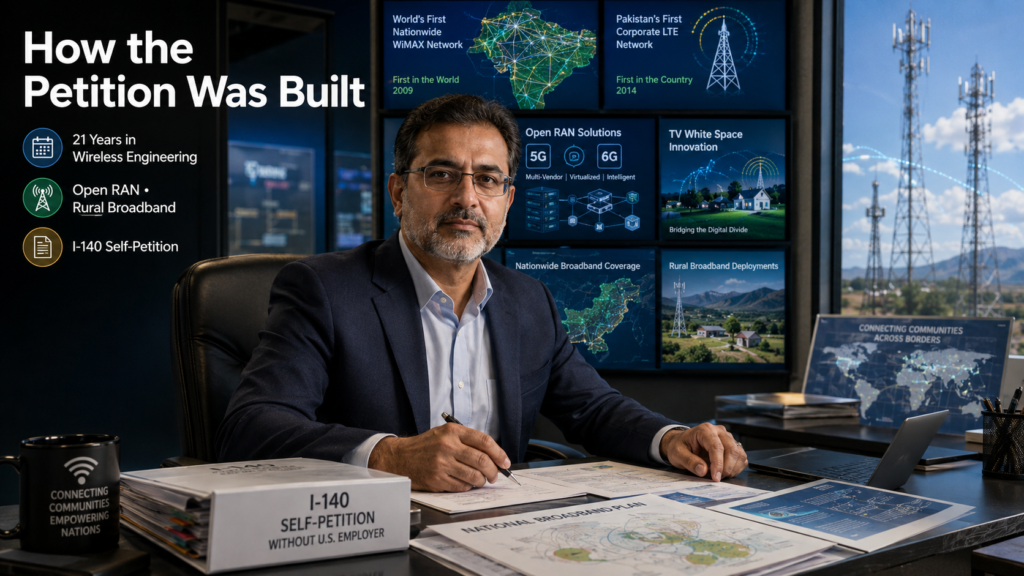
– Well-positioned evidence: World’s first nationwide WiMAX broadband network (Bahrain, 2007), 84% population coverage and 100K+ customers in Oman nationwide network, Pakistan’s first corporate LTE network (Certificate of Excellence), current VP at Open RAN solutions company, current independent consultant to U.S.-based Open RAN/TV Whitespace startup, TIP and OAI active community member, rural broadband deployments in Ghana and South Africa, 21 years of progressive wireless engineering.
I-140 filed as a self-petition without a U.S. employer.
The Outcome
Approved.
A self-petitioned EB-2 NIW for a telecommunications engineer who built the world’s first nationwide WiMAX network, rolled out the first corporate LTE network in Pakistan, deployed rural broadband across Ghana and South Africa, and is currently contributing to the Open RAN ecosystem through TIP, OAI, and a direct independent consulting engagement with a U.S. startup developing next-generation rural broadband technology.
The NTIA received nearly $3 billion in applications for $450 million in Open RAN funding. The gap between available
expertise and available supply is not theoretical – it is six-to-one, measured in federal grant applications. A 21-year track
record of building the world’s first wireless networks, now converging on the U.S. market through an active consultant
engagement, is a direct answer to that demand.
For Wireless and Telecommunications Professionals
If your career spans multiple generations of wireless technology, includes first-in-market or first-in-country deployments, and is currently engaged with the U.S. Open RAN or rural broadband ecosystem – the NIW is worth a serious assessment. The federal policy alignment for Open RAN, rural broadband, and IoT has never been stronger. The Dhanasar well-positioned analysis is answered by a career that built the standards, not just applied them.
Questions Wireless Professionals Ask Us
Does managing the world’s first nationwide deployment of a wireless technology substantially strengthen an NIW case?
Yes, significantly. First-in-the-world or first-in-country deployments are among the strongest forms of well-positioned evidence available because they demonstrate that the petitioner was selected for a technically complex, high-profile role that most professionals in the field have not had the opportunity to execute. The world’s first nationwide WiMAX network is documented in press releases from the operator and covered in global telecommunications trade media. That external, independent documentation converts a career claim into a verifiable public record, which USCIS can assess independently.
Does active participation in Open RAN ecosystem bodies like TIP and OAI help an NIW case?
It contributes specifically to the well-positioned argument and to the national importance prong simultaneously. For the national importance prong, it confirms that the work falls within the exact technical domain the U.S. government has named in the Critical and Emerging Technologies List, the NTIA Innovation Fund, and the DoD/NTIA 5G Challenge. For the well-positioned prong, active TIP and OAI participation demonstrates that the petitioner’s expertise is recognized and utilized by the broader industry ecosystem, not limited to a single employer. Influence on open standards and shared platforms extends the petitioner’s contribution beyond any single project.
Does current consulting work for a U.S. startup help a non-U.S.-resident NIW case?
It strengthens the well-positioned argument by establishing a current, active U.S. connection. An ongoing independent consulting engagement with a U.S.-based company demonstrates that the petitioner’s expertise is already being applied in the U.S. market, that U.S. counterparts recognize the value of that expertise, and that the proposed endeavor is not hypothetical but is already in partial execution. The TV Whitespace Open RAN work with a U.S. startup is precisely the kind of active U.S. nexus that shows USCIS the petitioner’s contribution is not something that might happen but something that is already happening.
Can a B.E. in Electronics Engineering qualify for an EB-2 NIW?
Yes, via the bachelor’s plus five years progressive experience equivalence. The EB-2 Advanced Degree category applies to a U.S. bachelor’s or foreign equivalent combined with at least five years of progressive post-baccalaureate experience in the specialty, which is deemed equivalent to a U.S. advanced degree. A 21-year career in telecommunications engineering, advancing from network rollout management to VP-level positions with documented first-in-world achievements, satisfies this standard substantially. The quality of the experience and the specificity of the proposed endeavor are what drive the Dhanasar analysis, not whether the advanced degree comes from a formal master’s program.
How does rural broadband experience from Ghana and South Africa transfer to a U.S. NIW case?
Rural broadband is a universal engineering and deployment challenge, and the skills it requires are not jurisdiction-specific. Strategy formulation for nationwide connectivity, regulatory navigation, stakeholder engagement with government entities and communities, proof-of-concept deployment in resource-constrained environments, and supply chain management for distributed network rollout – these are the same capabilities the U.S. BEAD program is trying to deploy. A consultant who has executed rural broadband initiatives in Ghana and South Africa has demonstrated those capabilities in environments that are arguably more challenging than U.S. rural deployments. The challenge transfers; the solution adapts.
Twenty-one years of first-of-their-kind wireless deployments across seven countries is the rarest kind of well-positioned evidence, see how Immignis builds NIW cases around career-defining firsts.