An architect with twelve years of large scale project delivery across Saudi Arabia including four years on one of the region’s largest affordable housing programs approved for an EB-2 NIW to industrialize affordable housing delivery in the United States.
In short: A licensed architect holding a Bachelor of Architecture with twelve years of progressive international experience delivering large scale housing, commercial, and hospitality projects in Saudi Arabia, was approved for an EB-2 NIW architect as a self petitioner. Pakistani national, Saudi Arabia based. He is an AIA International Associate, RIBA Chartered Member, and USGBC member, with registration in both the Pakistan Council of Architects and Town Planners and the Saudi Council of Engineers. His project portfolio spans over SAR 4 billion in total value, with four years working on one of Saudi Arabia’s largest precast affordable housing programs. Proposed endeavor: develop and deploy an industrialized, factory first affordable housing delivery framework for the United States, combining Design for Manufacture and Assembly (DfMA) modular kits, climate optimized energy efficient envelopes, stage gate QA/QC systems, and financing ready evidence documentation. Approved under Matter of Dhanasar.
The petitioner’s name and employer details have been withheld for privacy. Career record, projects, credentials, and outcome are real.
Why Building Faster Is the Wrong Goal:
The United States is short approximately 3.5 to 4 million homes, a national context directly relevant to an EB-2 NIW architect case. The White House Council of Economic Advisers documented the housing affordability deterioration in a June 2025 research brief. A January 2025 Presidential Memorandum called for emergency action on housing costs and supply. Harvard’s Joint Center for Housing Studies documented in its 2025 State of the Nation’s Housing report that over 64.8 million households cannot afford a $250,000 home. The National Low Income Housing Coalition reports a shortage of 7.3 million affordable rental units for the lowest income renters.
The common diagnosis is that the country needs to build more homes faster. That is true but incomplete. The deeper problem is that U.S. housing production is still organized the way it was decades ago: each project restarts from a blank page, redesigning the same components, re detailing the same joints, re arguing the same code compliance questions, repeating the same submission and correction cycle. The manufacturing sector eliminated that problem in the 1950s. Cars, appliances, electronics, aerospace components all of them are designed once, codified into a production system, and then replicated at scale with predictable cost and quality, which supports the EB-2 NIW architect argument.
Housing has never made that shift, and the consequences are measurable. Schedule overruns. Cost volatility. Labor shortages that stop projects mid construction. Every year, the NAHB estimates the construction workforce shortage at over 500,000 workers. Every year, conventional delivery produces fewer homes than the country needs, at higher cost per unit, with longer cycle times.
His proposed endeavor is to close that gap by industrializing the delivery process, as an EB-2 NIW architect focused on scalable housing delivery. Not by inventing new technology. By applying manufacturing discipline (standardized components, factory first production, embedded quality controls, automated documentation) to a sector that has resisted it.
Twelve Years and SAR 4 Billion in Project Delivery:
His career has been spent delivering large, technically demanding projects in Saudi Arabia, a strong EB-2 NIW architect foundation. The range is wide: one of Saudi Arabia’s largest affordable national housing programs, one of the Middle East’s largest financial district developments, a five star international hotel, a major entertainment complex. Each project at a different scale, different building type, different delivery challenge. All of them real, all of them completed.
The most directly relevant to his proposed endeavor is one of Saudi Arabia’s flagship affordable national housing programs a multi billion riyal, multi phase residential development delivering thousands of units under the national housing program. His role included coordinating precast subcontractors and integrating modular components into the construction workflow, preparing and reviewing shop drawings and technical submittals, managing RFIs, conducting site inspections, and working with design teams to translate drawings into something that could actually be built at scale. This is precisely the execution experience his proposed DfMA framework is built on as an EB-2 NIW architect.
Before and alongside that program, he spent six years on a major mixed use religious tourism development in Makkah one of the most demanding and high stakes construction environments in the world. Then a year on one of the largest financial district developments in the Middle East (SAR 1 billion), managing facade coordination, multidisciplinary clash resolution, and construction documentation. Then an interior design role on a landmark international hotel project. And currently: Senior Architect leading the delivery of a SAR 1 billion entertainment and retail complex, coordinating precast facades, managing BIM-derived shop drawings, supervising junior architects, and chairing technical meetings with clients, consultants, and subcontractors.
Total project value across his career: over SAR 4 billion. That is not a credential list. It is a track record of executing at scale, in difficult environments, on deadline, supporting the EB-2 NIW architect case.
The well positioned argument here does not require inference. Four years on one of Saudi Arabia’s largest affordable housing programs using precast methods is the same work the proposed U.S. endeavor requires. The context changes. The discipline doesn’t.
The Professional Memberships That Signal Intent:
He holds professional registrations in Pakistan and Saudi Arabia. He also holds an AIA International Associate membership in the American Institute of Architects, a RIBA Chartered Membership from the Royal Institute of British Architects, and individual membership in the U.S. Green Building Council, strengthening his EB-2 NIW architect profile.
For an architect based in Saudi Arabia with no current U.S. license, maintaining AIA International Associate and RIBA Chartered memberships is not routine. Those affiliations require professional engagement with international standards, ethical codes, and continuing education. They reflect a deliberate positioning toward the professional practice environments of the United States and the United Kingdom not as aspirations but as current, active memberships that require renewal and participation, which supports the EB-2 NIW architect case.
He is not proposing to sign or seal U.S. construction drawings independently. His proposed role is explicitly framed as a housing innovation and construction systems specialist who will develop standards, frameworks, and delivery models and collaborate with licensed U.S. architects and engineers for stamping, permitting, and code approvals. That division of responsibilities is how independent architectural innovators operate in the U.S. and it is the appropriate model for someone whose primary value is in the system design and standardization work rather than in project specific professional sign-off as an EB-2 NIW architect.
The Four-Component Framework:
His proposed endeavor has four integrated components, each addressing a specific bottleneck in U.S. affordable housing delivery, as an EB-2 NIW architect focused on scalable housing systems.
The first is a code aligned modular/precast kit of parts, a standardized set of walls, floors, roof cassettes, and wet core pods, pre parameterized to 2021 IECC and ASHRAE 90.1-2019 energy code baselines and coordinated with BIM workflows so that selecting a climate preset (hot dry Arizona, hot humid Texas, wind/hurricane Florida) automatically generates compatible envelope details, fastener schedules, and complete submittal packs. The goal is to turn each new project from a blank page design exercise into a configuration exercise. Most of the design work is already done. The project specific work is selecting the right combination and validating it for the specific site.
The second is a climate optimized energy efficient envelope and materials stack tiered “good / better / best” assemblies for each climate zone, with airtightness detailing, thermal bridge control, high performance glazing, reflective/heat mitigating roofing, and low VOC, lower carbon material options. Each assembly is pre mapped to federal energy standards so developers using these stacks do not have to rebuild the compliance argument from scratch for every project, strengthening the EB-2 NIW architect framework.
The third is a factory first delivery system with stage gate QA/QC shifting the majority of construction work from the site to the factory, with clear gates (design freeze, manufacturability review, first article inspection, site readiness, commissioning), digital traveler records that follow each module from factory to handover, and takt planned set sequences that treat on site assembly as a predictable industrial operation rather than a weather dependent construction gamble.
The fourth is a performance, compliance, and financing ready evidence framework a standardized system for capturing, verifying, and presenting the outcomes of each project in a form that lenders, housing finance agencies, and federal funders can actually use for underwriting. Build time reduction. Cost variance. Energy use intensity. Jobs per 100 units. U.S. domestic content. Each metric tracked, logged, and compiled into a closeout binder that makes scaling only the things that demonstrably work not the things that sound good in a funding application, reinforcing the EB-2 NIW architect case.
Why the Federal Policy Landscape Makes the Timing Right:
The federal policy alignment for this proposed endeavor is the most concentrated in the series.
White House CEA Research Brief on Housing Affordability (June 2025): documented worsening affordability in rural and urban America, called for immediate supply expansion.
Presidential Memorandum on Delivering Emergency Price Relief (January 2025): directed federal agencies to reduce housing costs and expand supply, explicitly including industrial/modular methods.
DOE Advanced Building Construction Initiative (2025): promotes industrialized, off site construction and high performance building envelopes as national priorities.
DOE/PNNL Cost Effectiveness Analysis of 2024 IECC (2025): confirmed that current energy code standards can be met affordably the direct compliance target for the proposed kit of parts.
HUD and USDA energy efficiency standards notices (2025): extended compliance timelines with emphasis on repeatable compliance pathways including ENERGY STAR and Zero Energy Ready Homes.
S.1299 Housing Supply Frameworks Act (119th Congress): advances zoning and permitting reforms to expand housing types, including modular.
S.2651 ROAD to Housing Act (2025): directs HUD to study the role of off site construction in expanding supply.
NIST draft meta framework on supply chain traceability: underpins the digital traveler and audit log in the proposed evidence framework.
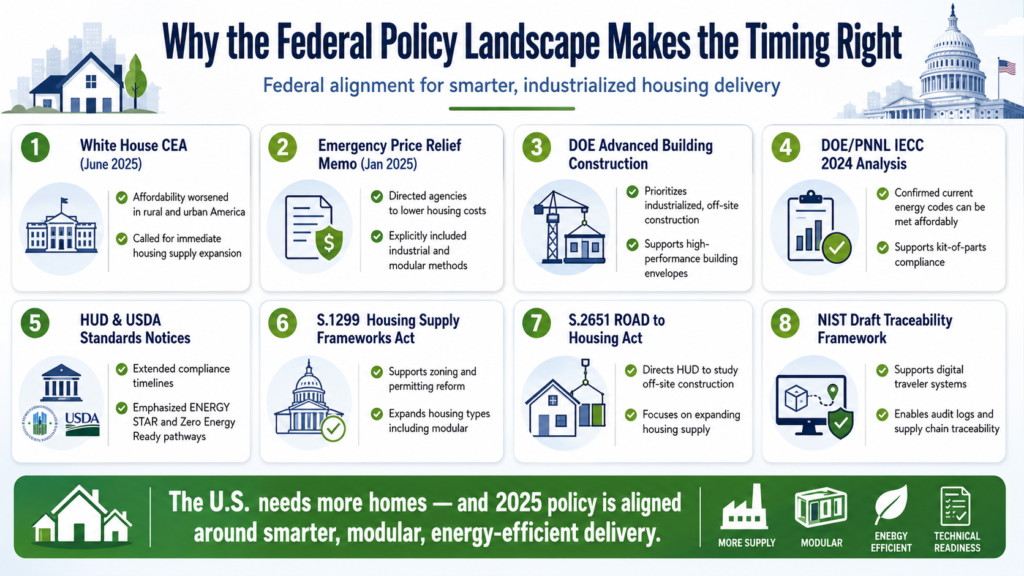
The country needs more homes. The White House has said so explicitly and repeatedly in 2025. The DOE has identified industrialized construction as the specific delivery method to prioritize. HUD and USDA are actively updating energy standards for federally financed housing. Congress is legislating to remove barriers to modular and off site construction. All of this was happening simultaneously when this petition was filed and the proposed endeavor is a direct, technically specific response to each of these federal initiatives.
How the Petition Was Built:
This was a direct petition for an EB-2 NIW architect. The career record, the project portfolio, and the proposed framework were already in place.
National importance sourcing: White House CEA housing affordability brief (June 2025), Presidential Memorandum on emergency price relief (January 2025), Harvard JCHS State of the Nation’s Housing 2025, NLIHC Gap report, NAHB construction labor shortage data, Freddie Mac housing deficit data (3.9M units), UpforGrowth 3.5M missing homes analysis, DOE Advanced Building Construction Initiative, DOE/PNNL 2024 IECC cost effectiveness analysis, HUD/USDA energy standards notices, S.1299, S.2651, NIST digital thread framework, DOE energy code performance targets, IBHS resilient construction standards.
Well positioned evidence for the EB-2 NIW architect case: four years of precast coordination on one of Saudi Arabia’s largest affordable national housing programs (SAR 1.9 billion), Senior Architect leadership on SAR 1 billion and SAR 500 million projects, 12 years of shop drawing, RFI, submittal, and site coordination across over SAR 4 billion in project value, AIA International Associate + RIBA Chartered Member + USGBC membership, Pakistan and Saudi Arabia professional registrations, peer reviewed scholarly research validating climate specific envelope assemblies, modular logistics optimization, SPC for precast manufacturing, and wind load detailing.
Proposed endeavor: four component integrated system each tied to documented U.S. delivery gaps, supported by specific 2025 federal programs and policies, and grounded in work the petitioner has already executed on large scale precast and modular projects as an EB-2 NIW architect.
USD 20,000 personal seed funding committed. I-140 filed as a self petition without a U.S. employer.
The Outcome:
Approved.
A self petitioned EB-2 NIW for a licensed architect with twelve years of large scale project delivery in Saudi Arabia, four years of precast affordable housing coordination, over SAR 4 billion in completed project value, AIA International Associate and RIBA Chartered memberships, and a proposed endeavor that addresses the most directly and repeatedly named domestic crisis in 2025 federal policy.
Every manufacturing industry figured out decades ago that you design a product once and replicate it reliably at scale. Housing hasn’t made that shift. An architect who spent four years doing exactly this on one of Saudi Arabia’s largest affordable housing programs is the right person to bring that discipline to the United States.
For Architects and Building Design Professionals:
If your career is in architecture, building design, modular construction, sustainable envelope systems, or construction project delivery and your project record demonstrates specific, large scale execution of the technical systems your proposed endeavor requires the NIW is worth a serious assessment. The housing shortage and the federal push toward industrialized, energy efficient construction have created one of the most clearly documented national importance cases for building design professionals that has ever existed. The proposed endeavor does not require a U.S. architectural license to proceed. It requires documented expertise in the specific systems the endeavor will develop and deploy, and a career that demonstrates the ability to execute at scale.
Questions Architects and Building Professionals Ask Us:
Can an architect without a U.S. architectural license qualify for an EB-2 NIW?
Yes. The NIW evaluates national importance and positioning, not whether the petitioner currently holds a U.S. professional license. An architect proposing to develop standardized modular delivery frameworks, climate optimized envelope systems, and evidence based quality standards working in collaboration with licensed U.S. architects and engineers for stamping and permitting, is proposing a legitimate and nationally important contribution that does not require the petitioner to independently sign or seal U.S. construction documents. The mode of execution is a collaboration model, not a solo licensee practice.
Does experience on large-scale Middle East construction projects transfer to a U.S. NIW case?
Yes, particularly when the specific technical systems involved are the same. Precast concrete production and modular assembly (the coordination of factory made components, interface control documents, tolerance management, shop drawing review, and site sequencing) are governed by the same engineering principles whether the project is in Riyadh or Phoenix. An architect who has spent four years coordinating precast systems on a national affordable housing program has direct, field proven experience with the technical execution that the proposed U.S. framework requires. The regulatory environment differs; the construction discipline does not.
How do AIA International Associate and RIBA Chartered Memberships help an NIW case?
They help specifically in the well positioned argument. Both memberships require active professional engagement with international architectural standards, continuing education, and ethical practice frameworks aligned with U.S. and U.K. professional environments. For an architect currently practicing in Saudi Arabia, maintaining both of these international memberships simultaneously reflects a deliberate positioning toward U.S. and international professional practice norms. It also demonstrates ongoing professional engagement with the standards frameworks (energy codes, building performance, sustainable design) that are central to the proposed endeavor.
Does the current U.S. housing shortage create a strong national importance argument?
One of the strongest in the series. The White House issued a research brief on housing affordability in June 2025, a Presidential Memorandum on emergency price relief in January 2025, and multiple federal agencies (DOE, HUD, USDA) published new rules and initiatives on affordable housing construction in 2025. Congress introduced the Housing Supply Frameworks Act and the ROAD to Housing Act. The National Low Income Housing Coalition documents a shortfall of 7.3 million affordable rental units. Freddie Mac estimates a deficit of 3.9 million homes. This is not an emerging concern it is a documented, declared national emergency with specific federal programs calling for exactly the industrialized modular delivery approach the proposed endeavor provides.
How is the DfMA kit of parts approach different from what U.S. builders already do?
Current U.S. practice restarts design effort substantially on each project, even when the building type, climate conditions, and code requirements are similar to dozens of previous projects. Tolerances are re specified, submittal packs are manually assembled, and QA/QC processes vary by contractor. A DfMA kit of parts embeds those decisions into a reusable, rules based system: climate presets auto-populate compatible envelope assemblies, interface control documents lock the mating geometry between factory made components, and submittal packs are generated from a consistent data model rather than rebuilt each time. The difference is between treating each project as a custom product and treating it as a deployment of a validated platform. The former is what the U.S. currently does. The latter is what the proposed endeavor introduces.
If your career is in architecture or building design and you want to understand whether your project record supports an EB-2 NIW, start with an honest assessment. Free assessment: immignis.us/contact-us