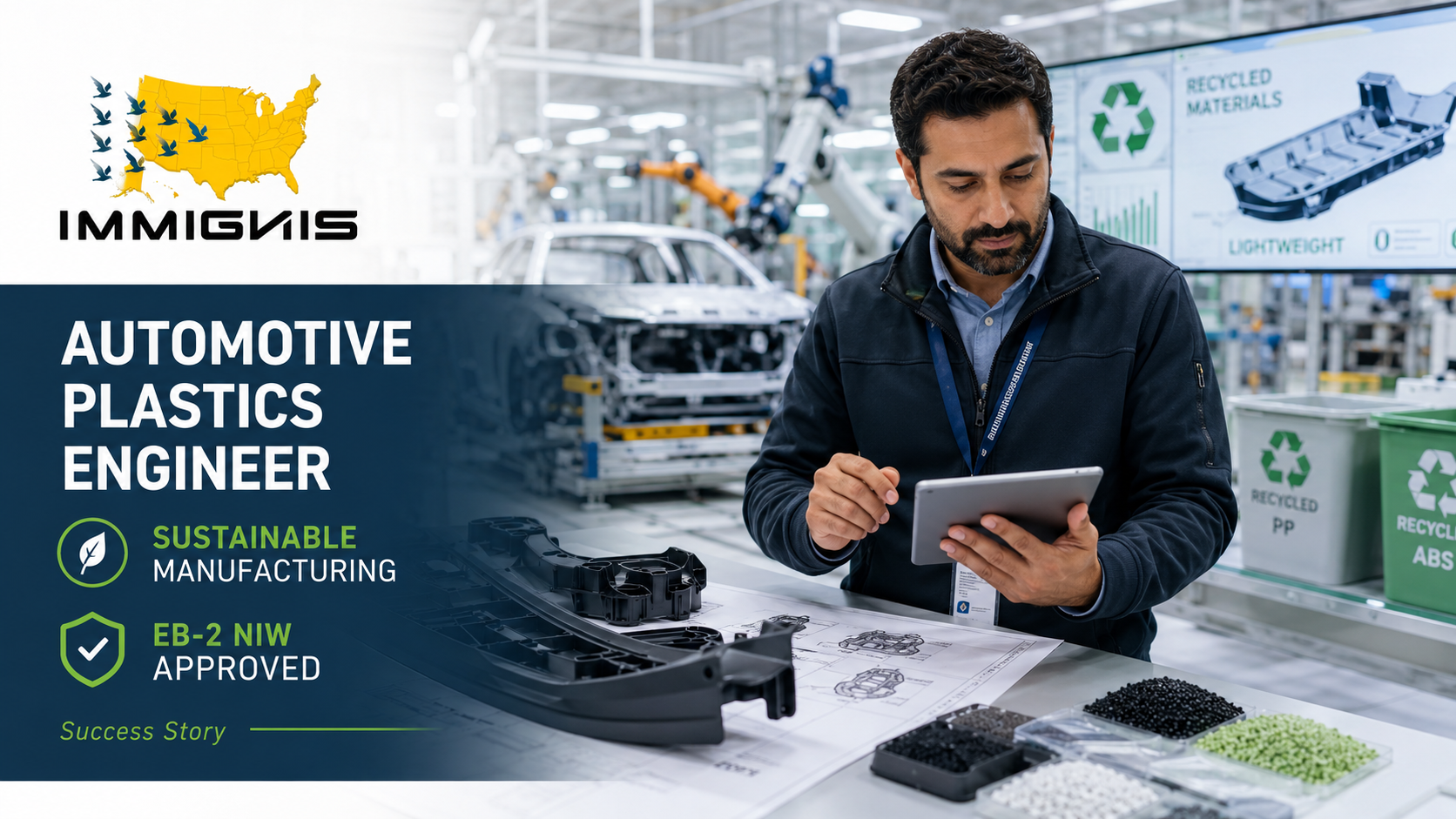
EB-2 NIW automotive engineer case showing how a Pakistani mechanical and industrial engineer built a national-interest case around recycled plastic auto parts, lightweight design, crash-energy absorption, and sustainable automotive manufacturing.
Case Snapshot
| Category | Details |
| Professional profile | Pakistani mechanical and industrial engineer with an M.S. in Industrial and Engineering Management, a B.S. in Mechanical Engineering, and progressive automotive product-development experience. |
| Field | Automotive plastics, recycled materials, lightweight component design, product development, quality assurance, and advanced manufacturing. |
| Proposed endeavor | Designing and developing durable, lightweight, aerodynamically sustainable plastic auto parts from plastic waste to improve fuel efficiency, crash-impact performance, and environmental sustainability. |
| Initial challenge | The technical record was strong, but the case needed to connect factory-level automotive achievements to U.S. national priorities in recycling, clean transportation, vehicle safety, lightweighting, and supply-chain resilience. |
| Profile-building focus | Sustainable materials, auto-parts development, OEM project evidence, validation systems, quality documentation, and Dhanasar evidence architecture. |
| Outcome | EB-2 NIW I-140 approved. |
The Approval Result
This case ended with EB-2 National Interest Waiver approval for a Pakistani mechanical and industrial engineer, an EB-2 NIW automotive engineer, whose strongest immigration story was not a routine automotive job description. The approval was built around a clear technical and national-interest theme: sustainable automotive component engineering using recycled plastics, lightweight design, aerodynamic improvement, crash-energy absorption, and quality-assured manufacturing systems.
The petitioner already had serious technical evidence. The challenge was to organize that evidence so USCIS could see how factory-level automotive achievements could support broader U.S. priorities in recycling, clean transportation, vehicle safety, advanced manufacturing, and supply-chain resilience, making a strong case for an EB-2 NIW automotive engineer.
The final petition did not present him as a general automotive employee. It presented him as an applied engineer positioned to advance durable, lightweight, and sustainable plastic auto parts that can support cleaner, safer, and more efficient vehicles as an EB-2 NIW automotive engineer.
The National Problem Behind the Case
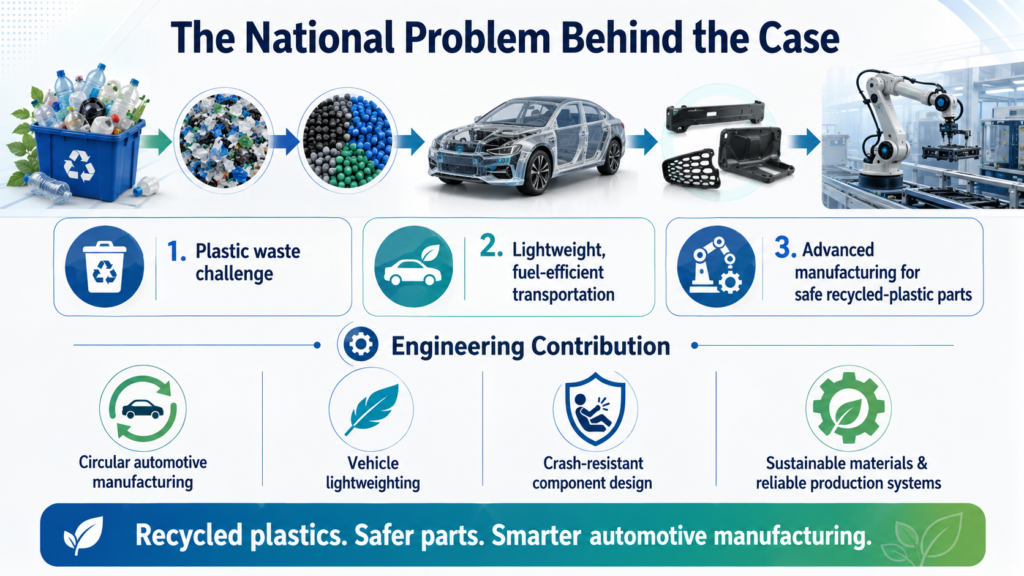
The case was built around three overlapping national concerns. First, plastic waste remains a serious environmental and materials-management challenge. Second, clean transportation and fuel efficiency require lighter and more sustainable vehicle components. Third, the automotive industry needs advanced manufacturing methods that can convert recycled and high-performance plastic materials into reliable, safe, and compliant parts.
For that reason, the petition could not be framed as a narrow manufacturing role. It had to be positioned as an engineering contribution to circular automotive manufacturing, vehicle lightweighting, crash-resistant component design, sustainable materials use, and reliable supplier-level production systems.
The Client’s Starting Point
The petitioner worked as Deputy Manager for Product Development, Design and Quality Assurance at a major automotive plastic-molding manufacturer, a major automotive and custom plastic molding company, building a strong EB-2 NIW automotive engineer profile. His responsibilities included recycled material evaluation, CAD/CAM design, prototyping, stress and impact testing, aerodynamic simulation, product localization approval, drawing and specification preparation, inspection standards, audits, SAP project structures, Bill of Materials management, and customer-facing technical approvals.
He also had prior production and assembly-line experience with Master Motors and Al Haj FAW Motors. His automotive project record included work connected to Yutong buses, Fuso Mitsubishi trucks, Changan plant construction, Toyota Yaris HVAC plastic parts, Suzuki fan shroud development, Honda chrome garnish optimization, Toyota Fortuner fan shrouds, Toyota Cross SUV components, and E-mark certification for Toyota mirror components, supporting the EB-2 NIW automotive engineer case.
The evidence was meaningful, but it needed to be translated from a list of projects into a national-interest record. The case became stronger when those projects were grouped as proof of sustainable materials engineering, lightweighting, crash-energy absorption, product validation, OEM coordination, and regulatory-readiness capacity for an EB-2 NIW automotive engineer.
The Proposed Endeavor
The proposed endeavor for this EB-2 NIW automotive engineer was framed as follows:
To design and develop durable, lightweight, and aerodynamically sustainable plastic auto parts from plastic waste. These parts aim to enhance the fuel efficiency of light and heavy commercial vehicles, improve human safety by reducing crash and collision impact, and support environmental sustainability by aligning automotive component development with circular manufacturing and U.S. sustainability goals for an EB-2 NIW automotive engineer.
This formulation linked the petitioner’s existing automotive plastics experience as an EB-2 NIW automotive engineer with a future endeavor that could apply across vehicle categories, suppliers, and sustainable manufacturing programs. It moved the case away from ordinary production support and toward a technical model with broader U.S. relevance.
What Immignis and AdvanceMyProfile Built
The profile-building work focused on converting practical engineering experience into petition-grade evidence. The record was organized around five connected themes:
- Sustainable materials and circular manufacturing: use of plastic waste, recycled thermoplastics, bio-based plastics, and pyrolysis-derived feedstocks for automotive applications.
- Lightweighting and fuel efficiency: vehicle-weight reduction, aerodynamic component design, and improved fuel economy for light and heavy commercial vehicles.
- Safety and crash-energy absorption: impact-resistant plastics, bumper absorbers, front-end modules, and structural features that reduce collision forces.
- Advanced manufacturing and validation: injection molding, additive manufacturing, finite element analysis, computational fluid dynamics, durability testing, environmental testing, quality assurance, and regulatory compliance.
- Real automotive implementation experience: work with major vehicle programs, OEM customers, Japanese technical partners, suppliers, toolmakers, and certification processes.
This structure allowed the petition to show more than technical employment history. It showed a transferable engineering model that could support U.S. clean transportation, safety, sustainability, and advanced manufacturing goals.
How the Evidence Supported Dhanasar
| Dhanasar element | Evidence used | Strategic value |
| Substantial merit and national importance | Recycling, clean transportation, advanced manufacturing, vehicle safety, lightweighting, fuel-efficiency standards, and sustainable materials use. | Showed that the endeavor addressed public and industrial priorities, not only one employer’s manufacturing needs. |
| Well positioned | Auto-parts design, recycled material analysis, CAD/CAM, product development, impact and stress testing, aerodynamic improvement, quality documentation, E-mark certification, customer approvals, supplier coordination, promotion, bonuses, trainings, and memberships. | Showed that the petitioner had the practical engineering background needed to advance the proposed endeavor. |
| Balancing / waiver benefit | Transferable methods across automotive manufacturers, suppliers, testing groups, materials partners, and U.S. sustainability-oriented mobility programs. | Supported the argument that waiver of the job-offer requirement would serve the national interest more effectively than a narrow employer-specific role. |
Why This Was Not Just an Automotive Job Description
The petition materials had to move away from a job-task style presentation. The final story showed that the petitioner’s work was not limited to routine production support. His profile involved product development, quality assurance, testing, regulatory documentation, supplier coordination, advanced manufacturing, and applied engineering for real vehicle programs.
Those elements gave the endeavor a credible bridge from past experience to future U.S. impact. The strongest public story therefore emphasized the national problem, the specific technical solution, and the petitioner’s ability to execute it, rather than presenting the case as a long list of duties.
The Filing and Approval
The final EB-2 NIW petition was organized as an evidence architecture. The proposed endeavor explained the national industrial problem. The project record showed real automotive implementation experience. The quality and validation evidence showed technical discipline. The Dhanasar analysis connected recycled materials, lightweighting, safety, and sustainable manufacturing to U.S. national-interest priorities.
USCIS approved the EB-2 NIW I-140. The approval confirmed that a manufacturing and product-development profile can succeed when the petition shows a specific national problem, a credible technical mechanism, and a record demonstrating the petitioner’s ability to advance that solution.
What Changed Beyond Approval
The approval was the immigration result, but the profile-building process also gave the petitioner a clearer professional identity. His experience could now be explained as sustainable automotive component engineering, not merely automotive product development or quality assurance.
That clarity made his record stronger for professional conversations with automotive suppliers, advanced manufacturing groups, materials partners, clean-transportation stakeholders, and sustainable mobility programs. The same evidence that supported the petition also made his expertise easier for the market to understand.
What This Case Teaches
- Technical experience alone is often not enough for EB-2 NIW. USCIS must be able to see the national problem, the specific proposed solution, and the petitioner’s credible ability to advance that solution.
- Automotive plastics can support a national-interest case when the work is tied to recycling, lightweighting, fuel efficiency, crash safety, clean transportation, and advanced manufacturing.
- Factory and OEM project experience becomes stronger evidence when it is organized as transferable proof of technical execution rather than left as a résumé-style work history.
- Quality systems, validation, documentation, testing, supplier coordination, and regulatory-readiness evidence can be powerful for applied engineers.
- Ethical profile building does not manufacture a false profile. It identifies the professional’s strongest work, connects it to a defined national need, and organizes the evidence so the proposed endeavor is understandable, specific, and persuasive.
If you are a manufacturing engineer, design engineer, quality engineer, product-development specialist, automotive engineer, or sustainable materials professional, your profile may have stronger NIW potential than it first appears. The key is to show how your technical work addresses a broader national need through a specific, measurable, and transferable endeavor.
To explore whether your engineering or manufacturing profile can be structured for a strong EB-2 NIW strategy, start with a free assessment through immignis.