EB-2 NIW biomedical engineer: A biomedical engineer who led a hospital department in Pakistan, held clinical engineering roles at a major NHS Trust in London, and has spent years in diagnostic sales across six countries - approved for an EB-2 NIW to establish a U.S.-based enterprise integrating vendor-neutral lifecycle management with a regulated pathway for recovering and exporting retired American medical equipment to underserved healthcare markets.
In short: A biomedical engineer holding a Bachelor of Science in Biomedical Engineering, with over 17 years of progressive experience spanning hospital biomedical engineering management, clinical engineering services for NHS-linked hospital systems in the United Kingdom, diagnostic systems support across South Asia and the Middle East, and technical procurement and lifecycle planning, was approved for an EB-2 National Interest Waiver as a self-petitioner.
Pakistani national, Oman-based. He led the Biomedical Engineering Department at a major private hospital in Karachi, held Senior Biomedical Engineer and Team Leader roles at a major NHS Trust in London through a clinical engineering services contract, and has managed diagnostic product lines across Abbott and major commercial distributors in six countries.
He has received a support letter from a Regional Director of Clinical Engineering at a major U.S. hospital system in Alabama. All scholarly citations are real and DOI-linked. Proposed endeavor: establish and operate a U.S.-based biomedical engineering enterprise providing vendor-neutral preventive maintenance, lifecycle optimization, procurement review, technician training, and regulated recovery, refurbishment, and export of retired U.S. medical equipment. Approved under Matter of Dhanasar.
The petitioner’s name and employer names have been withheld for privacy. Career record, projects, and outcome are real. All scholarly citations are verifiable at the DOIs stated in the petition.
The Gap Nobody Closes
U.S. hospitals spent $1.6 trillion on hospital care in 2024, according to the CMS National Health Expenditure data - an 8.9% increase in a single year. A significant portion of that spending is tied to medical equipment: acquisition, service contracts, maintenance, and replacement. And yet the pattern for retired equipment, once it is no longer needed by the hospital that owns it, is often straightforward abandonment. It sits in a storage room. It is liquidated for scrap. It is informally transferred. Only rarely does it go through a structured technical assessment, refurbishment to a documented standard, and export to a healthcare system that genuinely needs it.
The gap is real, and it is documented. A 2025 peer-reviewed study in Frontiers in Health Services that examined medical equipment in Ugandan hospitals found that long-term usefulness of transferred equipment depends entirely on context-aware planning, maintenance support, spare parts availability, and compatibility with the recipient facility. Equipment that arrives without documentation, without parts, or without trained service capacity becomes useless quickly.
A 2024 study in Expert Review of Medical Devices confirmed that refurbished medical devices require technical screening, documentation, regulatory awareness, and safety review before they enter secondary use. Neither paper is arguing that retired medical equipment cannot be exported. Both are arguing that it requires a structured, technically governed pathway to be safe and useful. That pathway does not yet exist at scale.
His proposed enterprise is that pathway. Vendor-neutral lifecycle engineering on the maintenance side; regulated recovery, refurbishment, certification, and export on the disposition side. One connected system for the full equipment lifecycle.
The Career That Earns the Right to Build This
His career has moved through nearly every relevant role in sequence.
He began as a field support engineer servicing Thermo Fisher Scientific and Mettler Toledo analytical equipment across Pakistan spectrophotometers, atomic absorption systems, FT-IR instruments. This is the foundational layer: learning how equipment actually behaves, fails, and needs to be maintained. He then added the commercial layer as a sales and services engineer handling laboratory analyzers, viscosity baths, and distillation units across Pakistan and Afghanistan, learning tenders and prequalification processes in his early career.
He then moved to the UK. From April 2013 through early 2015 he worked as Medical Engineer at a major private hospital in London and then at an NHS treatment centre in Southampton, performing day-to-day planned preventive maintenance and corrective maintenance on clinical equipment: infusion pumps, defibrillators, ECG systems, patient monitors, diathermy units, fetal monitors, incubators, and humidifiers.
Then, from April 2015 through November 2016, he held Senior Biomedical Engineer and Team Leader roles at a major NHS Trust in London - one of the UK’s largest and most technically demanding NHS hospitals - contracted through a UK clinical engineering services company. His responsibilities there included managing repair and maintenance of critical diagnostic and therapeutic devices, supporting a GE Healthcare contractual service partnership, monitoring contract KPIs, supervising monthly PPM and reactive maintenance performance, providing procurement advice, supporting capital replacement planning, and managing quality-management compliance.
Back in Pakistan, he was appointed Manager of the Biomedical Engineering Department at a major private hospital in Karachi (May 2017-October 2019) - the leadership role that synthesized everything before it. He managed medical equipment projects for quality, cost, and timeline. He oversaw technical evaluations and tenders, managed the department budget, coordinated capital replacement planning, led recruitment, and ensured ISO compliance. This is the role where field engineering knowledge, clinical engineering experience, and commercial understanding converge into institutional leadership.
His most recent phase has been in diagnostic systems at a major global diagnostics company: first as Ambassador managing customer business reviews, service-level achievement, profitability metrics, and contract renewals; then as Sales Executive for the transfusion division across Pakistan, Sri Lanka, Bangladesh, and the Maldives, managing capital business planning and ROI analysis for analyzer placement; and now in his current role managing the same company’s key accounts in Oman including Ministry of Health, Ministry of Defense, and private hospital clients. This phase has given him the commercial intelligence, ROI analytical discipline, and diagnostic system depth that the procurement and lifecycle advisory component of the proposed enterprise requires.
Field engineering. NHS clinical engineering. Hospital department management. Global diagnostic sales across six countries. These are four career tracks that almost nobody completes all of. Each one is a different lens on the same problem: how do U.S. healthcare facilities acquire, maintain, optimize, and eventually retire the equipment they depend on?
The Four-Component Enterprise
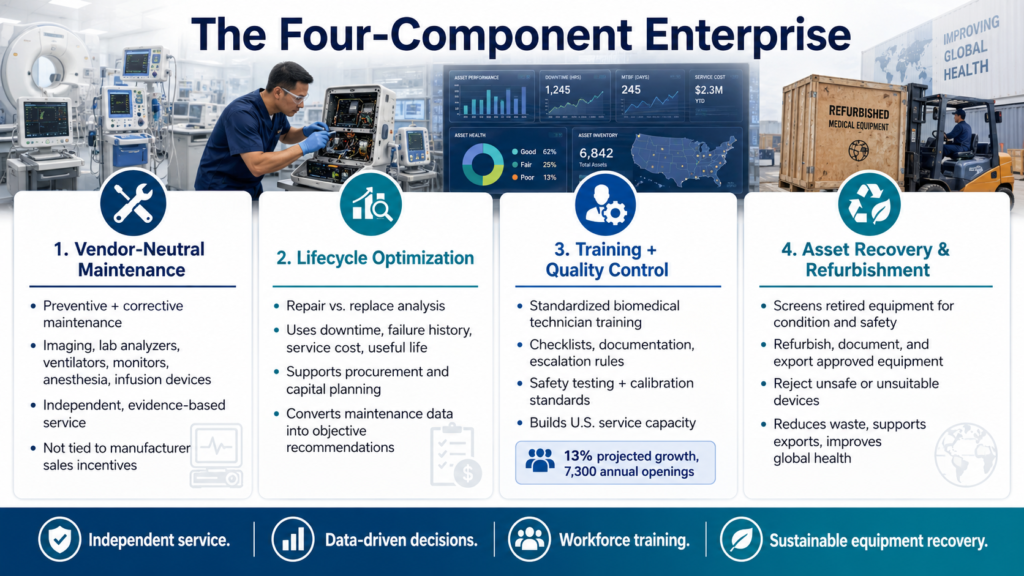
His proposed enterprise has four integrated components, each drawing on a different part of his career.
The first is vendor-neutral planned preventive maintenance and corrective maintenance for high value medical equipment: imaging systems, diathermy units, defibrillators, ECG systems, dental chairs, laboratory analyzers, ventilators, anesthesia machines, infusion devices, and patient monitors. Vendor neutral means the enterprise will not be tied to any manufacturer’s recommendations, sales incentives, or service contracts.
It will assess equipment condition and maintenance needs based on technical evidence, clinical context, and lifecycle economics independently. This matters because U.S. hospitals often rely on fragmented vendor specific service rather than unified engineering analysis and vendor recommendations do not always align with the facility’s long-term operational interest.
The second is lifecycle optimization and procurement support - using maintenance history, failure patterns, downtime data, service costs, and remaining useful life to guide repair versus replacement decisions, service contract evaluation, and capital planning. A 2024 study in Frontiers in Medicine identified this as an active gap: most large medical equipment replacement decisions are based on subjective judgment rather than objective analysis. His model addresses that gap by converting maintenance data into structured technical recommendations.
The third is standardized biomedical technician training and quality control - converting the Petitioner’s senior engineering experience into reproducible procedures for U.S. biomedical technicians. Service checklists, documentation templates, escalation rules, safety testing protocols, and calibration standards will allow technicians to perform reliable maintenance work under quality controls, increasing service capacity beyond what a single engineer can provide. The Bureau of Labor Statistics projects 13% growth in medical equipment repairer employment from 2024 to 2034, with approximately 7,300 annual openings, confirming documented national demand for exactly this kind of trained capacity.
The fourth is regulated asset recovery, refurbishment, and export - when U.S. healthcare facilities retire equipment, much of it still has technical and economic value that is lost through informal disposal, liquidation, or storage. His enterprise will screen retired equipment for condition, safety, documentation, serviceability, refurbishment potential, and destination-market suitability. Equipment that passes will be refurbished, documented, and exported through a controlled process to underserved healthcare markets abroad. Equipment that does not pass will be rejected from the reuse pathway. This process supports sustainability by reducing waste; supports U.S. export interests by creating value from deployed assets; and supports global health by placing functional, certified equipment into healthcare systems that genuinely need it.
The Federal Policy Alignment Is All Current
- FDA Final Guidance, Remanufacturing of Medical Devices (May 2024): Clarifies when work performed on medical devices constitutes remanufacturing and identifies regulatory expectations for maintaining quality and safety. Directly supports the asset recovery and refurbishment pathway.
- FDA Final Guidance, Cybersecurity in Medical Devices (February 2026): Addresses cybersecurity design and documentation for networked medical devices. Supports the lifecycle documentation and governance component as connected healthcare equipment requires disciplined service records.
- CISA ICS Medical Advisory on Patient Monitor vulnerabilities (February 2025): Confirms that patient-care equipment presents operational and cybersecurity vulnerabilities requiring technical controls and trusted sourcing. Supports the need for structured lifecycle governance.
- EPA Guidance, New International Requirements for Electrical and Electronic Waste (August 2025): Confirms that international movement of used electrical and electronic equipment is subject to controlled requirements. Supports the regulated export pathway's compliance framework.
- White House Executive Order on Skilled Technical Workforce (April 2025): Supports the technician training component by establishing federal priority on skilled-trade workforce development.
- BLS Occupational Outlook Handbook, Medical Equipment Repairers (2024-2034): 13% projected growth, 7,300 annual openings - direct documentation of national workforce demand in the specific occupation the enterprise addresses.
- AAMI 2025 State of HTM Report: Documents staffing strain, workload growth, and skills gaps in healthcare technology management departments nationally.
- National Academy of Medicine (2022): U.S. health sector responsible for approximately 8.5% of U.S. carbon emissions, supporting the environmental merit of extending equipment life and reducing disposal.
The Scholarly Literature Is Clean
Six peer-reviewed papers were cited in the petition, all with full DOI links and verifiable publication records. Each citation supported a specific technical component of the proposed endeavor, including lifecycle analytics, repair-versus-replacement decisions, maintenance documentation, structured maintenance protocols, refurbished-device regulation, and medical equipment reuse. Each citation supports a specific technical component of the proposed endeavor, including lifecycle analytics, repair-versus-replacement decisions, maintenance documentation, structured maintenance protocols, refurbished-device regulation, and medical equipment reuse:
- Zhou et al. (2024), Artificial Intelligence in Medicine: Data-driven predictive maintenance for CT equipment - supports the lifecycle analytics component.
- Huang et al. (2024), Frontiers in Medicine: Multi-criteria decision model for medical equipment replacement - supports the repair-versus-replacement advisory component.
- Omar et al. (2024), Expert Systems with Applications: Accountability and traceability in medical imaging equipment maintenance - supports the documentation and quality-control system.
- Titah & Bouchaala (2024), Journal of Quality in Maintenance Engineering: Ontology-driven maintenance management model - supports the structured maintenance protocol system.
- Pinheiro et al. (2024), Expert Review of Medical Devices: Regulatory landscape for refurbished medical devices across U.S., EU, Malaysia, and Ghana - directly supports the regulated recovery pathway.
- Paustian et al. (2025), Frontiers in Health Services: Medical equipment sustainability and donation practices in Uganda - directly supports the export pathway design.
The U.S. Support Is Confirmed
A Regional Director of Clinical Engineering at a major U.S. hospital system in Alabama provided a formal support letter, offering technical guidance, market insight, and professional network introductions. A U.S. hospital system’s regional clinical engineering director is precisely the stakeholder who evaluates, hires, and partners with biomedical engineering service providers of the kind the proposed enterprise would become. His support is not abstract endorsement; it reflects the informed judgment of someone who manages the exact problem the proposed enterprise addresses.
How the Petition Was Built |EB-2 NIW biomedical engineer
This was a direct petition, structured with full legal analysis under Matter of Dhanasar.
- Well-positioned evidence: Manager of Biomedical Engineering Department at major private hospital (Karachi), Senior Biomedical Engineer and Team Leader at major NHS Trust London (through a UK clinical engineering services company), GE Healthcare partnership KPI fulfillment at NHS, Sales and diagnostic roles at a major global diagnostics company across six countries (Pakistan, Sri Lanka, Bangladesh, Maldives, Oman), tender and procurement experience, ROI analysis for capital equipment placement, ISO compliance management, technician supervision, support letter from U.S. Regional Director of Clinical Engineering.
- National importance sourcing: CMS NHE Fact Sheet ($1.6T hospital spending, January 2026), AHA 2024 Costs of Caring (April 2025), FDA remanufacturing and servicing guidance (2024-2026), Joint Commission maintenance standards (December 2025), ECRI Top 10 Health Technology Hazards 2025, BLS 13% medical equipment repairer growth projection, AAMI 2025 State of HTM, NAM health sector carbon emissions, AHRQ patient safety data, FDA cybersecurity guidance (February 2026), CISA patient monitor advisory (February 2025), EPA e-waste guidance (August 2025), White House skilled workforce EO (April 2025), all 2025-2026 current sourcing. I-140 filed as a self-petition without a U.S. employer.
The Outcome
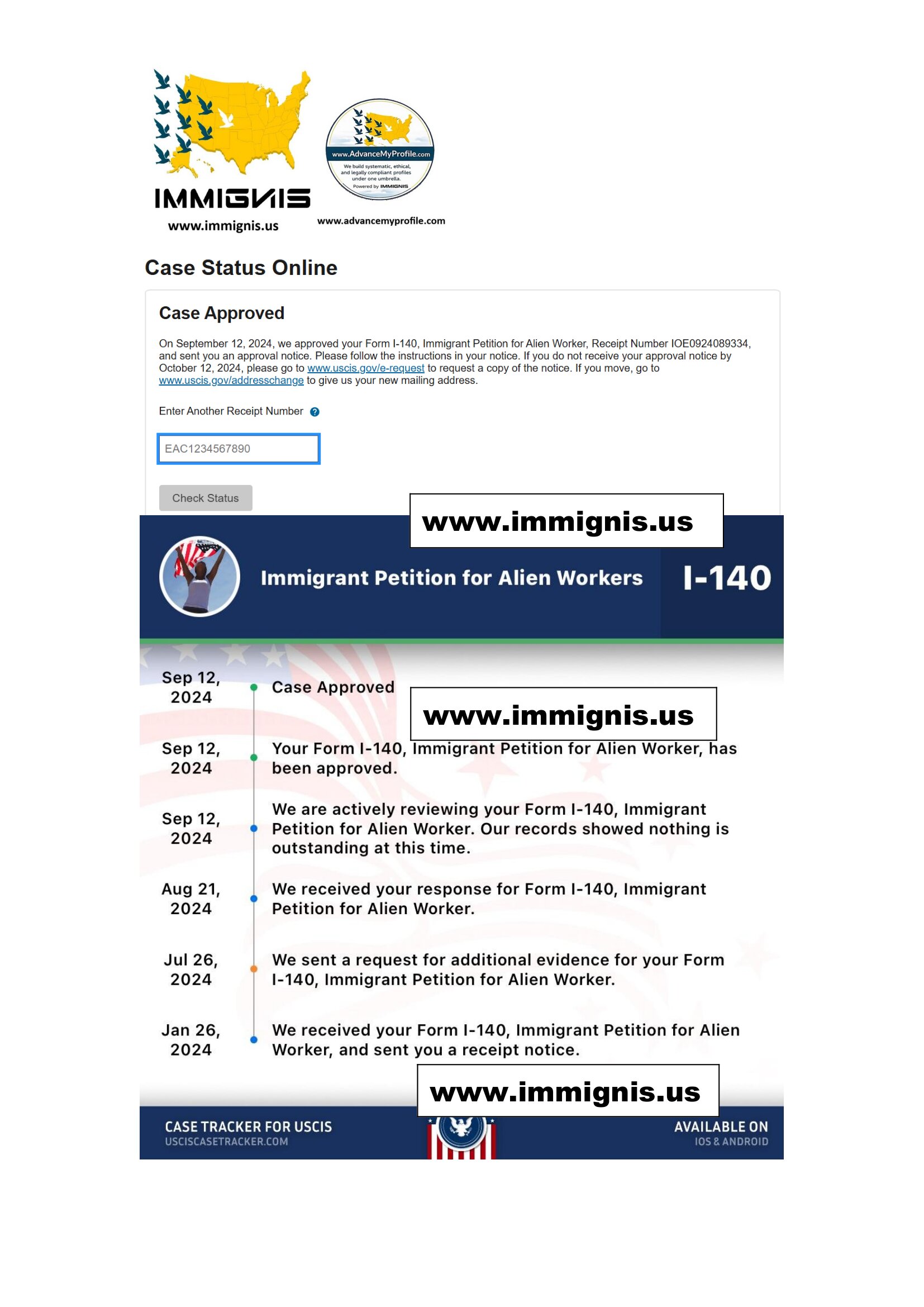
Approved.
A self-petitioned EB-2 NIW for a biomedical engineer who led a hospital biomedical engineering department in Pakistan, held clinical engineering roles at a major NHS Trust in London, managed global diagnostic sales across six countries, and proposes to establish a U.S.-based enterprise that integrates vendor-neutral lifecycle management with the first structured, regulated pathway for recovering, certifying, and exporting retired U.S. medical equipment to underserved healthcare markets.
The BLS projects 13% growth in medical equipment repairer employment through 2034. AAMI documents that healthcare technology management departments are understaffed and under-resourced nationally. And large volumes of functional U.S. medical equipment are retired each year without a disciplined pathway for responsible recovery. The proposed enterprise addresses all three in one integrated model.
For Biomedical Engineers With NHS, Hospital, or Clinical Engineering Experience
If your career has spanned both the technical maintenance side and the commercial lifecycle side of medical equipment particularly with NHS hospital experience, hospital department management, or large-system diagnostic support, the NIW is worth a serious assessment. The Dhanasar test is satisfied when the proposed work has national importance and you are positioned to advance it. A career that has run through field engineering, NHS clinical engineering operations, hospital department leadership, and global diagnostic sales provides an answer to that question across every dimension the proposed enterprise requires.
Questions Biomedical Engineers Ask Us About Lifecycle and NHS Experience
Does NHS clinical engineering experience in the UK help an NIW case for a U.S.-based biomedical engineering enterprise?
Yes. NHS clinical engineering experience at a major NHS Trust is among the most demanding and standardized biomedical engineering environments in the world. It requires working within defined KPI frameworks, supporting GE Healthcare and similar vendor-contracted service obligations, maintaining critical clinical equipment to regulated standards, managing PPM completion rates, and producing documentation that meets NHS quality requirements. These skills are directly transferable to the U.S. healthcare environment because U.S. hospitals operate under similar Joint Commission, FDA, and accreditation documentation requirements. The NHS experience validates the petitioner’s ability to perform biomedical engineering work at a high institutional standard, which directly supports the Dhanasar well-positioned analysis.
Does managing a biomedical engineering department at a hospital strengthen the NIW well-positioned argument?
Yes, specifically for a proposed endeavor that goes beyond individual repair work. A biomedical engineering department manager has responsibility not just for technical maintenance but for the full operational context: budget management, recruitment, procurement evaluation, ISO compliance, tender participation, capital replacement planning, and team leadership. These leadership and management functions are directly relevant to founding and operating an independent biomedical engineering enterprise, which requires all of those capabilities simultaneously. The transition from department manager to independent enterprise founder is much more credible than a transition from field technician, because the department management role already required the same organizational and strategic functions the proposed enterprise will need.
What makes the regulated asset recovery and export component of this proposed endeavor nationally important?
Three federal policy threads converge on it. EPA’s August 2025 guidance on international requirements for electrical and electronic waste confirms that the international movement of used electronic equipment (including medical equipment) is subject to controlled requirements, which supports the need for a structured, compliant recovery and export pathway rather than informal resale. EPA’s 2026 sustainable electronics management resource identifies extending product life and responsible reuse as federal sustainability priorities. FDA’s 2024 final guidance on remanufacturing and servicing confirms that work performed on medical devices requires disciplined technical and regulatory judgment to maintain safety and effectiveness. Together, these sources establish that the responsible disposition of retired U.S. medical equipment is a matter of federal regulatory concern, sustainability policy, and technical governance - giving the recovery and export component its own national importance argument independent of the maintenance and lifecycle components.
Does having verified, DOI-linked scholarly citations in a NIW petition matter?
It matters both substantively and strategically. Substantively, peer-reviewed research published in journals like Artificial Intelligence in Medicine, Frontiers in Medicine, and Expert Review of Medical Devices provides independent expert validation that the technical components of the proposed endeavor address real, documented gaps in the field. Strategically, verified citations prevent the petition from being challenged on a factual basis. The petition relied on six peer-reviewed studies with verifiable DOI links, each connected to a specific technical component of the proposed endeavor. A petition with six real, DOI-linked citations in top-tier journals, all verifiable by USCIS, is on a completely different evidentiary footing.
Four career tracks nobody else completes, field engineering, NHS clinical engineering, hospital leadership, and global diagnostic sales, became one approved NIW enterprise case. See how Immignis builds these connections.