A British biomedical engineer with 22 years specializing in CT scan, ultrasound, and X-ray systems – approved for an EB-2 NIW to provide independent installation, servicing, lab planning, and technology innovation for U.S. healthcare facilities at a moment of documented nationwide shortage.
In short: An EB-2 NIW biomedical engineer holding a Master of Engineering in Electronics Engineering and a Bachelor of Biomedical Engineering, with 22 years of progressive experience specializing in the installation, service, calibration, and innovation of CT scan, ultrasound, and X-ray medical imaging equipment, was approved for an EB-2 National Interest Waiver as a self-petitioner. British citizen. Proposed endeavor: provide independent consulting services to U.S. healthcare facilities for medical imaging equipment installation, preventive maintenance, lab planning, equipment selection advisory, and CT scan technology R&D including image quality algorithms, hardware modifications, and smart sensor integration. Approved under Matter of Dhanasar.
The petitioner’s name and employer details have been withheld for privacy. Career record, credentials, and outcome are real.
When the CT Scanner Goes Down
An estimated 1.9 million new cancer cases will be diagnosed in the United States annually. Nearly 655,000 Americans die from cardiovascular disease annually. CT scans are how physicians detect lung cancer early enough to treat it, identify strokes in time to reverse their damage, and locate tumors before they spread. MRI and ultrasound diagnose the conditions that affect hundreds of millions more, making this directly relevant to an EB-2 NIW biomedical engineer.
When a CT scanner fails in a hospital, patients wait. Scans are deferred, diagnoses are delayed, and in time-sensitive conditions that is not acceptable. The machine is extraordinarily complex – its rotating gantry, X-ray tube, detector arrays, and reconstruction software must all function within precise tolerances and keeping it running requires a specialist. Not a general IT technician. An EB-2 NIW biomedical engineer who knows CT-specific hardware, understands radiation safety, and can diagnose a fault and restore function quickly.
The United States has a documented shortage of those specialists. According to the Association for the Advancement of Medical Instrumentation, 40% of currently employed biomedical engineers and technicians are aged 55 or above, with 22% over 60 and approaching retirement. Young talent is not entering the field fast enough to replace them. The Bureau of Labor Statistics projects 10% growth in biomedical engineering employment through 2031 – faster than the average for all occupations – against a base that is already shrinking through retirement. That is the gap his proposed endeavor as an EB-2 NIW biomedical engineer addresses.
The Three-Track Proposed Endeavor
His proposed endeavor for the United States is structured around three interconnected tracks, each targeting a different dimension of the medical imaging equipment challenge for an EB-2 NIW biomedical engineer.
The first track is installation and service of medical imaging equipment – providing independent, expert-level installation, calibration, preventive maintenance, and emergency repair for CT scanners, ultrasound systems, and X-ray equipment at healthcare facilities across the United States. This track directly addresses the workforce shortage: when an institution cannot find a qualified biomedical engineer for its imaging equipment, it defers maintenance, extends equipment beyond its operational window, or loses capacity while waiting for vendor support. An independent specialist available to multiple facilities fills that gap in a way a single employer cannot for an EB-2 NIW biomedical engineer.
The second track is advisory services for lab planning and equipment selection – consulting healthcare facilities on the design and layout of imaging suites, selection of equipment matched to their patient population and clinical needs, and compliance with regulatory standards. This is particularly important for smaller hospitals, community health centers, and rural facilities that may not have the institutional expertise to make high-value capital decisions on imaging equipment independently.
The third track is CT scan technology innovation – applying engineering expertise to improve the performance of existing equipment through image quality enhancement algorithms, hardware design modifications to detectors and gantry systems, and smart sensor integration. This track produces improvements that benefit not just one machine but the methods applied to a class of equipment. His dual educational background (a Master of Engineering in Electronics Engineering alongside a Bachelor of Biomedical Engineering) is the specific credential combination that makes this R&D track credible for an EB-2 NIW biomedical engineer: the electronics engineering depth addresses the hardware layer, and the biomedical engineering foundation connects that work to clinical outcomes.
The Aging Infrastructure Problem
The U.S. medical imaging equipment market was valued at $48.75 billion in 2021 and is projected to reach $84.08 billion by 2030, creating a strong context for an EB-2 NIW biomedical engineer. The CT market alone is expected to grow from $8.14 billion in 2023 to $10.95 billion by 2028. That growth reflects both new installations and the expansion of imaging-dependent diagnostic practice as the U.S. population ages.
The U.S. Census Bureau documents that the 65-and-older population grew by 34.2% in the last decade, and is projected to continue growing. An aging population means more chronic disease, more imaging procedures, more machine utilization, and more demand on the biomedical engineers who keep those machines functional. Florida already has the highest concentration of senior citizens at 21% of its population. California has the largest absolute population of older adults. These are the states where imaging demand is highest and where the workforce shortage bites hardest for an EB-2 NIW biomedical engineer.
The FDA has documented a shortage of medical devices in the United States, including CT imaging equipment. The shortage is not only a matter of new machines not being manufactured fast enough; it is also a matter of installed machines not being maintained well enough because the specialists to maintain them are retiring faster than they are being replaced, strengthening the EB-2 NIW biomedical engineer case.
What Makes This Case Different from Other Biomedical Engineers
The biomedical engineering field is broad for an EB-2 NIW biomedical engineer. It spans medical device design, clinical engineering, equipment service, regulatory affairs, and R&D across dozens of equipment categories. What makes this petitioner’s profile distinct within that field is the combination of three elements that most practitioners develop only one or two of.
The first is depth of specialization. CT scan, ultrasound, and X-ray are the three most widely used diagnostic imaging modalities in U.S. healthcare. They diagnose cancer, cardiovascular disease, stroke, respiratory conditions, trauma, and obstetric complications across millions of patients annually. Specializing at the equipment-service level – not the clinical use level, but the engineering level that keeps the machines running – for 22 years across all three modalities is unusual for an EB-2 NIW biomedical engineer.
The second is the R&D dimension. Most biomedical field service engineers maintain and repair what manufacturers build. The third track of his proposed endeavor ‘developing image quality algorithms, designing hardware modifications, and integrating smart sensors into CT platforms’ crosses from service engineering into the innovation layer. His Master of Engineering in Electronics Engineering is the credential that supports this: it provides the technical depth for hardware and algorithm development that a purely clinical biomedical background would not.
The third is the independent consulting model. A biomedical engineer employed at a manufacturer or hospital system serves that organization’s equipment base. An independent consultant serves multiple facilities, including smaller hospitals and community health centers that cannot support a full-time biomedical engineering staff. The proposed independent model addresses institutions that the employer model systematically underserves, strengthening the EB-2 NIW biomedical engineer case.
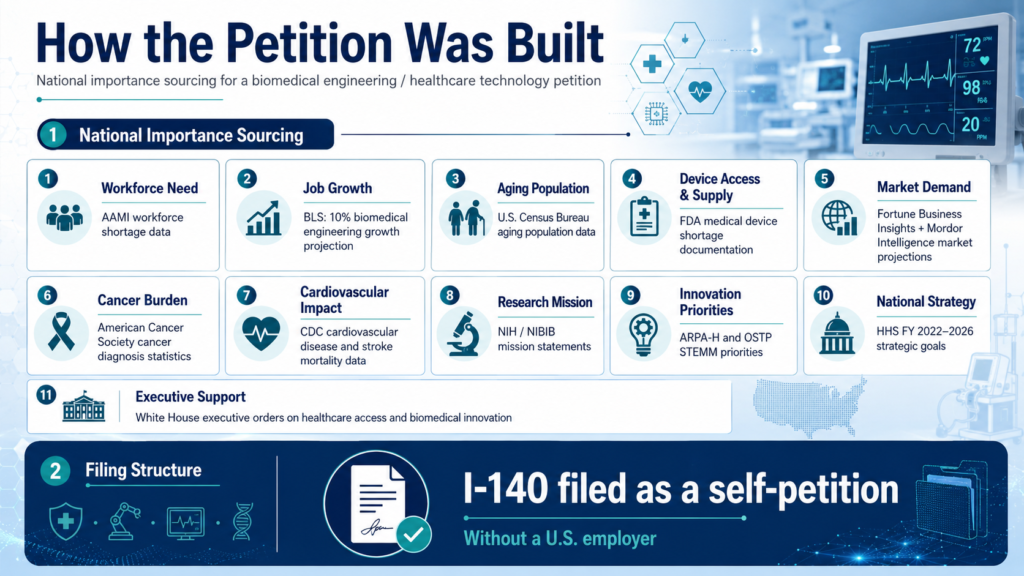
How the Petition Was Built
National importance sourcing: AAMI workforce shortage data, BLS 10% biomedical engineering growth projection, U.S. Census Bureau aging population data, FDA medical device shortage documentation, Fortune Business Insights and Mordor Intelligence market projections, American Cancer Society cancer diagnosis statistics, CDC cardiovascular disease and stroke mortality data, NIH/NIBIB mission statements, ARPA-H and OSTP STEMM priorities, HHS FY 2022-2026 strategic goals, multiple White House executive orders on healthcare access and biomedical innovation.
I-140 filed as a self-petition without a U.S. employer.
The Outcome
Approved.
For Biomedical Engineers and Medical Imaging Specialists
If your career is in medical imaging equipment – CT scan, MRI, ultrasound, X-ray, or related modalities – and your work includes installation, service, calibration, lab planning, or R&D innovation at a documented level of specialization, the NIW is worth a serious assessment. The U.S. biomedical engineering workforce shortage is documented, the field is growing at above-average rates, and the equipment these professionals maintain is directly connected to patient outcomes in life-threatening conditions. The Dhanasar national importance case for specialized medical imaging engineers is one of the clearest in the healthcare equipment domain.
Questions Biomedical Engineers Ask Us
Can a biomedical engineer specializing in medical imaging equipment qualify for an EB-2 NIW?
Yes. The U.S. national importance case for biomedical imaging engineers is well-supported by documented evidence: the Association for the Advancement of Medical Instrumentation has documented a workforce shortage with 40% of practitioners aged 55+; the Bureau of Labor Statistics projects 10% employment growth through 2031 (faster than average); and the FDA has reported shortages in medical imaging devices including CT equipment. A proposed endeavor focused on providing expert installation, maintenance, lab planning, and CT innovation services to U.S. healthcare facilities addresses documented national healthcare infrastructure needs.
Does having both an ME in Electronics Engineering and a B. Biomedical Engineering strengthen a medical imaging NIW case?
Yes, specifically for an endeavor that includes both service engineering and equipment R&D. The biomedical engineering undergraduate degree provides the clinical-equipment foundation. The Master of Engineering in Electronics Engineering provides the hardware and system depth needed for the innovation components – algorithm development, detector hardware modifications, smart sensor integration. Together they support a broader proposed endeavor than either degree alone, which strengthens the Dhanasar well-positioned argument by demonstrating that the petitioner is qualified to execute all dimensions of the proposed work.
Does 22 years of specialization in specific imaging modalities (CT, ultrasound, X-ray) help a NIW case differently from general biomedical engineering experience?
Deep specialization in specific modalities strengthens both the national importance and well-positioned prongs. For national importance, specialization in CT scan, ultrasound, and X-ray – the three most widely used diagnostic imaging modalities in U.S. healthcare – means the proposed work addresses the systems that bear the highest clinical demand and generate the highest consequence from downtime. For well-positioned, 22 years of focused expertise in the same equipment class demonstrates a level of technical depth that generalist biomedical experience cannot match, and that depth is directly relevant to the proposed endeavor’s service, advisory, and R&D components.
Does the independent consultant model for a medical imaging NIW require a different well-positioned argument than an employer-sponsored case?
It requires a different emphasis within the well-positioned argument. For an independent consultant, USCIS evaluates whether the petitioner has the professional standing, network, and technical credibility to operate successfully without employer scaffolding. This means the well-positioned evidence needs to demonstrate not just technical competence but also a track record of operating across multiple clients or institutions, recognition from the healthcare community or professional bodies, and evidence that the proposed independent model has been validated by prior independent work or consulting engagements. A 22-year career in medical imaging service that includes work across multiple hospitals, manufacturers, and healthcare systems provides exactly that track record.
If your career is in biomedical engineering and medical imaging and you want to understand whether your background supports an EB-2 NIW, start with a free assessment.
Free assessment: immignis